Automated storage solutions for manufacturing space savings
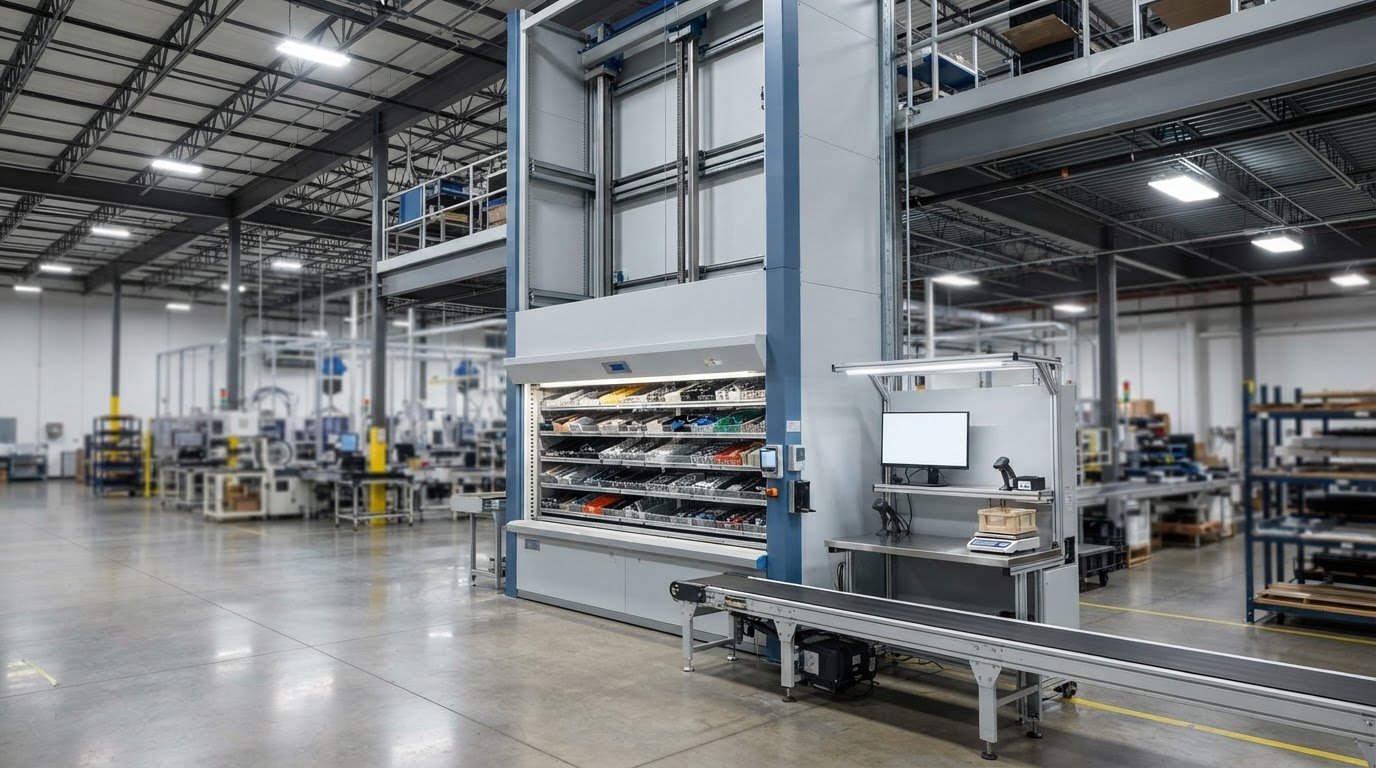
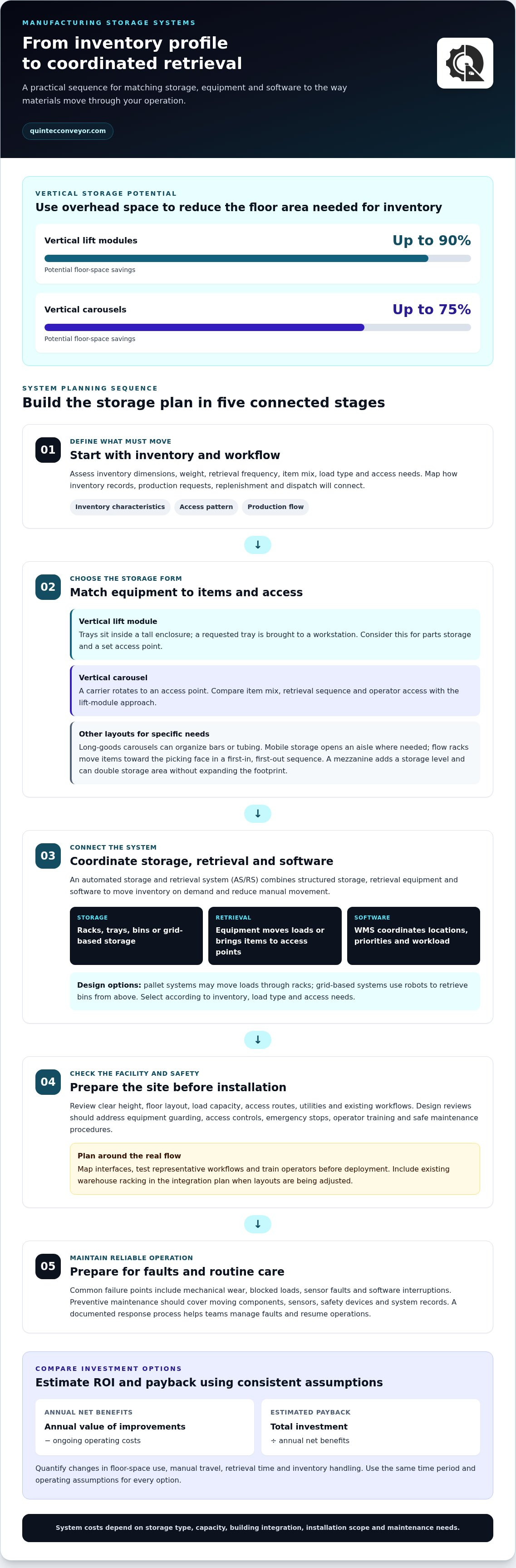
Vertical lift modules can save up to 90% of floor space, while vertical carousels can save up to 75%. Automated storage solutions for manufacturing combine storage structures, automated equipment and software to use space more efficiently and retrieve inventory with less manual handling.
When production materials and supplies compete for limited floor space, adding capacity without expanding the building can be a practical priority. Vertical storage makes better use of overhead space, but the right solution depends on what you store and how materials move through your operation.
This guide explains how automated storage works and how vertical lift modules differ from carousels. It also covers ways to increase storage density and connect retrieval with automated material handling, helping you assess how an integrated system could support your facility’s workflow.
Key Takeaways
- Assess vertical lift modules for compact parts storage and retrieval, especially where floor space is constrained.
- Understand how storage equipment, automated handling, and software work together in an automated storage and retrieval system.
- Match storage density and access methods to your inventory profile and facility layout to make better use of available space.
- Plan storage, picking, replenishment, and transport as one material flow to support efficient manufacturing operations.
Why Choose a Vertical Storage Solution?
Vertical systems use overhead capacity to reduce the floor space needed for inventory. Vertical lift modules can save up to 90% of floor space, while vertical carousels can save up to 75%.
Vertical Lift Modules for Parts and Inventory
A vertical lift module stores trays inside a tall enclosure and brings a requested tray to a workstation. For manufacturing parts, this gives workers a set access point rather than requiring them to search shelves or walk between storage locations. When planning capacity, assess inventory dimensions, weight, and retrieval frequency. These factors help determine which parts suit the system and how it can support production supply.
ROI and Payback Calculations
Manufacturers can estimate ROI by comparing annual net benefits with the system’s total investment. First, quantify changes in floor-space use, manual travel, retrieval time, and inventory handling. Then subtract ongoing operating costs from the annual value of those improvements. Estimate payback by dividing the investment by annual net benefits. Use the same time period and operating assumptions for every option to make comparisons more useful.
Vertical lift modules and vertical carousels suit different access patterns. A lift module extracts a tray from its enclosure, while a carousel rotates a carrier to an access point. Both use vertical space, but the right choice depends on item mix, retrieval sequence, and operator access. Compare these factors with your production workflow before setting storage capacity.
Long-goods vertical storage carousels can organize lengthy materials such as bars or tubing. Consider item length and handling direction when assigning storage locations, so retrieval fits the route between storage and production.
Mezzanine floors add a storage level above existing floor operations and can double a business’s storage area without expanding its footprint. Compare that approach with vertical equipment by considering available vertical space, access routes, and the supply chain tasks performed on each level.
What Is Automated Storage?
Automated storage solutions for manufacturing combine structured storage, automated equipment, and software to manage inventory movement. An automated storage and retrieval system (AS/RS) retrieves items on demand, reducing the manual movement associated with traditional warehouse shelving.
System designs vary. A pallet system may move loads through racks, while a grid-based system uses robots to retrieve bins from above. Automated storage solutions for manufacturing can serve production, healthcare, and technical settings, including smaller storerooms. The right design depends on inventory, load type, and access needs.
An AS/RS generally brings together storage, retrieval equipment, and software to coordinate inventory movement. The WMS coordinates item locations, order priorities, and workload across stations. Together, these components connect inventory records with physical movement and route requests through the appropriate retrieval systems.
In the United States, safety requirements depend on the equipment, facility, and work tasks. Design reviews should address guarding, access controls, emergency stops, operator training, and safe maintenance procedures.
System costs depend on storage type, capacity, building integration, installation scope, and maintenance needs. A project price is provided after a quote request, with those factors shaping the overall investment.
Before installation, assess clear height, floor layout, load capacity, access routes, utilities, and existing workflows. Map how inventory records, production requests, replenishment, and dispatch will communicate with the WMS.
Common failure points include mechanical wear, blocked loads, sensor faults, and software interruptions. Preventive maintenance should cover moving components, sensors, safety devices, and system records. A documented response process helps teams manage faults and resume operations.
Select a system by matching storage and retrieval equipment to inventory characteristics and production flow. Map interfaces, test representative workflows, and train operators before deployment. Facilities adjusting existing layouts can include warehouse racking in the integration plan.
Floor-space savings and high-density storage
High-density designs increase inventory capacity by using vertical space and reducing access aisles. The right layout balances space utilization with picking speed, accuracy, and fulfillment needs.
High-Density Mobile Storage and Flow Racks
Mobile storage places shelving or racking on movable bases, opening an aisle only where access is needed. This reduces fixed aisle space while keeping inventory accessible. Flow racks use inclined lanes to move items toward the picking face, supporting a first-in, first-out sequence. Compare item size, replenishment direction, and picking frequency before assigning locations. These details help optimize capacity without obstructing material movement.
Space Utilization with High-Density Storage
Space utilization depends on more than how tightly goods fit. Review usable building height, required access routes, load characteristics, and how often workers retrieve each item. A denser layout may suit reserve inventory, while fast-moving parts need convenient access. For industrial mobile shelving, consider how shelves move, where operators stand, and whether the arrangement supports safe replenishment and accurate picking.
Storage density can be illustrated by a documented example: according to CSUN University Library, an AS/RS used an 8,000-square-foot room at forty feet high, with 13,260 steel bins. According to Georgia Southern University, an automated retrieval system occupies about 5,000 square feet. These examples show how automated systems can organize substantial inventory within a defined footprint.
Direct-access racks generally suit operations with many SKUs and few pallets per SKU, because workers or equipment can reach individual stock locations. Compact AS/RS designs suit the opposite profile: fewer SKUs with many pallets per SKU. Robots can retrieve bins from above in grid-based systems, while mobile shelving reduces unused aisle space. Match the design to inventory mix and replenishment flow, then assess how it connects with production and fulfillment. This helps prevent space savings from slowing retrieval or creating bottlenecks.
Automated materials handling
Automated material handling connects storage with production, replenishment, and shipping. Automated storage solutions for manufacturing work best when every handoff has a defined route, destination, and operating signal. A flow-based approach helps teams identify delays between storage and the processes that use inventory.
Goods-to-person systems bring requested inventory to a workstation. Operators stay at a fixed station to pick and pack while automated equipment handles transport. For example, a production cell can receive components at a planned point, then send completed items toward the next operation. This can reduce unnecessary walking and manual handling.
Shuttle systems retrieve totes or cartons across multiple levels and suit larger facilities with predictable order flows. Conveyors or autonomous guided vehicles can move materials between storage, workstations, and production areas. Select routes according to load type, delivery sequence, and production access, so transport supports the process rather than obstructing it.
Software coordinates inventory by assigning storage locations, setting order priorities, and distributing work across stations. Map how a request becomes a retrieval task, how replenishment follows, and how completion updates inventory records. Automated storage solutions for manufacturing should align these signals with actual production needs, including changes in order priority or material availability.
To maximize density without restricting flow, assess storage capacity alongside retrieval speed and downstream transport. Compare peak demand with workstation requirements and shipping schedules. This helps avoid a mismatch where compact storage holds inventory efficiently but cannot supply the next process at the required pace.
Use process engineering to map material routes and integration priorities. Plan your automated material handling system around the processes it must support.
Quintec Conveyors: Conveyors
Quintec Conveyors helps manufacturers connect storage with production through conveyor systems, Robotics & Automation, infrastructure, and additional material handling equipment. Turn to the team when stored parts need a defined route to workstations or when material movement between processes needs a coordinated design.
Conveyors can link storage and production areas, while robotics and automation can support movement within a broader material-handling setup. Infrastructure and related equipment help shape the physical system around facility needs. The right combination depends on the materials being moved, the flow between process steps, and how storage interacts with production.
Bringing these elements together starts with understanding the facility’s current material paths and operational objectives. This gives the design a clear basis for connecting storage, handling, and production rather than treating each element in isolation.
To discuss a manufacturing material-handling project, contact Quintec Conveyors.
Turn Storage Priorities Into an Operational Plan
Before selecting equipment, define what your facility needs to improve. Identify the affected production areas, the inventory movement causing friction, and the outcomes your team wants to track. This creates a practical basis for evaluating automated storage solutions for manufacturing and deciding how a system should fit into the facility’s broader operating plan.
Quintec Conveyors offers Conveyors, Robotics & Automation, and Infrastructure to support material-handling needs. Consider these offerings in the context of your facility’s layout and operational priorities, rather than as isolated equipment decisions. A clear project brief helps focus the discussion on how storage and movement should work together.
Bring your priorities and facility context to the next conversation. Discuss your storage project with Quintec Conveyors and take a considered step toward a more coordinated manufacturing operation.
Frequently Asked Questions
What types of automated storage and retrieval systems (AS/RS) are used in manufacturing?
Manufacturers use pallet-handling cranes, miniload systems for totes or cartons, shuttle systems, robotic grid storage, and vertical or horizontal carousels. Choose by examining unit loads, inventory profile, order patterns, and access requirements. A facility handling bulky palletized materials, for example, has different retrieval needs from an assembly area supplying small components in bins.
How do vertical lift modules, vertical carousels, and horizontal carousels compare for manufacturing storage?
Vertical lift modules present a requested tray at an access opening, while vertical carousels rotate carriers along a vertical path. Horizontal carousels rotate carriers along a horizontal path and can group several units around a picking zone. Compare item mix, replenishment method, operator access, and available building height. A small-parts assembly cell may benefit from carousel access, while varied tray inventory may favor a lift module.
What are the benefits of automated storage systems for manufacturing productivity, space, and labor?
These systems can make inventory easier to locate, reduce travel between storage and production, and reserve floor space for workstations or material movement. Their impact depends on how well retrieval timing matches production demand. For example, scheduled component delivery to an assembly area can help workers stay at their stations instead of searching for supplies, while location records support more controlled inventory handling.
How do automated storage systems integrate with manufacturing execution systems, ERP, and warehouse management software?
Integration connects inventory and work instructions across software platforms. An ERP system may provide item and order records, a warehouse management system can coordinate storage tasks, and a manufacturing execution system can communicate production demand. Define which system owns each data field, then map request, confirmation, and exception messages. Test scenarios such as a changed work order or unavailable component before live operation.
What are the safety standards and regulations for automated storage systems in the United States?
Applicable safety requirements depend on the equipment, facility, and work tasks. Design reviews should address guarding, access controls, emergency stops, operator training, and safe maintenance procedures.