A conveyor designed around the equipment alone can miss the demands that matter most. Effective conveyor engineering matches the system to the material, operating environment, facility layout, and movement requirements. Food handling, manufacturing, and distribution each have distinct needs that influence the design and components.
It’s not enough for a conveyor to move products from one point to another; it must also suit how a facility operates. This article explains how custom designs address specific applications and how food-grade requirements, heavy-duty rollers, and industry needs influence system choices.
You’ll see what engineers consider when planning a conveyor solution, from product characteristics and operating conditions to integration with existing material handling equipment. This provides a clearer basis for planning reliable material flow and operational efficiency.
Key Takeaways
- Match the conveyor design to the material, facility layout, and operating conditions to support a reliable flow.
- Food-grade systems can be designed with washdown access and components suited to food-zone requirements.
- For items weighing at least 500 pounds, heavy-duty roller conveyors may be an appropriate option; load and handling needs guide the design.
- Industry requirements vary widely, so material characteristics and process conditions help determine which conveyor type fits.
Custom engineering solutions
Custom design starts with the product and the route it must travel. Conveyor engineering also accounts for facility layout, operating conditions, and how the system connects with surrounding processes.
Applicable Standards and Regulations
In the United States, applicable standards and regulations depend on the facility, conveyed material, and conveyor configuration. A design review should identify the requirements for the specific system, rather than assume one set applies to every application. A food-handling line and a bulk-material line, for example, have different operating conditions to consider. The facility’s process and equipment are central to that review.
System Design and Sizing
Engineers size a system by examining the product, required movement, route, and facility constraints. They consider how material enters and leaves the conveyor, whether it needs elevation changes, and how the equipment fits the production flow. For example, screw conveyors can be installed horizontally, at an incline, or vertically. An inclined screw conveyor can convey and elevate products in one operation.
Conveyor engineering projects can include system design, integration, installation, or maintenance, as well as process engineering to connect material movement with the wider operation. When a project adds automation, planning should account for how conveyors and robotics interact. The appropriate scope depends on the process and equipment needs.
Material characteristics influence conveyor design. For example, screw conveyors can be sealed for dust-free and vapor-tight requirements. Materials can also be selected for resistance to corrosion, abrasion, or heat, based on the conveyed product. Sticky or stringy materials may suit a shaftless screw conveyor when they could build up on a standard screw’s pipe or wrap around it.
These choices connect conveyor design to the work the system must perform. Engineers consider the product, route, and operating environment instead of treating equipment selection as a standalone decision.
Conveyor Engineering & Manufacturing reports experience handling more than four hundred and fifty materials, illustrating how widely product requirements can vary. Evaluating each material’s behavior and operating demands helps guide custom equipment choices and align the conveyor with the process it must support.
Food-grade conveyor design
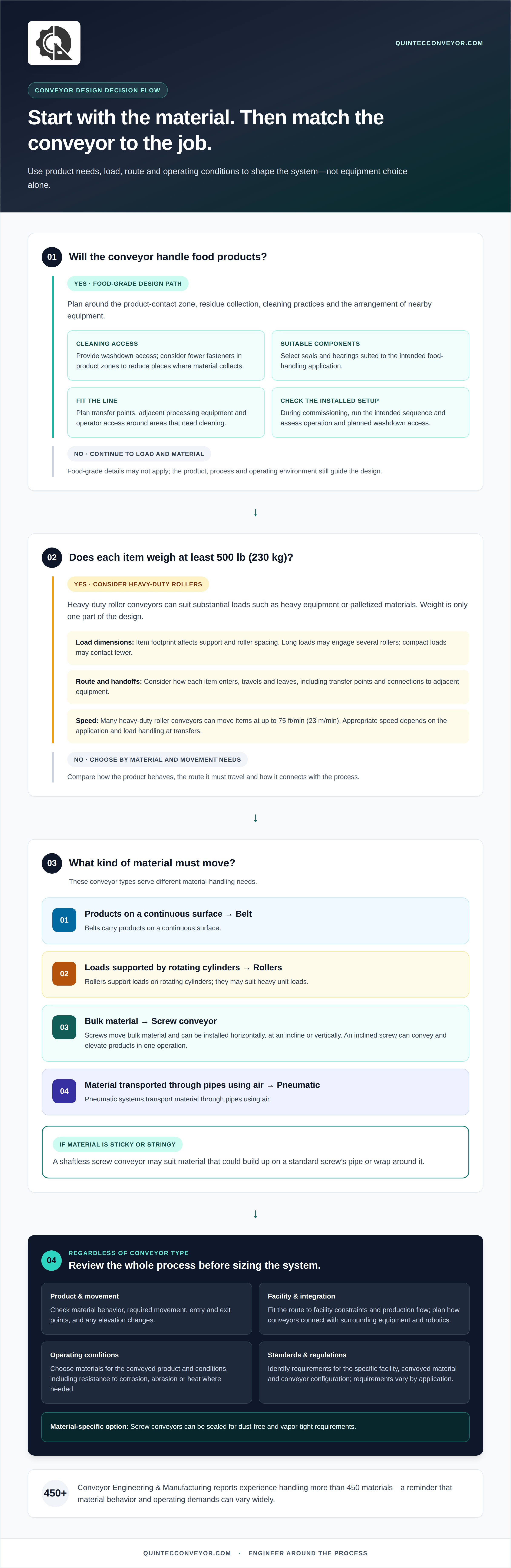
Food-handling equipment must suit the product and the cleaning practices used in the process. Design decisions consider where product contacts the conveyor, where residue could collect, and which areas need washdown access. For example, an exposed product path calls for close attention to the surfaces and components in that zone. These details shape the layout before installation.
Food-grade conveyor design should account for cleaning access and the suitability of components for the application. Each feature addresses a different design consideration. Access supports cleaning around the equipment, while fewer fasteners in product zones can reduce places where material collects. Seals and bearings should suit the intended food-handling application.
Layout matters, too. Engineers consider how the conveyor meets adjacent processing equipment and how operators access areas that need cleaning. A transfer point between a conveyor and a packaging line, for instance, should allow for both product movement and access around the connection. Making these decisions during design helps the equipment fit the facility’s workflow.
During installation and commissioning, the team positions and integrates the conveyor, then runs it through its intended operating sequence. This helps assess system operation and whether the installed layout provides the planned access for washdown and routine use.
Food-grade design also involves coordinating equipment details with the facility’s process, rather than selecting components in isolation. Product characteristics, the arrangement of nearby equipment, and cleaning access all influence the final configuration. A clear design plan connects those choices to how the line operates day to day. For a facility planning food-handling equipment, food-grade conveyor design is a useful next step in shaping a system around its process.
Heavy-duty roller conveyors
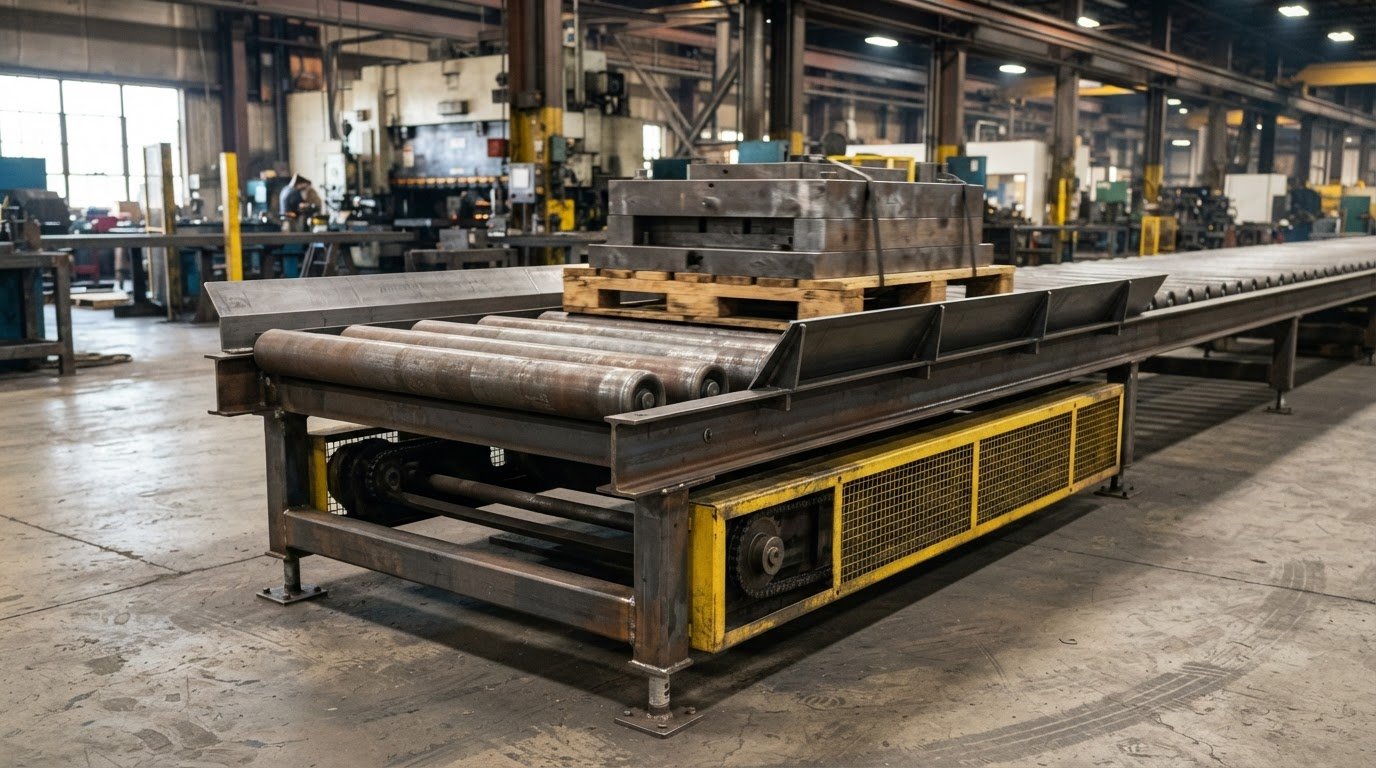
Heavy-duty roller conveyors move items weighing at least 500 pounds (230 kg). They suit applications involving substantial loads, such as moving heavy equipment or palletized materials through a facility. The load’s weight and dimensions help determine the roller configuration and supporting structure. Engineers also consider how each item enters, travels along, and leaves the conveyor.
Capacity is only one design consideration. The conveyor’s path, transfer points, and connection to adjacent equipment all affect how the system handles a load. A line moving large components between work areas, for example, needs compatible connections at each handoff. Planning these transitions helps align the conveyor with the facility’s material flow.
Many heavy-duty roller conveyors can move items at speeds of up to 75 feet per minute (23 m/min). The appropriate operating speed depends on the application and how loads are handled at transfers. A system moving heavy parts between process stages may need a different flow than one feeding a packing area. Load, route, and handling sequence should be considered together.
Belt, roller, screw, and pneumatic conveyors serve different material-handling needs. Belts carry products on a continuous surface; rollers support loads on rotating cylinders; screws move bulk material; and pneumatic systems transport material through pipes using air. Rollers may suit heavy unit loads, while a screw conveyor can move or elevate bulk products.
For roller systems, engineers assess an item’s footprint as well as its weight. A long load may engage several rollers at once, while a compact load contacts fewer. This affects support and roller spacing for smooth movement. Engineers also consider whether items move individually or in a controlled sequence, particularly at equipment connections.
These decisions help shape a roller system around the actual loads and route, not just a weight figure. Clear information about products, transfer points, and facility layout gives the engineering team a practical basis for planning.
Industries using conveyor systems
Conveyor needs vary by industry because products, processes, and facility layouts differ. Food processing prioritizes product handling and cleaning access, while distribution operations plan for movement between receiving, storage, and shipping. Manufacturing lines may connect separate production stages, making transfer points and process timing central design considerations.
Different conveyor types suit different tasks: belts carry products along a continuous surface, rollers move unit loads, screws convey bulk materials, and pneumatic systems move material through pipes using air. The best fit depends on the product’s form and route. Bulk material, for example, may call for a screw conveyor, while packaged items can move on belts or rollers.
Conveyor layouts should also account for safety during operation and servicing. The design team can assess moving components and transfer points, then consider guarding, access, and the relationship between equipment and work areas. These decisions should reflect the specific conveyor and its operating environment.
Materials and components follow the same application-led approach. A system may include a frame, drive, belt or rollers, or a screw and housing. Product characteristics and operating conditions inform material selection. For instance, vibrating conveyors can move newly cast metal parts that may reach temperatures above 1,500 °F (820 °C), so the application calls for equipment suited to those conditions.
Maintenance helps identify wear, alignment concerns, and interruptions in material flow before they disrupt the wider process. Troubleshooting traces an issue through relevant conveyor components and operating conditions to target corrective work. For example, irregular movement may prompt an assessment of the affected section and its connection to adjacent equipment.
Industry needs provide the clearest starting point: define the material, process, route, and operating environment, then match the conveyor and components to those demands. If a system must support changing production needs, discuss conveyor system requirements with an engineering team.
Pneumatic conveying also varies by pressure mode: suction or vacuum systems operate at about 0.4-0.5 atm below atmospheric pressure, while pressure-type systems operate at 6 atm and upwards. This distinction helps teams align pneumatic equipment with the material route and process needs.
Quintec Conveyors: Process Engineering
Quintec Conveyors provides process engineering for facilities planning a new system or refining material flow across existing operations. It’s a practical next step when product movement, facility layout, and connected equipment need to work as one coordinated process.
Quintec’s offerings include conveyors, conveyor maintenance, and robotics and automation. Process engineering connects equipment needs to the wider operation, including how materials move between stages. A facility introducing automation, for example, can plan how conveyors and robotic equipment interact within its workflow. Maintenance supports conveyor systems as operational needs continue.
To start a discussion, outline the material being moved, the process it supports, and the challenges your facility needs to address. Contact Quintec Conveyors to discuss your project.
Plan the next stage of material flow
Frame the operational decision clearly: what needs to move, where it needs to go, and how the process may evolve. This gives the project team a practical basis for aligning equipment decisions with facility priorities. Conveyor engineering supports this planning by treating material movement as part of the wider operation, not as an isolated equipment choice.
Quintec Conveyors offers Conveyors, Robotics & Automation, and Infrastructure for industrial material handling projects. These offerings can work together when planning a new system or coordinating equipment with the facility’s operational layout. A clear project scope focuses the discussion on the flow, integration, and infrastructure requirements that matter to your operation.
Take the next step with a clear view of your process and priorities. Contact Quintec Conveyors to discuss the project and explore a practical path forward.
Frequently Asked Questions
What does conveyor engineering involve?
Conveyor engineering involves planning and integrating equipment to meet a facility’s material-handling needs. This can include defining the system concept, developing its layout, and coordinating conveyors with other equipment and operational processes. A brownfield expansion, for example, may need a new conveyor connection that fits an existing workflow, while a greenfield project can incorporate material movement into the facility’s initial design.
What safety risks and safeguards should conveyor systems address?
Design teams should assess moving components and transfer points, considering guarding, access, and how equipment relates to work areas. Safeguards should reflect the specific conveyor and its operating environment.
How do you maintain and troubleshoot industrial conveyors?
Professional maintenance can identify wear, alignment concerns, and interruptions in material flow. Troubleshooting traces an issue through relevant components and operating conditions; irregular movement may call for checking the affected section and its connection to adjacent equipment.

Article by
Jon Huang