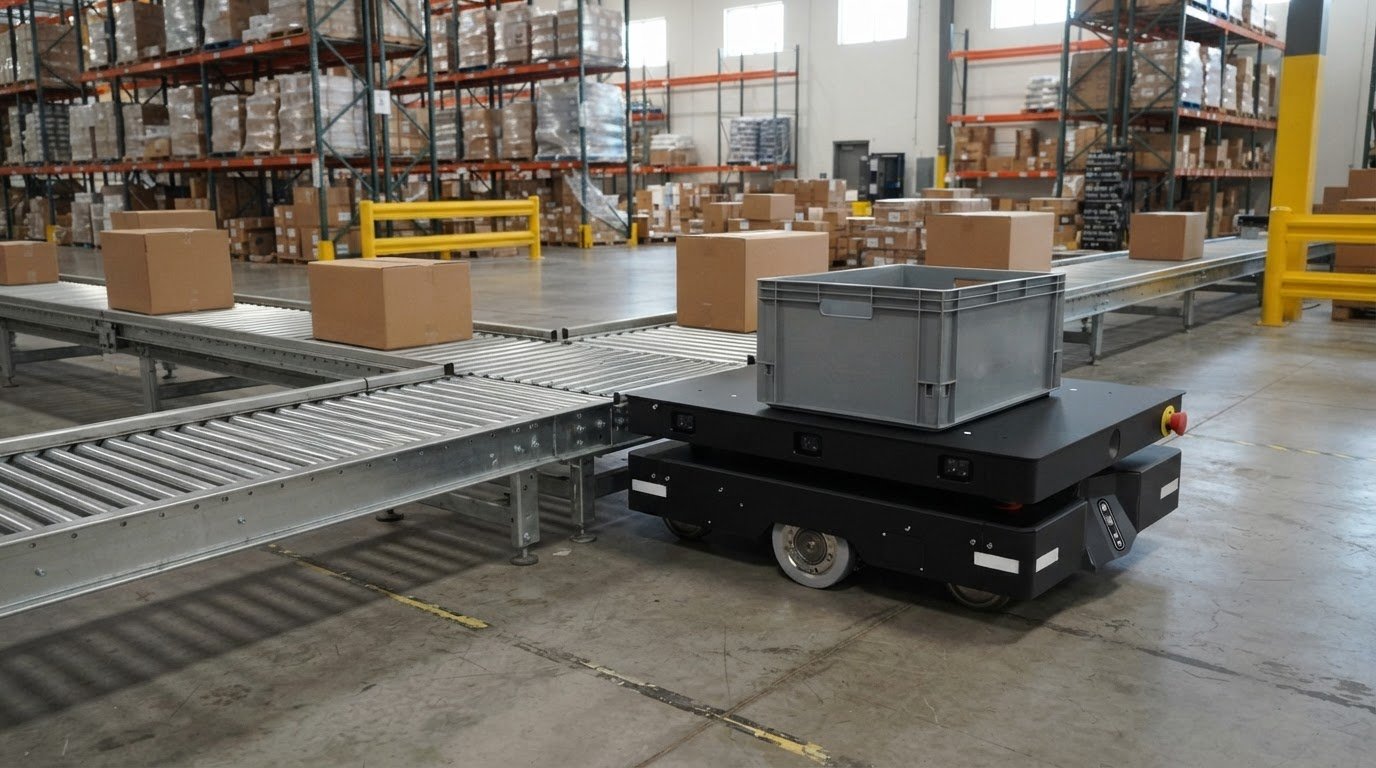
The most flexible automation option is not always the best fit for a high-throughput route. AGV conveyors and AMRs can accommodate changing movement needs, while fixed conveyors move goods efficiently between established points. The right choice depends on your loads, workflow, available floor space, and plans for change. Each option also has different design, installation, and operating-cost considerations.
Compare more than the equipment itself. Consider how each system is designed and commissioned, how it will fit into an operating facility, and what may affect its cost over time. This guide explains the differences between AGVs, AMRs, and conveyor systems, including when a combined approach may make sense. You’ll also find a practical decision guide to match the technology to your operation’s throughput, route flexibility, and material-handling requirements.
Key Takeaways
- Match the system to route stability, load type, throughput needs, and how much flexibility your operation requires.
- Plan for expansion and maintenance as part of system design, since fixed routes and mobile equipment call for different approaches.
- Assess operating costs across the full system lifecycle, not only the initial equipment and installation.
- Use installation design and commissioning to align the chosen technology with facility constraints and day-to-day operations.
How does the process of system design and installation compare between conveyor systems and AGVs/AMRs?
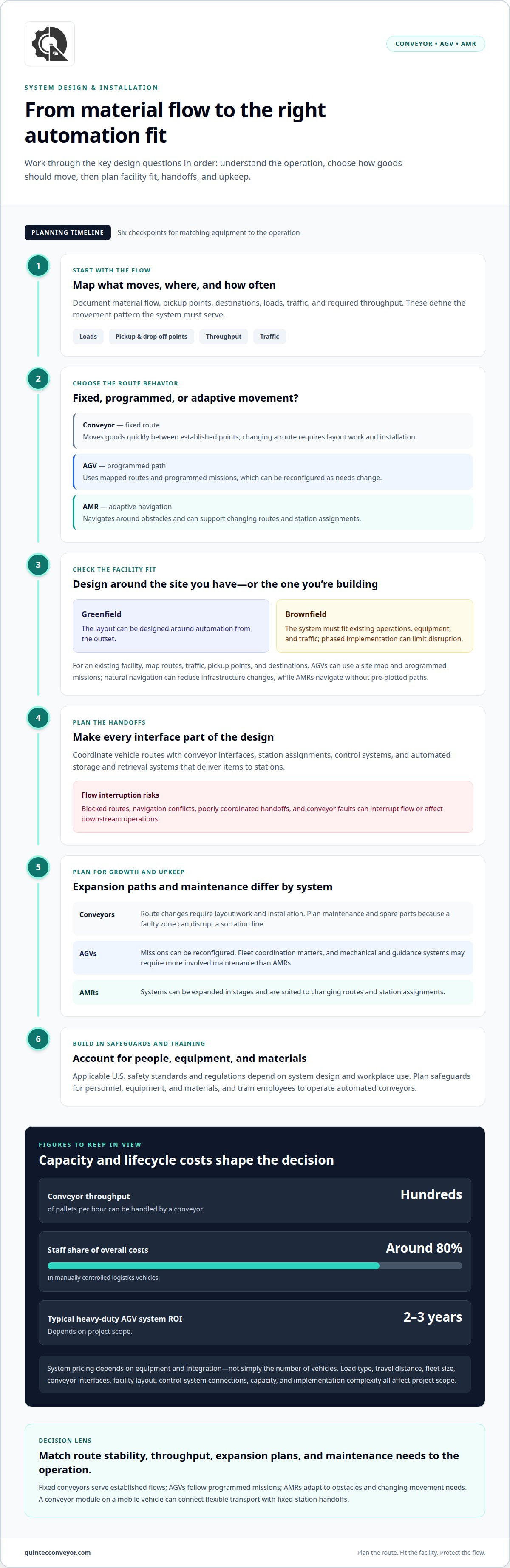
Design begins with material flow, destinations, loads, and throughput. Conveyors, AGVs, and AMRs differ in route flexibility, facility changes, fleet coordination, and maintenance requirements.
Flexibility, Expansion, and Maintenance
Conveyors create defined routes between stations, moving goods quickly along established flows. Changing those routes requires layout changes and installation. AGVs follow programmed paths, while AMRs navigate around obstacles. AMR systems can be expanded in stages, and AGV missions can be reconfigured as needs change. AGV mechanical and guidance systems may require more involved maintenance than AMRs.
Existing-System Implementation and Integration Challenges
In an existing facility, implementation starts with mapping routes, traffic, pickup points, and destinations. AGVs can use a site map and programmed missions, while natural navigation can reduce infrastructure changes. AMRs navigate without pre-plotted paths. Integration planning must also account for equipment interfaces and automated storage and retrieval systems that deliver items to stations. Blocked routes or poorly coordinated handoffs can interrupt flow.
Applicable U.S. safety standards and regulations depend on system design and workplace use. Plan safeguards for personnel, equipment, and materials, and train employees to operate automated conveyors.
Manufacturing, distribution, and order fulfillment operations use conveyors and mobile vehicles to move materials. Adaptable AMRs can suit fulfillment routes, while fixed conveyors serve established flows.
Common risks include blocked vehicle routes, navigation conflicts, and conveyor faults that affect downstream operations. A faulty conveyor zone can disrupt a sortation line, making maintenance and spare-parts planning important.
Manufacturers and material-handling integrators serve the U.S. market with vehicle, conveyor, and integrated automation systems. Project scope can include equipment, controls, facility integration, and maintenance.
| Option | Route | Expansion and integration | Throughput and upkeep |
|---|---|---|---|
| Conveyor | Fixed | Route changes require layout work and installation | Can handle hundreds of pallets per hour; zone faults can disrupt flow |
| AGV | Programmed | Uses mapped routes and missions | Fleet coordination and guidance maintenance matter |
| AMR | Adaptive | Can scale in stages and navigate obstacles | Fits changing routes and station assignments |
Choose a system by matching route stability, required throughput, expansion plans, and maintenance needs to your operation.
Automation benefits and operating costs
Automation can shift repetitive transport from manual handling to coordinated equipment. The business case depends on system scope, operating patterns, and facility conditions.
Factors Affecting System Pricing
System pricing depends on the equipment and integration required, not simply the number of vehicles. Load type, travel distance, fleet size, conveyor interfaces, facility layout, and control-system connections all affect project scope. A greenfield warehouse can be designed around automation, while a brownfield installation must fit existing operations and equipment. Required capacity and implementation complexity are key cost drivers.
Maintenance Needs and Operating Costs
Maintenance and operating costs reflect equipment type, duty cycle, and system complexity. AGVs can need more mechanical and guidance-system maintenance than AMRs, while conveyors may require broader maintenance and spare-parts planning. In manually controlled logistics vehicles, staff can account for around 80% of overall costs. A typical heavy-duty AGV system reaches return on investment in 2 to 3 years, depending on project scope.
Automated towing and pallet handling can move full pallets between trailers and racks without human interaction. In warehouse operations, this can reduce repetitive vehicle tasks and support consistent transport between defined handoff points. An automated guided vehicle suits repeatable movement, while the right load-handling configuration depends on the materials and equipment involved.
In a greenfield facility, teams can design the layout around automation from the outset. Brownfield projects must integrate with existing operations, equipment, and traffic, so phased implementation can limit disruption. The system’s operating schedule and integration needs shape the work required.
AGV conveyor automation can pair mobile navigation with fixed equipment, including automated storage and retrieval systems that bring items to a station. Staged deployment can support expansion, and mobile equipment may be relocated more readily than a fixed conveyor line. Assess changes to routes, handoffs, and warehouse operations before moving or scaling the system.
For integrated conveyor and automation planning, explore automation system planning.
Choosing between AGVs, AMRs, and conveyors
Choose equipment based on the material, route, and handoff. Fixed lines, guided vehicles, and autonomous mobile robots support different handling processes.
AGV and Conveyor Module Combinations
A conveyor module mounted on a mobile vehicle can transfer goods between vehicle routes and fixed stations. This combination connects flexible transport with conveyor handoffs, unlike a standalone conveyor that stays on one route. It can suit processes that need movement through shared space and consistent transfers at selected points. Plan each interface around the load and destination.
Types of AGV Conveyor Systems
Common types include tow or tugger AGVs, unit-load AGVs, deck-load AGVs, and vehicles fitted with conveyor modules. A tugger pulls a train of loads, while a unit-load vehicle carries a single load; a deck-load design carries material on its platform. Conveyor modules provide a powered handoff to compatible equipment.
Market sources describe AGVs as requiring pre-programmed instructions and physical guides, while AMRs use sensors and processors to navigate without pre-programmed paths or physical guides. An AMR can route around an obstacle, while an AGV may wait until its path clears. This difference matters in facilities where people, equipment, or layout changes affect vehicle movement.
Load weight and handling method narrow the options. A 2,000-pound tugger and a 50,000-pound unit-load AGV require different engineering, and AGVs are generally better suited than AMRs to heavier, bulkier pallets and containers. Some manufacturing products weigh 20,000 pounds or more and travel along a fixed, predictable path, which may favor conveyors.
For a practical selection, define the payload, origin and destination, required handoff, and route conditions. Then compare manual handling, mobile transport, and fixed infrastructure across each process. Use conveyors for fixed paths or storage buffering, AGVs for repeatable guided movement, and AMRs where navigation must accommodate obstacles. A facility can combine all three when different areas have distinct requirements.
Installation design and commissioning
Installation succeeds when layout, material flow, and equipment interfaces are designed as one project. Conveyor systems need site-specific design, which can require substantial effort, time, and expense.
Start by documenting the origin, destination, material, load characteristics, and required throughput. Then map how pallets and other goods move through the facility, including handoffs between mobile robots, conveyor systems, and existing equipment. For a fixed production route, design the conveyor around predictable flow. For vehicle transport, identify travel paths, crossings, and delivery stations before programming missions.
AGV implementation can involve creating a site map, then programming vehicle missions and actions. Natural or free navigation can reduce infrastructure changes in an existing facility. Conveyors take a different approach: their fixed route and equipment placement must fit the building and process. During design, assess whether changing a route would require a revised layout and installation.
Commissioning should test the complete material path, not just individual machines. A practical sequence is to confirm vehicle routes, verify each pickup and delivery handoff, and run the integrated system through its intended operating process. At each station, confirm that loads transfer as designed and the next process can receive them. This helps uncover interface problems before the system is relied on for routine throughput.
System choice must also reflect capacity. At Basel Airport, a cited example described a need to move approximately 200 pallets per hour, a rate that was not feasible with AGVs in that application. That illustrates why throughput targets should shape engineering decisions early, rather than being treated as a commissioning adjustment. For multi-level routes, vertical conveyors can connect AGV, AMR, or shuttle movement between levels without manual transfers or forklifts.
Commissioning also includes preparing employees to operate automated conveyors and establishing safety measures for people, equipment, and materials. Clear operating procedures help teams understand handoffs and respond to interruptions. For a coordinated system design, plan an integrated material-handling project.
Quintec Conveyors: Conveyor Maintenance
Quintec Conveyors provides conveyor maintenance to help operations keep material moving reliably. Consider maintenance when wear, recurring faults, or a conveyor-zone issue threatens downstream processes. A fault in one zone can disrupt a sortation line or wider operation, so maintenance planning and spare-parts inventory are important to system reliability.
For facilities reviewing a larger material-handling system, conveyor equipment, infrastructure, and robotics and automation can all be part of the design. The right approach depends on how conveyors connect with vehicle routes, stations, and other equipment in your operation.
Contact Quintec Conveyors to discuss conveyor maintenance for your operation.
Build the Next Stage of Your Material Flow
Use your next planning cycle to define the process you want to improve and the operational outcome that matters most. A clear starting point gives your engineering team a practical basis for deciding how AGV conveyors, mobile robots, and fixed equipment should work together as operations evolve.
Quintec Conveyors supports material-handling planning with conveyors, Robotics & Automation, and infrastructure. The goal is to shape a system around your facility’s material flow, operational priorities, and future requirements, rather than treating each piece of equipment as a separate decision.
Bring your material-handling priorities and facility requirements into a conversation with Contact Quintec Conveyors. A focused discussion can help you identify a practical next step and move your automation plans forward with confidence.
Frequently Asked Questions
What is an AGV/AMR Conveyor?
An AGV conveyor is a mobile vehicle equipped with, or working alongside, conveyor equipment to transfer materials between process points. For example, a vehicle-mounted belt can move a carton from a pickup point to a fixed conveyor. The vehicle travels between locations, while the conveyor section provides a controlled handoff. The design depends on the material and how it must transfer.
How does an AGV work?
An automated guided vehicle follows programmed instructions along a designed route. A control system can assign a task, such as moving a pallet from receiving to a production station. Guidance methods direct the vehicle, while programmed missions establish pickup and delivery actions. Clear routes and consistent handoff points help the vehicle complete repeatable transport tasks within the facility.
What are agv conveyors and how do they work?
AGV conveyors combine a guided vehicle with conveyor equipment to move goods between work areas. During a transfer, the vehicle aligns with a conveyor station, and the load moves between the two surfaces. Controls coordinate movement and handoffs. For example, a vehicle can collect a tote at a work cell and carry it to a packing area.
How much do agv conveyors cost in the United States?
The price depends on the project and is provided after a quote request. Cost factors include vehicle quantity and type, payload, route requirements, conveyor modules, facility modifications, and controls integration. A system serving a small number of handoffs has a different scope from one connecting several processes across an operating warehouse. These design choices shape the overall project.
How do mobile vehicle systems compare with fixed conveyors and AMRs?
Fixed conveyors move materials along installed routes, while AGVs follow programmed paths and AMRs navigate dynamically. A stable production process with repeated transfers may suit fixed equipment. An area with changing destinations or obstacles may benefit from mobile robots. Compare the options based on material, route, handoff requirements, and how facility traffic patterns affect movement.
How do you plan and install an AGV conveyor system?
Begin by defining the material, pickup and delivery points, traffic patterns, and handoff locations. Design routes and conveyor interfaces to fit your facility’s operations, then integrate controls and test each transfer. During commissioning, run representative loads through the process and train employees on equipment operation and safe responses to interruptions. Quintec Conveyors prioritizes employee safety and follows all OSHA requirements and regulations.