Reliable warehouse automation depends not on avoiding every fault, but on finding and addressing problems before they interrupt operations. Automated warehouse maintenance combines planned inspections and servicing with system monitoring, helping teams identify emerging issues and keep equipment in dependable working order.
It’s understandable to expect automated systems to monitor themselves and correct every problem. Monitoring can flag unusual equipment behavior, and automatic correction can resolve certain issues without manual intervention. But faults that require physical inspection or repair still need maintenance support. This article explains how maintenance services, self-monitoring, and auto-correction work together to support uptime. It also covers preventive and predictive approaches, and why maintenance plans should reflect the equipment and operating conditions in your facility.
Key Takeaways
- Understand how reactive, preventive, and predictive approaches differ, and how each can support equipment reliability.
- See how maintenance services can complement in-house expertise and help address operational needs.
- Learn how monitoring and automatic corrective responses can identify or resolve some issues before they disrupt workflow.
- Explore how maintenance planning, conveyor support, and warehouse racking fit into a broader approach to uptime.
Automated Warehouse Maintenance: Simpler Than You Think?
Three maintenance approaches address different equipment needs: respond to faults, prevent wear, and anticipate emerging problems. Their value depends on matching each task to the equipment’s condition and role.
Warehouse Maintenance Approaches
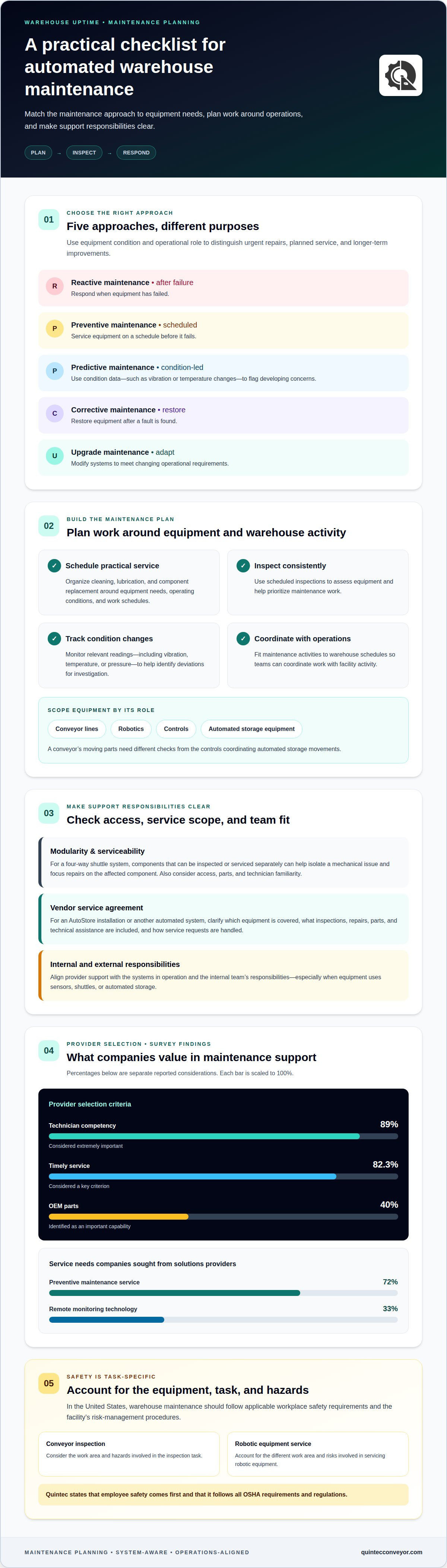
Reactive maintenance begins after a failure, while preventive maintenance follows a schedule to service equipment before it fails. Predictive maintenance uses condition data, such as changes in vibration or temperature, to flag developing concerns. Corrective maintenance restores equipment after a fault is found, and upgrade maintenance modifies systems to meet changing operational requirements. Distinguishing these approaches helps industrial teams separate urgent repairs from planned servicing and longer-term improvements.
Planned Maintenance and Inspections
Planned maintenance organizes servicing and inspections around equipment needs, operating conditions, and work schedules. For example, a facility can schedule cleaning, lubrication, and component replacement instead of waiting for visible wear to cause disruption. Scheduled inspections give technicians a consistent way to assess equipment, while condition monitoring tracks changes that may signal deterioration. Together, these practices help teams prioritize work and coordinate it with warehouse activity.
Systems Covered by Automated Maintenance
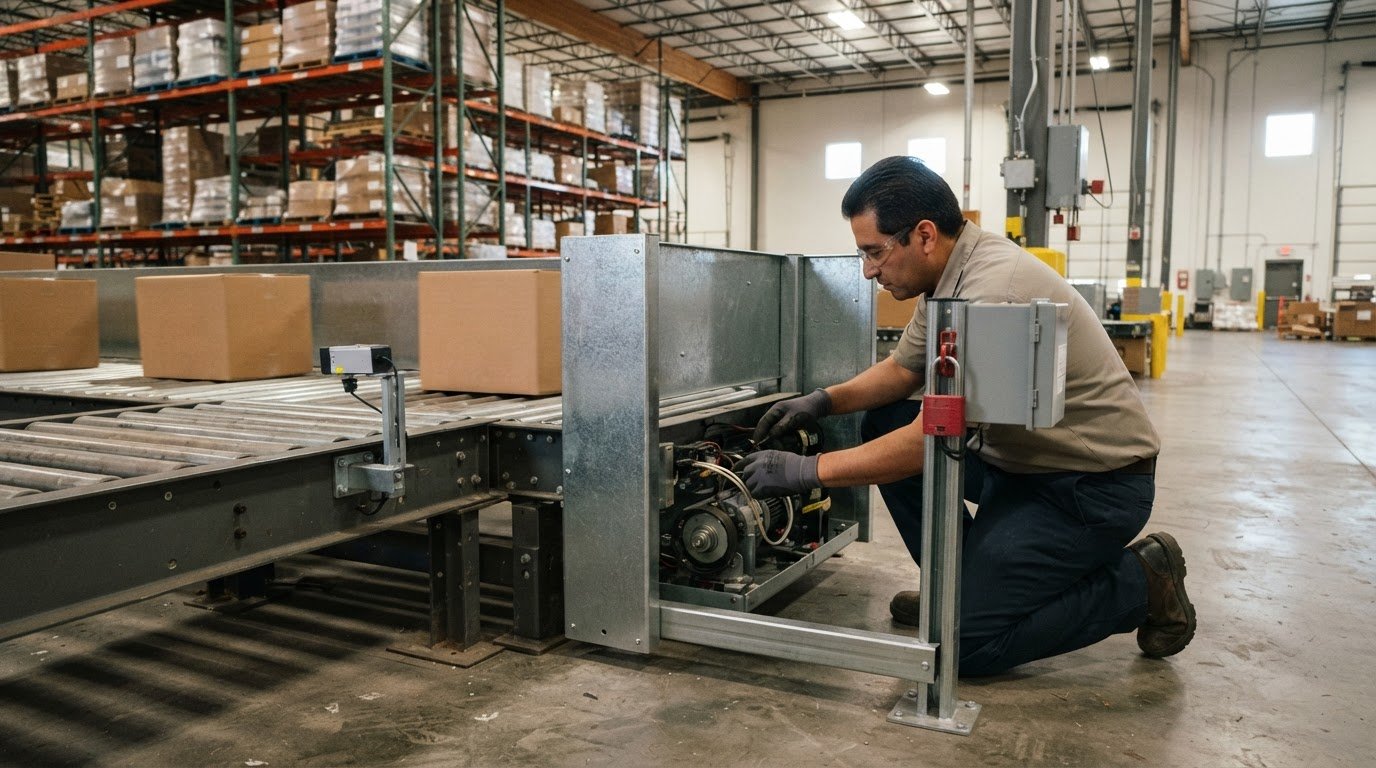
Automated warehouse maintenance covers the inspection, servicing, and repair of equipment and connected systems used to move, store, and process goods. This may include conveyor lines, robotics, controls, and automated storage equipment. The plan depends on each system’s components and role. A conveyor’s moving parts, for example, need different checks from the controls coordinating automated storage movements.
Applicable U.S. Safety Standards
In the United States, warehouse maintenance should follow applicable workplace safety requirements and the facility’s procedures for managing risk. The appropriate practices depend on the equipment, maintenance task, and hazards involved. Inspecting a conveyor and servicing robotic equipment, for example, involve different work areas and risks. A maintenance plan should account for these task-specific hazards. Quintec places employee safety first and follows all OSHA requirements and regulations.
Maintenance services and operational reliability
Maintenance support brings technical expertise, service planning, and equipment needs together across a logistics facility. Clear responsibilities help teams coordinate repairs and base operational decisions on the system’s requirements.
Modularity and Serviceability
For a four-way shuttle system, modularity means organizing equipment into components that can be inspected or serviced separately. This can make it easier to isolate a mechanical issue and focus repairs on the affected component rather than treating the entire system as one unit. Serviceability also depends on access, parts, and technicians’ familiarity with the equipment. These factors shape how maintenance fits into facility operations.
Service Agreements and Technical Support
A vendor service agreement defines the maintenance support available for specific equipment, including the scope of inspections, repairs, parts, and technical assistance. For an AutoStore installation or another automated system, focus on which equipment is covered, what work is included, and how service requests are handled. Clear terms help warehouse teams understand support responsibilities and coordinate service with internal maintenance staff.
Choosing a Maintenance Provider
Choose a provider based on technical competence, relevant system experience, and the support your operation needs. In a survey, 89 percent of respondents considered technician competency extremely important when choosing a maintenance service provider. Another 82.3% considered timely service a key criterion, while 40 percent identified OEM parts as an important capability. These findings point to practical areas for assessing whether a provider can support your equipment and workflows.
Service scope matters, too. In a survey, 72 percent of companies sought preventive maintenance service from solutions providers, and 33 percent named remote monitoring technology as an important provider capability. For a facility using sensors, shuttles, or automated storage, align support with the systems in operation and the internal team’s responsibilities. That clarity helps maintenance services contribute to operational reliability without blurring who handles each task.
Self-monitoring and auto-correction in warehouse automation
Warehouse software and connected sensors can make equipment status visible during daily operations. Automated responses can address defined conditions, but faults requiring physical work still need maintenance.
Software-Based Equipment Monitoring
Warehouse management software can connect with ERP and facility operations systems to support real-time monitoring and data analysis. This lets teams view operational information alongside warehouse activity and spot changes that may affect order flow. For example, they can review a recurring equipment alert alongside related process data. Software monitoring supports decisions, but it does not replace a technician’s assessment of a mechanical fault.
IoT Monitoring and Real-Time Analytics
IoT-enabled monitoring uses connected sensors to collect equipment information as conditions change. Predictive maintenance can use readings such as vibration, temperature, and pressure to identify deviations from normal operation. This gives maintenance teams a basis for investigating an issue before it develops into a failure. Its value depends on selecting relevant measurements and interpreting them in the context of the equipment and its workload.
Equipment Health Monitoring
Equipment health monitoring combines sensor readings and system data to assess whether automated equipment is operating as expected. Predictive systems can use AI and advanced algorithms to identify trends or deviations that may signal failure. For instance, a change in vibration may prompt an inspection. This helps teams prioritize investigation, but it does not mean every issue can be diagnosed or repaired automatically.
Remote Monitoring and Assistance
Remote monitoring lets authorized support teams review system information without being physically present at the installation. When connected warehouse management software shares operational data, remote assistance can help interpret alerts and determine whether a manual inspection is needed. Auto-correction is more limited: a gravity roller stop, for example, can reset automatically when a pallet moves, removing the need for a manual reset. Such responses apply to defined conditions, not every fault.
Warehouse automation maintenance and uptime
Uptime depends on how well maintenance protects the connections between equipment, controls, and warehouse workflows. A fault in one conveyor can affect linked processes, so technicians need to consider the system-wide impact, not just the failed component.
Common failure risks include mechanical wear, sensor misalignment, control faults, and interrupted communication between equipment and software. A conveyor stoppage, for example, can slow downstream sorting and create a backlog. Robots may pause when sensors detect an obstacle or a system condition that needs investigation. These disruptions can affect productivity and order flow, and may influence replacement planning.
Prioritize maintenance according to operational impact. If a conveyor serves several process areas, its condition may matter more to facility flow than that of an isolated unit. Technicians can review fault records to identify repeated stoppages, note affected equipment, and distinguish recurring issues from one-time events. This helps direct inspections and repairs toward systems with the greatest connection to throughput.
Maintenance schedules should include checks for specific equipment. For shuttle systems, the stated standard schedule calls for verifying positioning accuracy and sensor alignment quarterly. Monthly tests of emergency stops and obstacle detection help assess whether these safety-related functions respond as intended. A consistent schedule gives technicians clear inspection points and helps them spot changes before performance worsens.
Replacement requires judgment, not just a response to immediate failure. Repeated repairs, declining performance, and a component’s role in the wider system all help determine whether continued servicing or replacement better supports uptime. For robots and conveyors, reviewing these factors alongside operational records helps teams plan work without treating every fault as an isolated event.
For conveyor-related reliability needs, explore conveyor maintenance as part of a practical uptime strategy.
Quintec Conveyors: Warehouse Racking
Quintec Conveyors helps facilities address material-flow needs with warehouse racking, conveyors, robotics and automation, and conveyor maintenance. Turn to these services when storage layout, equipment integration, or conveyor condition is affecting how goods move through your operation.
Warehouse racking supports storage planning, while conveyors and automation move materials between processes. Maintenance can address the needs of existing conveyor systems as part of an operational reliability plan. The right focus depends on your facility’s layout, equipment, and maintenance priorities.
For help with warehouse racking, conveyor maintenance, or automation, contact Quintec Conveyors to discuss your facility’s needs.
Make Maintenance Part of Your Next Improvement
Use maintenance findings to shape your next operational decision. Recurring faults, changing workloads, and equipment condition can reveal where facility planning or system design needs closer attention. A practical plan connects maintenance priorities to the way materials move through your warehouse, helping your team consider reliability as operations evolve.
For facilities assessing automated warehouse maintenance alongside wider operational needs, Quintec Conveyors offers conveyors, Robotics & Automation, and infrastructure solutions. These services can support planning around equipment and facility requirements, with your project’s needs guiding the conversation.
Bring your operational priorities into focus and identify the right next step for your facility. Contact Quintec Conveyors to discuss your needs and move forward with confidence.
Frequently Asked Questions
Can existing warehouse staff maintain these systems?
Existing staff can handle maintenance tasks that match their training and technical capabilities. A practical division is to assign routine equipment observations and reporting to operators, while trained technicians handle diagnostics, adjustments, and repairs. For a new automated installation, training should cover normal operating conditions, alarm reporting, and escalation procedures. This helps staff recognize when a fault needs specialist attention rather than an improvised fix.
Is Automation Maintenance Worth the Long-Term Investment?
Planned maintenance can be worthwhile when it prevents avoidable disruption and helps equipment remain serviceable over its working life. Assess the need based on operating conditions, system complexity, repair history, and the consequences of a stoppage. For example, recurring faults in equipment that supports several warehouse processes may warrant a closer review. Compare the effort of planned maintenance with the operational impact of repairs and replacement, not just the immediate task.
What is Predictive Maintenance in Logistics?
Predictive maintenance in logistics uses equipment condition data to guide when maintenance attention is needed. Rather than relying only on a fixed calendar or waiting for a breakdown, teams review information from operating equipment and investigate developing changes. In a distribution workflow, this can help prioritize equipment that affects goods movement. The approach works best when teams review data alongside maintenance records and operational context.
What should an industrial preventive maintenance plan include?
An industrial preventive maintenance plan should identify the equipment covered, scheduled tasks, responsible roles, and how completed work is recorded. It should also coordinate maintenance windows with warehouse activity to avoid unnecessary workflow conflicts. For example, a plan can distinguish checks performed during normal operations from repairs that require a controlled work area. Include a process for recording defects and assigning follow-up work.
How does predictive maintenance work for warehouse automation equipment?
Predictive maintenance compares equipment condition information over time to help identify meaningful changes. A technician can review a developing pattern, consider the affected system’s role, and decide whether inspection or repair is appropriate. For example, changing equipment readings alongside repeated operating alerts may warrant investigation. This method supports prioritization, but it does not diagnose every fault automatically or replace technical judgment.
What sensors and software are used to monitor automated warehouse systems?
Depending on the equipment, sensors can track vibration, temperature, or pressure. Warehouse management software can integrate with ERP and facility operations systems to support real-time monitoring and data analysis. Together, these tools help teams connect equipment signals with warehouse activity. For instance, reviewing an equipment alert alongside process information may help identify the affected operation and guide a focused investigation.