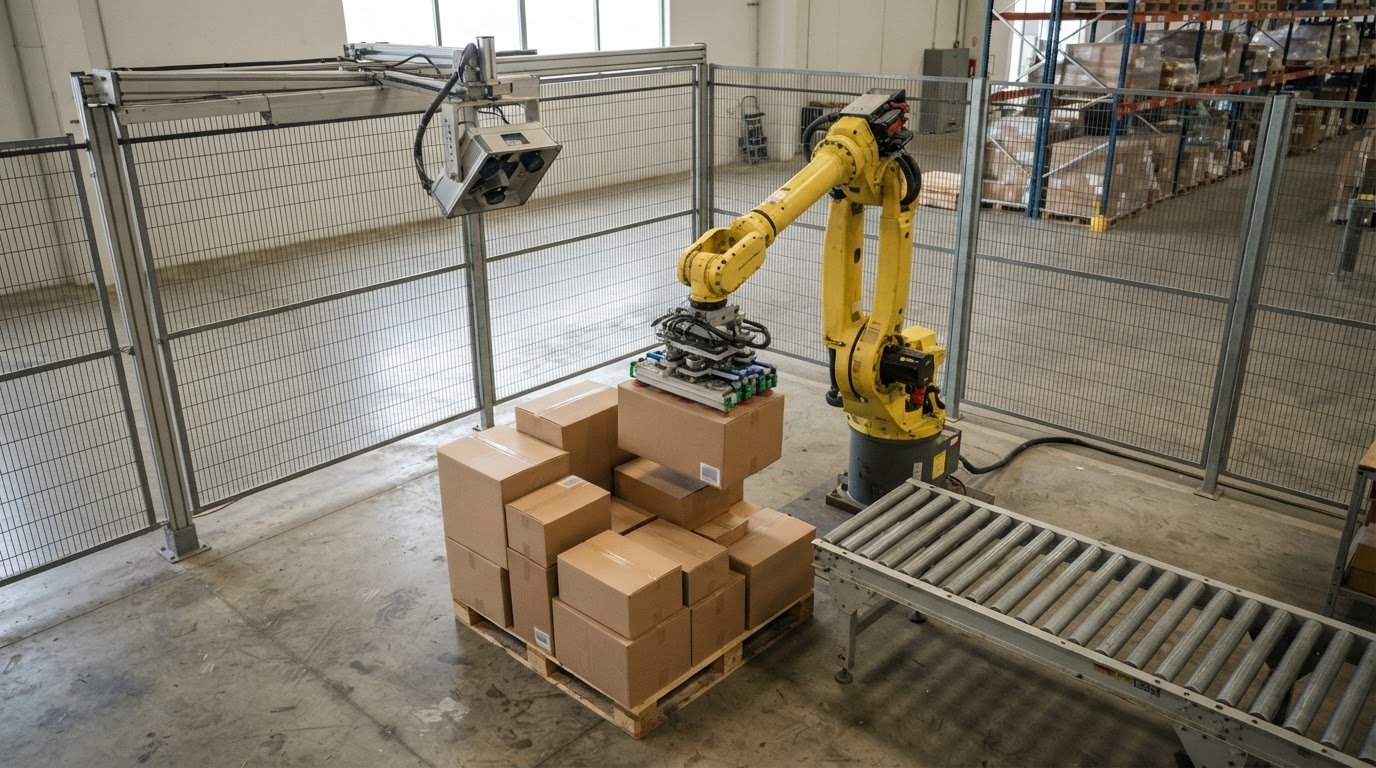
Manual unloading can become a bottleneck in mixed-load operations. Robotic depalletizing solutions use vision-guided robots to identify cases in varied positions and orientations, then remove them in a controlled sequence. Performance depends on coordinating vision, gripping tools, robot reach, and the flow of cases to the next process.
That complexity matters: mixed pallets may have shifting patterns, different package sizes, and cases that are not neatly aligned. This guide explains how vision-guided systems interpret varied pallet layouts, where depalletizing fits into material handling, and what to consider when integrating a system. It also covers how product presentation, gripping requirements, and downstream equipment shape the design, helping you assess whether robotic depalletizing suits your operation.
Key Takeaways
- Assess case size, orientation, and pallet pattern to understand how a system can handle changing loads.
- See how 3D vision helps a robot locate cases and adapt its picking sequence to the pallet in front of it.
- Explore how depalletizing can support material flow across logistics, consumer goods, retail, and healthcare operations.
- Plan integration around facility layout, case handling, and the equipment that receives products downstream.
Handling varied box orientations and pallet layouts
Robotic depalletizing solutions use vision and programmed picking logic to adapt to changing case positions. Throughput depends on the case mix, pallet pattern, gripper, and how quickly downstream conveyors receive each case.
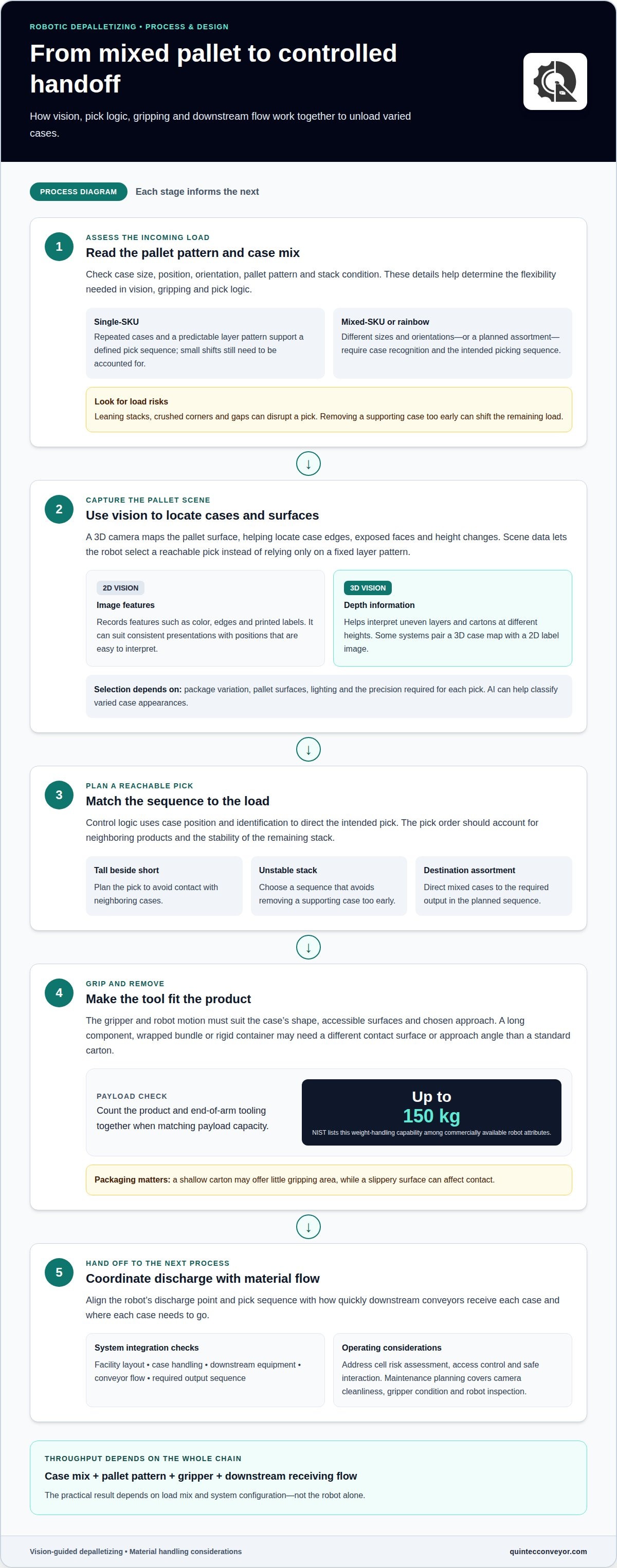
The National Institute of Standards and Technology lists weight-handling capability up to 150 kilos among commercially available robot attributes. Payload capacity must suit the products and end-of-arm tooling handled together.
Single-SKU and Mixed-SKU Pallet Handling
A single-SKU pallet typically has repeated cases with consistent dimensions and a predictable layer pattern. The robot can follow a defined pick sequence, while still accounting for small shifts between cases.
Mixed-SKU pallets require the system to distinguish case positions, sizes, and orientations. For example, a layer with tall cartons beside shorter cases calls for a picking plan that avoids contact with neighboring products. Assessing the range of incoming patterns helps determine how flexible the vision and gripping setup must be.
Irregular and Unstable Pallet Handling
Leaning stacks, crushed corners, or gaps between cartons can disrupt a planned pick. Vision guidance can locate exposed surfaces and identify a reachable case, while the robot’s motion and grip must suit that position.
With an unstable pallet, pick order matters: removing a supporting case too early can shift the remaining load. The system design should account for stack condition and sequence, with a controlled handoff to the next process. This helps manage awkward loads without treating every pallet as a uniform block.
Custom handling also matters for industrial products that differ from standard cartons. A long component, wrapped bundle, or rigid container may need a different contact surface or approach angle. The robot’s payload calculation includes the product and tooling, while the gripper design reflects the item’s shape and accessible surfaces. These factors help establish a repeatable pick path for each product family.
Mixed-case and rainbow pallets combine products in a planned assortment, so the robot must follow the required case sequence. For example, a pallet intended for different store destinations may have several carton types in one layer. Vision identifies each case’s position, and control logic directs picks to the intended output. Coordinating the sequence with conveyor flow supports a smooth transfer and helps maintain throughput as pallet layouts change.
AI-powered, 3D vision-guided depalletizing
Vision-guided automated depalletizing combines image capture and robot control to select and remove cases. The sensing method should match the products, pallet surfaces, and operating conditions.
3D Vision and Case Identification
A 3D camera maps the pallet surface, helping the robot locate case edges, exposed faces, and changes in height. Software uses that scene data to select a reachable pick rather than relying only on a fixed layer pattern.
AI can help classify varied case appearances, while identification logic distinguishes product types or package features. A label, printed surface, or visible carton shape, for example, can help separate similar cases. The key design consideration is whether the available image information supports the required pick and sequence.
2D and 3D Vision Systems
Two-dimensional vision records image features such as color, edges, and printed labels. It can suit layouts where cases are presented consistently and their positions are easy to interpret.
Three-dimensional vision adds depth information, which helps interpret uneven layers or cartons at different heights. Some applications combine both views: a 3D map locates the case, while a 2D image helps recognize its label. The choice depends on package variation, lighting, and the precision required for each pick.
Compared with manual unloading, robotic systems perform programmed pick sequences. Unlike conventional fixed-pattern automation, vision can help adapt to changing case positions. The practical difference depends on the load mix and system configuration.
In the United States, safety requirements depend on the robot cell and its use. System design should address risk assessment, access control, and safe interaction around moving equipment.
Maintenance planning typically covers camera cleanliness, gripper condition, and robot inspection. Operating costs and return on investment depend on labor, uptime, energy use, maintenance, and case volume.
Robot Brands and Solution Providers
Robot manufacturers and system integrators in the United States configure vision, end-of-arm tooling, controls, and material flow. A suitable integration aligns these elements with the pallet types and downstream process, rather than selecting a robot in isolation.
Applications in logistics, consumer packaged goods, retail, and healthcare
Automated depalletizing supports operations that receive palletized goods before sorting, storage, or production. The right configuration depends on package types, load patterns, and the next process.
In logistics, a system can unload inbound cartons for sortation or conveyor transfer. Consumer packaged goods operations may feed cases of food, beverages, or household products into production and distribution flows. Map where each case goes after depalletizing, then align the robot’s discharge point with that destination.
Retail distribution centers handle mixed assortments destined for different stores. A pallet may include several case sizes that must move into separate order-processing lanes. In healthcare supply chains, cartons of medical supplies may move from receiving to storage or fulfillment. These applications require attention to product identification, handling sequence, and downstream routing.
Supported packaging can include corrugated cartons, rigid containers, and shrink-wrapped bundles, depending on the gripper and system design. Consider edge cases: a shallow carton may offer little gripping area, while a slippery surface can affect contact. Packaging dimensions, weight distribution, and accessible faces inform the handling approach.
Damaged or variable packaging complicates automated picking. A crushed corner can change a carton’s shape; torn wrapping may expose loose items or obscure the intended pick surface. Vision can help locate visible case surfaces, but the end effector still needs a suitable grip. The sequence should also account for cases that lean or sit unevenly.
Key limitations include occluded cases, inconsistent packaging, unstable stacks, and loads outside the gripper’s intended range. These conditions can cause missed picks, require a revised sequence, or call for human intervention. Before deployment, account for representative products and pallet conditions in the system design, rather than relying on ideal cases alone. This evaluation helps match applications to achievable handling performance.
System integration and facility considerations
Start integration by mapping the pallet’s route from receiving to the next operation. Identify where loads arrive, how pallets are positioned, and where empty pallets go. For example, a depalletizer beside an inbound conveyor needs a clear handoff between the conveyor, robot cell, and case takeaway line.
Facility layout shapes cell design. The integration plan should account for floor space, operator access, pallet staging, and the route outgoing cases take. A column, doorway, or existing conveyor can constrain robot reach or conveyor placement. Reviewing these features early helps coordinate equipment placement with the inbound workflow.
Inbound processes also affect performance. Consistent pallet presentation helps the system locate the load, while variable arrival positions may require a defined staging point. Establish how pallets are identified, delivered, and removed, including how to handle a damaged or out-of-sequence load. These decisions connect the depalletizer with receiving and warehouse procedures.
Integration covers controls and material flow, not just the robot. The system must coordinate signals between the robot, conveyor, and upstream equipment. For instance, a full takeaway conveyor needs a planned response so the robot does not keep picking into a blocked line. The design should also define how manual handling fits into exceptions and recovery.
Training should cover routine operation, safe access, jam recovery, and responses to missed picks. Operators and maintenance staff need role-specific instruction for the controls and equipment they use. Support planning should identify who handles software, robot, conveyor, and gripper issues, so faults can be directed to the right technical resource.
A practical integration review connects pallet presentation, picking sequence, conveyor capacity, and facility constraints. Discuss your depalletizing integration requirements to align the automation concept with inbound handling and downstream material flow.
Quintec Conveyors: Robotics & Automation
Quintec Conveyors helps connect robotic depalletizing with the wider material flow of your facility. Its Robotics & Automation offering can work alongside conveyors and other material handling equipment to support mixed-pallet operations.
An integration project depends on coordinating the robot, pallet presentation, case discharge, and downstream process as one system. Quintec Conveyors provides process engineering, along with custom conveyor design, engineering, and installation for industrial applications. This broader perspective helps align automation with facility infrastructure and operational requirements.
If you’re planning a depalletizing project or assessing how it could fit your facility, contact Quintec Conveyors to discuss your requirements.
Turn Depalletizing Priorities Into a Project Plan
Start by defining what a successful depalletizing project must support across your operation. Identify the pallet conditions that matter most, the case flow required downstream, and the facility constraints that affect equipment placement. These priorities provide a practical foundation for evaluating how robotic depalletizing solutions fit into your material handling system.
Quintec Conveyors can bring Robotics & Automation together with conveyors and infrastructure planning for industrial applications. This integration perspective connects the depalletizing cell with the equipment and facility layout around it, rather than treating the robot as a standalone purchase.
Share your operational goals and project requirements with Quintec Conveyors to discuss a suitable path forward. Contact Quintec Conveyors to begin planning your next step.
Frequently Asked Questions
Tired of Manual Unloading That Slows Everything Down?
Manual unloading can become a bottleneck when inbound pallets queue faster than teams can clear them. Automation can handle repetitive case removal, while employees focus on pallet exchange, exceptions, or tasks requiring judgment. Start by locating where delays form, such as receiving or a line-side buffer. Then define how an automated cell should hand cases to the next operation.
What type of Depalletizing System do I need?
Choose a system based on how consistently products arrive and what happens after unloading. Robotic depalletizing solutions can suit operations with changing case arrangements, while fixed-pattern equipment may fit repeatable loads. Consider whether the process needs individual case selection, a steady discharge to conveyors, or both. The right configuration also depends on product handling requirements and how exceptions are managed.
What is robotic depalletizing and how does it work?
Robotic depalletizing uses a programmed robot to remove products from a pallet and transfer them to another process. A typical cycle brings a pallet into position, identifies an available case, selects a grip, and places the case at a designated discharge point. Controls coordinate the robot’s movements with surrounding equipment, allowing the next pick to proceed when the receiving area is ready.
What are the main types of robotic depalletizing systems?
Common approaches include layer-based systems and robotic case picking. Layer-based equipment removes a full layer at once, suiting loads arranged in consistent layers. Robotic case picking removes individual cases and can accommodate more varied arrangements when paired with suitable sensing and gripping. During planning, compare the incoming pallet pattern with the selectivity required at the discharge point.
What steps are involved in selecting and integrating a robotic depalletizing system?
Begin by defining the products, pallet patterns, and destination for each case. Establish operating priorities, facility constraints, and how the system should respond to blocked conveyors or exceptions. Then develop the equipment layout and controls interface, followed by installation, testing, and operator training. A practical acceptance review uses representative loads and confirms the complete handoff to downstream operations.
What products, packaging, and pallet patterns are difficult to depalletize robotically?
Products can be difficult to handle when cases have little exposed gripping area, flexible packaging, or shapes that vary within the same load. Gaps, overhangs, leaning stacks, or cases hidden behind others can complicate access and picking order. For example, a crushed carton beside an intact case may change the available grip. Test representative packaging and load conditions during system planning.