Manufacturing plant conveyor systems move raw materials, parts, and finished products between locations and production stations. A drive mechanism moves a belt, rollers, or a chain along a planned route, carrying items to the stages where they are needed. Some systems use airflow to transport material, while elevators move it vertically.
The right type depends on what the line needs to move and how it must travel. Belt conveyors carry products on a continuous surface; roller conveyors move items by gravity, manually, or with powered rollers; chain systems carry loads on attached slats. Pneumatic systems use air to move material along a route. These differences matter because a conveyor is part of the production flow, not just a way to move items from one point to another.
This article explains how conveyors move products and raw materials, how common types work, and what factors shape system design. You’ll see how layout, material characteristics, operating speed, and connections to other equipment affect the choice, helping you understand how a conveyor system fits into a manufacturing plant.
Key Takeaways
- Understand how belts, drives, and supporting components move materials, including on inclines where grip is important.
- See how planned transfers and buffer zones can help filling and packaging equipment work within a coordinated production flow.
- Match conveyor type to the products being moved, the facility layout, and the required operating conditions.
- Recognize when conveyor maintenance can help address wear and upkeep needs as part of reliable material handling.
How Does A Conveyor System Work?
Manufacturing plant conveyor systems transport materials along a planned route using a powered belt, rollers, chain, or airflow. The chosen mechanism determines how products move through a facility, including whether the route rises or descends.
In the United States, lead times and installation costs depend on the conveyor type, route complexity, facility layout, controls, and connections to other equipment. Design and installation typically involve mapping product flow, selecting system components, planning the layout, and integrating and testing the equipment.
Conveyor Types and Transport Paths
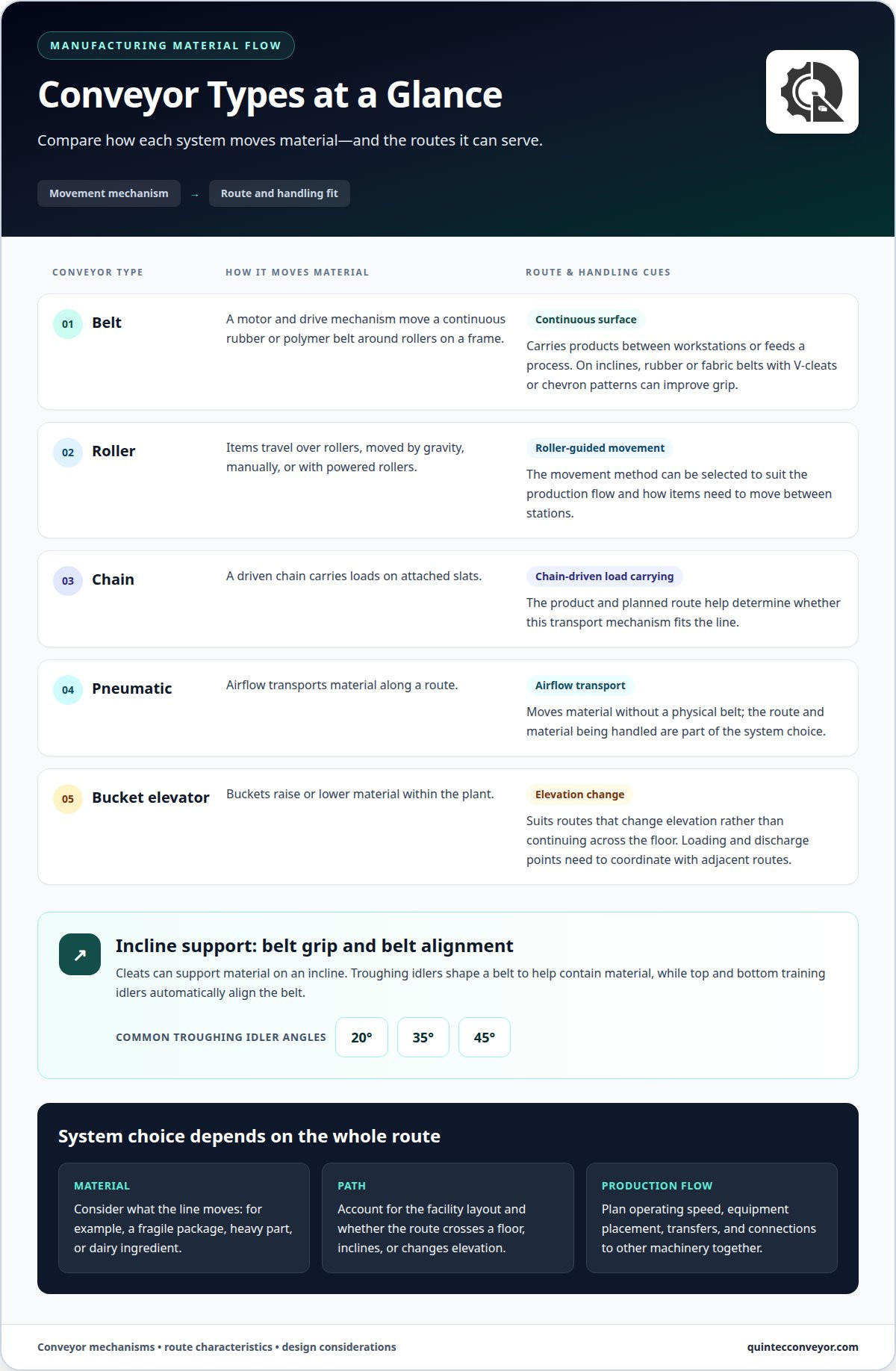
Belt conveyors carry products on a continuous belt, roller conveyors move items over rollers, chain conveyors use a driven chain, and pneumatic conveyors transport material with airflow. Each type suits different products and routes.
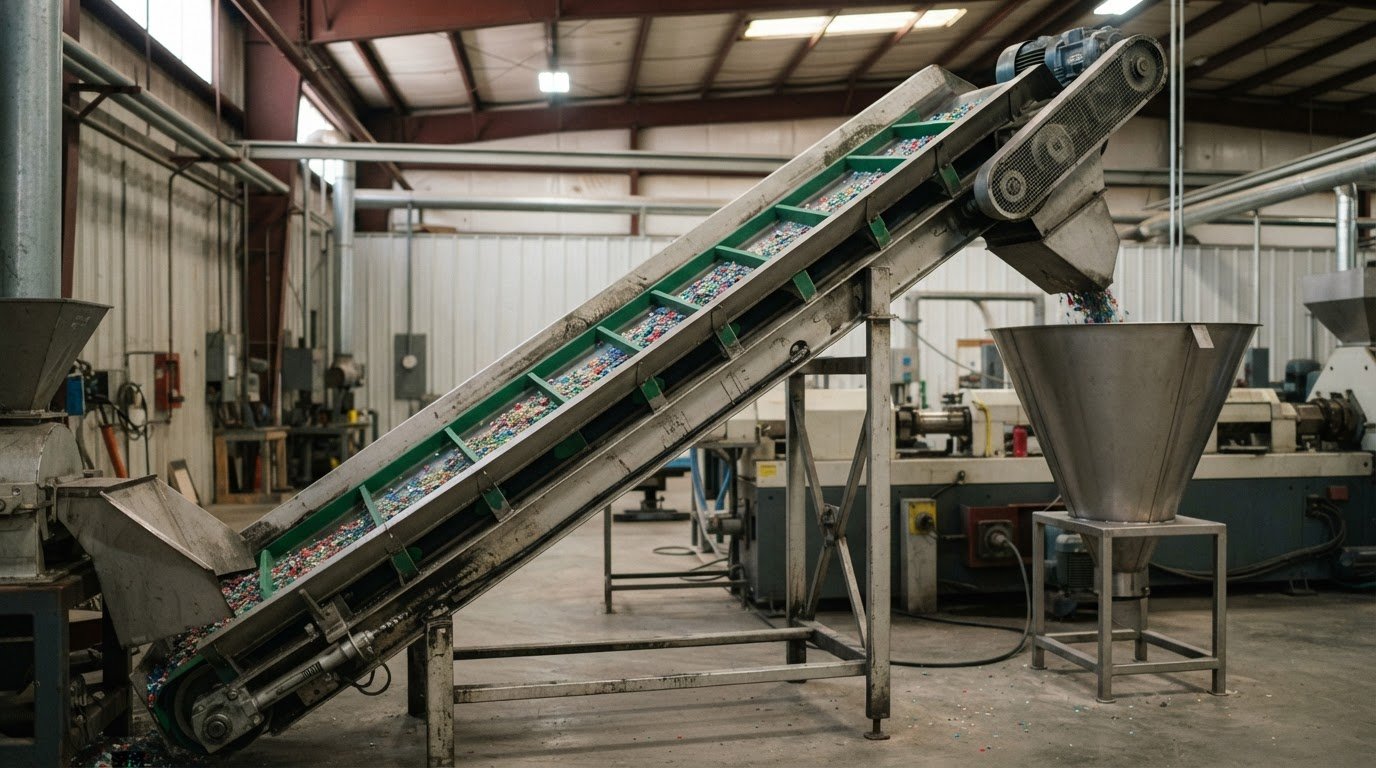
On an incline, rubber or fabric belts with V-cleats or chevron patterns can improve grip; a decline carries products downward. Roller systems may use gravity or powered rollers, while pneumatic systems move material without a physical belt. Matching the conveyor to the product and route helps prevent poor transfers.
Belt Construction and Applications
A belt conveyor uses a rubber or polymer belt stretched around rollers, with a motor and drive mechanism moving it along a mechanical frame. It can carry products between workstations or feed a process.
For example, cleats can support material on an incline. Designing and installing a system involves mapping its route, selecting conveyor type and speed, and planning equipment placement. CAD layouts, including 3D models, help visualize product and personnel flow before implementation and testing.
Installation timing and cost depend on design choices, facility constraints, and the work needed to connect equipment.
Idlers, Rollers, and Belt Tracking
Idlers support the belt along its route, while rollers guide or carry products. Troughing idlers shape the belt to help contain material, with common angles of 20°, 35°, or 45°.
Top and bottom training idlers automatically align a belt, helping reduce wear and spillage. Tracking components help correct belt drift before it disrupts transport. For servicing, OSHA 29 CFR 1910.147 covers lockout/tagout procedures for controlling hazardous energy. Guards and emergency stops should also be tested as part of safety checks.
Belt and Bucket Elevator Systems
Belt and bucket elevator systems use buckets to raise or lower material within a plant. They suit routes that need to change elevation rather than continue across the floor.
For example, an elevator can carry bulk material from a lower feed point to an elevated process stage. Manufacturing plant conveyor systems need to coordinate elevator loading and discharge points with adjacent routes so material transfers smoothly between stages.
Conveyor integration with filling and packaging equipment
A conveyor becomes part of the production line when its movement is coordinated with connected machinery. At a filling station, for example, it can position containers, carry them through filling and capping, then transfer them toward packaging. Transfer tables connect equipment with different orientations, while buffer zones absorb small speed differences between stages and help prevent bottlenecks.
Controls coordinate the equipment. Programmable logic controllers (PLCs) or microcontrollers can manage conveyor operations, while a central human-machine interface (HMI) provides a point for monitoring and control. Sensors and wireless connections can send operating information to a centralized dashboard. Controls should reflect the production sequence, equipment handoffs, and expected product volume rather than treating each machine as an isolated unit.
Automated storage and retrieval systems add another destination to the material flow. Conveyors can distribute products to storage zones or fulfillment areas, linking production output with downstream handling. A four-way shuttle system can serve multiple aisles, so the conveyor route and transfer points must align with the storage plan. This coordination helps products move between production, staging, and storage without disconnected handling steps.
Autonomous vehicles and vision-guided equipment also need planned handoffs. Defined transfer points help coordinate where a vehicle delivers or receives a load, while computer vision can classify objects or support quality control along a conveyor. For example, a vision system can inspect products at a checkpoint, with the control system directing the next step according to the production process.
At production stations, conveyors and robotic cells can be engineered as one synchronized system. Conveyors move materials; robots act on them. Coordinated timing helps equipment receive items in sequence, perform its task, and release them downstream. A design that integrates filling machines, capping machinery, transfer tables, and packaging equipment can account for buffer capacity and line speed together. For a connected material-handling plan, explore conveyor and automation integration as part of the production system.
How conveyor systems move products and raw materials
Conveyors transport ingredients, components, and finished goods between production steps, either throughout a process or along one section. The handling method and materials should suit the product, such as a fragile package, heavy part, or dairy ingredient.
Automated and Worker-Operated Handling
Material handling can be automated, worker-operated, or a combination, depending on the task and production flow. A conveyor may carry parts between stations where employees perform assembly, inspection, or packing; automated equipment can move products without direct human interaction.
Reducing manual movement of heavy, fragile, or dangerous items can lower exposure to strain and handling accidents. For example, a conveyor can carry a heavy component between work areas instead of requiring workers to lift and carry it. Robots act on materials, while conveyors move them through the industrial process.
Belt Materials, Covers, and Splicing
Belt materials and covers form the moving surface that contacts or supports a product, while a splice joins belt ends into a continuous loop. Rubber or polymer belts suit different transport tasks, and the product’s weight, edges, and production environment guide selection.
Top covers range from 3/16 to 3/8 inches thick. For dairy production equipment, food-grade stainless steel grades 304 or 316L are materials to prioritize. A splice must maintain belt continuity as it passes around rollers; wear, edge damage, and splice integrity are useful inspection points during routine maintenance.
Material Flow and Energy Efficiency
Material flow describes how products travel through storage, staging, and processing between production steps. A conveyor route can connect these points, while accumulation areas absorb small differences in process timing and help prevent bottlenecks.
Variable frequency drives can adjust conveyor speed to match changing production needs and improve energy efficiency. For example, slowing a belt during a reduced-volume period can align transport with the active process. Controls and sensors can help operators monitor system movement and identify where material flow needs adjustment.
Throughput and Load Capacity
Throughput is the rate at which a conveyor moves products, while load capacity is the weight or volume it can carry. Neither has a typical value that applies across belt, roller, chain, and pneumatic systems; product dimensions, load, route, and operating speed shape performance.
A powered roller conveyor may accumulate pallets for picking, while a belt carries products along a continuous route. The design must account for the heaviest load and required production pace. Matching conveyor components to both conditions helps maintain a workable flow through the facility.
Conveyor system types used in manufacturing
Conveyor type shapes how products move through assembly, production, and warehouse areas. The right fit depends on the material, required speed, facility conditions, and available floor space.
Belt conveyors provide a continuous surface for products and are widely used in manufacturing plants. Slat conveyors move spaced platforms on parallel chain drives, making them useful for products that need stable support or a route around corners. Accumulation and unscrambling tables can also be incorporated into slat layouts.
Roller conveyors move goods manually, by gravity, or with powered rollers. Powered versions can transport large items such as pallets and accumulate loads for picking. Mesh conveyors use plastic or stainless-steel mesh driven by sprockets, which may suit process environments that need a differently constructed conveying surface.
Layout matters as much as conveyor style. Portable units can move to different locations, helping teams trial floor plans; smaller modular conveyors can be reconfigured as manufacturing needs change. These flexible designs may suit operations that assemble multiple products, while a fixed, large system can limit workstation moves and future process changes. Consider product weight and dimensions, required speed, temperature, humidity, and available space together.
For U.S. facilities, OSHA 29 CFR 1910.147 covers lockout/tagout procedures for controlling hazardous energy during servicing. OSHA 29 CFR 1910.212 requires guarding at points of operation and rotating parts. Applicable ANSI standards depend on the conveyor design and hazards, so a single standard should not be assumed. Test emergency stops, guard interlocks, and warning devices as part of safety checks.
To reduce downtime, schedule maintenance around the system’s operating needs. Inspect belts for wear patterns, edge damage, and splice integrity; lubricate bearings according to manufacturer schedules, and replace worn parts as needed. Longer, more complex lines have a higher probability of failure, making routine monitoring valuable.
For a conveyor layout suited to your production needs, plan a manufacturing conveyor system.
Throughput and load suitability depend on the required speed and the products’ weight and dimensions. Powered roller conveyors can transport large items such as pallets, while slat conveyors provide stable support for products that need it.
Quintec Conveyors: Conveyor Maintenance
Quintec Conveyors provides Conveyor Maintenance to support plants managing wear, routine upkeep, or recurring conveyor issues. Maintenance can include monitoring system condition, scheduled tasks, and replacing worn parts before they disrupt material flow. Belt inspections can focus on wear patterns, edge damage, and splice integrity, while bearing lubrication should follow manufacturer schedules.
Turn to maintenance support when recurring faults, belt-tracking problems, or upkeep demands affect production. For a new line or a changing process, conveyors, infrastructure, and robotics and automation may also be relevant to the overall material-handling system.
Contact Quintec Conveyors to discuss your conveyor maintenance needs.
Shape the next stage of your operation
Use your next planning discussion to connect material flow with the production changes your facility needs to support. A clear view of current constraints, future process requirements, and equipment handoffs can guide decisions about Manufacturing plant conveyor systems without locking the operation into a layout that no longer fits.
Quintec Conveyors offers Conveyors, Robotics & Automation, and Infrastructure for industrial material-handling applications. Consider these offerings together when the next step involves coordinating conveyor routes, automated equipment, and the facility environment. The right focus depends on the operational challenge, whether it involves a new production flow or changes to an existing system.
Move the planning forward by discussing your facility’s material-handling goals with Quintec Conveyors. Contact Quintec Conveyors to start a conversation about your operation’s next step.
Frequently Asked Questions
How are conveyors used in manufacturing?
Conveyors move materials through production, from receiving and staging to processing, assembly, or finished-goods handling. They can support a whole production process or connect selected stations. For example, a plant may use a conveyor to deliver components to an assembly area while workers complete specific tasks. This planned movement helps coordinate material delivery with each operation’s needs.
What Is Material Flow in Manufacturing?
Material flow is the path raw materials, components, and products follow through a facility, including storage and staging between process steps. Trace an item from its entry point to its next operation and final destination to see where transfers happen and where a production layout may need a conveyor, staging area, or other handling method.
What are the four types of conveyors?
Four common types are belt, roller, chain, and pneumatic conveyors. Belt systems carry items on a moving surface; roller systems use rollers; chain systems move loads with a driven chain; pneumatic systems transport material using airflow. The category alone doesn’t determine suitability. Product form, load, route, and operating environment help identify which mechanism fits a particular task.
What industries use conveyors?
Conveyors are used in manufacturing and other material-handling operations, including warehouses and distribution centers. Applications vary with the products being moved: production lines may transfer ingredients or parts between operations, while fulfillment areas move goods toward storage or dispatch. Food and dairy production also use conveyor equipment, with materials and equipment design selected to meet the process’s handling and cleaning needs.
What types of conveyor systems are used in manufacturing plants?
Plants use belt, roller, chain, pneumatic, slat, mesh, overhead, and vertical conveyor systems. Each supports a different route or product need. For instance, mesh conveyors use plastic or stainless-steel mesh, while overhead systems grip products from above. Vertical conveyors move material primarily up or down. Modular or portable units can also suit layouts that need adjustment as production requirements change.
How do you choose the right conveyor system for a manufacturing facility?
Start by matching the conveyor to the material, required transport speed, route, and facility conditions such as temperature and humidity. Then consider available floor space, connections to production equipment, and whether the line must handle different products. For example, a sharp or heavy item may require a different belt arrangement than a lightweight package. The layout should support current operations and practical process changes.