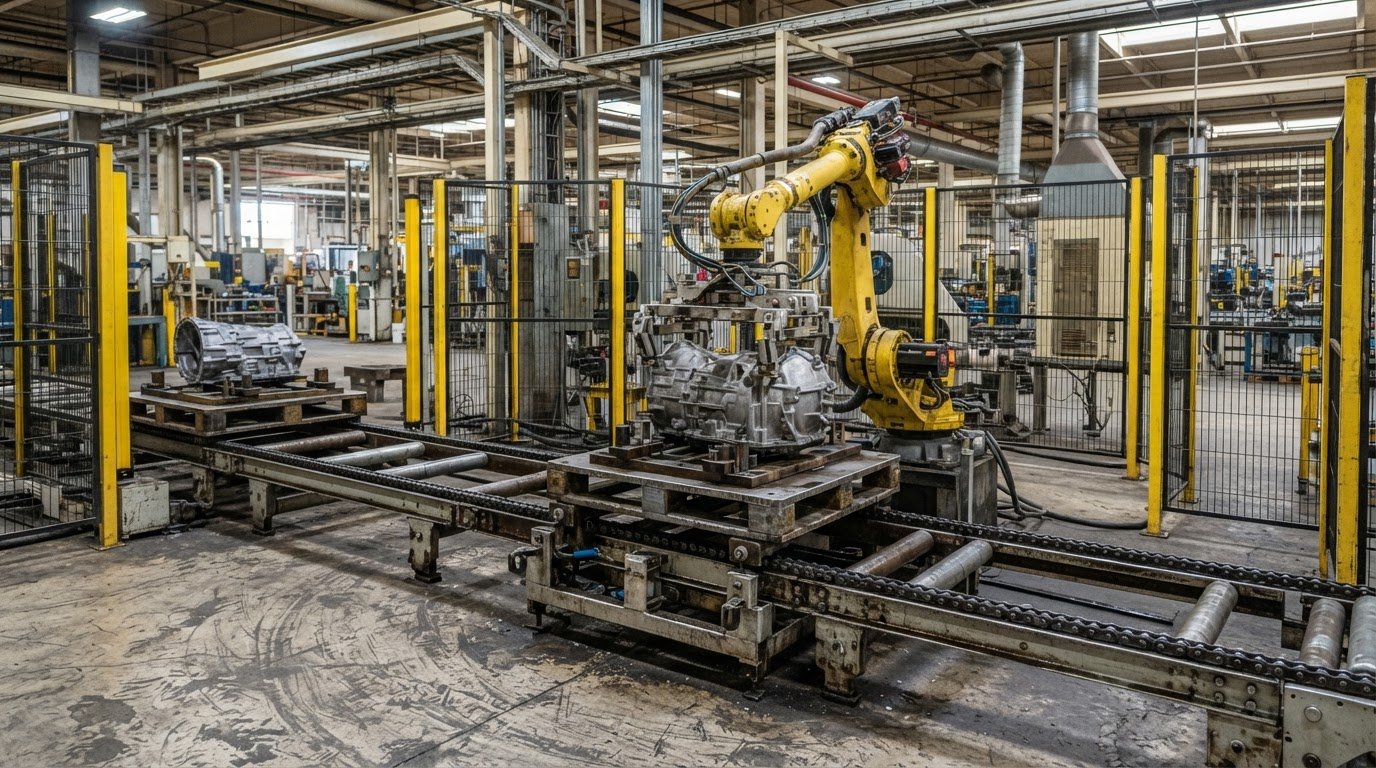
In automotive manufacturing, moving a part is only the beginning. A conveyor transports parts between production stages, while Automotive conveyor system integration connects that movement with material handling equipment, automation, and logistics tools. The result is a coordinated flow of materials through the facility.
That coordination matters: a fast robot cannot keep production moving if parts arrive late or the next process is not ready. Conveyors work best as part of a connected system designed around material movement and the way equipment and production steps interact.
This article explains what conveyors and conveyor systems do, how they connect with other material handling equipment, and how logistics tools fit into automotive operations. You will also learn what integration involves, which factors shape system design, and how Quintec Conveyors brings conveyors, automation, infrastructure, and process engineering together for industrial applications.
Key Takeaways
- Understand how conveyor systems move automotive parts between production stages and support robotic sub-assembly workflows.
- See how lifts, pallet stops, and other material handling equipment can coordinate positioning and movement along a production line.
- Learn why automation depends on a connected production flow, including links between conveyors and logistics management tools.
- Compare the main conveyor system types and discover when conveyor maintenance can help support reliable material movement.
What does “conveyor” mean, and what is a Conveyor System?
A conveyor moves material along a defined route; a conveyor system combines that equipment with controls, transfer points, and production processes. In automotive plants, the route may connect component handling, robotic work cells, and vehicle assembly lines.
Automotive Conveyor Applications
For robotic subassemblies, conveyors position parts within a robot’s work area and move completed assemblies to the next process. Engineers match load, weight, orientation, and spacing to the robot’s reach and production sequence. Overhead delivery can supply parts to parallel assembly lines, leaving floor space available for equipment and vehicle movement.
Tier 1 component assembly uses conveyors to move items such as modules between workstations, inspection, and packing. The key design step is mapping each transfer point, including where a robot loads or unloads parts, so the line supports the required handling sequence.
Vehicle Assembly Conveyor Types
Slat conveyors carry vehicles or heavy assemblies on linked platforms, supporting a defined route through vehicle assembly. Towline conveyors pull carriers along a floor-level route, which can suit workflows where vehicles or fixtures travel between stations. Suitability depends on the load, positioning needs, floor layout, and assembly line arrangement.
Cycle time depends on the production sequence, product mix, transfer delays, and available buffers; there is no single benchmark for every plant. Throughput planning starts with the required output and tests whether each station and transfer point can keep pace.
Controls and System Integration
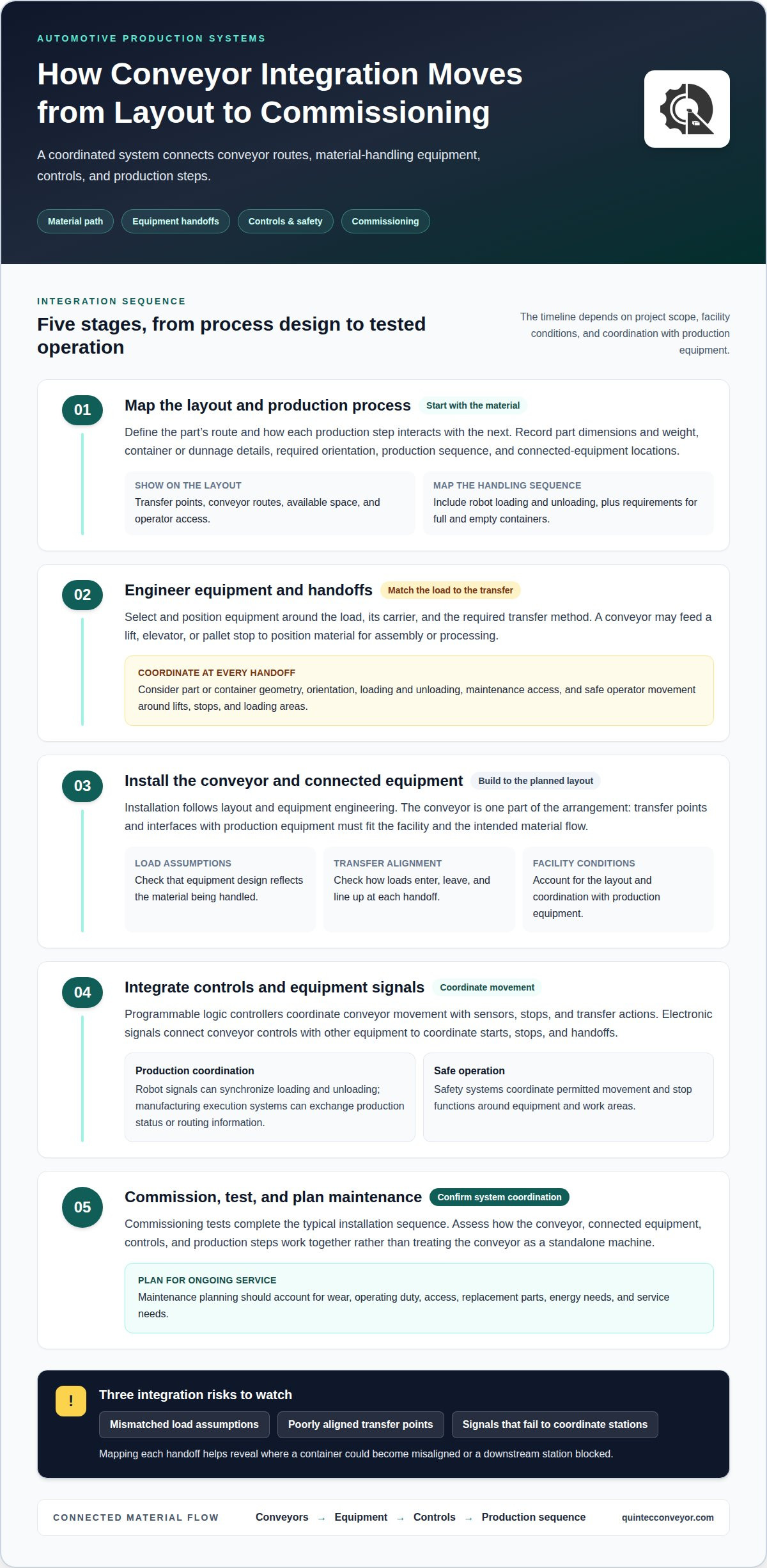
Programmable logic controllers coordinate conveyor movement with sensors, stops, and transfer actions. Robot signals can synchronize loading and unloading, while manufacturing execution systems exchange production status or routing information. Safety systems coordinate permitted movement and stop functions around equipment and work areas.
Common integration risks include mismatched load assumptions, poorly aligned transfer points, and control signals that fail to coordinate stations. An integrator serving US plants should demonstrate how its design addresses layout, equipment interfaces, controls, testing, and commissioning, rather than treating the conveyor as a standalone machine.
Installation typically progresses through layout and process design, equipment engineering, installation, controls integration, and commissioning tests. The timeline depends on project scope, facility conditions, and coordination with production equipment. Maintenance planning should account for wear, operating duty, access, and replacement parts; operating costs depend on those conditions and the system’s energy and service needs.
Integrating conveyors with material-handling equipment
Conveyor integration connects moving material with the equipment and production steps around it. A coordinated design accounts for part geometry, containers, operator access, and the handoffs that keep manufacturing flow smooth.
Equipment and Conveyor Coordination
A conveyor can feed a pallet lift, elevator, or pallet stop to position a load for assembly or processing. These modules add control beyond point-to-point transport, helping equipment receive material in the right location and orientation. For tire and wheel handling, the design must account for each load’s shape, weight, carrier, and transfer method, including how it enters and exits the conveyor.
Electronic signals between conveyor controls and connected equipment coordinate starts, stops, and transfers. Mapping each handoff helps reveal where a container could become misaligned or a downstream station blocked. Consider maintenance access and safe operator movement around lifts, stops, and loading areas during layout design.
Design Information Requirements
Design starts with the material and its path through the operation. Essential information includes part dimensions and weight, container or dunnage details, required orientation, production sequence, and the locations of connected equipment. Layouts should also show transfer points, operator access, and the space available for conveyor routes.
These details guide equipment selection and control coordination. For example, a component arriving in a reusable tote needs a different transfer interface from a tire carried on a dedicated support. Include handling requirements for full and empty containers, along with maintenance access around equipment.
Reducing manual lifting and carrying of heavy or bulky items can limit repetitive handling tasks, but conveyor placement and loading methods matter. For each application, map the load’s route, identify operator touchpoints, and coordinate equipment stops and transfers. This supports a safer, more controlled operation without assuming every movement should be automated.
For a project that combines conveyor routes with connected equipment, explore conveyor and material handling solutions suited to industrial applications.
Pneumatic lifts, elevators, pallet stops, and other pallet-system modules can position pallets and add control to production lines beyond simple point-to-point transport. Their role is to support positioning and control within a production line’s material handling arrangement.
Automotive automation experience
Automotive manufacturing has helped shape industrial automation since the 1960s. In 1961, General Motors began using George Devol’s Unimate to weld die castings to auto bodies on an assembly line. That milestone shows why automation experience involves more than selecting a robot. Conveyor movement, part presentation, and station timing must all support the production sequence.
Consider a robotic fastening station: the conveyor must position a part consistently before the robot begins its task. A robot that tightens a screw in half the time of a person still depends on the rest of the line moving quickly enough to receive and release work. Integration coordinates the robot’s operating cycle with upstream material handling and downstream production requirements.
Pallet movement adds another layer. Pneumatic lifts, elevators, and pallet stops can position carriers at production stations, while connected controls coordinate transfers. During installation, engineers must account for pallet orientation, load stability, and the sequence of equipment actions. These details determine whether a carrier arrives ready for robotic processing or requires manual repositioning.
Automation also connects physical movement with logistics management. Automotive conveyors can integrate with existing logistics tools, linking material flow to production status and routing information. The practical design process maps material movement, defines equipment handoffs, and aligns control signals with each operation. This helps identify interruptions between a robot cell and the surrounding line before commissioning. It also helps teams assess where automation supports the process and where manual handling remains part of the workflow. Each decision should reflect actual production requirements, not robot speed alone.
What are the main types of automotive conveyor systems and how do they differ?
Automotive plants use conveyors to move parts, carriers, and vehicles between production stages. The right type depends on the load, route, positioning needs, and work performed at each station.
Belt conveyors provide a continuous surface for moving smaller components or packaged materials. Roller conveyors support containers and pallets along straight routes, with powered or gravity movement selected for the transfer. For example, rollers can move a loaded tote between a staging area and an assembly workstation.
Slat conveyors carry vehicles or heavy assemblies on linked platforms, supporting a controlled route through vehicle assembly. Towline systems pull carriers along a floor-level path, connecting stations where vehicles or fixtures move between processes. Compare payload, carrier requirements, and available floor space before choosing between them.
Overhead conveyors move suspended parts above floor-level work areas. In automotive applications, they can deliver components to parallel assembly lines while leaving floor space available for other equipment. The route must suit the part, its suspension method, and the required loading and unloading positions.
Each configuration handles a different movement task. A practical selection sequence is to identify the material, establish its route, define positioning requirements, then match the conveyor to the load and process. A pallet moving between stations may need a different carrier and transfer arrangement from a vehicle body passing through assembly. Curved frames can also help point-to-point conveyor systems fit facility layouts.
Use these distinctions to frame an integration plan around actual production flow, rather than selecting equipment by type alone. Explore conveyor solutions for automotive material movement and facility applications.
Quintec Conveyors: Conveyor Maintenance
Quintec Conveyors provides conveyor maintenance for facilities addressing conveyor wear, upkeep, or changing production requirements. Maintenance is especially relevant when conveyor performance affects connected material handling, robotic work cells, or movement between production stages.
For an integrated system, maintenance must consider more than the conveyor itself. Equipment interfaces, transfer points, and service access all affect how the line operates. Quintec Conveyors also offers Conveyors, Robotics & Automation, and Infrastructure, bringing related equipment and system needs into the same project.
If your conveyor system needs maintenance or a closer look at its role in production, contact Quintec Conveyors to discuss your requirements.
Shape the Next Stage of Your Production Flow
The next step is to turn operational priorities into a clear project direction. Identify where material flow needs to change, which production areas must connect, and how future requirements could affect the layout. These decisions create a practical starting point for planning automotive conveyor system integration around your facility, rather than treating equipment as a standalone purchase.
Quintec Conveyors offers Conveyors, Robotics & Automation, and Infrastructure to support coordinated industrial projects. The right combination depends on your production objectives and the systems that need to work together. A focused discussion can help define the project scope and identify the considerations that matter most to your operation.
Contact Quintec Conveyors today to discuss your project and take the next step toward a material flow designed for your production needs.
Frequently Asked Questions
How do you integrate a conveyor system into an automotive assembly line?
Start by defining the product mix, station sequence, and material routes, then design equipment interfaces around those requirements. For example, a line handling different component variants may need routing decisions that direct each carrier to the correct work cell. Automotive conveyor system integration also involves testing normal operation and exception handling, such as a blocked transfer or unavailable station, before production handover.
What safety standards and regulations apply to automotive conveyor systems in the United States?
U.S. workplace safety requirements include applicable OSHA requirements, which should inform equipment design, installation, operation, and maintenance. A project should assess hazards such as access to moving components, pinch points, and safe stopping during service. Quintec states that employee safety is its first priority and that it follows all OSHA requirements and regulations; system safeguards must also fit the actual layout and tasks.
How do overhead, floor-mounted, pallet, and skid conveyor systems compare for automotive plants?
Overhead systems carry suspended material above floor activity, while floor-mounted systems use floor-level space and can support direct transfers. Pallet and skid systems describe how loads travel on carriers, not necessarily whether the route is overhead or floor-mounted. Choose based on the product’s support needs, transfer points, available space, and how operators or equipment load and unload each carrier.
How should automotive conveyor systems be maintained, and what are typical operating costs?
Plan maintenance around wear, operating duty, equipment access, and replacement parts. Operating costs depend on these conditions, as well as the system’s energy and service needs.