AI in Conveyor Systems: Key Uses and Efficiency Gains
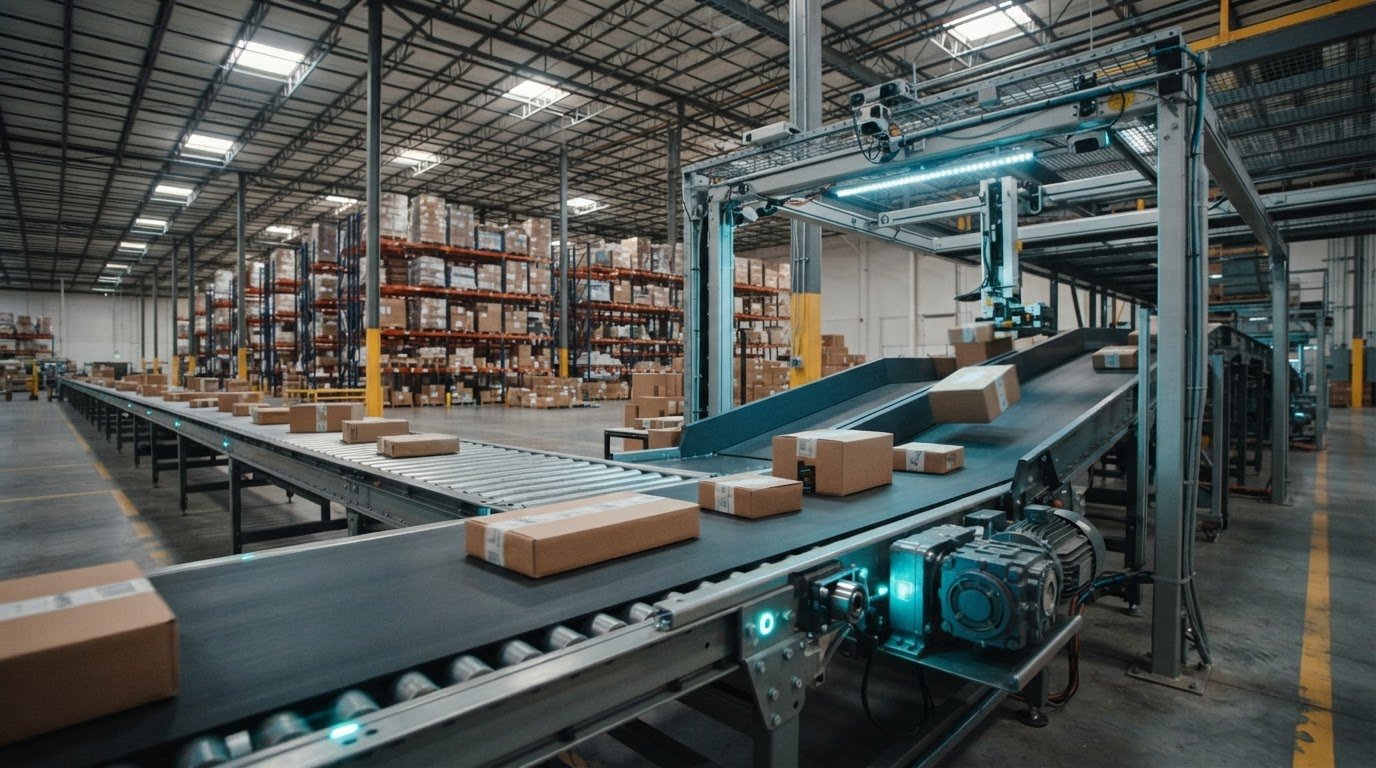
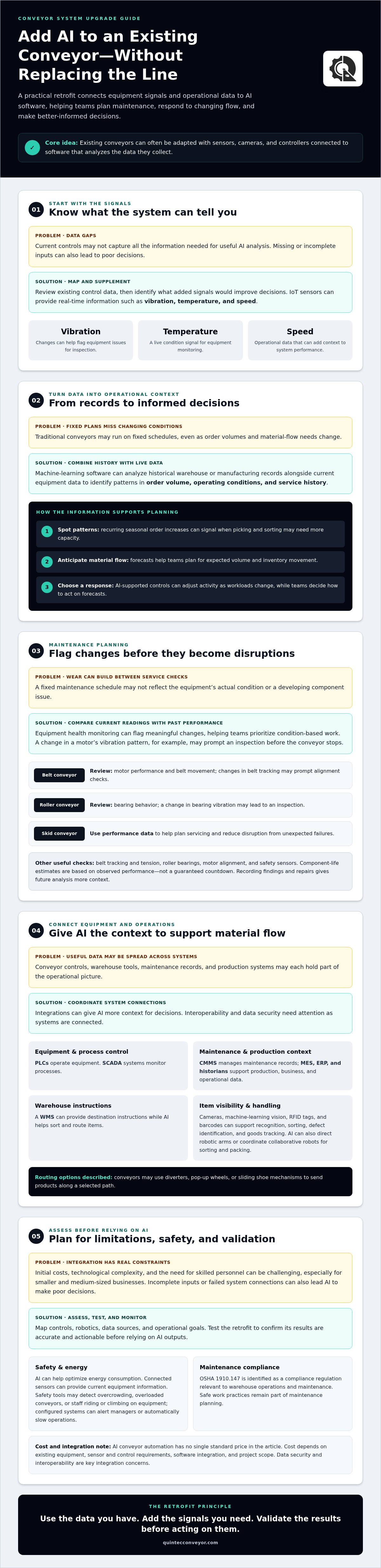
Existing conveyor systems can often be adapted for AI with sensors, cameras, and controllers, plus software that analyzes the data they collect. The key ways AI is used in conveyor systems include forecasting demand, planning maintenance, adjusting operations, and detecting emerging equipment problems. An AI upgrade does not necessarily require replacing an entire conveyor line.
If you’re considering AI, start by asking whether your current controls and operational data can support it. Existing performance data can inform decisions, while added IoT sensors can provide real-time information about conditions such as vibration, temperature, and speed.
This article explains how AI can use those inputs to improve conveyor monitoring, maintenance planning, and material flow. It also outlines what retrofitting involves and how to assess whether an AI-enabled approach fits your operational needs.
Key Takeaways
- Use operational history and live conditions to inform demand forecasts, maintenance timing, and conveyor decisions.
- Assess how robotics and warehouse management systems can coordinate item routing, sorting, and material flow.
- Compare existing control data with added sensors to identify what information your system needs for useful AI analysis.
- Track equipment signals such as temperature, vibration, and speed to spot changes in conveyor performance.
- Recognize how AI can flag belt wear, bearing issues, and mistracking patterns before they disrupt operations.
Predictive analytics for maintenance and demand forecasting
Key ways AI is used in conveyor systems include predictive maintenance and demand forecasting. Machine-learning software analyzes historical warehouse or manufacturing records alongside current equipment data, identifying patterns in order volume, operating conditions, and service history. For example, recurring seasonal order increases can help teams anticipate when picking and sorting processes may need more capacity. Forecasts inform operational plans, but teams still decide how to respond.
Demand predictions help operations prepare for changes in material flow. Traditional conveyors may run on fixed schedules, while AI-supported controls can adjust activity as workloads change. AI can also use order patterns to inform decisions about conveyor capacity and inventory movement. When forecast demand rises, teams can plan for expected volume; when it falls, they can avoid running equipment unnecessarily.
Predictive analytics can support belt, roller, and skid conveyor maintenance, with relevant signals depending on each system’s components. On a belt conveyor, teams might review motor performance and belt movement. On a roller conveyor, bearing behavior can be an important indicator. AI-enabled skid conveyors can also use performance data to help plan servicing and reduce disruption from unexpected failures.
Equipment health monitoring compares sensor readings with historical performance to flag meaningful changes. For example, a motor’s vibration pattern may prompt an inspection before the conveyor stops. Teams can combine this information with checks of belt tracking and tension, roller bearings, motor alignment, and safety sensors. Predictive maintenance helps prioritize condition-based work instead of relying only on fixed service schedules.
Component-life estimates help maintenance teams decide when to inspect or replace parts. They are based on observed performance, not a guaranteed countdown. A change in bearing vibration, for example, may lead to an inspection, while changes in belt tracking may prompt alignment checks. Recording findings and repairs gives future analysis more context, helping teams distinguish recurring patterns from isolated readings and plan work around operational needs.
Maintenance plans also need to account for safe work practices. OSHA 1910.147 is identified as a compliance regulation relevant to warehouse operations and maintenance, according to the Occupational Safety and Health Administration. AI conveyor automation in the United States has no single standard price. Cost depends on the existing equipment, sensor and control requirements, software integration, and project scope; pricing is provided after a quote request.
Can You Add AI to Existing Conveyor Systems?
Yes. Existing conveyor systems can be retrofitted with sensors, cameras, and controllers, then connected to AI software that collects and analyzes operational data. Start by identifying what information the current controls provide and what additional signals would improve decisions. Before relying on AI outputs, test the retrofit to ensure its results are accurate and actionable.
Traditional automation follows programmed rules, such as sending an item to a set destination after a barcode scan. AI can also analyze historical and real-time conditions, then adjust decisions as product flow or demand changes. For example, a warehouse management system (WMS) can provide destination instructions while AI helps sort and route items. Conveyors may use diverters, pop-up wheels, or sliding shoe mechanisms to send products along the selected path.
Integration can connect conveyor controls with warehouse and plant systems. Programmable logic controllers (PLCs) operate equipment, while supervisory control and data acquisition (SCADA) systems monitor processes. A computerized maintenance management system (CMMS) manages maintenance records; manufacturing execution systems (MES), enterprise resource planning (ERP) platforms, and historians support production, business, and operational data. Coordinated connections can give AI context for decisions, but interoperability and data security need attention.
Computer vision and IoT can add item-level visibility. Cameras with machine-learning software can recognize and sort products, while vision systems can identify defects before items move farther through the supply chain. RFID tags and barcodes help track goods through a warehouse. AI can also direct robotic arms to pick or place material, or coordinate collaborative robots for sorting and packing. These tools connect item recognition with conveyor movement and warehouse instructions.
Energy use and safety are also relevant. AI can help optimize energy consumption, while sensors and connected devices provide current equipment information. Safety tools can detect hazards such as overcrowding, overloaded conveyors, or staff riding or climbing on equipment. Systems can alert managers or automatically slow operations when configured to respond to detected risk. For safety, OSHA 1910.147 is identified as a compliance regulation relevant to warehouse operations and maintenance, according to the Occupational Safety and Health Administration. Cybersecurity has no specific standard identified here; data security and interoperability are key concerns when integrating AI.
The main limitations include high initial costs, technological complexity, and the need for skilled personnel, especially for smaller and medium-sized businesses. AI may also make poor decisions when input data is incomplete or system connections fail. A practical integration assessment can map controls, robotics, data sources, and operational goals; conveyor integration and automation can be part of that system-level planning.
Using existing control data versus installing new sensors
Start with the signals already recorded by a conveyor’s programmable logic controller (PLC). Run status, speed commands, fault codes, and cycle counts can show how equipment behaves during normal operation. AI algorithms can compare this history with current readings to detect recurring interruptions or changes in material flow. For example, repeated stoppages at one transfer point may indicate a handling constraint worth investigating.
Existing data is useful when it captures the conditions behind the decision an AI system needs to make. A fault code may show that a conveyor stopped, but not whether excess load, belt movement, or a sensor issue contributed. New sensors can fill those gaps. Vibration, temperature, pressure, or motor-strain sensors add information about equipment condition, while cameras capture product movement and appearance.
The right integration uses the smallest set of additional signals that supports a practical decision. If existing controls already report motor speed and operating state, a new sensor may add little for those measures. If the task is to detect a developing mechanical change, a vibration sensor can provide a signal missing from basic control data. A camera may be more useful for checking product orientation or visible defects. AI results depend on data quality, consistent timestamps, and clear links between sensor readings and conveyor events.
Computer vision supports quality control by classifying products and identifying defects before goods move farther through logistics operations. A camera captures images, and machine-learning software compares product features with its trained classifications. For instance, a vision system can flag a damaged package or sort items by type. Linking the result to conveyor controls allows the system to divert a product or alert an operator, depending on its configuration.
AI-driven controls can use sensor inputs to adjust conveyor operation as conditions change. For example, a belt-tension control loop can compare measured tension with its target and adjust a connected control mechanism. This requires compatible sensing and control hardware; software alone cannot change belt tension. Sensor placement, calibration, belt condition, and load variation all affect whether readings support reliable control.
Voice interfaces offer another potential input. Natural language processing can translate an operator’s spoken instruction into a system command or retrieve operational information. A worker might request a conveyor status update without navigating a separate display. Access permissions and command limits matter: spoken requests should not bypass established equipment controls.
Existing data offers a useful starting point, while added sensors improve visibility where information is missing. Before choosing an integration path, compare the operational question, available PLC records, and required response. This keeps AI focused on measurable material-handling needs rather than collecting data without a defined use.
IoT sensor monitoring of temperature, vibration, and speed
IoT sensors give AI systems current information about conveyor conditions, including temperature, vibration, pressure, and speed. This data helps teams monitor equipment health, operational efficiency, and potential failure risks during manufacturing.
Real-Time Failure-Risk Monitoring
Real-time failure-risk monitoring uses connected sensors and AI to identify equipment patterns that may signal a developing problem. Vibration analysis, for example, can reveal changes in motor or bearing behavior before a visible stoppage. Conveyor-monitoring sensors can capture operational data at sub-second intervals, allowing software to compare changing readings with established operating patterns.
Edge processing analyzes sensor information near the equipment instead of relying only on a remote system. This can help control systems respond promptly to current conditions. If vibration rises while speed remains steady, the system can flag the pattern for investigation. IoT connectivity also lets conveyors, sensors, and robots share operational information, supporting coordinated monitoring across a facility.
Reliability, Safety, and Performance Tracking
Reliability and safety tracking combines equipment signals with operating context to help teams identify abnormal conditions. AI monitoring can use vibration, temperature, pressure, and motor-strain data to assess performance patterns and failure risk. Safety tools can identify hazards such as overcrowding or overloaded conveyors, then alert managers or slow equipment when configured to respond.
Performance monitoring can also show where efficiency is lost. Teams can compare speed, stops, and item flow to identify bottlenecks or unnecessary operation. Conveyor efficiency strategies include sizing belt widths to products, using energy-efficient motors, and scheduling preventive maintenance during low-demand periods. Tracking these measures helps teams assess whether an adjustment improves productivity without creating new flow constraints.
Downtime and Labor Savings
AI monitoring can reduce unplanned manufacturing downtime by 30% to 50%, while condition-based conveyor maintenance can lower maintenance costs by 40%. These reported figures offer useful ROI indicators, but a facility’s financial return depends on its downtime baseline, labor practices, system scope, and implementation costs.
AI-powered predictive maintenance can save more than 500 minutes annually per conveyor line. Fewer unplanned stoppages can reduce time spent diagnosing failures and coordinating urgent repairs. To assess value, compare monitoring and maintenance costs with recorded downtime, labor hours, and production interruptions before and after deployment. That comparison connects sensor data to measurable operational efficiency rather than treating alerts as the outcome.
AI detection of belt wear, bearing failures, and mistracking
AI fault detection combines equipment signals with machine-learning analysis to identify changes in conveyor behavior. It can help teams investigate belt, motor, bearing, roller, and splice issues before they disrupt material flow.
Motor, Idler, Roller, and Splice Failure Detection
AI systems can detect anomalies in motor performance, belt wear, and sensor function by comparing current operating data with established patterns. A change in motor vibration or a belt beginning to mistrack can prompt an inspection before the condition causes a larger interruption. This helps maintenance teams focus on the component showing an unusual change.
Splices deserve particular attention: nearly 90% of belt failures during production occur at splice points. Idlers and rollers also affect belt movement, so irregular operation in those components can contribute to mistracking or uneven wear. Machine-learning models can identify conveyor failure patterns two to four weeks before failures, giving teams time to assess the relevant part and plan maintenance.
Machine-Learning Anomaly and Sound Analysis
Machine-learning anomaly detection identifies readings or sounds that differ from normal conveyor behavior. For example, a sound-based belt-detection method collects audio at 48 kHz in segments approximately 2 seconds long. It processes those segments to identify acoustic patterns associated with potential belt damage.
MFCC feature extraction divides continuous audio into overlapping frames typically lasting 20-30 milliseconds. These features represent sound patterns in a form machine-learning algorithms can analyze. A flagged sound can direct an inspection to a particular belt section, while visual inspection or computer vision can add evidence about visible wear. Together, sound and vision support more targeted fault detection.
The practical value comes from linking an alert to a maintenance decision. A flagged vibration pattern may call for checking a motor or bearing; an unusual belt sound may warrant examining a splice. Teams can compare alerts with inspection findings and operating conditions, then refine how the system recognizes normal and abnormal behavior. This feedback improves detection and reduces reliance on alerts without clear operational meaning.
AI detection supports rather than replaces inspection and maintenance judgment. A sensor may identify a change, but the maintenance team still needs to assess the component and select the appropriate response. Clear records of alerts, findings, and repairs help distinguish recurring problems from isolated events. To connect conveyor fault findings with planned service, plan conveyor maintenance around the equipment’s observed condition.
Quintec Conveyors: Conveyors
Quintec Conveyors helps businesses plan conveyor systems when material flow needs redesign, new equipment, or closer integration with facility operations. Its custom conveyor services include design, engineering, and installation for industrial applications.
For projects involving connected equipment, Quintec Conveyors also offers Robotics & Automation, Infrastructure, and Additional Material Handling Equipment. These services and products can support a broader system plan, connecting conveyor requirements with the surrounding facility and material-handling processes.
If you’re assessing a conveyor project, consider how equipment layout, product movement, and automation needs fit together. Contact Quintec Conveyors to discuss your operational requirements and next steps.
Turn AI Potential Into an Operational Plan
Start by defining the operational decision you want better information to support. This keeps an AI initiative tied to measurable priorities, rather than making technology adoption the goal by itself. Understanding the key ways AI is used in conveyor systems can help your team ask focused questions: which process needs attention, who will act on the findings, and how will performance be reviewed?
Bring operations, maintenance, and engineering perspectives into the planning conversation. A shared view can clarify how a proposed system fits existing workflows, what information teams need, and how changes should be managed over time. A clear project scope also gives everyone a common basis for evaluating system design and integration choices.
Quintec Conveyors can help you explore a conveyor project in the context of your facility’s material-handling needs. Contact Quintec Conveyors to discuss your objectives and identify a practical direction for your operation.
Frequently Asked Questions
How is AI used for predictive maintenance in conveyor systems?
AI helps maintenance teams prioritize inspections by connecting equipment signals with service and fault records. For example, if a conveyor repeatedly stops after a production change, technicians can compare those events with operating data and maintenance history. This context helps distinguish a recurring condition from an isolated alarm. The practical outcome is a targeted inspection plan, with findings recorded to inform future maintenance decisions.
How does AI optimize conveyor speed, routing, and throughput?
AI can coordinate conveyor decisions with order priorities and downstream capacity. If one sorting destination becomes congested, routing logic can direct eligible items toward another available path while upstream flow adjusts to avoid adding to the queue. Accumulation zones can separate dependent processes, allowing one section to keep operating during a brief slowdown elsewhere. These decisions work best when system status and warehouse instructions stay synchronized.
How do computer vision systems detect defects and misplaced items on conveyors?
Computer vision analyzes camera images to classify products, identify visible damage, or flag an item in an unexpected position. Image quality matters: changing lighting, motion blur, and obstructed views can affect recognition. A facility can define which findings require operator review and which trigger an automated exception process. Reviewing flagged images alongside inspection results helps refine detection for the products and conditions on that line.
How does AI improve conveyor safety and detect hazards?
AI can analyze camera or sensor inputs for risks such as unsafe access, congestion, or overloaded equipment, then notify staff or slow a system when configured to do so. It should support, not replace, established machine safeguards and safe work procedures. OSHA 1910.147 is identified as relevant to warehouse operations and maintenance. Quintec states employee safety is its first priority and that it follows all OSHA requirements.
What sensors and data are needed to add AI to a conveyor system?
The right inputs depend on the problem being addressed. A motor-condition project may use vibration and temperature readings; item inspection may require cameras and product identifiers. Useful context can also include timestamps, equipment IDs, control-system events, and maintenance records. Aligning those records lets teams connect a signal to a specific machine and operating event. Choose data that supports a clear decision, rather than collecting signals without a defined use.
How can a facility implement AI in an existing conveyor system?
Begin with one operational problem, such as repeated stoppages at a transfer point, and map the available control data. Identify missing information, then add suitable sensors or cameras and connect the required controls. Test the retrofit under operating conditions to confirm its outputs are accurate and actionable. Operators and maintenance staff can compare alerts with actual events, document exceptions, and refine the system before expanding it to other processes.