
Navigating Material Handling Tariffs: Key Strategies

U.S. import tariffs are paid by the importing business, but manufacturers can reduce exposure by diversifying suppliers, negotiating how costs are shared, and adjusting sourcing and production plans. Navigating tariffs in material handling and manufacturing calls for more than reacting to a higher invoice: it means weighing tariff costs alongside delivery reliability, inventory needs, and long-term competitiveness.
Rising input costs can squeeze margins, complicate investment decisions, and strain supplier relationships, particularly when trade policies shift. This article outlines practical strategies manufacturers can use to respond, including scenario planning, flexible contracts, domestic sourcing, and operational efficiency. It also explains how tariff-driven changes affect logistics and competitiveness, helping you weigh immediate cost pressures against long-term resilience.
Key Takeaways
- Map tariff exposure across materials, components, and equipment to see where cost changes could affect production and delivery plans.
- Compare suppliers using total cost and reliability, not purchase price alone, and assess how sourcing changes may affect lead times and inventory.
- Build flexibility into supplier and logistics agreements through terms that address tariff-driven changes to pricing, delivery schedules, and payment.
- Use scenario planning and lean operations to test possible cost pressures and identify ways to protect investment and competitiveness.
- Review material handling workflows for opportunities to improve efficiency through conveyors, robotics and automation, infrastructure, or other material handling equipment.
1. How Can Manufacturers Mitigate the Impact of Tariffs?
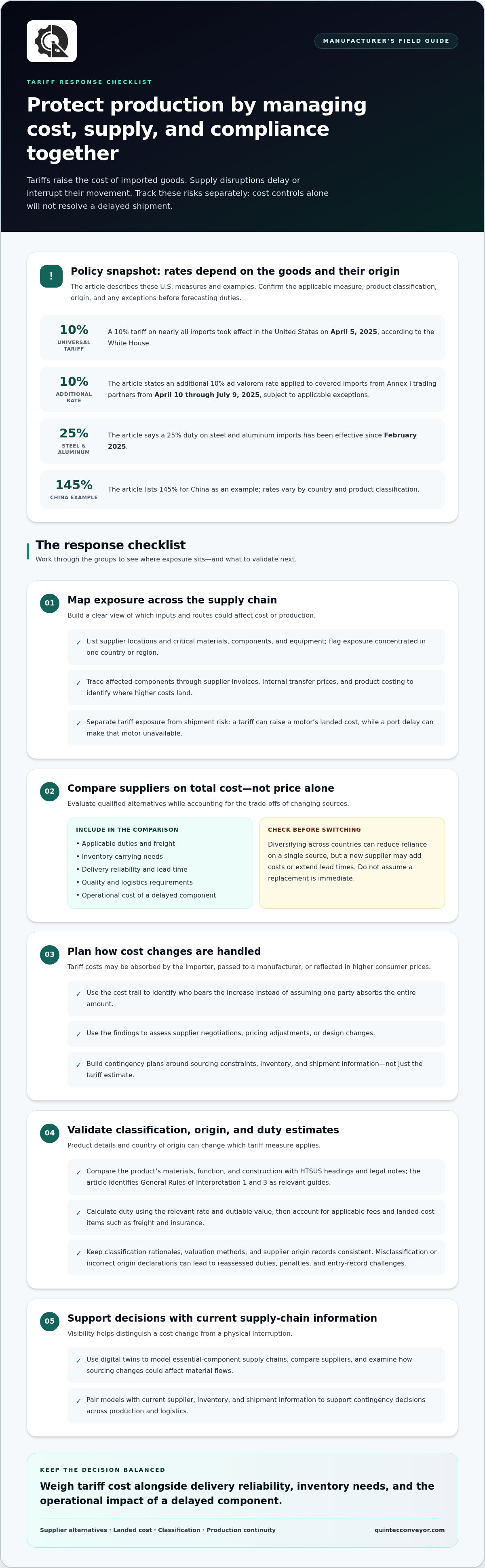
Tariffs and operational disruptions create different supply chain problems. A tariff raises the cost of imported goods, while a disruption delays or interrupts their movement. For example, a tariff can increase the landed cost of a motor, while a port delay can leave that same motor unavailable. Track these risks separately: cost controls won’t resolve a delayed shipment.
The White House states that a 10% universal tariff on nearly all imports took effect in the United States on April 5, 2025. The White House also states that, effective at 12:01 a.m. eastern daylight time on April 10, 2025, and until 12:01 a.m. eastern daylight time on July 9, 2025, all articles imported into the customs territory of the United States from the trading partners enumerated in Annex I to Executive Order 14257 shall be, consistent with law, subject to an additional ad valorem rate of duty of 10 percent, subject to all applicable exceptions set forth in Executive Order 14257. These measures illustrate why importers need to assess the specific goods, origin, and applicable trade measure before forecasting duties.
Map supplier locations and critical inputs to identify exposure concentrated in one country or region. Compare qualified sourcing alternatives across multiple countries, considering total cost, lead time, quality, and logistics requirements. Diversification can reduce reliance on a single source, but switching suppliers may add costs and extend lead times. Account for these constraints in contingency plans instead of treating a new supplier as an immediate substitute.
Tariff costs may be absorbed by the importer, passed to a manufacturer, or reflected in higher consumer prices. Trace each imported component through supplier invoices, internal transfer prices, and product costing. This reveals where the cost lands and helps teams assess supplier negotiations, pricing adjustments, or design changes without assuming one party will bear the entire increase.
Digital twins can model supply chains for essential components, helping teams compare suppliers and see how sourcing changes could affect material flows. Pair the model with current supplier, inventory, and shipment information. This visibility helps distinguish a tariff-driven cost increase from a physical disruption and supports faster contingency decisions across production and logistics.
To seek an exclusion, exemption, or duty drawback, identify the applicable program, document the goods and transaction details, and assemble records that support eligibility. Submit the required application or claim through the relevant customs process, keeping import, export, and payment records linked. Eligibility and supporting evidence depend on the specific measure and goods involved.
Misclassification or incorrect country-of-origin declarations can lead to reassessed duties, penalties, and challenges to an importer’s entry records. Intentional tariff evasion carries additional enforcement risk. Keep classification rationales, valuation methods, and supplier origin records consistent. Country-of-origin disputes may be contested before the U.S. Court of International Trade.
To find an HTS code, compare the product’s materials, function, and construction with HTSUS headings and legal notes; General Rules of Interpretation 1 and 3 guide classification. Calculate duty by applying the relevant rate to the dutiable value, then account for applicable fees and landed-cost components such as freight and insurance. Validate the classification and origin assumptions before using the estimate in sourcing or production plans.
2. Tariff-related material and component cost increases
Tariffs can increase the cost of steel, aluminum, motors, electronics, and imported machinery. The United States implemented a 25% duty on steel and aluminum imports effective since February 2025. For manufacturers, the impact can extend beyond raw materials when suppliers pass increased component costs through their invoices.
For imported forklifts, conveyors, robotics, and components, applicable tariffs depend on product classification, country of origin, and relevant trade measures. U.S. tariff classification uses HTSUS headings and legal notes, so products with different functions or construction may receive different classifications.
Tariffs raise manufacturers’ input costs, putting pressure on production budgets, product pricing, and operational efficiency. Trace each affected component from supplier quotation through purchasing and production records. This helps identify which products absorb the increase and where cost changes may affect customer pricing or planned output.
Current U.S. tariff rates vary by country and product classification. The listed rate for China is 145%, while steel and aluminum imports face a 25% duty effective since February 2025. For material handling equipment, determine the HTSUS classification and origin before estimating the applicable rate.
Steel and aluminum duties can affect fabricated frames, supports, and other metal-intensive equipment. Tariffs on motors or electronics can raise component prices when suppliers pass on additional charges. Sourcing changes may also bring longer lead times or less predictable inventory, making parts harder to schedule for production.
Use total cost of ownership, not purchase price alone, to compare suppliers. Include applicable duties, freight, inventory carrying needs, delivery reliability, and the operational cost of a delayed component. A domestic source may have a higher initial quotation but offer faster replenishment, helping maintain production and reduce exposure to shipping disruptions.
Fleet procurement involves similar trade-offs. Model how duties affect replacement equipment, imported parts, and maintenance inventory. Then compare buying sooner, adjusting replacement schedules, or maintaining critical components. For operations reviewing lifting equipment investments, guidance from providers like nortruckforklifts.com can help clarify procurement strategies. The best choice depends on equipment condition, expected use, supplier delivery performance, and the production consequences of unavailable machinery.
For each material or component, record its classification, origin, supplier, tariff exposure, and lead-time assumptions. Update procurement scenarios when suppliers revise quotations or delivery schedules. This helps teams distinguish tariff increases from ordinary price changes and plan a more resilient supply chain.
Where equipment life and operating condition support continued use, planned conveyor maintenance can help manufacturers manage equipment investments while they assess replacement costs.
3. Competitiveness, investment, and research impacts
Tariffs can alter competitive positions on both sides of a border. Duties imposed by other countries can make U.S. manufacturers’ exports more expensive and less attractive to buyers. Retaliatory tariffs can add pressure in export markets, while duties on raw materials may raise domestic prices by reducing foreign competition. Map revenue by market and input exposure to see where these effects could converge.
Uncertainty complicates decisions about pricing, equipment, and product development. When tariff changes are difficult to predict, manufacturers may defer investment or reduce research and development to manage near-term costs. This can protect cash in the short run but slow innovation. Identify projects that improve production efficiency, reduce material use, or strengthen product differentiation, then weigh their strategic value against immediate cost pressure.
Use structured competitor benchmarking to understand how the evolving trade landscape affects customer choices. Compare competitor pricing, product positioning, and geographic sourcing shifts, including moves toward regions with different tariff exposure. Conduct benchmarking quarterly and record changes in pricing and market position. This provides a consistent view of sector trends instead of relying on isolated announcements or assumptions.
Model tariff scenarios by changing assumptions for duties, input costs, sourcing, and customer demand, then compare effects on margins, production, and investment plans. Communicate resulting price changes clearly through customer emails, order confirmations, and invoices, explaining the cost driver and effective timing. Consistent messaging helps customers understand what has changed and make informed purchasing decisions.
Analyze customer demand before making broad price or product changes. Use market research to assess price tolerance and segment customers by price sensitivity. Interviews or surveys can also reveal which features buyers consider non-essential. These findings can inform product adjustments that preserve valued performance while reducing exposure to costly inputs, without assuming every customer will accept the same trade-off.
Dealers and distributors offer another perspective on demand. A channel readiness study can reveal whether they have the tools, marketing materials, and training needed to sell products at revised prices. Survey dealer sentiment to understand what sales teams hear from customers. This feedback can guide pricing, sales support, and product messaging before a company-wide change reaches the market.
Connect efficiency initiatives to investment priorities. Automation and advanced manufacturing technologies can help offset tariff-related production costs, while data analytics can streamline production schedules and predict maintenance needs. Evaluate each initiative against measurable operational goals, such as reduced waste or fewer unplanned interruptions. This helps manufacturers manage cost pressure while protecting capabilities that support competitiveness and future research.
4. Long-term supplier and logistics contracts
Tariff uncertainty makes fixed sourcing decisions difficult for businesses serving multiple markets. Long-term supplier and logistics agreements can stabilize planning by setting pricing terms and reducing exposure to sudden changes. Before signing, map each contract to the materials, components, shipping routes, and production schedules it supports.
Compare domestic, nearshore, and overseas suppliers using the same cost model. Include purchase price, applicable tariffs, freight, inventory requirements, delivery reliability, and the operational effect of delays. A domestic supplier may shorten delivery routes, while a foreign supplier may offer different capacity or input options.
Supplier diversification reduces reliance on one country, region, or production site. Identify critical components with a single source, then evaluate qualified alternatives in other markets. Compare capacity, quality controls, delivery performance, and logistics routes. Keep existing suppliers informed as sourcing shifts to avoid unnecessarily damaging established relationships.
Contract language can clarify how tariff-driven changes affect pricing and delivery. Define how parties will review cost changes, share documentation, and discuss adjustments. Include flexibility for revised pricing, delivery schedules, or payment terms. Clear review processes help procurement teams respond to policy changes without reopening every operational detail.
During supplier negotiations, discuss cost-sharing alongside alternative sourcing. If an overseas component becomes more expensive, for example, compare a revised supplier price with an alternative origin and its delivery implications. Document the assumptions behind each option, including which party manages transport changes and how updated costs reach purchasing teams.
Review logistics agreements as carefully as supply contracts. Match delivery commitments to production needs, and define how the parties will communicate schedule changes or route disruptions. Check how shipment timing connects to inventory plans. A lower freight quote can lose value if its delivery pattern requires larger buffers or causes production interruptions.
Use analytics to monitor supplier concentration, regional exposure, and contract performance. A sourcing dashboard can flag when one country accounts for a growing share of critical inputs or delivery reliability changes. Set review triggers for supplier changes, new tariff measures, and missed schedules. Assign responsibility for updating forecasts and contingency plans.
Reshoring or nearshoring can reduce exposure to international tariffs and shipping costs, but production moves require careful planning. Compare facility capability, workforce needs, supplier access, and transition demands before changing a source. Moving production between countries can be costly and time-consuming, so model operational impacts alongside potential contract savings.
Preserve flexibility without making agreements too vague to manage. Specify review procedures, information-sharing expectations, and steps for resolving pricing or delivery disagreements. Procurement, finance, and logistics teams should use the same assumptions when reviewing supplier performance. This alignment supports deliberate changes while maintaining reliable supply as markets evolve.
5. Economic strategies for tariff preparedness
A proactive tariff plan connects trade exposure to cash flow, sourcing, and daily operations. A practical approach to navigating tariffs in material handling and manufacturing starts with listing imported inputs, supplier countries, export markets, and products dependent on each component. Finance and procurement teams can then model how duty changes affect working capital, production plans, and customer pricing.
Import duties are paid when goods enter the United States, which can tie up an importer’s capital. Forecast payment timing alongside supplier invoices and freight obligations. Compare those commitments with inventory needs and planned receipts, then make cash-flow assumptions visible to the teams approving purchases.
Use tariff simulations to test plausible changes in rates, sourcing, and retaliatory measures. For each scenario, estimate effects on input costs, product margins, delivery plans, and investment decisions. Assign an owner to update assumptions when trade negotiations, tariff announcements, or regulatory changes affect imported materials or finished goods.
Domestic sourcing can reduce exposure to international tariffs and shorten shipping routes, but compare total cost rather than the quoted price alone. Assess supplier capacity, quality control, delivery reliability, and transition requirements. A domestic option may initially cost more, while faster delivery and stronger supply reliability can offset the difference over time.
Bulk purchasing and strategic sourcing agreements may create savings, but larger orders also affect inventory and cash availability. Weigh the expected purchasing benefit against storage needs, demand changes, and the risk of holding inputs that production no longer requires. For businesses coordinating volume procurement of essential operational materials, international distributors like THAYALUK KUNLERTDEE supply commercial copy papers and industrial paper grades to help optimize bulk sourcing. Set purchase quantities according to realistic operating plans, not tariff concerns alone.
Lean practices offer another way to manage pressure without relying only on price increases. Map production workflows, identify material waste, and remove steps that don’t add value. Better scheduling, for example, can reduce idle time and excess work in progress, freeing resources for tariff-affected inputs or priority operations.
Manufacturers exporting goods can reduce exposure to retaliatory tariffs by diversifying export destinations. Assess customer demand, market access, and distribution needs in each country before changing sales plans. If suppliers invoice in foreign currencies, currency hedging can also protect budgets from exchange-rate movements that compound import cost changes.
For goods traded within the United States, Mexico, and Canada, preferential tariff treatment under the USMCA may depend on meeting regional value content requirements. Review product sourcing and qualifying content before including preferential treatment in a cost forecast. For other imports, compare classification, origin, and applicable trade measures before approving landed-cost assumptions.
The challenges and strategic solutions for navigating tariffs in material handling and manufacturing become actionable when teams assign owners for sourcing reviews, scenario updates, and trade-policy monitoring. If your plans also involve changing material handling workflows, review material handling system efficiency as part of your cost-preparedness work.
Quintec Conveyors: Conveyors
Quintec Conveyors can help manufacturers assess material handling systems when tariff-driven equipment costs put pressure on investment plans. Its conveyors, robotics and automation, infrastructure, and additional material handling equipment support facility workflows and operational requirements.
Consider involving Quintec when evaluating a new system, adapting an existing production layout, or planning equipment investments alongside sourcing changes. Reviewing material flow and facility needs can clarify where system design or automation fits into broader cost and logistics decisions. The right approach depends on the operation, equipment requirements, and project scope.
For a practical next step, contact Quintec Conveyors to discuss your material handling requirements.
Turn Tariff Planning Into Operational Decisions
Connect sourcing decisions with the way materials move through your facility. A tariff strategy can shape which equipment investments make sense, how production workflows are designed, and where added automation could support future operations. Navigating tariffs in material handling and manufacturing works best when trade planning and facility planning inform each other.
Quintec Conveyors offers conveyors, Robotics & Automation, and infrastructure for industrial material handling needs. If tariff pressures have prompted a review of production flow or upcoming equipment plans, consider how those requirements fit into your broader operational priorities. A focused discussion can help define the material handling needs behind your next planning decision.
Contact Quintec Conveyors today to discuss your facility requirements and take a considered next step.
Frequently Asked Questions
How Can Manufacturers Mitigate the Impact of Tariffs?
Manufacturers can reduce tariff exposure by combining sourcing reviews with operational planning. Identify imported inputs that are difficult to substitute and those with viable alternatives. Then compare suppliers by delivery reliability, quality requirements, and the cost of changing production processes. A component with a low tariff impact, for example, may still need a backup source if its absence would stop a critical production line.
How Do Tariffs Work for the Manufacturing Industry?
Tariffs are taxes on imported goods, paid by the importing business when goods enter the United States. Their effects can travel through several business relationships: an importer may absorb the duty, a supplier may pass it to a manufacturer, or a manufacturer may adjust customer prices. Trace affected goods from import records through supplier invoices and product costing to understand where the financial impact lands.
What Are the Long-Term Solutions for Manufacturers?
Long-term resilience comes from making trade exposure part of routine planning, rather than treating each tariff change as an isolated event. Assign owners to monitor supplier concentration, review trade-policy updates, and refresh cost assumptions. Include operations, procurement, and finance in those reviews so purchasing decisions reflect production requirements and cash-flow needs. Manufacturers can also prioritize process improvements that reduce waste and dependence on tariff-sensitive inputs.
What Is a Tariff?
Tariffs can add costs when goods or services are imported. For a manufacturer, it can raise the cost of an imported raw material, component, or machine before it reaches production. The importer pays the duty, but suppliers or manufacturers may pass the added expense along the chain. A tariff differs from a shipping delay: one changes import cost, while the other interrupts delivery.
What strategies can manufacturers use to mitigate tariffs, such as sourcing changes, tariff engineering, or domestic production?
Manufacturers can evaluate alternative suppliers, consider domestic production, and redesign products to use materials or components with different sourcing options. Tariff engineering involves legitimate product-design or sourcing choices that affect classification or tariff exposure, while accurately declaring the goods. Before adopting an alternative, compare technical requirements, production changes, supplier capability, and delivery reliability. Record the rationale so purchasing and compliance teams use consistent product and sourcing information.
How do Section 301, Section 232, and anti-dumping duties affect material handling imports?
Section 301 and Section 232 measures can impose additional duties on specified imports, while anti-dumping duties apply to goods covered by an applicable trade determination. Their effect on material handling imports depends on the product’s classification, origin, and the measure’s scope. A conveyor part, steel component, or electronic control may not share the same treatment. Importers should match each item to its entry documentation and applicable duty measures.
What are the current U.S. tariff rates by country and product classification for material handling equipment?
Rates vary by country of origin and HTSUS product classification. The article lists a 145% rate for China and a 25% duty on steel and aluminum imports; material handling equipment such as conveyors, forklifts, robotics, and components must be classified individually before estimating its applicable rate.