Suspended conveyor systems: how tracks move goods overhead
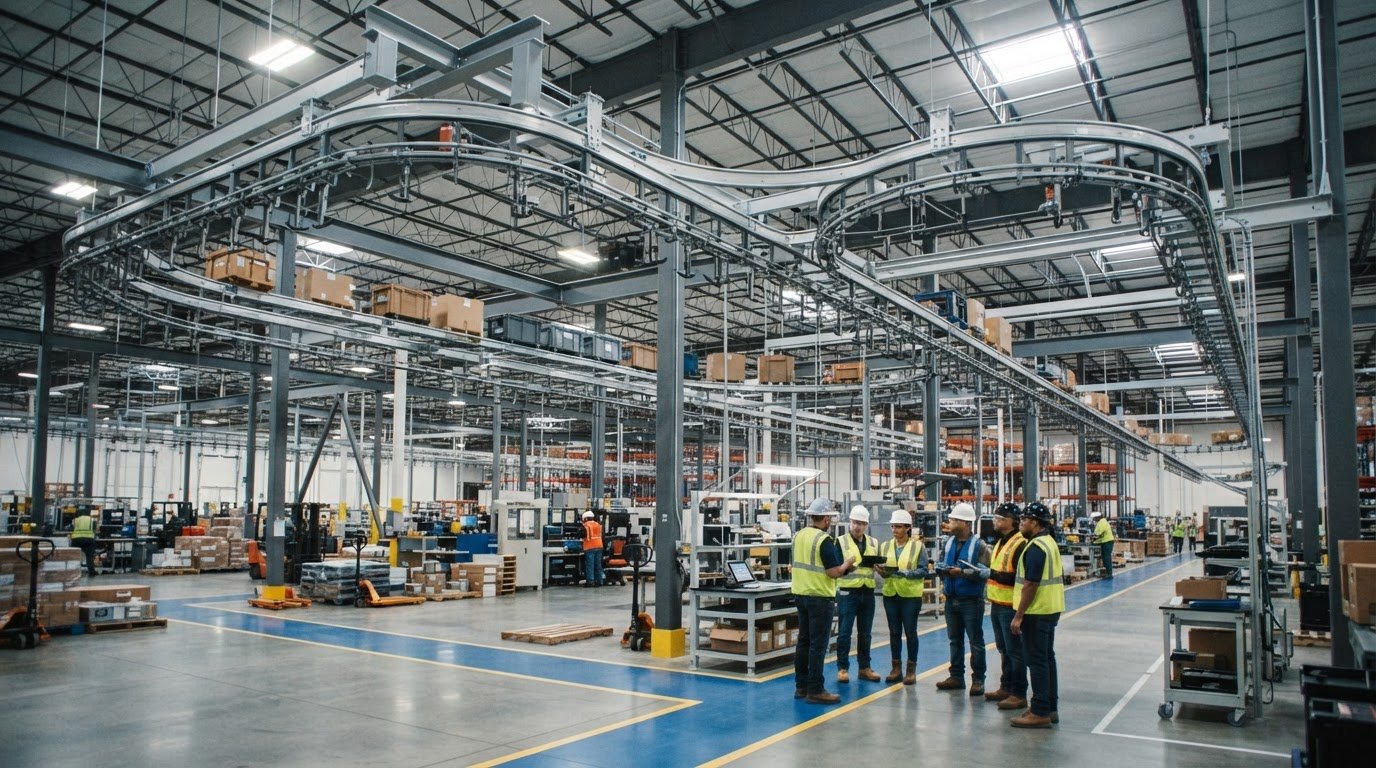
The floor isn’t the only route for moving goods through a facility. Suspended conveyor systems carry products overhead on carriers, hooks, or trolleys that travel along a track. In powered systems, a drive unit pulls a continuous chain through the track, while the layout guides loads around curves, between work areas, or between levels.
An overhead route can free floor space and help separate product movement from foot traffic and forklift paths. A useful suspended conveyor system, however, depends on more than placing a track above the production line: the load, carrier, track type, and facility layout all affect how goods move and where they can pause or change direction.
This guide explains how overhead conveyors work, where they’re used, and how synchronous and power-and-free designs differ. It also covers how load dimensions and weight, carrier spacing, environmental conditions, and structural support shape system design, helping you identify what matters when planning material flow.
Key Takeaways
- Overhead tracks move goods on carriers, hooks, or trolleys, using powered drives or gravity depending on the system.
- Automotive, apparel, and e-commerce operations can use overhead routes to move products while keeping floor areas available for other work.
- Track type determines how loads travel, pause, accumulate, or divert, so match the system to the process flow.
- Assess load weight, dimensions, support method, carrier spacing, and facility conditions when shaping a conveyor layout.
- Plan system movement alongside structural supports, work areas, and other material handling equipment to support a coordinated operation.
Overhead Conveyors 101: What is an Overhead Conveyor?
Overhead conveyors move goods above work areas on a track, using carriers, hooks, or trolleys. By routing products above the floor, they can preserve space for production, equipment, and people while connecting material-handling stages.
Overhead Conveyor Basics
A powered overhead conveyor uses a drive unit to pull a continuous chain through track sections and horizontal or vertical curves. The chain carries loads along a planned route, while carriers or hooks connect each product to the moving system. This arrangement suits manufacturing workflows that need a defined route above active work areas, rather than more equipment at floor level.
Industries and Applications
Automotive manufacturers can use overhead routes to move parts between production steps, while apparel distributors can transport hanging garments. E-commerce operations may use them to move goods through facility processes, and overhead takeaway can carry trash and corrugate away from work areas. The application shapes the route: products may need to change levels, pause for inspection, or move continuously through production.
Overhead and Floor-Mounted Systems
Overhead systems carry goods above the work area; floor-mounted conveyors move products at ground level. An overhead route can free floor space and separate product flow from foot traffic and forklift paths. Floor-level equipment may be a better fit when goods need direct access to a belt or roller surface. Hybrid layouts combine overhead routes with floor-level belt or MDR conveyors when a facility needs both transport methods.
Planning an overhead route involves matching the process to track routes, carriers, drive equipment, and system integration. The design needs to account for what moves, where it goes, and how it interacts with production equipment. Existing building structures and connections to other conveyor sections are key considerations, particularly when the system must fit into an active workflow.
Hybrid designs can transfer goods between overhead tracks and floor-level conveyors at process handoffs. An overhead route, for example, may carry an item above a production area before a floor-level conveyor moves it onward. This can accommodate different handling needs in one facility, provided the transition points and movement sequence suit the goods and workflow.
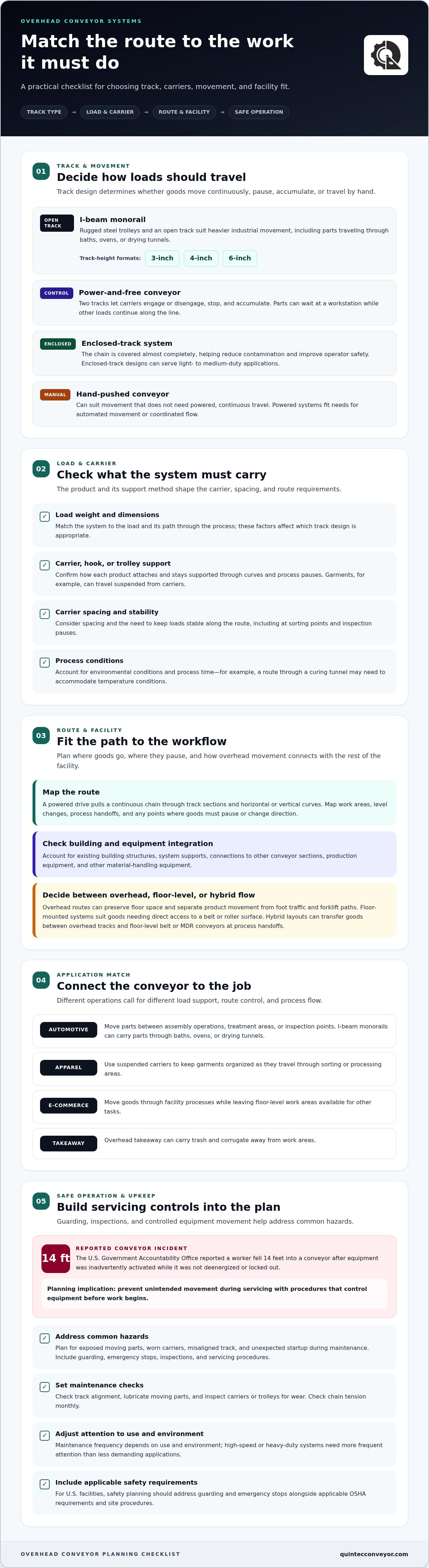
For U.S. facilities, safety planning should address guarding and emergency stops, alongside applicable OSHA requirements and site procedures. The U.S. Government Accountability Office reported that a worker fell 14 feet into a conveyor system after equipment was inadvertently activated while it was not deenergized or locked out. That incident underscores the need to prevent unintended movement during servicing.
Maintenance typically includes checking track alignment, lubricating moving parts, and inspecting carriers or trolleys for wear. Check chain tension monthly as a maintenance practice. The appropriate maintenance frequency also depends on use and environment, with high-speed or heavy-duty systems needing more frequent attention than less demanding applications.
Common hazards include exposed moving parts, worn carriers, misaligned track, and unexpected startup during maintenance. Address these risks with guarding, emergency-stop planning, inspections, and procedures that control equipment before servicing. Employee safety should come first: Quintec follows all OSHA requirements and regulations at all times.
Automotive, apparel, and e-commerce applications
Industrial overhead conveyor types include I-beam monorails, enclosed-track systems, power-and-free designs, and hand-pushed conveyors. Each supports a different mix of load, process control, and automation, so choose based on the application.
In automotive manufacturing, an overhead route can move parts between assembly operations, treatment areas, or inspection points. I-beam monorails use rugged steel trolleys and open tracks, making them suitable for moving parts through baths, ovens, or drying tunnels. Their track heights include 3-inch, 4-inch, and 6-inch formats. The appropriate system depends on the load and the path through the industrial process.
Apparel distribution has distinct handling needs. Garments can travel suspended from carriers, keeping them organized as they move through sorting or processing areas. In e-commerce operations, overhead lines can support product movement while leaving floor-level work areas available for other tasks. These uses show why carrier design matters: loads must stay supported and stable through the route, including curves and process pauses.
For heavier industrial applications, I-beam monorails provide an open-track arrangement with robust trolleys. Power-and-free conveyors offer greater control over movement: two tracks allow carriers to engage, disengage, stop, or accumulate. This can let parts wait at a workstation while other loads continue along the line. Enclosed-track systems cover the chain almost completely, helping reduce contamination and improve operator safety.
Light- to medium-duty applications may use enclosed-track or hand-pushed systems, depending on load and process requirements. Hand-pushed conveyors can suit movement that does not need powered, continuous travel. Powered systems are useful when automated movement or coordinated flow is needed. Consider load weight and dimensions, route complexity, and the required movement sequence when choosing a design.
A facility moving parts through a curing tunnel, for example, may prioritize a route that accommodates process time and temperature conditions. A distribution operation handling garments may focus instead on carrier spacing and sorting points. Although both use suspended tracks, these are distinct industrial applications. Matching the design to the task aligns material handling with the actual workflow.
Compare the required load support, routing, stopping, and accumulation before selecting a system. That distinction helps clarify whether an open monorail, enclosed track, or power-and-free arrangement fits the application. For facilities evaluating industrial conveyor systems, these process requirements provide a practical starting point for shaping the design.
Conveyor tracks, carriers, hooks, and trolleys
A conveyor’s track guides each carrier, hook, or trolley through the facility. The component selection and route determine how loads travel, transfer, and stay supported.
Cross-Track Capacity and Stability
Cross-track capacity describes the load a system can carry along its route while maintaining stable movement. Load weight, dimensions, and hanging method affect carrier selection and stability. A long or unevenly balanced item, for instance, needs support that limits swinging and keeps it clear of nearby equipment.
Carrier spacing also affects performance. Close spacing may suit a steady sequence of small items, while bulky loads need clearance through curves and transfer points. Check how each load hangs in different orientations, not just how it sits on a stationary carrier. This helps prevent contact with adjacent products, track components, and workstations.
Track Layout and Structural Support
Track layout defines the route, elevation changes, curves, and operating zones that loads follow. A design may be supported from the ceiling, mounted to structural steel, or integrated with mezzanines and platforms. The support structure must suit both the facility and the conveyor’s load path. Three-dimensional modeling can help assess ceiling height, support locations, and integration points before installation.
Map the route around production equipment, access areas, and transfer locations. Position supports to suit the planned track rather than forcing the route around unsuitable attachment points. A facility with a mezzanine, for example, may use an elevated track to connect levels while preserving floor space below.
Enclosed-track systems cover the chain almost completely, helping reduce contamination and improve operator safety. Manual push-track systems move carriers by hand rather than with a powered drive, which may suit workflows requiring controlled, intermittent transport. In either case, carriers and hooks must match the load’s shape and attachment points. I-beam tracks use trolleys suited to open-track applications, while power-and-free systems let carriers stop or accumulate independently.
Portable and tracked stacker conveyors play a different role from overhead tracks: they move material at floor level, often toward a storage or transfer point. A facility can integrate a stacker with an overhead route when goods need to transfer between transport methods. Plan each handoff around load stability, travel direction, and the space needed to move the equipment.
Installation and commissioning generally involve mapping the route, confirming load and support requirements, installing and aligning the track, and then testing carrier movement and system operation. Before normal material handling begins, testing should verify the planned route, transfers, clearances, and stopping or accumulation behavior.
Automation and operating efficiency
An overhead conveyor system can automate continuous product movement between work areas. Its drive and controls coordinate material flow, reducing reliance on manual transport and helping limit delays between production steps. A line, for example, can carry a part from assembly toward inspection while operators prepare the next task. The benefit depends on matching conveyor movement to the process, not simply increasing speed.
Automation works best when movement matches each station’s capacity. A synchronous chain moves loads at a harmonized pace, while power-and-free equipment can stop or accumulate carriers for separate operations. When a station needs time to process an item, controlled accumulation can keep following loads from crowding it. Sequencing also helps deliver products to the appropriate work area in a planned order.
Integration is especially important at transfer points. An overhead route may feed a floor-level belt or roller conveyor when goods need a different support surface or direction of travel. Controls must coordinate the handoff so products move through connected equipment without unnecessary waiting. When robotics and conveyor transport work together, the sequence should also keep the robot’s working area clear during pickup and placement.
Efficiency depends on operational reliability as well as motion. In one beverage producer’s example, a preventive maintenance strategy increased mean time between conveyor failures from 6 months to 18 months. Unplanned conveyor downtime dropped by 85% in that example. These results illustrate how maintenance can affect availability; the system’s operating conditions and use influence the attention it needs.
Set maintenance plans according to the application. Check conveyor chain or belt tension monthly as a maintenance practice. Vibration analysis can help detect bearing wear early on high-speed or critical conveyors. High-speed and heavy-duty equipment needs more frequent attention, and operating environment and use also affect maintenance intervals. Daily cleaning may be important where material can accumulate on equipment.
An enclosed conveyor route can help limit exposure of moving components, while guarding and emergency-stop planning remain part of system safety. Operators also need clear procedures for stopping and controlling equipment during servicing. The U.S. Government Accountability Office reported a worker fell 14 feet into a conveyor system after equipment was inadvertently activated while it was not deenergized or locked out. Safe servicing practices are therefore integral to reliable operations.
Assess efficiency across the full flow: where products enter, pause, and leave. Track accumulation, transfer delays, and downtime to identify bottlenecks. This can help determine whether controls, conveyor maintenance, or a revised handoff is the best way to improve material movement without creating congestion elsewhere.
Load and layout considerations for system design
System design starts with the product, not the route. Identify each load’s type, weight, dimensions, and how it will hang or be supported. Accurate load details are essential: the carrier, track, and support structure must suit the actual product and its movement.
Next, match the load to the carrier and spacing. A long component may swing or extend beyond its carrier, while a compact item may need a different attachment point. Plan clearance around curves, transfer points, and neighboring loads. Spacing should let the largest item travel without striking equipment or another product, especially on routes with turns or accumulation zones.
Environmental conditions also shape design. Heat, moisture, dust, washdowns, and process materials affect track, carrier, and component selection. A route through a drying area, for example, faces different conditions from one serving a clean distribution zone. Account for the full operating environment, including places where loads pause for curing, drying, or inspection, rather than designing only for continuous travel.
Map how goods move through the facility before fixing track positions. Note pickup and delivery points, vertical transitions, workstations, foot traffic, and forklift paths. A route may be supported from the ceiling, mounted to structural steel, or integrated into mezzanines and platforms. Each approach affects where the track can run and how it connects with production equipment.
Three-dimensional modeling and simulation can evaluate ceiling height, structural support, and integration points with other systems. Use the model to compare alternative layouts, identify clearance conflicts, and examine how carriers pass through curves and process zones. This can reveal design changes before installation, supporting flexibility while reducing the risk of interference, rework, or operational downtime.
Plan the route loads need, not simply the shortest one. A direct line may conflict with a workstation, while a curved route may preserve access or connect levels. Hybrid layouts can combine overhead tracks with floor-level belt or MDR conveyors where products need different handling. The key is deciding where each transfer occurs and how the load stays supported through it.
Bring load data, process steps, and facility constraints together before selecting components. Discuss your conveyor layout and system design to align the track route, supports, and material flow with your operation.
Choose power-and-free, monorail, or hand-pushed conveyors based on product weight, process requirements, and the desired level of automation. This aligns the handling method with operational needs.
Quintec Conveyors: Conveyors
Quintec Conveyors helps facilities plan conveyor systems around their loads, routes, and operating requirements. Its conveyor design, engineering, and installation work can support projects where suspended tracks need to fit existing production areas or connect with other material handling equipment.
Turn to Quintec when evaluating track layouts, coordinating conveyor movement with robotics and automation, or integrating infrastructure into a broader material-flow plan. Quintec provides conveyor integration, process engineering, and installation for industrial operations. Start with clear requirements: what needs to move, where it needs to go, and how the route fits the facility.
Contact Quintec Conveyors to discuss your operation, or visit quintecconveyor.com.
Shape the Next Stage of Material Flow
Turn your operating priorities into a clear project brief. Identify the products that need to move, their destinations, and the constraints of the facility. This foundation helps determine how suspended conveyor systems fit into the wider operation, including where automation or infrastructure needs to connect with material flow.
Quintec Conveyors brings together conveyors, Robotics & Automation, and infrastructure for industrial material-handling projects. Whether you’re planning a new route or adapting an existing operation, a focused discussion can help align system design with your facility and process requirements.
Contact Quintec Conveyors to discuss your material handling goals. A well-defined next step can turn a complex layout into a practical plan for your operation.
Frequently Asked Questions
What are suspended conveyor systems and how do they work?
Suspended conveyor systems transport goods on a track positioned above the operating floor. A powered design uses a drive unit to pull a chain, while gravity can move loads along suitable routes. For example, a facility can carry a component above a work cell and deliver it to a designated process area. The movement method depends on how loads must travel, pause, and reach their destinations.
What are the typical capacity, speed, and load limits of overhead conveyors?
Speed depends on the drive and control arrangement, the required production sequence, and whether loads need to stop or accumulate. A steady flow between process stages requires different movement behavior from a line with frequent inspection pauses. Load dimensions and support method also affect practical capacity.
What factors should be considered when designing and sizing an overhead conveyor?
Start with the products: document their weight, dimensions, shape, and support points. Then map pickup and delivery locations, required pauses, turns, and level changes. A long load passing a workstation, for example, needs enough clearance to avoid nearby equipment. Include ceiling height, structural support, environmental conditions, carrier spacing, and integration points. Modeling the proposed route can reveal fit and coordination issues before installation.
Which industries and applications benefit most from suspended conveyor systems?
Automotive manufacturing, apparel distribution, and e-commerce operations use overhead conveyors for different material flows. An automotive line may move parts between process stages; apparel operations can transport garments while they remain hanging. E-commerce facilities can move goods or takeaway material, such as corrugate, overhead. The best fit is a workflow where a defined overhead route supports product movement and leaves floor-level areas available for other tasks.
What OSHA and other safety standards apply to overhead conveyor systems in the United States?
U.S. safety planning should address applicable OSHA requirements and site procedures, including guarding and emergency stops. Procedures should also prevent unintended movement during servicing.