Material handling process optimization for better supply chain flow
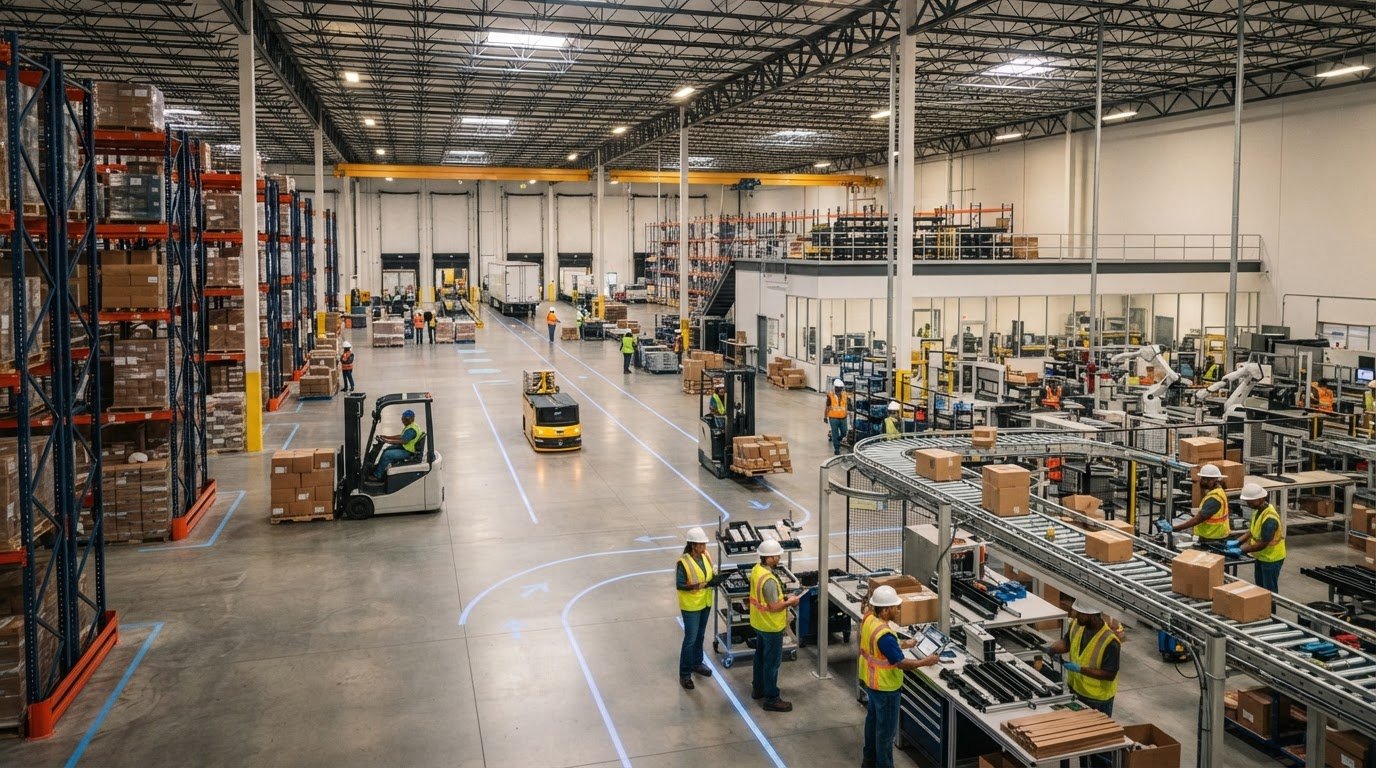
The shortest route through a facility isn’t always the most efficient. Material handling process optimization improves supply chain flow by reducing unnecessary work, travel, and repeat handling while coordinating the movement, storage, protection, and control of goods. The goal is a connected process that moves materials where they’re needed without adding avoidable steps.
When receiving, storage, picking, and production run as separate workflows, bottlenecks and delays can build between them. Improving flow means considering how each activity affects the next, not just speeding up one machine or moving equipment in isolation.
This article explains material handling process optimization, how it works across a facility, and which equipment and operational factors shape an effective approach. You’ll learn how layout, storage, automation, and handling practices can work together to reduce friction and support a more consistent supply chain.
Key Takeaways
- Map how materials move from receiving through storage, production, and shipping to spot where delays or unnecessary handling accumulate.
- Coordinate equipment, storage, and information systems as one connected flow rather than optimizing each area in isolation.
- Choose handling and storage solutions around the materials, travel paths, access needs, and changing demand in your facility.
- Reduce manual strain and product damage by considering worker capabilities and how goods are lifted, protected, and transported.
- Match lift trucks, AGVs, conveyors, and other equipment to the movement each task requires before redesigning workflows.
How is a Materials Handling System Implemented Throughout the Supply Chain?
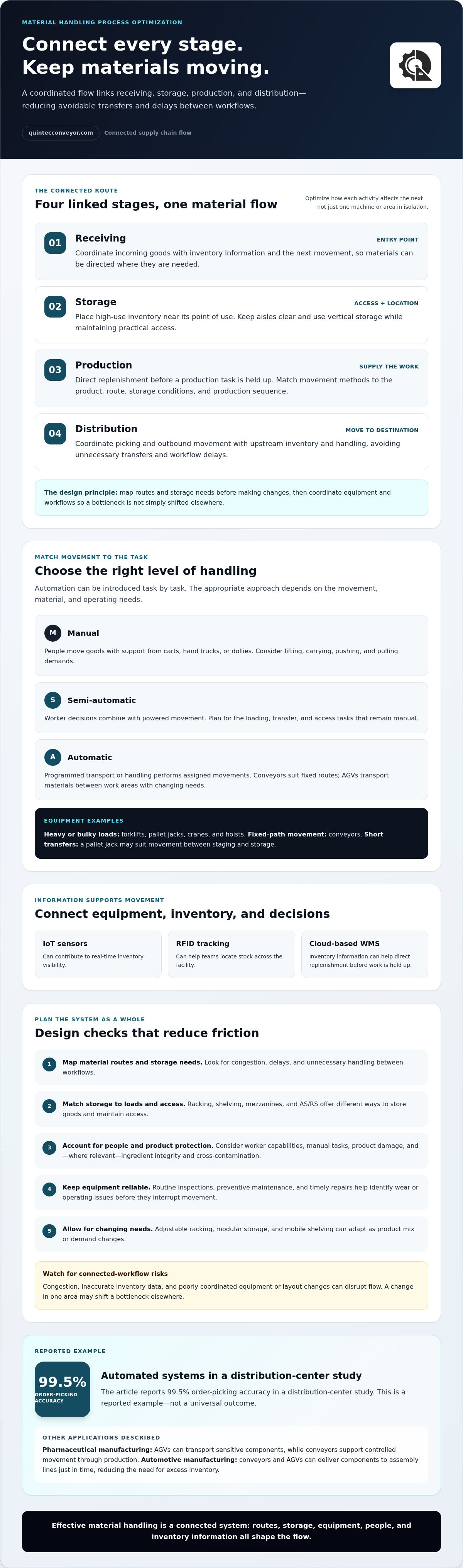
A supply chain runs more smoothly when receiving, storage, production, and distribution operate as connected stages. A material handling system coordinates those stages so goods reach the right locations with fewer delays and unnecessary transfers.
Automation and Warehouse Technologies
Automation and warehouse technologies connect equipment, inventory information, and movement decisions across a facility. Their value comes from coordinating tasks: conveyors move goods along fixed routes, while automated guided vehicles (AGVs) transport materials between work areas with changing needs.
IoT sensors, RFID tracking, and cloud-based warehouse management systems can provide real-time inventory visibility. This information helps teams locate stock and direct replenishment before a production or distribution task is held up.
Automation can also be introduced task by task. Manual handling uses people and equipment such as carts; semi-automatic systems combine worker decisions with powered movement; automatic systems perform programmed transport or handling. This lets facilities match technology to each task instead of automating every movement at once.
Sustainability can be part of the same design. Electric forklifts, LED lighting, and eco-friendly packaging are examples of warehouse measures that support efficient use of energy and materials. Adjustable racking and mobile shelving help facilities adapt storage as product mix or demand changes.
Layout, Risks, and Results
Warehouse layout and storage optimization align locations, travel paths, and access with how goods move. Place high-use inventory near its point of use, keep aisles clear, and use vertical storage such as pallet racks or mezzanines while maintaining practical access.
Common implementation challenges include congestion, inaccurate inventory data, and equipment or layout changes that disrupt connected workflows. Map material routes and storage needs before changing the system, then introduce equipment in a coordinated way so bottlenecks aren’t simply shifted elsewhere.
Measured results can illustrate the potential of a coordinated design. A distribution-center study reported 99.5% order-picking accuracy with automated systems. In pharmaceutical manufacturing, AGVs can transport sensitive components, while conveyors support controlled movement through production; in automotive manufacturing, conveyors and AGVs can deliver components to assembly lines just in time, reducing the need for excess inventory.
Pharmaceutical handling also needs to protect ingredient integrity and help prevent cross-contamination. The appropriate combination of manual, semi-automatic, and automatic processes depends on the product, route, storage conditions, and production sequence. Flexible warehousing supports this by allowing storage configurations to adapt as operating needs change.
Storage and handling equipment
Plan storage and handling equipment around the materials, movement paths, and access needs of each operation. Define what each activity must accomplish before selecting equipment or changing the warehouse layout.
Equipment Selection and Planning
Equipment selection matches storage and transport methods to the loads, routes, and tasks an operation requires. This planning helps prevent a mismatch between equipment capacity and the actual workflow.
Before implementation, define objectives, needs, and functional specifications for every movement and storage activity. A material-handling equipment selection study evaluated alternatives against four criteria, each with three subcriteria, and applied the Analytical Hierarchy Process at a local industry. This approach makes trade-offs visible instead of relying on a single equipment feature.
Manual and Mechanized Handling
Manual handling moves goods without mechanical assistance, while mechanized equipment supports or performs transport. Choosing the right balance helps align labor with the weight, shape, and travel demands of materials.
Workers may lift, carry, push, or pull items, using hand trucks, carts, or dollies to support movement. Forklifts, pallet jacks, cranes, and hoists handle heavy or bulky loads; conveyors move goods along fixed paths. Plan labor around each piece of equipment, including the loading, transfer, and access tasks that remain manual.
Plan storage and movement together. Pallet racking, shelving, mezzanines, and automated storage and retrieval systems (AS/RS) offer different ways to store goods while maintaining access. High-density racking or narrow aisles can use floor space more effectively, while mezzanines and tall storage make use of vertical space. The right configuration depends on the load, retrieval frequency, and movement route.
Equipment selection also affects product handling. Appropriate racking, conveyors, and forklifts can reduce manual work, improve workflows, and help prevent damage to goods. A pallet jack may suit short transfers between staging and storage; a conveyor may suit repeated movement between fixed work areas. Select equipment for the task and load, then consider how it affects other equipment and workers.
Reliable performance depends on routine inspections, preventive maintenance, and timely repairs. Inspections can reveal wear or operating issues before they interrupt movement. For example, checking conveyor components and reviewing forklift condition as part of a maintenance routine helps keep equipment ready for its assigned work. Maintenance planning should reflect the equipment’s role and the consequences of downtime.
Storage systems must adapt as inventory and business needs change. Adjustable racking, modular storage, and mobile shelving can accommodate changing demand without major infrastructure changes. Align these options with transport routes and retrieval needs, then incorporate them into an integrated warehouse plan. This keeps storage decisions connected to the wider supply chain instead of treating capacity as an isolated concern.
How do you optimize a material handling process?
Improve operations by identifying delays, unnecessary movement, and repeat handling across the warehouse workflow. Then adjust processes with worker safety, product protection, and steady production flow in mind.
Flow, Productivity, and Cost
Flow optimization aligns receiving, storage, picking, and production so work moves without avoidable bottlenecks. A delay at one station can leave workers and equipment waiting elsewhere.
Trace a product’s route from inbound staging to its point of use, noting queues, aisle congestion, and retrieval delays. Place high-use materials closer to production and coordinate replenishment with consumption. These changes can reduce travel and downtime caused by unavailable materials.
Review the complete workflow before changing a single station. For example, speeding up picking won’t improve overall productivity if packing becomes the new bottleneck. Reducing unnecessary steps and balancing work between connected areas can limit wasted labor, excess inventory, and avoidable transport.
Unit Loads and Handling Reduction
A unit load groups materials on a pallet, in a tote, or inside a container so they can move together. This approach can reduce trips and product damage compared with handling each item separately.
Choose a container that suits the product, destination, and next handling step. A stable pallet load, for example, can move between staging and storage without lifting each carton repeatedly. Secure loads during stacking and transport with suitable wrapping, pallets, or containers.
Reducing how often goods are handled also supports careful movement. Map each transfer, then identify where a product can move directly to its next process. This can eliminate unnecessary travel while keeping materials accessible to the workers who need them.
Measurement and Optimization Tools
Efficiency measures and software make workflow performance visible, helping teams identify where changes could have the greatest impact. Track order-picking accuracy, retrieval time, congestion, damage, and delays between process stages.
Which KPIs measure material handling efficiency and performance? Use indicators such as order-picking accuracy, inventory retrieval time, product damage, and production delays. Compare them across the same workflow stages to locate recurring constraints.
What software tools support material handling optimization, such as WMS and simulation software? Warehouse management systems (WMS) can coordinate inventory information and support storage, tracking, and transport. Simulation software can model alternative layouts or workflows, helping teams assess potential effects before implementation.
How can lean methods reduce travel time, errors, and material handling waste? Map each movement, remove unnecessary transfers, and position frequently used materials near their point of use. Grouping items into unit loads and organizing storage locations can reduce repeat handling and retrieval errors.
Worker safety belongs in the same operational review. Manual handling can slow work and increase injury risk, while ergonomic equipment, safe lifting techniques, and automation can help protect workers from strains, slips, and falling objects. The U.S. transportation and warehousing sector reported 4.5 recordable injuries per 100 full-time workers in 2023.
Protect products at every handoff. Use wrapping, suitable containers, and stable stacking to limit damage during handling and transport. Train workers in proper lifting techniques, and design workstations around human capabilities and limitations. OSHA compliance is also essential to warehouse practices that support a safer working environment.
Lift trucks, AGVs, conveyors, and palletizers
Lift trucks, automated guided vehicles (AGVs), autonomous mobile robots (AMRs), conveyors, and palletizers serve different movement tasks. The right combination depends on whether inventory travels between changing destinations, along a fixed route, or through repeated palletizing work.
Forklifts, pallet jacks, and industrial trucks transport goods between storage areas, loading docks, and production lines. They offer flexibility when destinations change or loads need direct handling. Their routes, turning space, and interaction with pedestrians must fit the facility layout. A forklift can serve several locations, while a conveyor is better suited to a repeated route between fixed points.
AGVs follow programmed routes and schedules to transport materials within a facility. AMRs also move goods, using flexible paths rather than relying only on fixed routes. These automated vehicles can support replenishment between storage and production, especially when recurring movement makes dedicated transport useful. Route planning should account for pickup and drop-off points, crossings, and how each vehicle fits into surrounding workflows.
Conveyor systems use belts or rollers to move products along a fixed path. A belt conveyor can support continuous movement between process stages, while roller conveyors can suit goods that need to travel across a work area. Conveyors work best when the origin, destination, and flow are predictable. A fixed route may be less suitable when inventory needs frequent redirection, so the design should match the actual movement pattern.
Palletizers arrange products onto pallets for handling or onward transport. They can be integrated after packing or sorting, where consistent pallet formation supports the next warehouse or shipping task. The choice between manual and automated palletizing depends on product characteristics, pallet configuration, and how the work connects with upstream and downstream processes. The pallet itself must suit the load and the equipment moving it.
Facility geometry matters. One layout example uses a 48-inch lane for pallets that are 42 or 45 inches wide. The example shows why lane width, pallet dimensions, and vehicle movement need to be considered together; a route must allow equipment to travel and handle loads without obstructing adjacent work.
Combining equipment requires careful attention to handoffs. A lift truck might bring a pallet to a conveyor, which moves cartons toward a palletizer. If transfer points are poorly placed, queues and repeat handling can offset the benefits of advanced equipment. Map each movement from pickup to delivery, then assign equipment according to load type, route flexibility, and transfer needs.
Maintenance also affects reliable movement. Routine inspections and preventive maintenance can reveal wear or operating issues before they contribute to equipment breakdowns. For conveyor systems, maintenance planning should reflect their role and operating demands. Matching each system to its task and maintaining it accordingly supports more coordinated material flow.
Meaning of material handling process optimization
Material handling covers the movement, storage, protection, and control of goods inside a facility. Optimization means coordinating these activities so materials reach the right place in usable condition, with less unnecessary work. It’s a systems approach, not simply a decision to add faster equipment.
Consider a component moving from receiving to a production station. Its route may include unloading, identification, storage, retrieval, and delivery to the workstation. Every handoff creates a chance for delay, damage, or an inventory record mismatch. A well-designed handling system considers the full route and how each stage affects the next.
The key distinction is between improving an isolated task and improving the overall flow. Faster retrieval can create congestion if the next work area cannot receive goods. Likewise, additional storage capacity may not help if workers can’t efficiently access frequently needed inventory. Layout, handling methods, equipment, and inventory management must support the same operational purpose.
In practice, optimization starts with understanding current movement. Trace representative materials through the facility, from receiving to use or shipment. Identify repeated transfers, long detours, waiting areas, and points where inventory information becomes inaccurate. For example, relocating a component stored far from its production line may reduce travel while keeping stock visible and accessible.
The right solution depends on material characteristics and operating needs. Bulky loads may require different transport equipment from small cartons. A fixed production route may suit conveyor movement, while changing destinations may call for more flexible handling. Storage choices also depend on access frequency, product mix, and how goods move into and out of inventory.
Accuracy matters because physical movement and inventory records must agree. Barcode scanning, RFID tracking, and warehouse management systems can support visibility as items are received, stored, and moved. When records show a different location from the goods’ actual location, workers may lose time searching or production may wait for materials. Information processes are therefore part of the handling system.
Optimization also includes protection and control. Packaging, containers, stacking methods, and transfer points affect whether products remain intact and clean. In pharmaceutical manufacturing, careful handling helps protect sensitive ingredients and prevent cross-contamination. In bulk operations, suitable hoppers, silos, and conveyors can move loose materials such as grain or sand while limiting spills.
The Material Handling Institute established 10 principles to guide material handling system design and management. The practical takeaway is to evaluate the complete system: its routes, storage, equipment, information, and handoffs. Process engineering can help translate that evaluation into coordinated facility changes when the existing layout or workflow constrains material flow.
Quintec Conveyors: Conveyors
Quintec Conveyors helps facilities address material flow challenges through conveyor systems, robotics and automation, infrastructure, and additional material handling equipment. Turn to its team when movement between work areas creates bottlenecks, equipment needs to operate as an integrated system, or a facility’s handling requirements are changing.
For example, conveyors can support consistent movement along fixed routes, while robotics and automation can help coordinate repetitive handling tasks. Infrastructure and supporting equipment also shape how materials move through a facility. The right approach depends on the workflow, load characteristics, layout, and connections between process stages.
Quintec Conveyors can help develop a material handling solution aligned with your facility’s operational needs. Contact Quintec Conveyors to discuss your project.
Build the Next Improvement Into Your Flow
Operational improvement doesn’t have to start with a facility-wide redesign. Choose a recurring movement that creates friction, then define what a better handoff would look like for the people, materials, and equipment involved. This gives your team a practical basis for evaluating future changes.
Material handling process optimization becomes an ongoing discipline when each change informs the next. As needs evolve, engineering decisions can connect conveyors, robotics and automation, and infrastructure to the work your facility actually performs. The aim is a handling system that supports your operating priorities instead of adding complexity for its own sake.
If you’re considering an equipment or systems project, contact Quintec Conveyors to discuss options. A conversation can help you explore an approach suited to your facility and its material flow. Take the next step with a clear view of the movement you want to improve, and keep building toward a more coordinated operation.
Frequently Asked Questions
Why Does Warehouse Material Handling Matter?
Warehouse material handling matters because each transfer affects order readiness, production continuity, and inventory control. For example, a receiving delay can leave production waiting even when the required materials have arrived at the facility. Clear handoffs help teams understand where goods should go next and who or what moves them. This coordination supports reliable operations from inbound delivery through order fulfillment.
What is material handling process optimization?
Material handling process optimization is the deliberate improvement of how a facility moves, stores, protects, and controls goods. It isn’t simply equipment replacement. It considers how work methods, information, and equipment interact across a process. For example, a system change should account for how a new storage location affects inventory records and the next task. This broader view distinguishes a local improvement from one that supports the full operation.
What are the key steps to optimize a material handling process?
Start by establishing a baseline, then map material routes and identify the constraint affecting your intended outcome. Prioritize changes by operational impact and dependencies instead of choosing equipment first. For example, if inaccurate location records drive search time, improve inventory control before redesigning transport. Implement a focused change, compare the same performance measures afterward, and document the resulting workflow so teams can maintain consistent execution.
How can automation such as conveyors, AS/RS, and AMRs improve material handling?
Automation improves material flow by assigning movement tasks to systems suited to their routes. Conveyors carry goods along fixed paths, while autonomous mobile robots can transport items along flexible paths. Traditional automated storage and retrieval systems use cranes to retrieve loads from racking aisles. For example, a facility can use an AS/RS for structured storage retrieval and AMRs for transfers between work areas with changing destinations.
What are the costs and ROI of material handling optimization projects in the United States?
Project costs and return on investment depend on the facility, selected equipment, integration requirements, layout changes, and implementation scope. Assess ROI by comparing project investment with measurable operating benefits, such as reduced handling labor, fewer damaged goods, or less production downtime. Include ongoing maintenance and training in the evaluation. A useful business case states its assumptions clearly and measures comparable operating conditions before and after changes.
How do manual, automated, and hybrid material handling systems compare?
Manual systems rely on workers and tools such as carts, making them adaptable to varied tasks but dependent on direct labor. Automated systems use equipment for programmed or repeatable movement, such as a conveyor serving a fixed route. Hybrid systems combine both, for example, using a conveyor between process areas while employees handle exceptions and quality checks. Compare options by task variability, load characteristics, required control, and workflow connections.