
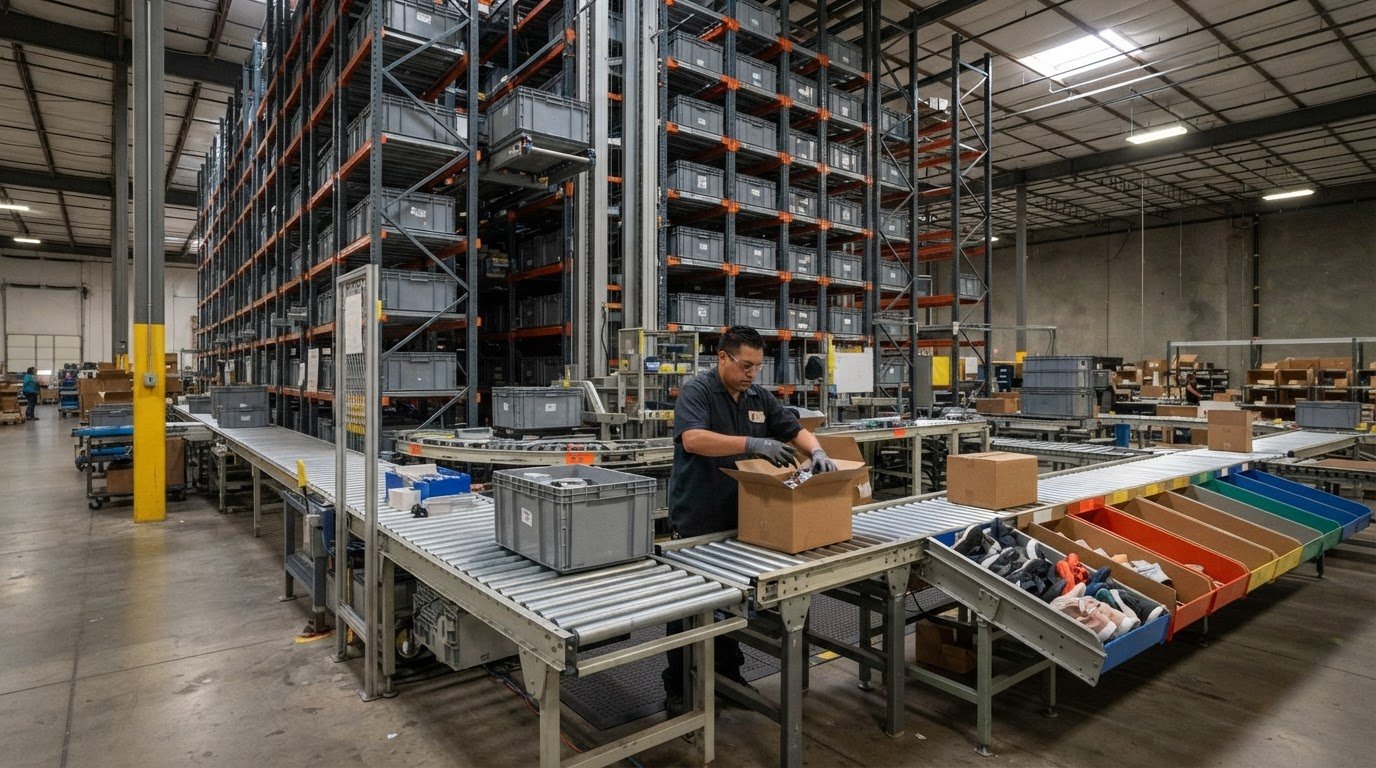
Storage automation alone does not eliminate labor from the order journey. ASRS conveyor integration connects automated storage and retrieval with the conveyors and sortation equipment that move retrieved goods to their next destination. An ASRS can bring orders to operators instead of requiring them to walk through the warehouse, while a well-matched conveyor flow helps prevent bottlenecks between storage and sortation.
Labor is a key consideration when evaluating warehouse automation, but the handoff between systems matters just as much. When storage output and conveyor capacity are out of balance, equipment may sit idle and manual intervention may be needed. This article explains how goods move from ASRS storage into conveyor and sortation flows, how controls and interfaces coordinate those stages, and how throughput, product dimensions, and future operating needs inform the design.
Key Takeaways
- Understand how different storage configurations serve pallets, totes, and cartons, and where they fit in warehouse operations.
- See why equipment interfaces, controls, and aligned conveyor capacity matter when connecting storage to sortation.
- Use the project timeline and commissioning considerations to set more realistic expectations for an automation rollout.
- Compare fixed conveyor flows with AGVs and AMRs to determine which movement approach best matches your operation.
ASRS definition and warehouse applications
Automated storage and retrieval systems manage inventory storage and movement within a warehouse. Their configuration determines how pallets, totes, or cartons are stored, retrieved, and presented for picking.
ASRS Meaning
ASRS means automated storage and retrieval system. Computer-controlled machinery places goods in defined locations and retrieves them when required. Cranes, shuttles, or robotics can perform these movements. The system tracks what is stored where and when it entered storage. For warehouse teams, this links inventory location with retrieval, helping coordinate supply to picking or production operations.
Different ASRS designs handle different loads. Unit-load systems use large cranes for pallets or heavy items, while mini-load systems use smaller cranes or shuttles for totes and cartons. Carousel systems rotate stored goods to picking stations. These differences matter because the load type and retrieval method affect how storage connects to the rest of the operation.
Warehouse Applications
ASRS systems support storage and retrieval in warehouses and distribution centers, including retail, e-commerce, automotive, pharmaceutical, and food and beverage operations. Goods-to-person systems can bring items to operators, which may reduce the need to walk warehouse aisles. In production, an ASRS can buffer completed units until a testing machine becomes available.
Storage density is another application. ASRS can use vertical space and deeper storage arrangements, including stacked bins or pallets stored more than one level deep. Pallet systems can store 25 to 30 racks deep, with an automated shuttle or carrier managing movement. The chosen configuration affects capacity and how inventory enters or leaves storage.
A warehouse management system (WMS) or warehouse control software can direct storage and retrieval commands. An ASRS can also update an ERP system with the location of newly stored goods, helping align inventory records with physical movement. During planning, consider product dimensions and weight, storage and retrieval volumes, peak demand, and SKU velocity. These factors shape system capacity and the flow required for picking or distribution.
ASRS integration with conveyors and sortation
Automated storage connects to conveyors and sortation through coordinated equipment, controls, and software. The handoff is critical: a storage system cannot sustain facility flow if downstream handling cannot accept its output.
Conveyor and Sortation Integration
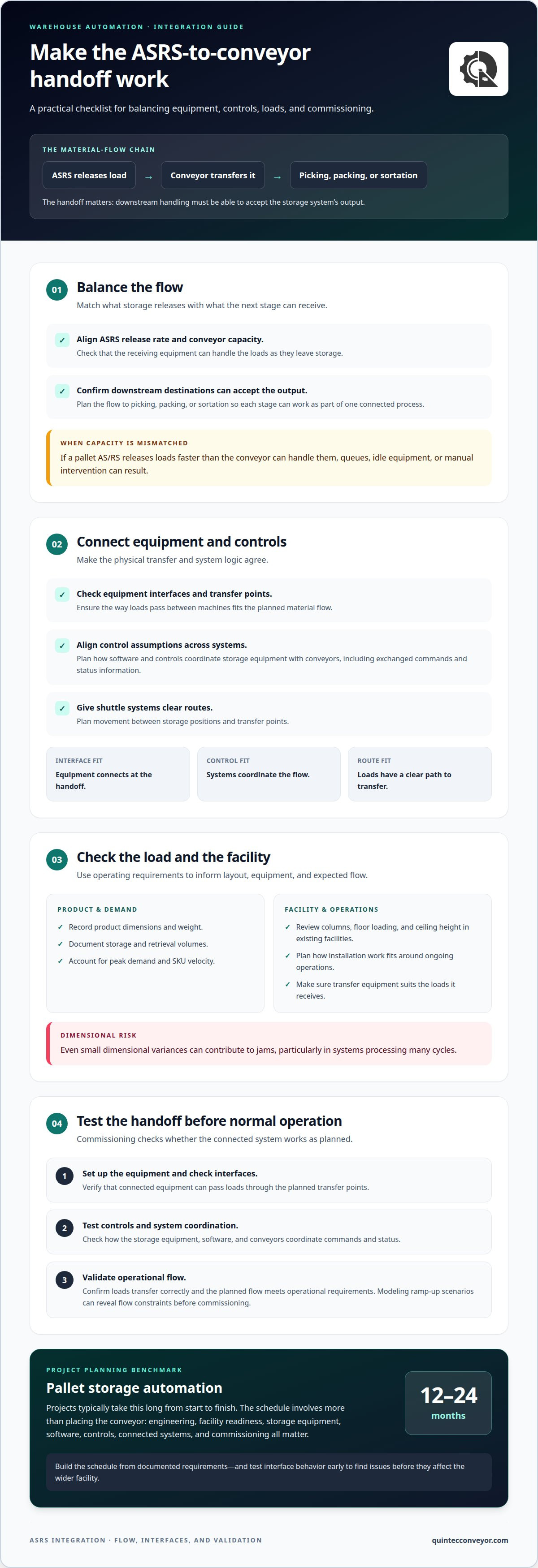
ASRS conveyor integration moves retrieved loads from storage to picking, packing, or sortation destinations. Conveyor interfaces must match the ASRS release rate and the receiving equipment’s capacity. If a pallet AS/RS releases loads faster than the conveyor can handle them, queues, idle equipment, or manual intervention can result. Shuttle systems also need clear routes between storage positions and transfer points. Aligning equipment interfaces and control assumptions helps each machine work as part of one material flow.
Safety Standards and Regulations
In the United States, applicable safety requirements depend on the equipment, workplace, and task. Review the system design against relevant machinery and workplace rules, since conveyors, transfer points, and automated storage create different access and operating conditions. Define how operators interact with equipment, how access is controlled, and how safe operation is maintained during routine work and maintenance. Quintec prioritizes employee safety and follows all OSHA requirements and regulations. The design should address the facility and equipment configuration.
Installation and Commissioning Timeline
Installation and commissioning cover equipment setup, interface checks, controls testing, and operational validation. Pallet storage automation projects typically take 12 to 24 months from start to finish. The project timeline includes more than setting the conveyor in place: storage equipment, software, facility infrastructure, and connected systems must work together. Commissioning evaluates whether loads transfer correctly and whether the planned flow meets operational requirements before normal use.
Integration Risks and Failure Points
Common failure points include mismatched conveyor capacity, incompatible equipment interfaces, and conflicting control assumptions. Each can interrupt the movement of stored goods, creating bottlenecks, idle equipment, or manual handling. Even small dimensional variances can contribute to jams, particularly in systems processing many cycles. Product weight and dimensions matter too: transfer equipment must suit the loads it receives. Map material flow and test interface behavior early to identify problems before they affect the wider facility.
How long does ASRS conveyor installation and commissioning take?
Pallet storage automation projects typically take 12 to 24 months from start to finish. That span covers more than equipment installation: facility readiness, engineering, controls, and commissioning all shape the schedule. Conveyor connections must also work with ASRS release behavior and downstream destinations.
Develop the schedule from documented requirements. Record product dimensions and weights, storage and retrieval volumes, peak demand, and SKU velocity before engineering. These inputs inform the layout, equipment interfaces, and expected material flow. In existing facilities, also account for columns, floor loading, ceiling height, and how installation work will fit around ongoing operations.
Planning also covers the software and controls coordinating storage equipment with conveyors. Identify how each system exchanges commands and status information, then verify the design against operational requirements. Modeling ramp-up scenarios can reveal flow constraints before commissioning. Changes in SKU mix or order profiles may also affect the assumptions used to assess system performance.
- Facility preparation: Confirm the layout and required infrastructure are ready for equipment installation.
- Equipment installation: Position the ASRS, conveyor lines, and transfer points according to the engineered flow.
- Controls integration: Test the interfaces that coordinate equipment movement and system commands.
- Commissioning: Validate transfers, exception handling, and performance against operating requirements.
Commissioning tests individual machines and connected flows as one operating system. Run representative loads through the complete route, from ASRS retrieval to the receiving conveyor or sortation destination. Check that handoffs work correctly and that the system responds to exceptions. Record results against design requirements, then use ramp-up observations to identify adjustments before normal operation.
Clear requirements and early design verification help limit late project corrections. Contingency planning matters too: determine how operations will handle equipment downtime, and include maintenance access in the layout. These decisions link the installation schedule to reliable day-to-day warehouse operations.
How does ASRS conveyor integration compare with AGVs and AMRs?
Conveyors and mobile robots move goods differently around a warehouse. The right fit depends on whether loads follow a stable route or need flexible delivery to changing destinations.
ASRS conveyor integration moves retrieved goods along a defined path toward picking, packing, or sortation. Conveyors connect equipment at planned handoff points, making them useful for repeatable flows between fixed destinations. The design must coordinate storage release with the conveyor’s ability to receive and move each load. Downstream equipment must accommodate the timing and direction of incoming goods.
AGVs and AMRs are floor robots that transport loads through a facility. Their routes can connect storage, work areas, and other destinations without a continuous conveyor line. Floor robots have throughput ranging from 100 to 300 lines per hour. Their suitability depends on the movement pattern, load, traffic, and how deliveries fit other warehouse activity.
- Choose conveyors when goods follow a consistent route between storage and fixed workstations or sortation.
- Consider floor robots when loads travel between multiple locations without dedicated conveyor paths.
- Assess combined flows when conveyors serve predictable movements and robots handle separate transport needs.
Compare more than throughput. Map each load’s origin and destination, how often destinations change, and where queues may form. Assess how the transport method exchanges commands and status with warehouse controls. For example, a conveyor can serve a steady flow from storage to sortation, while mobile robots carry loads to dispersed work areas. A combined design can give each method a distinct role and define their transfer points.
For fixed material flows, explore conveyor system design options as part of the integration plan. Align the transport approach with the facility’s order profile, destination patterns, and storage output.
Quintec Conveyors: Conveyors
Quintec Conveyors integrates conveyor requirements with the wider material handling layout. Turn to the team when your ASRS project needs conveyors coordinated with robotics, automation, infrastructure, or other material handling equipment. Mapping load movement, transfer points, and downstream destinations helps shape a system around the facility’s operating flow.
For an existing operation, conveyor maintenance can help support equipment reliability as warehouse requirements evolve. Whether you’re planning a new integration or refining an established flow, discuss how conveyor equipment can fit your storage and sortation requirements.
Contact Quintec Conveyors to discuss your project and material handling needs.
Turn Your Integration Plan Into a Connected Operation
Define how your warehouse should respond as order profiles, inventory, and operating priorities change. Treat the design as a connected system, not a collection of standalone machines. This approach helps align ASRS conveyor integration with the facility’s broader material handling needs and future plans.
Quintec Conveyors provides conveyors, Robotics & Automation, and infrastructure for industrial material handling projects. If you’re planning a new system or refining an existing flow, discuss your facility, operational goals, and key interfaces with the team to establish a clear direction.
Contact Quintec Conveyors to discuss your project. A well-considered integration plan is a practical foundation for building a more coordinated operation.
Frequently Asked Questions
Can AS/RS solutions work with existing racking or mezzanines?
Existing racking or mezzanines can be incorporated when their structure and layout suit the automated system. Engineers assess load capacity, clearances, aisle geometry, floor conditions, and equipment access. For example, a mezzanine may provide a picking or conveyor interface, while existing rack bays may constrain shuttle or crane movement. The design must coordinate storage equipment with the building’s structural limits and intended material flow.
How does an ASRS work?
An ASRS receives an instruction to store or retrieve a specific load, then moves it between a defined storage position and a handoff point. A crane, shuttle, or other automated equipment performs the movement, while control software tracks the transaction. For example, a retrieval command can direct a tote to a workstation, where an operator completes the pick before the tote returns or moves onward.
What does the transition from manual to automated warehousing actually look like?
Automation changes how work is assigned, inventory is located, and goods reach employees. Teams map current tasks, identify which movements automation will handle, and align inventory records with the new operating process. For example, pickers may shift from walking aisles to working at fixed stations that receive totes. Training, exception procedures, and a planned operational changeover help employees adapt to new workflows.
What is an ASRS conveyor integration?
ASRS conveyor integration connects automated storage and retrieval equipment with conveyor controls and the facility’s material flow. The design defines how a load is released, transferred, identified, and routed after leaving storage. For example, a tote may need a destination signal at a junction to reach the correct workstation. Clear interface logic helps prevent routing errors and mismatched equipment responses.
What types of conveyors are compatible with ASRS systems?
Belt, roller, and chain conveyors can work with ASRS equipment when their operating characteristics suit the load and transfer point. Selection depends on the item’s dimensions, weight, base, orientation, and required route. A stable carton moving toward packing has different handling needs from a pallet transferred from storage. Conveyor controls and transfer geometry must also match the ASRS handoff.
How do you integrate conveyors with an ASRS step by step?
Plan the integration in a defined sequence to align equipment, controls, and operating needs:
- Document loads, destinations, and operating requirements.
- Map routes, transfer points, and exception paths.
- Specify conveyor interfaces and control signals.
- Install equipment, then test representative loads through each route.
Record test results against the design requirements and resolve interface issues before normal operation begins.