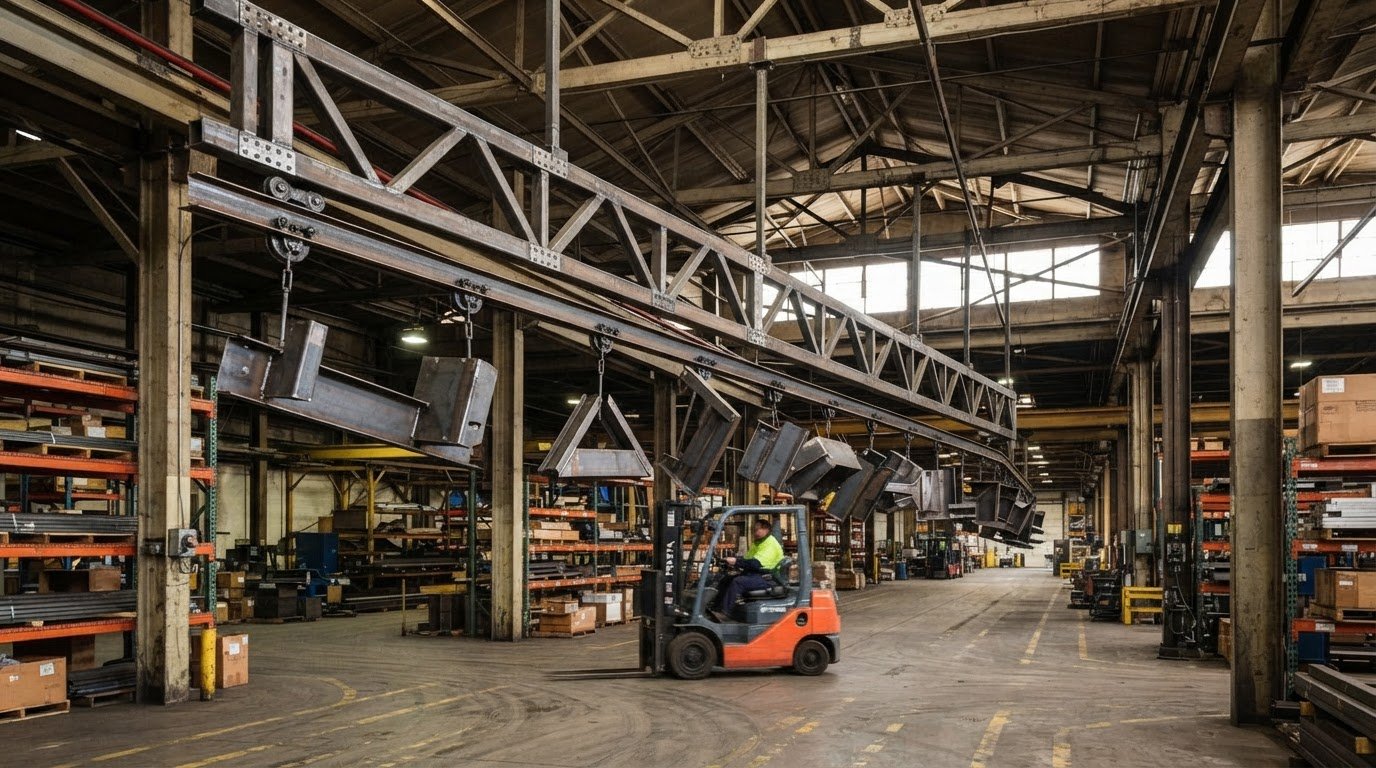
An overhead conveyor truss is a welded lattice frame that supports a conveyor across a span, with sections pinned or bolted together in series. A section can be 20 feet long, and four conveyor trusses can combine to create an 80-foot conveyor. This construction provides rigidity for longer spans without excessive supports or deflection.
Keeping a conveyor overhead can free floor space, preserve forklift access, and route materials around obstacles. But the truss is only one part of the system: its supports, route, and fit with the facility all affect how well it serves the operation. This article covers common overhead conveyor truss types and uses, how they support longer spans, and the space benefits to consider. It also explains what to compare when evaluating system designs and suppliers, so you can assess how the structure meets your facility’s needs.
Key Takeaways
- Understand how building attachments and track supports shape a conveyor route and its structural integration.
- Compare enclosed-track, I-beam monorail, and power-and-free systems by how they move and manage loads.
- Assess whether an overhead route can improve access and workflow in your facility, considering obstacles and operating needs.
- Evaluate suppliers by their ability to align conveyor design with your load, process, routing, and integration requirements.
What is an overhead conveyor?
An overhead conveyor moves materials along an elevated track supported by building steel or a separate structure. Its layout can link production stations while keeping floor routes open for other work.
Truss function and operation
An overhead conveyor truss is a welded lattice frame that carries track across a span. Sections can be pinned or bolted together so the track follows a planned route. Carriers move along the track to transport items between stations, including through automotive production areas. The frame’s rigidity helps support longer spans while limiting the need for extra supports and reducing deflection. The conveyor and carriers, in turn, must suit the load and process.
Track supports and building attachments
Track supports transfer conveyor loads into building steel or independent supports. Hangers, brackets, or trusses attach the route to the facility structure, so the attachment method must suit the building and the conveyor layout. In the United States, conveyor trusses are welded lattice frames; a documented example used steel towers and angled steel rods. Overhead conveyors must comply with ANSI/ASME B20.1 and OSHA 29 CFR 1910.179.
Installation costs depend on the span, load, route complexity, building attachments, site access, and commissioning requirements. Structural modifications and installation scope also affect the work, so costs are determined for each project after a quote request.
Layout and structural support design
Layout design connects the conveyor route to the process, including loading points, stations, turns, and discharge areas. Designers consider load weight and dimensions, support locations, route features, and environmental requirements. An enclosed track may suit a different environment from an open arrangement. These factors also shape integration with existing equipment and controls. During commissioning, teams can assess carrier travel, route clearances, and system operation against the intended production flow.
Long-span support and rigidity
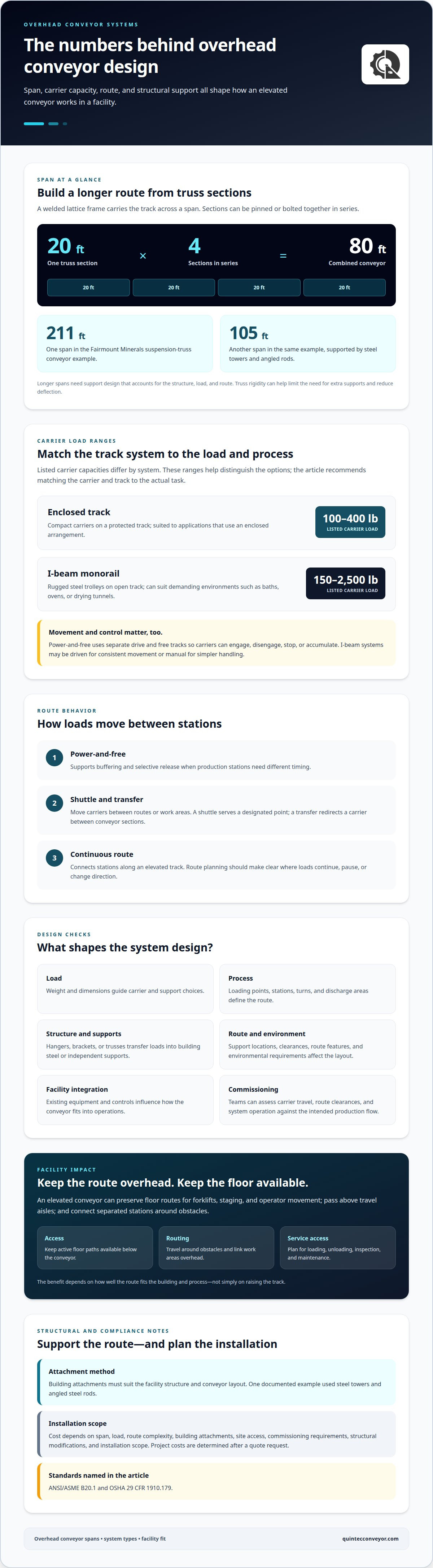
A truss provides a rigid support path across areas where floor-level columns could interfere with access. One truss section can be 20 feet long, and four sections can form an 80-foot conveyor. Longer spans require support design that accounts for the structure, load, and route. At Fairmount Minerals, a suspension-truss conveyor included spans of 211 feet and 105 feet, supported by steel towers and angled rods. That example shows how variable site constraints can influence structural design and installation planning.
Overhead conveyor system types and uses
Overhead conveyor systems move loads along elevated routes, using carriers suited to the task. The choice depends on the load, process sequence, and whether items need to stop or transfer between stations. In automotive production, for example, a route may connect work areas and control how components reach each machine.
Power-and-free and enclosed-track systems
A power-and-free conveyor uses two tracks: one drives the system, while the other lets carriers engage, disengage, stop, or accumulate. This arrangement supports buffering and selective release when production stations need different timing. Enclosed-track conveyors suit applications that use compact carriers and a protected track; their listed carrier load range is 100-400 lb. The system type helps determine how loads move and queue.
I-beam monorail systems
I-beam monorails use rugged steel trolleys on an open track. Their listed carrier load range is 150-2,500 lb, and the design can serve demanding environments such as baths, ovens, or drying tunnels. A driven conveyor suits consistent movement, while a manual arrangement may suit simpler handling needs. Match the trolley and track to the load and process, rather than treating all conveyor components as interchangeable.
Shuttle and transfer systems
Shuttle and transfer arrangements move carriers between routes or work areas rather than keeping every load on one continuous path. A shuttle can serve a designated point, while a transfer moves a carrier between conveyor sections. For example, a production line can use a transfer to redirect a component to a separate process. Route logic should make clear where loads pause, change direction, or continue.
System selection also depends on how much control each load needs. Power-and-free supports accumulation; I-beam monorail suits robust open-track movement. For a facility evaluating integrated conveyor systems, compare carrier loads, route changes, and process timing together.
Benefits compared with floor-based conveyors
An overhead conveyor can keep equipment above active floor routes, preserving space for forklifts, staging, and operator movement. Where a floor-based line would cross a travel aisle, an elevated route can pass above it instead. This can also keep production areas flexible, with workstations and access paths available below. The benefit depends on how well the route fits the building and process, not simply on raising the track.
Routing flexibility matters where equipment is fixed or material paths change. An overhead conveyor can travel around obstacles, connect separated stations, and keep materials moving above floor-level activity. A spiral conveyor offers another example: it can raise cartons toward a palletizing station while leaving the floor beneath clear. Operators can use that space for other work when the conveyor route and surrounding operations are planned together.
Floor access also affects how people and equipment interact with a line. Mounting conveyor components overhead can reduce conflicts with forklifts and carts, especially where a floor route would narrow an aisle. The layout must still provide access for loading, unloading, inspection, and maintenance. Operators need defined material-handling points, while service teams need access to track components without disrupting nearby stations.
Saving space is not the only design test. An overhead conveyor truss must suit the building structure, load path, and process route; its supports and clearances determine whether the floor remains usable. Compare an elevated option with a floor-based line by mapping forklift paths, operator work zones, equipment footprints, and inspection access. If overhead routing creates access difficulties or conflicts with the building, a floor-level system may suit that area better. Choose based on the actual workflow and facility constraints.
Overhead conveyor manufacturers and suppliers
Choosing a supplier means matching the conveyor design to the work, not selecting equipment by name alone. Start with the load’s weight and dimensions, then map the production sequence, route, and transfer points. A suspended conveyor serving assembly stations has different requirements from one moving materials through an oven. Manufacturers and system integrators use these details to guide equipment selection and system integration.
Compare proposals by how clearly they cover the complete system. The design should explain the track and carrier arrangement, structural support, route, and controls integration. It should also address environmental requirements and access for loading, unloading, inspection, and service. For example, an overhead route through a drying tunnel calls for a different design response from one serving open assembly areas. These details make a proposal more useful than a component list alone.
- Load and process: Confirm the carrier load and how production logic affects accumulation or release.
- Routing: Review turns, elevation changes, transfers, and building constraints as one connected path.
- Integration: Establish how the conveyor coordinates with existing machinery and controls.
- Service support: Include inspection access and maintenance needs in the system design.
Manufacturing and installation planning affect how the system comes together. Assembly must align track sections, supports, and transfers with the intended route; commissioning then assesses travel and operation across those components. The supplier’s scope should clarify these interfaces, especially where several stations depend on consistent material movement. Ask for a design rationale based on actual loads, process timing, and facility routing rather than generic system descriptions. This gives decision-makers a clear basis for comparing designs and finding a solution suited to their operation.
Quintec Conveyors: Conveyors
Quintec Conveyors helps facilities plan conveyor systems around their loads, production flow, and building constraints. Turn to the team when an overhead route needs to connect work areas, integrate with existing processes, or support a broader material-handling design.
Quintec provides custom conveyor design, engineering, and installation, with Robotics & Automation, Infrastructure, and Additional Material Handling Equipment to support related operational needs. These services can help coordinate an overhead conveyor with automated equipment or fit it into a facility-wide layout. Discuss your application, route, and material movement requirements with Quintec Conveyors to take the next step.
Contact Quintec Conveyors to discuss your conveyor project.
Turn Your Conveyor Concept Into a Practical Plan
Before finalizing a facility change, map how materials move today and where the next process constraint may arise. This helps clarify whether an overhead conveyor truss belongs in a broader redesign, supports a targeted route change, or needs to integrate with automation and building infrastructure. It also gives your team a shared basis for weighing operational priorities against facility requirements.
Quintec Conveyors can help develop the next step through its conveyor, Robotics & Automation, and Infrastructure offerings. Share the material flow, facility layout, and process goals that matter most to your operation. These details can guide a practical discussion about system design and integration, without assuming one arrangement suits every facility.
Contact Quintec Conveyors today to discuss your project and move toward a solution shaped around your operation.
Frequently Asked Questions
What is the minimum overhead clearance needed?
The stated minimum clearance is 7'-6″ (2.3 m) from the finished floor to the bottom of the conveyor carrier load. This measures clearance beneath the load, not open space above the track. Account for the tallest item being carried and the activities below the route. Space above the track also matters for take-up movement and inspection access.
What structural arrangements are used for overhead conveyors?
Common arrangements include welded lattice frames joined with pins or bolts, and suspension trusses supported by towers and angled rods. The configuration depends on the span, support locations, and building constraints. The conveyor running on the structure may use enclosed track, I-beam monorail, or power-and-free operation. These are conveyor system types, not truss structures, so distinguish the supporting frame from the track when comparing designs.
How do you size and design an overhead conveyor truss?
Size the system around the load’s weight and dimensions, carrier arrangement, route, and support conditions. Then coordinate structural capacity with track geometry and process needs. A common layout reference places track supports 8 ft apart on straight sections and 4 ft apart through curves. Vertical curves also need room: the minimum vertical radius is 1.5 times the horizontal radius. These constraints shape both the frame and route.
How do you install and support an overhead conveyor truss?
Transfer conveyor loads into building steel or dedicated supporting structures using suitable hangers, brackets, or trusses. Plan support locations around route geometry, including 8 ft spacing on straight sections and 4 ft through curves. Installation involves aligning connected track sections and securing attachments. During commissioning, assess carrier travel so transfers and turns operate along the intended route.
What inspections and maintenance are needed for the conveyor structure?
Inspect the frame, connections, hangers, track, and carriers for visible damage, looseness, wear, or displacement. Check joints where sections connect and supports meet building steel. During operation, watch for unusual noise, vibration, or changes in tracking. Address identified wear through maintenance and preserve inspection access. After a route change or structural adjustment, reassess the affected connections and alignment.
What are common conveyor safety risks, and how can they be prevented?
Key risks include falling material, contact with moving carriers, pinch points, and inadequate clearance beneath suspended loads. Keep loads within system capacity, maintain clear travel paths, and protect access near moving components. In the United States, conveyor systems must comply with ANSI/ASME B20.1 and OSHA 29 CFR 1910.179. Quintec Conveyors places employee safety first and follows all OSHA requirements and regulations at all times.