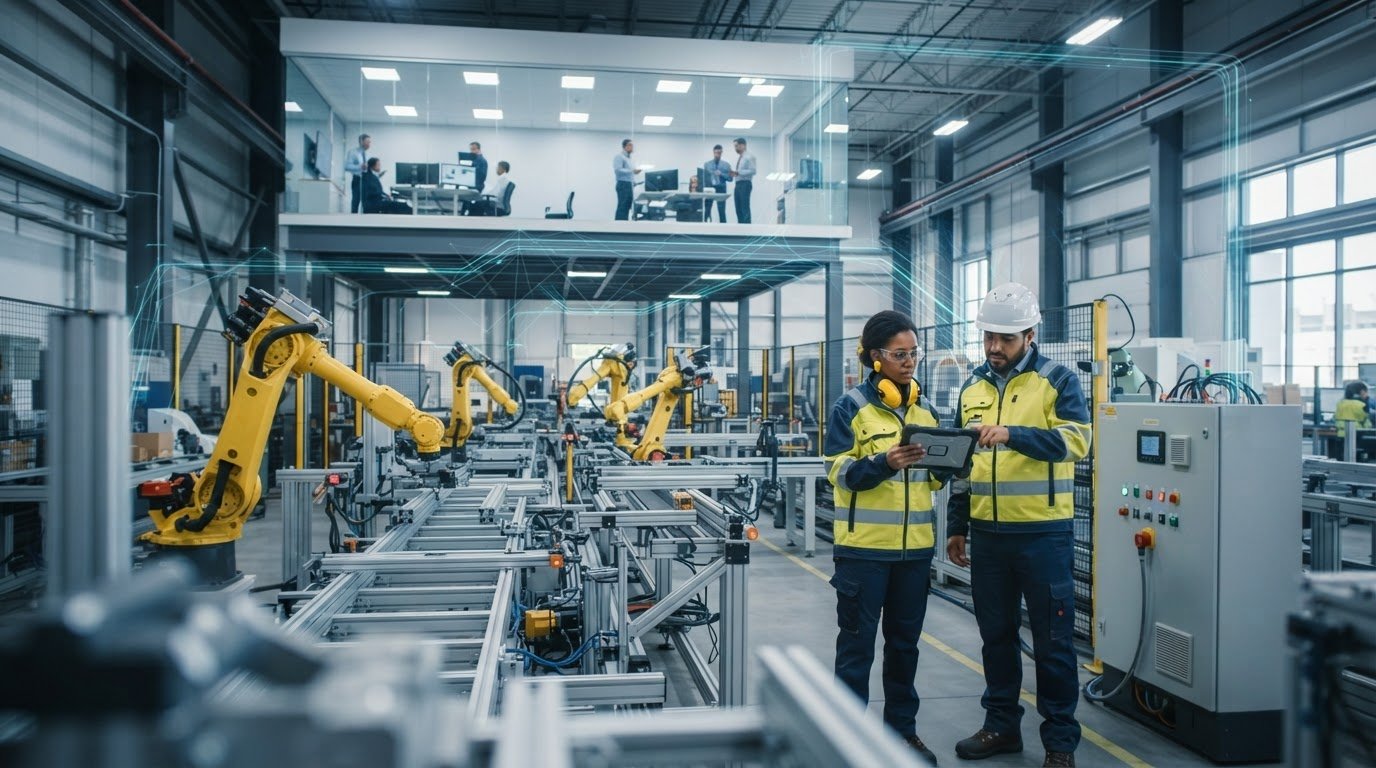
The right integrator connects more than machines. Industrial automation system integration brings together controls, production equipment, robotics, data, and business systems so they can work as a coordinated operation. An industrial automation integrator assesses a facility’s needs, defines the project, and designs and implements the connections across its systems.
It’s understandable to focus first on equipment and technical capability. But successful industrial automation system integration also depends on how well technologies, vendors, and teams work together, and whether the system can support future operational needs. This guide explains what integrators do, how they connect plant-floor controls with supervisory and enterprise systems, and where integration can make a difference. It also outlines how to compare providers, what CSIA certification evaluates, and why certification is one part of assessing fit, not a substitute for technical capability. You’ll come away with a clearer framework for understanding the work and choosing an integration approach that fits your facility.
Key Takeaways
- Use CSIA certification as one measure of a provider’s management and quality practices, then assess whether its technical capabilities fit your project.
- Consider how controls, supervisory systems, operations platforms, and enterprise applications need to exchange information across your facility.
- Reduce integration risk by mapping existing connections, defining outcomes, and planning an architecture that can scale with operational needs.
- Compare integrators by how they coordinate technologies and stakeholders, and how clearly their approach addresses your facility’s requirements.
What Are the Benefits of Choosing a CSIA Certified System Integrator?
CSIA Certification gives manufacturers an independent view of an integrator’s business practices. Certification requires an intense third-party audit and adherence to strict performance standards. The assessment covers project management, quality management, service and support, information systems management, and cybersecurity. These areas matter because a control system project involves more than selecting equipment. It also requires coordinated planning, documented quality processes, reliable support, and thoughtful management of information.
For operations, structured project management can clarify responsibilities, milestones, and handoffs before implementation affects production. Manufacturing teams can use that clarity to coordinate plant staff and integration work around operating needs. For engineering, quality management provides a framework for organizing design and implementation. Cybersecurity and information systems management also focus attention on how control-system information is handled. Together, these assessed areas help teams consider technical work alongside project execution, rather than treating integration as a programming task alone.
Finance teams benefit from a defined project approach because scope, responsibilities, and changes are easier to evaluate during planning and delivery. That doesn’t guarantee a particular financial result, but it supports clearer oversight of project decisions. Maintenance teams can also consider service and support as part of an integrator’s assessed practices. For example, when planning a controls upgrade, a facility can evaluate how future support will fit its operating needs, not just whether the initial installation meets the design.
CSIA members may also use the CSIA Best Practices and Benchmarks Manual to guide professional management of a system integration company. The CSIA Industrial Automation Exchange includes thousands of qualified integrators and suppliers, giving manufacturers a way to identify candidates. Certification can help compare management and delivery practices, but it doesn’t replace assessing technical fit. Match an integrator’s capabilities to the facility’s equipment, applications, and project scope. A strong management framework supports execution, while relevant technical experience determines whether the team can address the specific integration challenge.
Connecting control, supervisory, operations, and enterprise systems
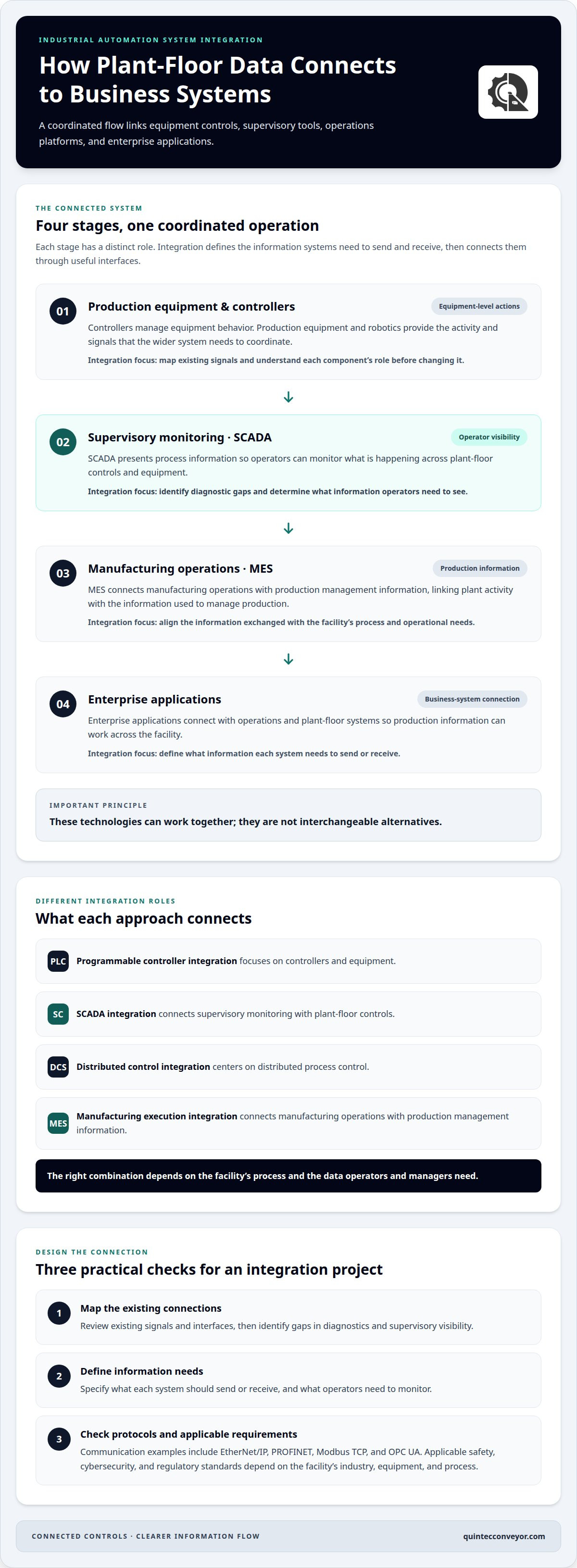
Industrial automation system integration connects equipment controls, supervisory tools, operations platforms, and enterprise applications. The connections help plant-floor activity and business information work together.
Control and Information System Integration
Control and information system integration links production equipment with supervisory, operations, and enterprise systems. In a chemical or spirits operation, for example, batch control can coordinate process steps while sending relevant production information to higher-level systems. Clear connections help teams track batch progress and support compliance processes. Defining what information each system needs to send or receive helps engineers design useful interfaces without treating each system as an isolated project.
Plant-Floor Controls and SCADA
Plant-floor integration connects controllers and equipment with supervisory control and data acquisition (SCADA) systems. Controllers manage equipment-level actions, while SCADA presents process information for operators to monitor. During a metals or automotive controls modernization, engineers can map existing signals, identify diagnostic gaps, and determine what information operators need. This focuses upgrades on the relationship between equipment behavior and supervisory visibility, rather than replacing components without understanding their role.
Comparing Integration Approaches
PLC, SCADA, DCS, and MES integration differ in the systems they connect and the information they coordinate. PLC integration focuses on programmable controllers and equipment; SCADA connects supervisory monitoring with plant-floor controls. DCS integration centers on distributed process control, while MES connects manufacturing operations with production management information. The right combination depends on the facility’s process and the data operators and managers need. These technologies can work together rather than serve as interchangeable alternatives.
Protocols and Applicable Standards
Industrial communication protocols define how automation devices and software exchange information. Examples include EtherNet/IP, PROFINET, Modbus TCP, and OPC UA. Protocol compatibility affects which systems can share data and how interfaces are designed. Applicable U.S. safety, cybersecurity, and regulatory standards depend on the facility’s industry, equipment, and process. A chemical batch operation and an automotive line may have different compliance considerations, so project teams should identify relevant requirements during system design, alongside network and equipment needs.
Who is an industrial automation integrator?
An industrial automation integrator analyzes a facility’s needs, defines the project, and designs and implements control systems. For a manufacturer, that can mean coordinating production-line equipment, robotics, software, and plant networks so they work as a connected system. The integrator translates operational goals into a technical scope, then coordinates the technologies and stakeholders needed to deliver it.
Services can include requirements analysis, project definition, control-system design, programming, equipment and software integration, testing, commissioning, and documentation. The scope depends on the project. For example, a facility connecting a production line with supervisory software may need interface design, data mapping, and tests to confirm information moves correctly between systems. In applications involving continuous rotation or robotics, integrators also coordinate with specialized hardware suppliers like TME Systems Pty Ltd to incorporate rotary connectors and slip rings that maintain uninterrupted power and signal transfer.
In the United States, integration costs depend on project scope and are provided after a quote request. Key cost factors include the number and condition of systems, interface complexity, hardware or software requirements, engineering work, and testing needs. Project duration also depends on scope, equipment readiness, system access, and commissioning requirements.
A successful project moves through connected planning and delivery activities. The integrator first assesses needs and existing systems, then defines outcomes and project boundaries. Next, the team maps current connections and designs an architecture for the required equipment and information flow. Implementation follows, with testing and commissioning to assess whether integrated functions meet the defined requirements. Documentation supports handover and future system work.
Reduce risk by starting with a focused project, not a facility-wide redesign. Choose one area where disconnected systems create a clear operational problem, such as a workstation that requires duplicate data entry. Map its equipment, information flows, and affected teams, then define the result the project must achieve. A focused test case can reveal interface, access, or workflow issues before the approach expands. Involving operations, engineering, and maintenance during planning also helps surface practical constraints early, including production access and support needs.
Finding and comparing industrial automation system integrators
Start with the operational problem, then compare integrators against the same project scope. A facility connecting production equipment with business systems needs different expertise from a plant modernizing controls. Define the processes involved, affected systems, desired information flow, and operating constraints. This shared baseline makes proposed technical approaches easier to compare.
Technical fit should lead the comparison. Match each candidate’s experience to the equipment, control platforms, networks, and applications in your facility. For example, a robotics project needs relevant robotics and controls capabilities, whereas integrating specialized end-of-line palletising or packaging equipment (such as systems from phoenixhandling.co.uk) requires proven experience with line synchronization and machinery controls. Assess whether the proposed architecture addresses current needs and can accommodate future growth.
Compare project execution as carefully as technology. A useful evaluation considers how the integrator defines scope, coordinates stakeholders, manages changes, tests interfaces, and documents the completed system. These processes affect how operations, engineering, and maintenance prepare for implementation and support. Look for a clear explanation of responsibilities and handoffs, especially where multiple technologies or vendors intersect.
CSIA Certification adds an independent measure of an integrator’s business practices, but it doesn’t establish technical fit for every project. Certified integrators undergo an audit every three years to assess continued compliance. Consider certification alongside the specific capabilities, applications, and project approach your facility requires. The distinction matters: an audit evaluates business practices, while your project’s technical requirements determine whether an integrator is a suitable match.
Use a consistent comparison framework: project-specific technical experience, clarity of scope, coordination processes, testing approach, documentation, and relevant certification. Weight each factor according to the operational challenge. A controls modernization may prioritize platform and diagnostic experience; a robotics project may depend more on application and equipment integration. This keeps the decision tied to requirements rather than broad claims.
For a facility assessing automation and process requirements, explore automation project solutions as a potential fit.
Quintec Conveyors: Conveyors
Quintec Conveyors helps facilities plan material movement as part of broader automation projects. Its offerings include conveyors, robotics and automation, infrastructure, and additional material handling equipment. These solutions can help address production flow, equipment, and facility requirements together.
Turn to Quintec Conveyors when assessing how material moves through your operation or considering equipment to support an automation plan. A clear picture of process needs and facility constraints can help shape the project scope. For facilities that already operate conveyors, Quintec also provides conveyor maintenance to support ongoing equipment needs.
To discuss your material handling or automation needs, contact Quintec Conveyors or visit quintecconveyor.com.
Set a Clear Direction for Your Next Project
The next step is to turn an operational challenge into a defined project objective. Identify the workflow or facility area that needs attention, the systems involved, and the outcome your team wants to achieve. That focus gives engineering, operations, and maintenance a shared starting point for planning.
Industrial automation system integration can involve equipment, robotics, and facility infrastructure, so the right scope starts with how these elements serve your operation. Quintec Conveyors offers conveyors, Robotics & Automation, and infrastructure for industrial applications. If your plans involve material movement or connected automation equipment, consider how those needs fit your broader facility objectives.
Discuss your project needs with Quintec Conveyors and take a considered step toward your next operational improvement.
Frequently Asked Questions
What are the risks and common challenges of integrating industrial automation systems?
Common challenges include incompatible interfaces, unclear data ownership, cybersecurity exposure, and disruption during installation. For example, a controller upgrade can affect downstream reporting if signal names or data formats change. Map system dependencies before modifying equipment, and plan how teams will manage access, testing, and production impacts. Involving operations, engineering, and maintenance early can reveal constraints that technical design alone may miss.
How do you choose an industrial automation system integrator in the United States?
Choose an integrator whose technical experience aligns with your equipment, process, and project scope. Compare how candidates handle interface design, testing, documentation, change management, and coordination with plant staff. CSIA certification can indicate assessed business practices, but it doesn’t replace evaluating technical fit. For a U.S. facility, include applicable safety and cybersecurity needs in the project scope, then assess each proposed approach against those requirements.
What ROI and productivity improvements can automation integration deliver?
Returns depend on the operational problem and how improvement is measured, so establish a baseline before implementation. A facility might track manual data entry, material handling delays, production interruptions, or time spent reconciling system records. Compare those measures after deployment using the same definitions and operating conditions. This helps determine whether the integration addressed the intended bottleneck without assuming a specific financial return or productivity increase.
How can legacy equipment be integrated with modern automation systems?
Legacy equipment can often remain in service while an interface or gateway connects its available signals to newer control or information systems. Start by documenting the equipment’s outputs, communication options, operating limits, and role in the process. Engineers can then determine whether data conversion, additional sensing, or a staged control upgrade is suitable. Testing the connection separately helps identify data or timing issues before broader deployment.