Budgeting Guide for Mid-Sized DC Automation
What if the biggest risk in an automation budget isn’t the equipment price, but the work left outside the scope? If you’re asking, “What should I budget for automating material movement in a mid-sized distribution center?”, a single price range won’t give you a defensible answer. The investment depends on how materials move through your operation and what it takes to connect each part of the solution.
Vendor proposals can be difficult to compare when one includes software, integration, facility work, and training while another doesn’t. A useful budget accounts for the complete project and its lifecycle, not just the visible hardware. Set consistent assumptions so leadership can evaluate options and assess the business case on equal terms.
This guide explains how to build a scope-based budget, compare automation approaches, and connect investment decisions to measurable operational outcomes. It covers key cost categories, from conveyors and robotics to software integration, infrastructure, training, and ongoing support. It also outlines how to frame expected returns without relying on unsupported estimates. Mapping operational needs first helps integrated engineering translate material-flow requirements into a practical system plan.
Key Takeaways
- What should I budget for automating material movement in a mid-sized distribution center? Start by defining the operational scope, not by relying on an equipment-only estimate.
- Use a line-item checklist to account for engineering, equipment, controls, software, installation, commissioning, facility work, and operational readiness.
- Compare targeted upgrades, phased expansion, and integrated material flow by their dependencies and operational impact, not price alone.
- Build a credible business case by establishing current performance baselines and linking expected changes to measurable outcomes.
- Prepare a project brief with workflows, volumes, schedules, constraints, and growth plans to support a tailored system plan.
What Belongs in a Mid-Sized Distribution Center Automation Budget?
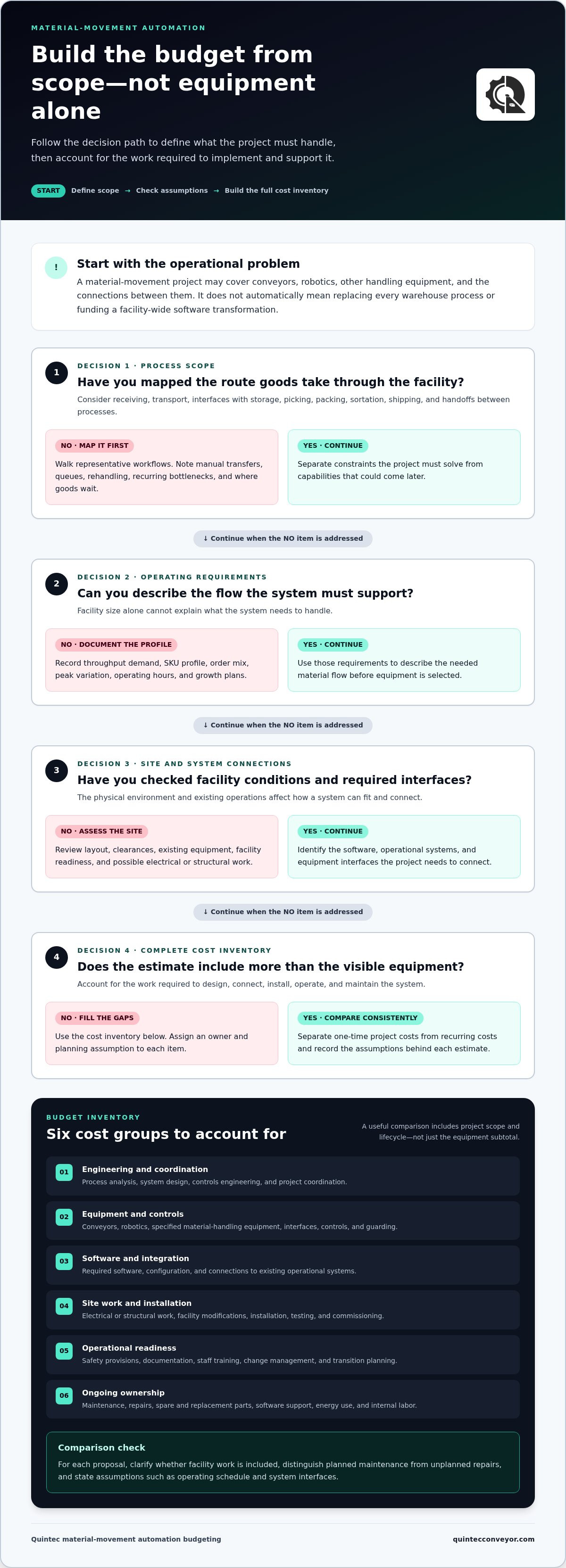
“What should I budget for automating material movement in a mid-sized distribution center?” Start by defining what the investment covers rather than treating the equipment list as the full project scope. An automation budget covers equipment, integration, implementation, and lifecycle planning. A clear scope lets leadership compare proposals consistently and spot work that might otherwise be left out.
Material-movement automation concerns how goods travel through the facility, including conveyors, robotics, other handling equipment, and the connections between them. It doesn’t automatically mean replacing every warehouse process or funding broader digitization, such as a facility-wide software transformation. Let the operational problem set the scope. A project might address transfers between receiving and storage, or connect several movement stages through to shipping. Logistics automation systems can include equipment and software, so specify which functions are part of the distribution center project and which are not.
Scope also reflects the operation’s order profile, required throughput, operating hours, and growth plans. A system designed for steady flows may need a different configuration from one that must handle pronounced peak-season variation. Process engineering helps translate these operating conditions into a defined material flow before equipment is selected.
Which material-movement processes are in scope?
Map the route goods take through the facility, including handoffs between processes. Consider receiving, transport, interfaces with storage, picking, packing, sortation, and shipping. The goal isn’t to automate every step by default. It’s to identify where movement, accumulation, or handoffs create constraints.
Walk through representative workflows and document manual transfers, queues, rehandling, and recurring bottlenecks. For example, note where pallets wait for a transfer or where orders repeatedly move between work areas. Separate constraints the project must solve from capabilities that could come later. This keeps the initial scope focused while giving phased expansion a clear direction.
Why facility size alone cannot determine the budget
Square footage provides context, but it doesn’t explain what a system must handle. Compare throughput demand with SKU profile, order mix, and peak variation. A facility processing a broad mix of small orders may have different movement requirements from one handling fewer, larger loads, even if both occupy similar space. Operating hours also shape the flow the system must support.
The physical environment matters just as much. Layout, clearances, existing equipment, and facility readiness affect how a proposed system can fit and connect to current operations. One site may accommodate a straightforward conveyor route; another may require more coordination among equipment, infrastructure, and processes. These differences shape engineering and integration needs, so facility size alone can’t establish a reliable budget.
Use the initial scope definition to describe the required flow, key constraints, and future considerations. With those assumptions documented, identify the cost categories needed to implement and support the system.
Which Costs Should a Material-Movement Automation Budget Include?
A complete cost inventory helps you compare proposals without mistaking a low equipment subtotal for a lower total investment. If you’re asking, “What should I budget for automating material movement in a mid-sized distribution center?”, include the work required to design, connect, install, operate, and maintain the system. Separate one-time project costs from recurring costs, and record the assumptions behind each item, such as operating schedule, facility modifications, and systems the automation must interface with.
Use this checklist to organize estimates and identify gaps:
- Engineering and coordination: Process analysis, system design, controls engineering, and project coordination.
- Equipment and controls: Conveyors, robotics, specified material-handling equipment, interfaces, controls, and guarding.
- Software and integration: Required software, configuration, and connections to existing operational systems.
- Site work and installation: Electrical or structural work, facility modifications, installation, testing, and commissioning.
- Operational readiness: Safety provisions, documentation, staff training, change management, and transition planning.
- Ongoing ownership: Maintenance, repairs, spare and replacement parts, software support, energy use, and internal labor.
Assign an owner and planning assumption to each item. For example, state whether facility work is included in the project scope and distinguish planned maintenance from unplanned repairs. This creates a practical comparison framework without relying on a single headline figure.
One-time project and implementation costs
Project costs cover the work required to specify the system and bring it into operation. Include process analysis, layout and system design, controls engineering, and coordination alongside the equipment. Account for interfaces with existing operations, as well as guarding and site modifications identified during planning. Installation is only one milestone. Testing, commissioning, documentation, staff preparation, and a planned operational transition also need defined scope. Integrated engineering brings these elements together before you compare commitments.
Recurring and lifecycle costs
Ownership costs continue after commissioning. Plan for preventive maintenance, repairs, replacement parts, software support, and energy consumption. Include internal time for training staff, supervising system operation, and managing process changes. The effort depends on the system and operating model, so state your assumptions rather than treating these costs as incidental. A recurring-cost view can reveal differences between scopes that appear similar at purchase.
Project capital costs fund design, equipment, and implementation; recurring ownership costs support the system’s operation and upkeep over time. Compare options across the same planning horizon and use consistent assumptions for maintenance, support, energy, and internal labor. A narrower scope may require less equipment but leave more manual work in place; a more connected system may have different integration and support needs. The goal is to make these trade-offs visible, not to assume one approach costs less.
Quintec Conveyors' design, engineering, and installation services bring conveyors, robotics, infrastructure, and process engineering into a connected scope discussion. Use integrated material-handling systems as the basis for aligning implementation needs with lifecycle planning, then carry those same assumptions into the business case.
How Do Automation Scope and System Choices Change the Investment?
“What should I budget for automating material movement in a mid-sized distribution center?” depends partly on whether the project solves one defined constraint, expands in stages, or connects several operational zones. These scopes differ in equipment, coordination, interfaces, and capacity for later changes. Comparing them against the same operational priorities makes the trade-offs easier to assess.
A targeted project might automate a repetitive transfer between two work areas. An integrated system could connect receiving, transport, storage interfaces, picking, and shipping handoffs. In either case, conveyors, robotics, storage, controls, and software must work within the intended material flow. The industrial conveyor systems guide offers additional context on conveyor equipment and integration.
Targeted automation versus an integrated system
Targeted automation focuses on a specific bottleneck or repetitive movement task, keeping the initial scope tightly defined. Integrated automation coordinates equipment and processes across multiple zones, creating more dependencies to plan around. Neither approach is automatically the better fit. The right choice depends on the constraint to solve, the interfaces involved, and whether future expansion is a priority.
| Scope | Dependencies | Operational impact | Planning question |
|---|---|---|---|
| Targeted bottleneck relief | Defined work area and its equipment interfaces | Addresses a specific movement constraint | Which recurring task or handoff must improve? |
| Phased expansion | Current phase must accommodate planned connections | Adds capability in sequence around operational priorities | What should the next phase connect or enable? |
| Integrated material flow | Coordination across zones, equipment, controls, and software | Connects movement across several process stages | Where must information and materials transfer between systems? |
Phasing, robotics, and storage interfaces
Phasing can align investment with operational priorities, but the sequence needs deliberate planning. Define the intended end state, identify which interfaces belong in the initial design, and distinguish what will be installed now from what may be added later. This helps prevent a short-term change from constraining a future connection. For robotics, map how robot movements interact with conveyor routes, people, and work zones. The warehouse robotics integration guide provides further flow-planning context.
Storage interfaces can also shape the scope. If goods move between conveyors or robotics and warehouse racking, clarify the transfer points, operating sequence, and space each connection requires. The automated warehouse racking systems guide is relevant when storage connections are part of the design. Quintec’s integrated engineering approach considers conveyors, robotics, infrastructure, racking, and process requirements as connected elements, translating operational needs into a tailored system plan.
How Can You Build a Defensible Automation Business Case?
A persuasive business case starts with evidence from your operation, not a projected savings figure chosen to make a proposal look attractive. Document current performance, define how the proposed system could change it, and show which assumptions drive the result. A clear model helps leadership assess benefits and uncertainty side by side.
Choose measurable baseline and outcome metrics
A credible ROI model compares documented baseline performance with defined post-installation measures. Before estimating benefits, establish how work performs today across the process zones affected by automation. Use consistent definitions and measurement periods so later comparisons reflect operational changes, not changes in data collection.
- Set the baseline. Record throughput, order cycle time, touches per order, error rates, labor allocation, downtime, and space use. Where possible, separate normal operating conditions from peak periods.
- Locate the constraint. Measure performance by zone and identify where queues, repeated handling, or delays occur. This connects the proposed equipment to a specific need instead of attributing every facility-wide result to one system.
- Define the expected change. For each relevant metric, describe what should change and how it will be measured after commissioning. For example, a project focused on repetitive handling should identify the task and the corresponding labor or throughput measure.
- Assign accountability. Name the person responsible for each measure, establish baseline and review periods, and schedule post-commissioning checks. This keeps the business case useful beyond approval.
Stress-test payback and implementation assumptions
Model conservative, expected, and growth scenarios using facility-specific assumptions. State the expected volume, operating conditions, and adoption level for each scenario rather than presenting one outcome as certain. Include ramp-up time, training, operational transition, and maintenance requirements. A system may not perform at its planned steady-state level immediately, so show how slower adoption or ramp-up could affect projected benefits.
Handling tasks can help clarify which measures belong in the analysis. If a proposed application involves repetitive placement or transfer, the robotic pick and place systems guide provides context for considering the task within a broader automation plan. Evaluate expected operating changes against the baseline, and don’t assign benefits to functions outside the project scope.
Finally, test the model against peak demand, maintenance needs, and planned growth. Consider whether the expected outcome still makes sense if throughput varies, adoption takes longer, or operating assumptions change. Record these sensitivities alongside the business case and revisit them after installation using the agreed measures.
Quintec’s process engineering and integrated system design connect operational requirements with a defined automation scope. Discuss your material-handling project with Quintec to develop a system plan grounded in your facility’s workflows and measurable priorities.
What Are the Next Steps for Budgeting a Quintec Automation Project?
Turn your budget assumptions into a concise project brief. A clear picture of the operation helps connect the material flow you want to improve with the equipment, engineering, and implementation the project may require. If leadership is asking, “What should I budget for automating material movement in a mid-sized distribution center?”, this brief is a practical starting point for defining scope before comparing capital requirements.
Prepare the operational information for project scoping
Bring together information about current operations and future priorities. It doesn’t need to be a finished engineering package. A process map, facility layout, operating data, and summary of constraints give the project team a useful foundation.
- Workflows and order profile: Map key material routes and describe order types, volume patterns, and throughput targets.
- Operating schedule and variation: Note operating hours, peak periods, and demand changes that affect material flow.
- Facility and existing systems: Share a layout, equipment details, system interfaces, and relevant space or access constraints.
- Current pain points: Identify bottlenecks, recurring delays, manual transfers, and areas where goods are repeatedly handled.
- Project priorities: Define success measures, must-solve issues, potential phases, growth plans, and the stakeholders involved in decisions.
Move from budget assumptions to an engineered scope
With this information, Quintec can review workflows and operational requirements, then develop a tailored system plan. Process engineering clarifies how material should move; conveyor and automation integration connect that flow to equipment and interfaces. Scope development can progress from workflow review to system design and installation planning, with infrastructure, warehouse racking, and conveyor maintenance included where relevant. This connects the budget to the system’s intended operation instead of leaving critical assumptions implicit.
Consider the system as a whole. A conveyor route may need to connect with robotics, storage, existing equipment, or a particular operating sequence. Identifying those relationships early helps define what belongs in the project and what could be planned for a later phase. Quintec’s team brings more than 100 years of collective industry experience to material-handling projects, supporting a structured path from operational needs to an integrated scope.
Before the project discussion, gather available workflow notes, layout, volume information, and priority outcomes. Flag which details are preliminary and which are established operating requirements. That distinction helps focus the conversation on decisions that shape system design, implementation planning, and the budget assumptions leadership needs to evaluate.
Discuss your material-handling project with Quintec to begin translating operational objectives into an engineered project scope.
What Should I Budget for Automating Material Movement in a Mid-Sized Distribution Center?
An automation budget can do more than support an approval decision. Use it as a working reference as operational priorities evolve: record the assumptions behind the scope, identify what would trigger a change, and revisit the plan when volumes, workflows, or growth priorities shift. This keeps investment decisions connected to operational needs rather than an outdated forecast.
If leadership is still asking, “What should I budget for automating material movement in a mid-sized distribution center?”, translate the question into a project conversation grounded in your facility’s objectives. Quintec brings together material-handling expertise to shape an approach around your operational requirements, with custom solutions developed for each project.
Start planning your automation project with Quintec. A well-defined next step can turn a broad investment question into a practical plan and give your team a stronger foundation for moving forward.
Frequently Asked Questions
How much does it cost to automate a mid-sized distribution center?
There’s no reliable single price for automating a mid-sized distribution center because the investment depends on workflows, equipment, interfaces, and implementation requirements. A project addressing one movement task differs from one connecting multiple zones. For a useful estimate, define what the system must do, what existing equipment it must work with, and what facility changes it requires. Then compare proposals with matching scope and lifecycle assumptions.
What costs are often overlooked when budgeting for warehouse automation?
Costs can be missed when planning focuses on equipment rather than the operational transition. Consider temporary workflow changes during installation, staff time spent supporting testing, production impacts during cutover, and the effort required to update operating procedures. Also clarify responsibility for preparing work areas and coordinating interfaces with existing systems. These details help prevent implementation tasks from appearing as unexpected additions after the project is underway.
Can a distribution center automate material movement in phases?
Yes. A phased approach can start with a defined operational constraint and add connected capabilities as priorities evolve. For example, a first stage might improve a transfer between two zones, while later stages extend movement to storage or shipping. Plan the intended future flow early, including space and connection points, so an initial installation can support expansion without assuming every later phase will be identical.
How do I estimate the ROI of material-handling automation?
Estimate ROI by comparing documented operating benefits with the full investment and ongoing ownership requirements over a stated period. For example, assess changes in labor allocation, throughput, handling touches, errors, or downtime only where the proposed system can reasonably affect them. Build conservative and expected cases, identify the assumptions behind each, and review actual results after commissioning. Avoid treating projected labor changes as guaranteed cash savings.
Does warehouse automation require new software or systems integration?
Not always. A project may use existing systems, require interfaces to coordinate equipment, or call for software changes, depending on how work is directed and information is exchanged. Map the current flow of instructions and status updates between operational systems and equipment. A conveyor or robotic process that operates independently has different connection needs from one that must respond to order or inventory information.
How long does it take to implement distribution center automation?
Implementation timing depends on the defined scope, design requirements, equipment interfaces, facility work, and operational transition plan. A focused installation and a multi-zone integration involve different coordination. Establish milestones for workflow review, design, site preparation, installation, testing, and commissioning, then identify operational constraints that could affect sequencing. Develop the schedule around the facility’s specific requirements rather than assuming timing based on size alone.
What information should I prepare before requesting an automation budget?
Prepare a recent process map, representative order and volume data, throughput targets, operating schedule, and a facility layout showing current equipment. Add examples of recurring delays or handling issues, along with relevant system interfaces and site constraints. Clearly label measured facts separately from estimates. This helps the project team understand where more operational observation may be needed before developing a dependable scope.
How can automation reduce labor requirements without disrupting operations?
Start by identifying repetitive movement tasks and deciding how affected employees could be redeployed to other work, rather than assuming headcount will automatically fall. Plan training and communication around new responsibilities, and introduce changes in a sequence that fits operational needs. For example, validate a new material route during a controlled transition before extending it across additional workflows. Track service, throughput, and workload measures during the change.