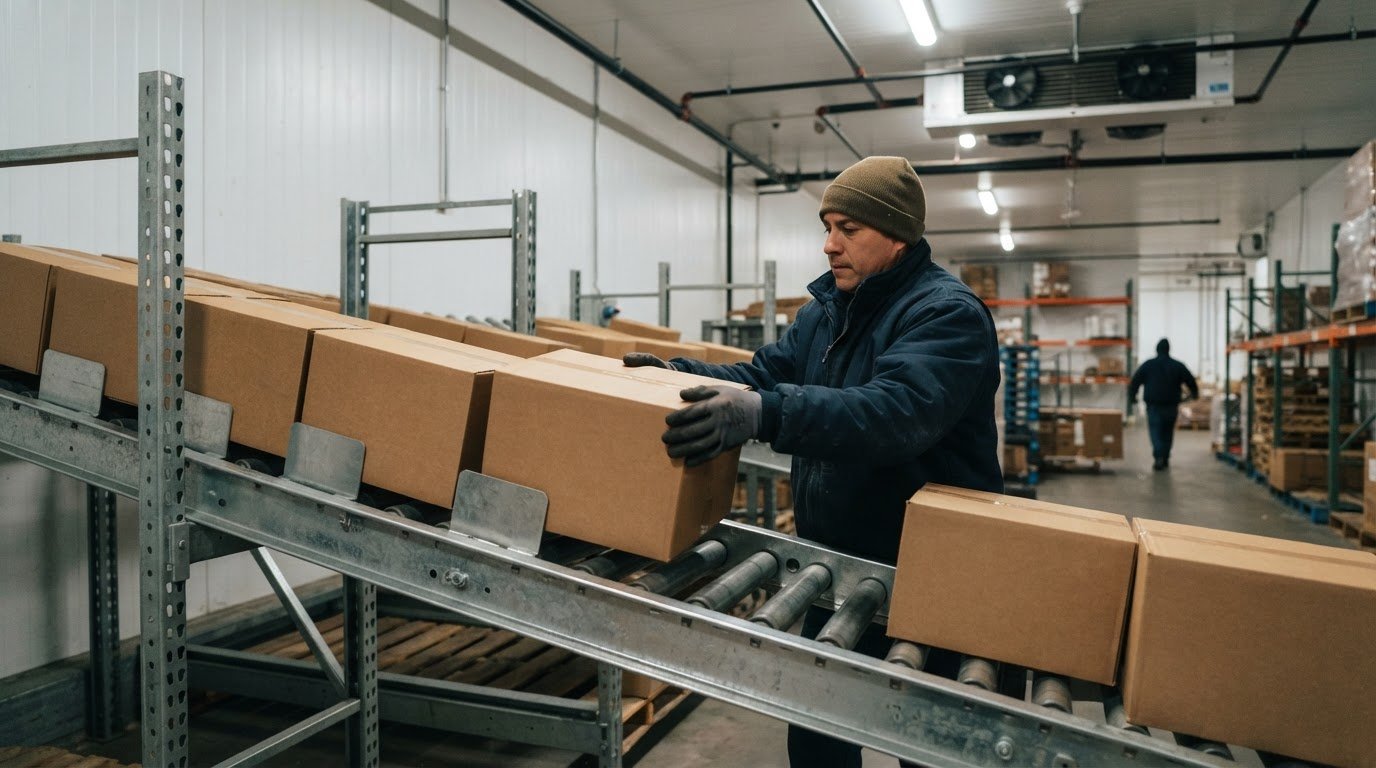
Cold storage doesn’t automatically rule out carton flow. Carton flow racking solutions can support cooler and freezer picking when the design accounts for operating conditions, products, and picking methods. The key is to match the flow track and lane arrangement to the inventory, not simply choose a rack.
It’s reasonable to ask how gravity-fed movement and stock rotation will work in a temperature-controlled area. The right configuration depends on whether your team picks full cases or individual items, how cartons travel through each lane, and how the operation maintains first-in, first-out rotation.
This guide explains where carton flow fits in cooler and freezer operations, how full-case and split-case picking differ, and what roller-track and wheel-bed options mean for your layout. You’ll also learn how FIFO works and which design considerations matter, so you can assess whether carton flow suits your facility.
Key Takeaways
- Assess cooler and freezer picking needs alongside product type and lane layout to determine where gravity-fed flow may fit.
- Match full-case or split-case picking to lane size and the way workers access inventory.
- Understand how roller tracks, wheel beds, rails, dividers, and presentation trays shape carton movement and product access.
- See how rear loading and forward movement support FIFO rotation, including for inventory with a shelf life.
Applications for full-case and split-case picking
Carton flow suits operations that pick boxed goods, including perishable products, retail orders, and pharmaceutical inventory. It supports both full-case picking and individual-item picking from open cases.
Gravity-Fed Picking Operations
Inclined shelves fitted with rollers or wheels move cartons by gravity from the loading side toward the pick face. Operators load inventory at the rear, and each carton advances as the one ahead is picked. Movement depends on carton weight and condition, along with lane design, so these factors guide track selection.
Full-case picking removes entire cartons or cases, making it suitable for replenishment and orders shipped in case quantities. These operations typically use larger lanes. Split-case picking serves orders for individual items from open cases, which can suit high product variety and smaller orders. Smaller lanes help organize these picks.
Picking Productivity and Accuracy
As workers remove stock, cartons advance to the front, reducing repeated reaching into the rack and keeping the pick face accessible. Presenting the next carton in the same location can streamline picking. Clear lanes also help distinguish products, supporting accurate selection when different items share a work area.
Choose the application around the goods and order profile. A distribution center handling full cases may prioritize wider lanes and steady replenishment. A retail or e-commerce operation with many individual-item picks may need smaller, clearly separated lanes. In either case, matching lane dimensions and flow components to the cartons helps maintain movement and efficient picking. Carton flow can also replenish a pick face from reserve stock farther back in the same lane.
Where is Carton Flow Rack Used?
Carton flow racks suit distribution centers, retail operations, pharmaceutical facilities, and other sites handling boxed goods. A flow rack retrofit can add gravity-fed case picking to existing pallet racking when the rack configuration supports the change.
In a carton flow rack, inclined tracks and wheels move cartons from the loading side to the pick face. Flow beds can rest on pallet rack beams, making a retrofit possible within an existing bay. Design and installation must account for the rack opening, lane layout, carton dimensions, and load. These details determine how the tracks fit and how inventory travels.
Carton flow differs from pallet flow in the load and picking scale. Carton flow presents individual cartons or cases for picking; pallet flow moves pallet loads through storage lanes. Shelving provides static storage unless fitted with flow components, while a flow rack uses gravity-fed tracks to advance cartons. Combining systems can support different inventory types: carton flow may work alongside selective pallet racking, push-back racking, or FIFO live pallet racking.
Professionals size capacity and dimensions around the stored material, carton weight and size, lane depth, track support, and pallet rack geometry. Installation planning also considers loading and picking access, so the layout supports case picking without obstructing adjacent operations. A retrofit assessment brings these factors together before components are specified.
For United States installations, safety planning should account for applicable workplace requirements, rated loads, rack condition, and installation details. Quintec prioritizes employee safety and follows all OSHA requirements and regulations. Maintenance focuses on keeping tracks and wheels clear, aligned, and undamaged to support carton movement. Common operational risks include blocked lanes, damaged cartons, and unsuitable loads.
US operations can source systems through rack manufacturers and material-handling integrators. The right supplier can assess the existing pallet rack and coordinate a compatible flow design. A pallet rack retrofit design can help minimize disruption while adding carton picking capacity.
What is the difference between roller track and wheel-bed carton flow?
Roller-track and wheel-bed designs both move cartons forward, but support the load differently. The carton range, lane layout, and required capacity help determine which flow rack system fits the warehouse.
Roller Tracks and Wheel Beds
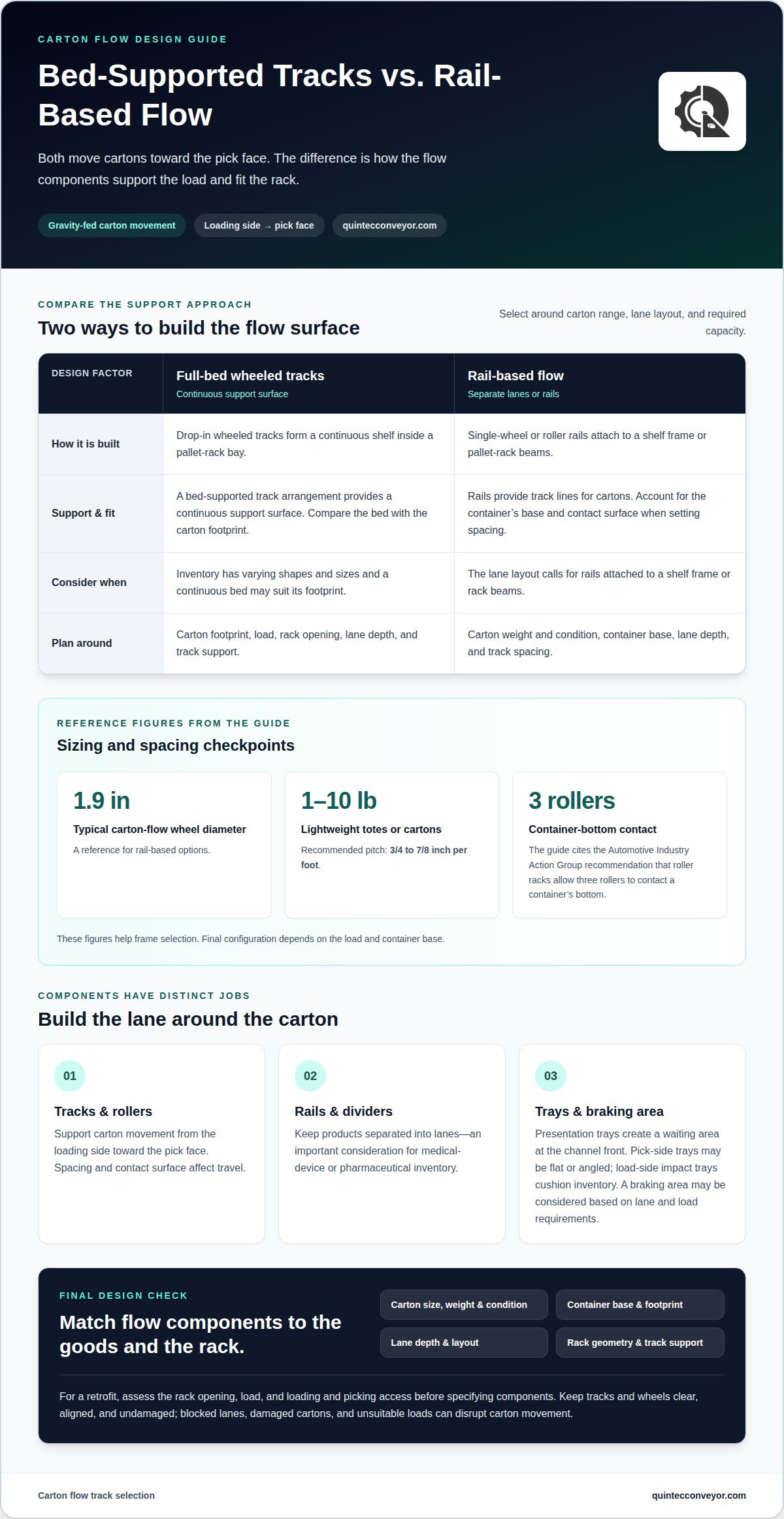
Roller-track carton flow may use a bed-supported track arrangement, while some rail configurations attach to rack or shelf beams. Full-bed systems use drop-in wheeled tracks to form a shelf inside a pallet-rack bay. This creates a continuous bed that can suit inventory with varying shapes and sizes. Compare the support surface with the carton footprint during design and installation.
Rail-based options can use single-wheel or roller rails attached to a shelf frame or pallet-rack beams. Carton-flow wheels are typically 1.9 inches in diameter. For lightweight totes or cartons weighing 1 to 10 pounds, a recommended pitch is 3/4 to 7/8 inch per foot. These figures help frame the selection, while the load and container base guide final configuration.
Rails, Rollers, and Dividers
Spacing matters: according to the Automotive Industry Action Group, roller racks should allow three rollers to contact a container’s bottom for smooth flow. Closer wheel or roller spacing can support reliable movement when carton condition and weight affect travel. The design should also account for lane depth and the container’s contact surface.
Rails and full-length lane dividers keep products separated, an important consideration for medical-device or pharmaceutical inventory. Presentation trays create a waiting area at the channel front, while pick-side trays can be flat or angled to improve carton visibility. Load-side impact trays cushion inventory before it reaches the rollers. A braking area may also be considered based on lane and load requirements.
These components serve different roles: tracks support movement, dividers organize lanes, and trays manage loading or presentation. Selecting them together helps match the installation to the cartons and picking process, rather than treating roller or wheel choice as an isolated decision.
FIFO inventory rotation
Carton flow supports first-in, first-out inventory management by loading stock from the rear aisle and picking it at the front. Each new carton enters behind the existing inventory, leaving earlier stock ahead of later stock. This sequence helps rotate goods with a shelf life, such as dated packaged products.
During loading, operators place cartons into the lane from the rear access point. Gravity moves inventory toward the front pick face as space opens. When a worker removes the leading carton, the next advances into position. This movement makes the lane’s physical order reflect the order of arrival, supporting FIFO stock management without requiring workers to reach past newer cartons.
Lane design influences how consistently cartons move. Weight, carton condition, and the contact surface affect travel along the flow track. If a carton stalls, inventory behind it may not reach the pick face as intended. Designers account for these characteristics when selecting tracks and supports, while operators keep lanes clear and load cartons correctly. These practices help maintain the intended rotation.
FIFO lanes can also shape warehouse layout. Rear loading and front picking separate replenishment from order selection, which can reduce interference between the activities. In a pick module, distinct load and pick aisles can support movement through busy areas. Shelves arranged for forward flow keep the next carton accessible, helping create an ergonomic pick face and use storage space effectively. The right layout depends on inventory dimensions and weight, replenishment access, and picking activity.
For a project that needs FIFO lanes integrated with warehouse storage, plan a FIFO rack layout around your inventory and loading process.
Quintec Conveyors: Warehouse Racking
Quintec Conveyors can align a warehouse racking project with carton-picking needs and the surrounding material-handling layout. Turn to Quintec when planning new storage or considering how racking should fit with conveyors, robotics and automation, or facility infrastructure.
A practical design starts with the operation: inventory dimensions and weight, picking method, replenishment access, and how goods move through the facility. Bringing these factors together helps define a racking approach that supports the workflow instead of treating storage as a standalone decision.
If you’re assessing carton flow for your operation, contact Quintec Conveyors to discuss your warehouse racking project and its requirements.
Plan the Next Step for Your Cold-Storage Operation
Before committing to a layout, define how carton flow should support the broader movement of goods through your cooler or freezer. Consider the operating environment, packaging, picking workflow, replenishment access, and how storage connects with other material-handling processes. These priorities give the design team a practical basis for aligning the system with your facility.
Carton flow racking solutions are one part of an operation-wide design decision. Quintec Conveyors can bring warehouse racking into context with conveyors, robotics and automation, and infrastructure to shape a coordinated material-handling approach around your facility’s needs.
Share your picking requirements, inventory characteristics, and facility goals to begin a focused project discussion. Contact Quintec Conveyors to explore the next step for your operation.
Frequently Asked Questions
Does carton flow work in cooler or freezer environments?
Carton flow can support temperature-controlled picking when designed for the facility’s operating conditions. The design should account for the storage environment, carton dimensions and weight, lane depth, and picking method. These factors influence track selection and carton movement. For example, a cooler handling varied case sizes needs a layout that supports each carton’s stable travel to the pick face.
Can carton flow handle heavy cartons or totes?
Carton flow is designed for individual medium-weight loads, and track selection should reflect the carton or tote’s weight and base. Heavier cartons weighing 30 to 60 pounds could require a pitch of 1″ or more. Track depth and load weight can also determine whether intermediate supports are needed. These considerations help maintain movement without treating every container as suitable for the same lane setup.
How do professionals configure carton flow to keep different carton sizes moving properly?
Professionals configure lanes around carton dimensions, weight, and the range of products sharing each bay. Full-width carton flow can use adjustable storage lanes and movable guide rails, allowing lane positions to match changing inventory needs. For standard-size inventory, dedicated lanes provide a defined path for each carton type. A varied carton range may call for a full-bed arrangement that supports different shapes and sizes.
What are carton flow roller centers or wheel centers and how do they impact material flow?
Roller or wheel centers describe the spacing between one roller or wheel center and the next along a track. Spacing affects how much of a carton’s base is supported as it moves. The Automotive Industry Action Group recommends roller spacing that lets three rollers contact a container’s bottom for smooth flow. Carton weight, base condition, and track layout also affect movement through the lane.
What is carton flow racking and how does it work?
Carton flow racking solutions use inclined tracks fitted with rollers or wheels to move cartons through a lane. During replenishment, cartons enter from the loading side, while picking takes place from the opposite face. Removing the front carton creates space for the next to advance. This arrangement suits operations that need an organized presentation point for case or item picking.
What types of carton flow rack systems are available?
Carton flow racking solutions include dedicated-lane systems, often called span track, roller-track systems, and full-bed wheel systems. Dedicated lanes suit standard-size inventory, while full-bed designs can accommodate varied carton shapes and sizes. Stand-alone units may be static or mobile for temporary inventory, such as seasonal fulfillment. The choice depends on product variety, picking layout, and how the rack integrates with existing storage.

Article by
Jon Huang