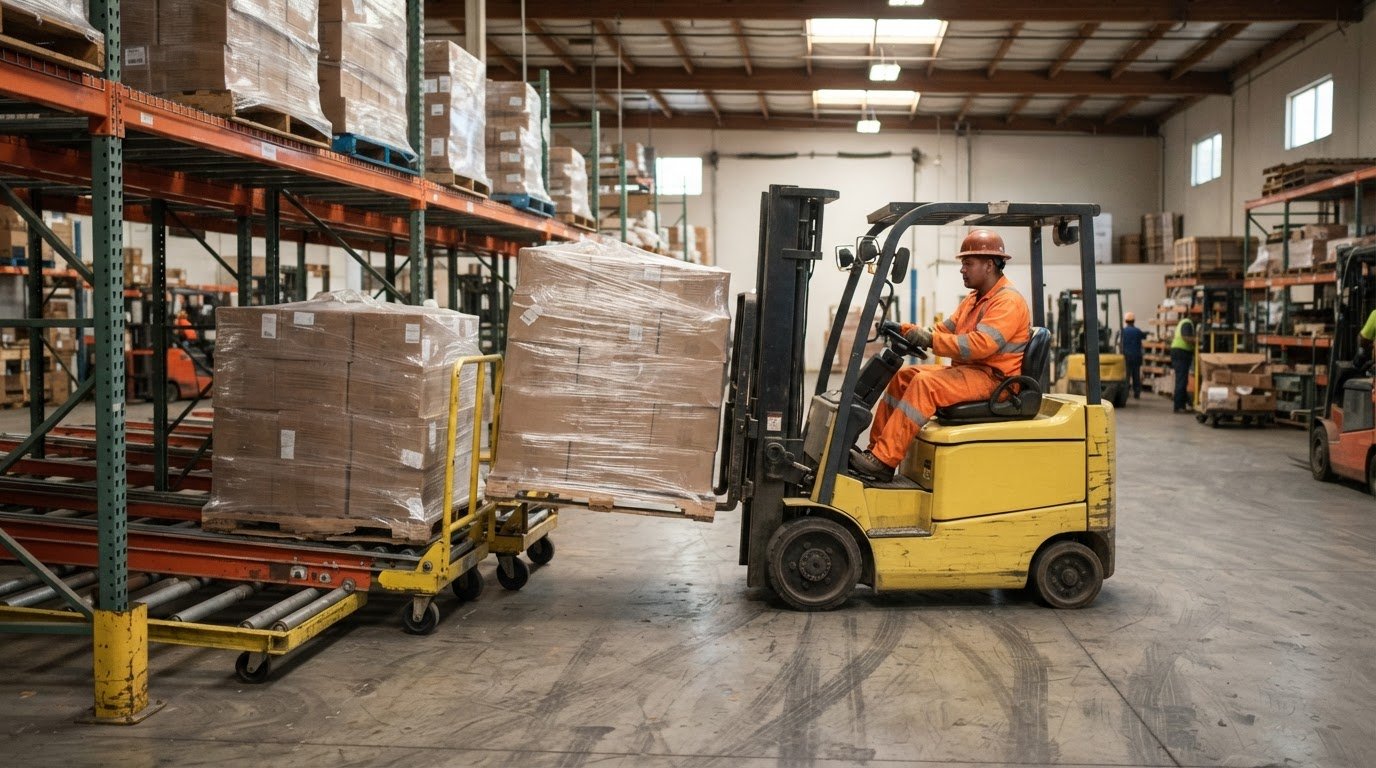
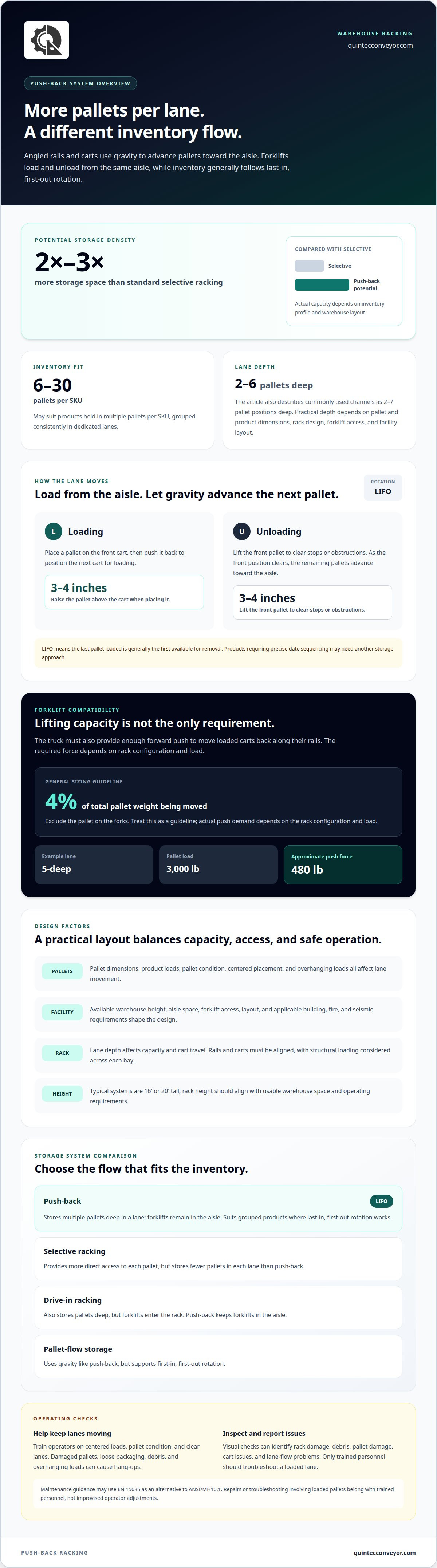
Push back racking system solutions use gravity and angled rails to move pallets through a lane, creating last-in, first-out (LIFO) flow. Forklifts load and unload from the same aisle; when the front pallet is removed, the next one advances. This arrangement can increase storage density when products are stored several pallets deep in each lane.
That density comes with an inventory consideration: the last pallet loaded is generally the first available for removal. Push-back racking suits operations where this rotation works for the products and picking process. It also keeps forklifts out of the rack structure while allowing access to each lane from the aisle.
Choosing a system involves more than selecting rack depth. This article explains how push-back racking works, which inventory profiles it can serve, and how forklift capabilities and layout factors affect a warehouse project. It also shows how installation examples can clarify the system’s role in a broader material-handling plan.
Key Takeaways
- Assess whether your inventory profile suits dense storage in dedicated lanes, especially when multiple pallets share a product line.
- Understand how rack depth, warehouse layout, and operating practices shape system design, installation, and ongoing performance.
- Identify the forklift’s role in moving pallets through the system and the push-force requirement that affects equipment suitability.
- Explore warehouse project examples to see how push-back racking can work alongside other storage systems at different scales.
What is push-back racking used for?
Push-back racking serves warehouses that need dense storage for multiple pallets of the same product. Pallets rest on carts running along angled rails, and gravity advances loads toward the aisle as front positions clear. Depending on the inventory profile and layout, the system can offer up to 2x to 3x more storage space than standard selective racking. Well-planned push back racking system solutions can also reduce the floor area assigned to aisles and individual pallet positions.
Main configurations use carts and rails arranged into lanes of different depths and bay widths. A lane can hold 2 to 6 pallets deep. Designers consider pallet dimensions, product loads, available warehouse height, and forklift access when determining a practical arrangement. Push back racking system solutions work best when products can be grouped consistently in dedicated lanes, rather than mixed across multiple product lines.
Compared with selective racking, push-back stores more pallets in each lane but provides less direct access to each pallet. Drive-in systems also store pallets deep, but forklifts enter the rack; with push-back, they stay in the aisle. Pallet-flow systems also use gravity, but support first-in, first-out rotation. Push-back generally follows last-in, first-out, so products requiring precise date rotation may need another storage approach.
A layout with lanes served from an aisle can suit products held in multiple pallets per SKU. Inventory ranging from 6 to 30 pallets per SKU may fit this approach. High-selectivity operations or products with strict date sequencing may be better served by selective or flow storage.
In the United States, building, fire, and seismic requirements depend on the facility’s jurisdiction and project conditions. Rack design must address the requirements that apply to the warehouse, as well as its layout, stored loads, and operating conditions.
How does a push-back rack system work?
Angled rails and carts use gravity to move stored pallets toward the aisle as front loads are removed. Design and installation must account for pallet dimensions, lane depth, structural loads, forklift access, and operating practices.
Warehouse-racking manufacturers and installers serve different locations across the United States. Project suitability depends on the facility layout, stored loads, and applicable building conditions. Professional design addresses these factors before installation and operator training.
The price of used Interlake push-back rack varies with equipment condition, configuration, capacity, and completeness. Assessing these details helps determine whether the system fits the planned warehouse layout and stored loads.
Loading and Unloading
During loading, the forklift places a pallet on the front cart, then pushes it back to position the next cart for another load. The operator should raise the pallet approximately 3 to 4 inches above the cart when placing it. During unloading, lifting the front pallet approximately 3 to 4 inches clears stops or obstructions; the remaining pallets then advance toward the aisle.
Training should cover centered loads, pallet condition, and clear lanes. Damaged pallets, loose packaging, debris, and overhanging loads can cause hang-ups. Only trained personnel should troubleshoot a loaded lane.
Channel Depth and Rack Height
Push-back systems commonly provide 2 to 7 pallet positions deep per lane, depending on pallet and product dimensions, rack design, forklift access, and facility layout. The selected depth affects capacity and how far carts travel during loading and unloading. Typical systems are 16′ or 20′ tall, so rack height must align with the warehouse’s usable vertical space and operating requirements.
Professional design accounts for structural loading across each bay. During installation, the rails and carts are aligned so pallets can move through the channel as intended.
Regular visual checks can identify rack damage, debris, pallet damage, cart issues, and lane-flow problems. Report issues when noticed; maintenance guidance may use EN 15635 as an alternative to ANSI/MH16.1. Repair or troubleshooting involving loaded pallets belongs with trained personnel, not improvised operator adjustments.
Forklift requirements
Forklift suitability depends on the push force required by the rack and the loads being handled. The truck moves pallets forward into the lane, while the rack’s carts and rails guide their movement.
Forklift Compatibility
Compatibility starts with the force needed to push the loaded carts back along their rails. A general sizing guideline calls for a forklift able to push 4% of the total weight of the pallets being moved, excluding the pallet on the forks. That figure helps frame equipment selection, but the actual demand depends on the rack configuration and load.
For example, a five-deep system carrying 3,000-pound pallets has an approximate push-force requirement of 480 pounds. This example shows why pallet weight and lane depth matter together. A forklift selected only for its lifting capacity may not suit the rack system’s forward-push requirement.
Forklift Access and Damage Reduction
Unlike drive-in racking, push-back keeps the forklift in the aisle during loading and unloading. The truck places a pallet at the front and pushes the carts back instead of entering the rack. Keeping equipment outside the structure reduces the uprights’ exposure to forklift impacts.
That advantage depends on trained operators and maintained equipment. Forklifts still need enough aisle space to align loads with the lane and push them forward without striking the rack. Pallet condition, centered placement, and clear travel paths also affect smooth movement through the system.
During project design, the installer considers load weight, pallet dimensions, lane depth, forklift access, and rack configuration together. These factors help determine the required push force and whether the equipment can serve the planned lanes. For example, in a five-deep lane, the forklift must move several loaded carts, not just lift the pallet on its forks.
Operators should be trained on the specific loading sequence and lane behavior. They need to understand how the carts move and what to do if a pallet stops moving. Trained operation, clear aisle access, and regular equipment and rack maintenance support consistent loading and help limit impacts to the uprights.
Installation examples and warehouse projects
Dufry’s Miami warehouse illustrates how push-back racking can sit within a larger storage plan. The facility covers 150,000 square feet and has capacity for 9,200 pallets across adjustable pallet racks and push-back racking. That combined figure describes the warehouse’s storage systems, not push-back capacity alone. The distinction matters when evaluating a project example.
The same Miami facility provides direct access and storage for 30,000 SKUs. This shows why project capacity and product variety need separate consideration. A high SKU count does not mean every item belongs in a deep push-back lane. The inventory profile determines which products can be grouped and stored efficiently while preserving the access the operation needs.
For a new warehouse, planning starts with the facility footprint, pallet requirements, product mix, and access needs. Designers can then position dense pallet racking where multiple pallets of the same product can share a lane. Aisle placement, rack height, and forklift operating space all shape how the layout works after installation.
The rack’s incline and cart arrangement matter too. Loads must move through each lane as intended, so the design should reflect pallet dimensions and operating conditions. Installation brings the structural layout and planned storage positions together. Operator training supports consistent loading and retrieval once the system is in use.
Use the Miami example as a planning reference, not a template: its 9,200-pallet capacity combines two rack types, while its 30,000 SKUs signal a separate access consideration. For another warehouse, the useful comparison is how storage capacity, product variety, and picking requirements fit together. Project examples help frame those decisions; they don’t replace a layout designed for the facility’s actual inventory and operations.
Quintec Conveyors: Warehouse Racking
Quintec Conveyors helps warehouse teams assess Warehouse Racking as part of a broader material-handling plan. Consider its offering when evaluating whether push-back storage fits your inventory, aisle layout, forklift operation, and available facility space.
A considered project also accounts for how racking relates to Conveyors, Robotics & Automation, and Infrastructure. This broader view helps align storage positions with product movement and operational needs instead of treating each system as a separate decision. To discuss your project in context, outline your products, pallet requirements, and warehouse priorities.
Contact Quintec Conveyors to discuss your warehouse racking requirements.
Plan the Next Step for Your Warehouse
Turn operational priorities into a clear project brief. Identify which products need dense storage, how inventory moves through the facility, and where future growth may change those needs. This gives the design process a practical foundation, rather than making rack capacity the only measure of success.
Push back racking system solutions can form part of a broader warehouse plan alongside Conveyors, Robotics & Automation, and Infrastructure. Considering these elements together can help align storage with material movement and facility requirements. The right configuration should support current operations while allowing for planning the next phase.
When you’re ready to discuss the project and its warehouse-racking needs, contact Quintec Conveyors about your project. A clear starting point can make the path from planning to a considered storage solution more straightforward.
Frequently Asked Questions
How Can a Provider Prevent Push-Back Rack Hang-Ups?
A provider can reduce hang-up risks by assessing the rack’s flow components and the pallets moving through each lane. The review can cover cart movement, rail condition, debris, and whether pallets are damaged, off-center, or overhanging. These conditions can obstruct travel. A useful operating plan also gives staff a clear way to report flow problems, so troubleshooting stays with trained personnel instead of leading to improvised adjustments.
Need Help Keeping Your Push-Back System on Track?
For a new installation, expansion, or storage redesign, Quintec Conveyors’ Warehouse Racking offering can support project planning. Bring your operational goals, product mix, and facility constraints to the discussion. Routine rack inspections, repairs, and troubleshooting of loaded systems require appropriately trained personnel. A warehouse-racking project does not replace these activities, and conveyor maintenance does not cover rack servicing.
What Should a Provider Check Before Loading Push-Back Pallet Rack?
Before loading, assess whether the rack is ready for the intended loads and operating pattern. This includes its structural condition, rail and cart movement, lane clearance, and pallet suitability. Damaged pallets, loose packaging, debris, and loads extending beyond the pallet can interfere with movement. Ensure operators understand the site’s loading procedure before the rack enters service.
What is a push-back racking system and how does it work?
A push-back rack is a pallet storage system in which each incoming load moves earlier loads farther into the lane. This makes replenishment order important: warehouse teams should plan which product lots occupy each lane and how picking schedules use them. For example, inventory with strict date sequencing may need a different storage approach. Assign lanes according to both product rotation needs and picking workflow.
How much does push-back racking cost per pallet position in the United States?
There is no single fixed U.S. price per pallet position. Project pricing depends on the case and is provided after a quote request. Cost factors include the number of storage positions, rack configuration, lane depth, load requirements, and facility layout. Installation scope and how the system fits into the wider warehouse project also affect the quotation. Compare project scope, not just a per-position figure.
What are typical push-back rack capacity, depth, and aisle requirements?
A push-back lane commonly provides 2 to 7 pallet positions deep, with the practical configuration depending on pallet dimensions, product, rack design, forklift access, and facility layout. Capacity is measured by the positions and loads the designed lanes accommodate. Aisle requirements depend on the operating forklift and the space needed to approach and serve each lane; the warehouse plan determines that clearance.

Article by
Jon Huang