Conveyor Retrofit Services: A Practical Guide to Upgrading Existing Systems
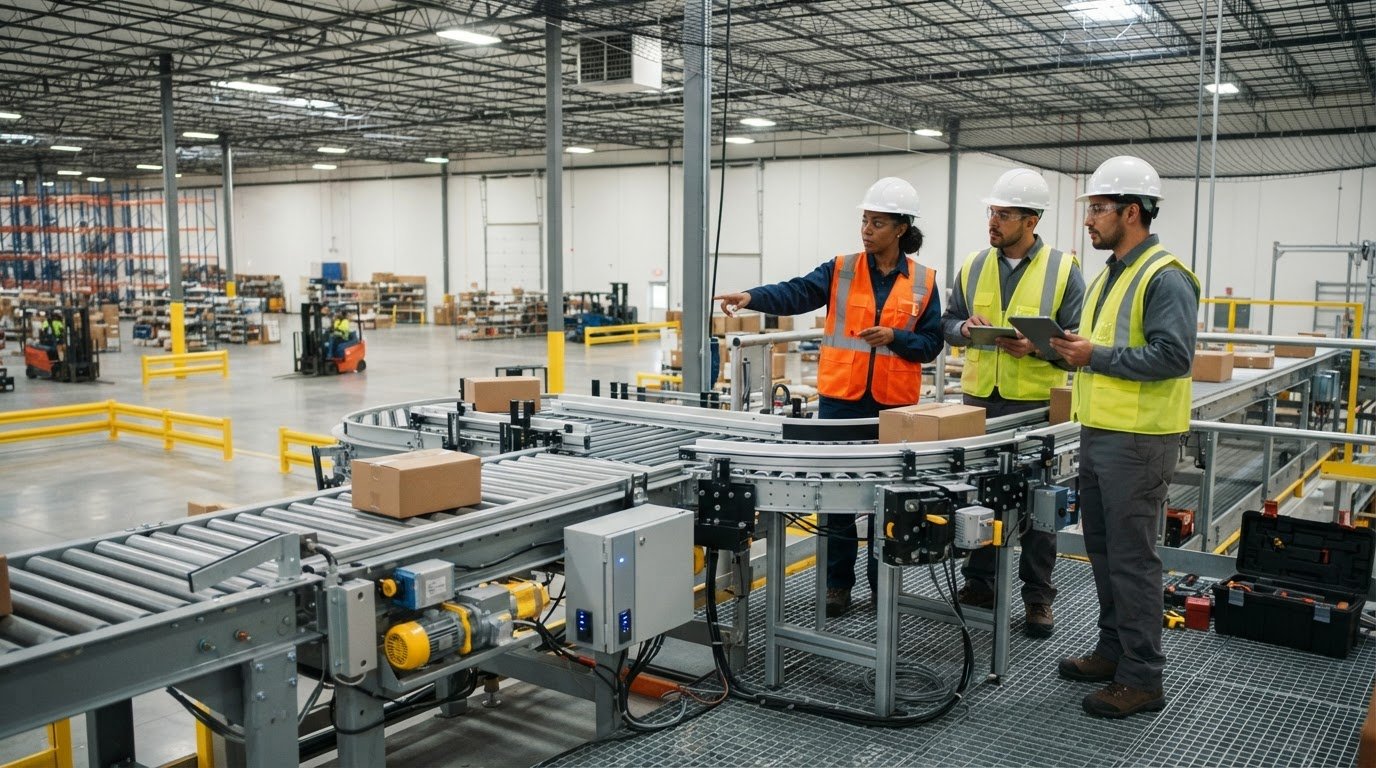
A recurring conveyor bottleneck doesn’t always call for a complete system replacement. The right conveyor retrofit services can address an operational constraint while preserving equipment that still fits your workflow. The key is to determine whether the system’s condition and layout can support the improvement, and how new mechanical or control components will work with existing equipment.
A retrofit still requires careful engineering. Changes need to address the cause of the constraint, fit the system around them, and support a clear operational objective. Quintec Conveyors brings more than 100 years of collective industry experience to conveyor design, engineering, maintenance, and process improvement.
This guide explains when a retrofit may make sense, how to define its scope, and what to consider when integrating equipment and controls with an existing operation. You’ll learn how to plan improvements around workflow, system condition, and measurable goals, so you can make an informed decision about upgrading or replacing your conveyor.
Key Takeaways
- Identify whether recurring bottlenecks, workflow changes, or integration needs point to a targeted upgrade.
- See how process engineering connects conveyor equipment, controls, operators, and downstream workflows.
- Use equipment condition, required capability, and workflow fit to distinguish repair, retrofit, and replacement.
- Prepare for conveyor retrofit services by documenting operating patterns, affected processes, and existing system information.
- Learn how Quintec’s conveyor and material-handling capabilities can support improvements across the wider operation.
What Conveyor Retrofit Services Change, and When an Existing System Needs More
A conveyor retrofit modifies an existing conveyor to meet a defined operational requirement. Instead of replacing the entire line by default, the project targets a gap between what the system can do today and what the operation needs. That may mean adapting equipment to a changed workflow, addressing a recurring restriction in material flow, or enabling a line to work with adjacent equipment.
Conveyors support different material-handling tasks and come in many forms, as the overview of a conveyor system illustrates. The right scope depends on the equipment in place and the outcome required. A project might involve one component or coordinated mechanical and control modifications. The distinction matters: replacing a failed part restores a function, while a retrofit changes or extends what the system can do.
What qualifies as a conveyor retrofit?
Retrofit work can range from updating a transfer point to changing a conveyor’s configuration to better support material flow. A new product mix or revised order-picking sequence, for example, may reveal a mismatch between the existing layout and the way goods now move through the facility. Engineering the change means considering both the affected conveyor and its connections to surrounding processes, rather than selecting a component in isolation.
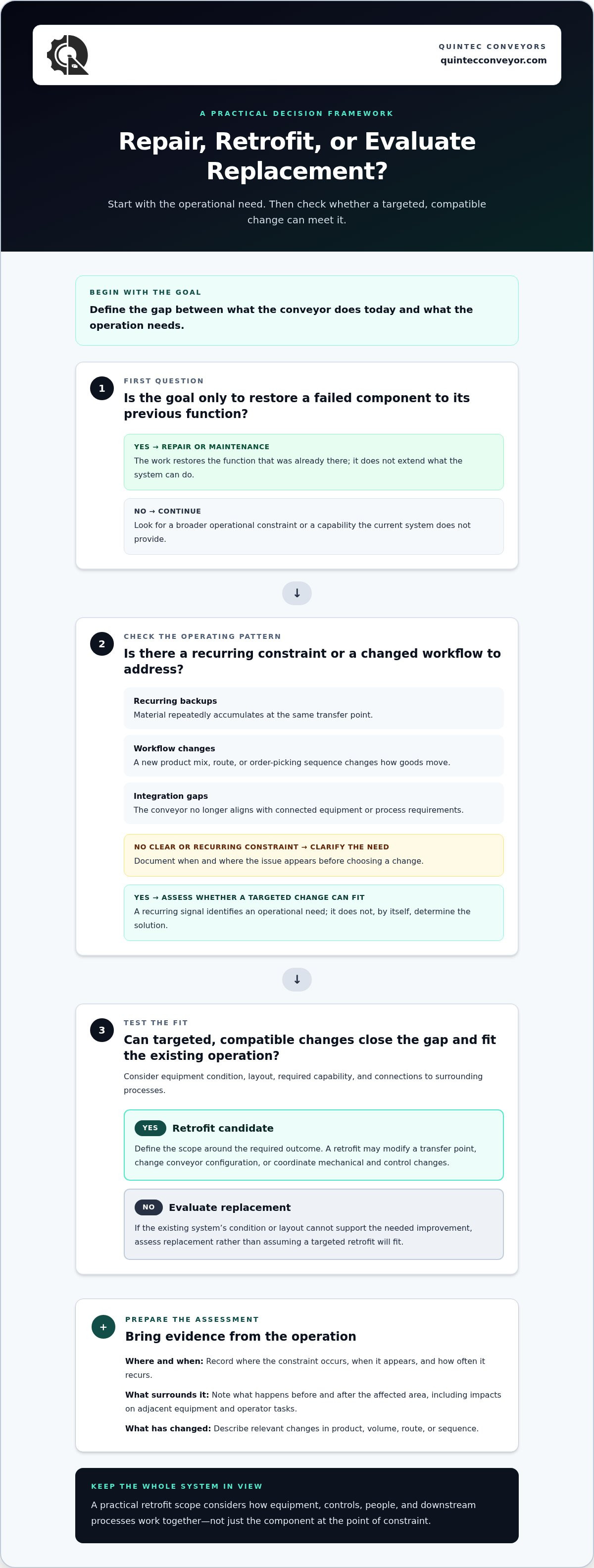
A retrofit is most suitable when targeted, compatible changes can close the gap between current and required performance. If the goal is simply to restore a failed component to its previous function, the work is generally repair or maintenance. If the operation needs a new capability, define the project around that outcome.
Which operating signals can point to a retrofit opportunity?
Look for constraints that recur across operating cycles, not just a single equipment fault. A stoppage caused by one worn component may be isolated. A line that repeatedly backs up at the same transfer point, struggles with a changed product mix, or cannot coordinate with a downstream process may have a broader limitation. These patterns can affect throughput, workflow, reliability, or integration.
Document the constraint before deciding what to change. Record where and when it appears, how often it recurs, and what happens before and after the affected area. Note relevant changes in product, volume, or sequence, as well as impacts on adjacent equipment and operator tasks. This information helps distinguish a local fault from a process issue and gives engineering a clearer basis for defining improvements.
- Recurring backups: Note where material accumulates and which upstream or downstream steps are affected.
- Changing workflows: Describe how new products, routes, or handling sequences differ from the original operating pattern.
- Integration gaps: Identify where the conveyor does not align with connected equipment or process requirements.
These signals don’t automatically mean a retrofit is the right answer. They clarify the operational need so an assessment can focus on system condition, required capability, and changes that address the constraint.
How Conveyor Retrofit Engineering Connects Equipment, Controls, and Workflow
A conveyor change can solve a local constraint and create another one elsewhere if the wider process isn’t considered. Process engineering traces how material moves through the operation, identifies where flow is constrained, and defines what the revised process needs to achieve. That may mean a smoother handoff between steps, a different route through the facility, or coordination with automation.
A retrofit scope should account for the connected material-handling system. Conveyor performance depends on how equipment, controls, people, and downstream processes work together. This systems view ties engineering decisions to operational requirements instead of treating a component choice as the solution on its own.
How process engineering shapes retrofit scope
Start with the material path: where items enter, how they travel, where they transfer, and what happens next. Compare that flow with the intended workflow. If products accumulate before a handoff, for example, the constraint may involve the transfer process or a mismatch between the conveyor and the next operation, rather than a single conveyor component.
Engineering can assess the existing layout and operating conditions against the required outcome. Proposed changes should address the identified constraint while accounting for surrounding equipment and processes. This defines a practical scope: what needs to change, what must remain connected, and how the operation will evaluate whether the modification meets its objective.
What to consider when integrating controls or automation
Existing conveyor controls are part of the integration picture. A retrofit may affect how the conveyor coordinates with adjacent material-handling equipment, warehouse automation, or robotics. The engineering review should consider the intended sequence of operations and handoffs between systems, so changes in one area are evaluated in relation to the rest of the workflow.
For example, introducing a robotic process near a conveyor may require the project team to define how items arrive, how the work area is used, and how material continues downstream. Compatibility depends on the project design and existing system. The Material Handling Industry (MHI) provides broader context on material-handling technologies and industry developments that can inform planning.
- Equipment interfaces: Identify connected conveyors and adjacent systems affected by the change.
- Control interactions: Record how the current process is coordinated and what the revised workflow requires.
- People and process: Consider operator tasks, access to the work area, and downstream responsibilities.
Effective conveyor retrofit services connect the operational objective to these interfaces before equipment changes are finalized. Quintec’s conveyor integration and engineering capabilities help frame existing equipment within the wider material-handling workflow. Explore conveyor integration and engineering as part of planning a coordinated system improvement.
Conveyor Repair vs. Retrofit vs. Replacement: A Practical Decision Framework
Choose the project type by defining the problem first. A repair restores a function, a retrofit changes or extends what an existing conveyor can do, and a replacement introduces a new system when the current one can’t reasonably support the operation’s needs. The decision depends on equipment condition, required capability, workflow fit, and integration needs, not project size alone.
| Option | Purpose and scope | Best fit to assess |
|---|---|---|
| Repair | Restore a failed or damaged component to its intended function. | The system remains suitable for the workflow once the discrete fault is corrected. |
| Retrofit | Modify useful existing equipment to address a defined capability or performance gap. | The system can support the required outcome with engineered changes. |
| Replacement | Install a different system to meet broader or substantially changed requirements. | The existing equipment or layout cannot reasonably accommodate the needed operation. |
These categories describe intent, not project complexity. A repair can involve significant work, while a focused retrofit can be limited in scope. The smallest initial project isn’t automatically the best operational decision: restoring a component may leave a recurring constraint untouched, while retaining unsuitable equipment can limit workflow or integration. Consider the intended outcome and the facility’s wider requirements alongside the immediate fault. This overview of conveyor system upgrade considerations offers additional context for weighing upgrade decisions.
When does a repair address the actual problem?
Repair is appropriate when a discrete fault prevents otherwise suitable operation. If a component fails but the conveyor’s capacity, layout, and connections still fit the process, restoring that function may address the issue. Repeated repairs in the same area, however, don’t necessarily resolve a process limitation. Ask whether the system will meet the required workflow once the fault is fixed.
When might retrofit or replacement be the better fit?
A retrofit may suit a system that remains useful but needs a defined change to meet current performance, workflow, or integration requirements. Consider replacement when the system’s condition, configuration, or limitations make the required capability unreasonable to achieve through modifications. Don’t base the choice on equipment age alone. Assess how the conveyor fits the operation now and how it must fit planned workflows, available footprint, connected equipment, and automation needs.
For conveyor retrofit services, weigh the target outcome against the existing system and facility. Use these questions to guide the decision:
- Is the issue a discrete equipment fault, or does it persist as an operational constraint?
- Can the existing system support the required capability with defined modifications?
- Will the proposed approach fit the workflow, footprint, and connected equipment?
- Would replacement better address the facility’s overall requirements?
An engineering assessment brings these factors together with actual facility requirements. It helps determine whether repair, retrofit, or replacement is the most appropriate path, keeping the decision focused on operational fit rather than the apparent simplicity of the first fix.
How to Prepare for Conveyor Retrofit Services Without Losing Sight of Operations
Good preparation turns an operational concern into a project brief that engineering, operations, and installation teams can use. It also helps account for effects on connected processes. Disruption depends on project scope and facility conditions, so identify dependencies and coordination needs rather than assuming a fixed downtime window.
What information helps define the retrofit requirement?
Start with what the operation needs to change, then gather information about current conditions. A useful brief connects the affected process and observed constraint to a specific improvement, supported by available system records and input from the people who work with the equipment.
How can a facility plan around project disruption?
Map the processes that rely on the affected conveyor and identify dependencies before planning the work sequence. Consider access, installation activities, adjacent equipment, and coordination between engineering and operations. Production impacts vary with project scope and facility conditions, so plan around known constraints and workable contingencies rather than a promised downtime duration.
- Define the constraint. Describe the affected process, what happens, where and when it occurs, and how it affects operations. State the improvement the project should support, such as a revised workflow or more effective transfer between process steps.
- Document operating patterns. Note relevant changes in product, volume, sequence, or operating conditions. Record whether the issue appears consistently or only in particular circumstances. This helps distinguish a persistent project requirement from a temporary operating condition.
- Gather existing system information. Collect available conveyor layouts, equipment details, control information, and maintenance history. Records don’t need to be perfect to be useful. Identify gaps and distinguish observed information from documented information.
- Map affected processes and connections. Identify upstream and downstream operations, adjacent material-handling equipment, and automation or robotics interfaces. Include operator tasks and access needs, since a change can affect how people interact with the work area as well as how material moves.
- Align stakeholders and planning needs. Include operations, maintenance, engineering, and other affected teams in scope discussions. Agree on the intended outcome, what must remain operational, and which access or sequencing constraints to consider during engineering and installation planning.
Maintenance records can add context about recurring equipment issues and service history. Quintec’s conveyor maintenance strategies offer a related perspective on maintaining system performance. For broader project planning, its conveyor system integrator guide can help explain the role of integration in an upgrade.
With the constraint, system records, and operational dependencies organized, the project team has a clearer basis for defining scope and sequencing work. Discuss your conveyor retrofit planning with Quintec to connect operational needs with engineering and integration considerations.
How Quintec Conveyors Approaches Existing-System Improvements
Improving an existing conveyor takes more than identifying a component to change. The project must connect an operational need with the equipment in place and the processes that depend on it. Quintec Conveyors brings conveyor design, engineering, installation, maintenance, and process-engineering capabilities to this work, helping assess how a proposed improvement fits the facility.
The team brings over 100 years of collective industry experience. That experience informs an engineering-led approach: understand the system and its operating role, define the required outcome, then develop a project-specific scope. The goal is to improve the operation without assuming every constraint calls for a complete redesign.
Why consider the full material-handling workflow?
A conveyor connects processes. A change to its route, transfer points, or operating role may affect adjacent equipment and the movement of material before or after it. Considering those interfaces helps keep a targeted improvement aligned with the workflow it supports. For example, an existing conveyor may need to serve a revised process involving other material-handling equipment or robotics and automation.
This broader perspective doesn’t mean every retrofit requires a warehouse or automation redesign. It means the project scope should account for relevant connections, including infrastructure or automation when they affect the intended outcome. Quintec’s integration and process-engineering capabilities help frame conveyor improvements within the larger material-handling operation, so the scope reflects the real requirement rather than an isolated equipment change.
For a wider view of how conveyor equipment fits into an integrated operation, Quintec’s industrial conveyor systems guide provides additional system context. The same principle applies to retrofit planning: understand the conveyor’s role in the full process, then define the improvement around that role.
What to expect when discussing a retrofit project
A useful project discussion begins with three essentials: the operational constraint, the equipment it affects, and the outcome the operation needs. Available layouts, operating information, maintenance history, and details about connected processes can clarify the starting point. You don’t need a finished engineering plan to describe the problem. Clear observations from operations and maintenance are a strong foundation.
From there, engineering and integration considerations shape a scope that fits the existing system and facility. Quintec’s capabilities span design and engineering through installation, with maintenance and process engineering also supporting existing-system improvements. The approach depends on the project, its equipment, and operational requirements. This keeps planning grounded in what the facility needs, rather than presuming a solution before considering the system and workflow.
Ready to discuss your operational constraint and the improvement you’re working toward? Discuss your conveyor retrofit project with Quintec Conveyors.
Set a Clear Direction for Your Next Conveyor Improvement
An existing conveyor can support the next stage of your operation, but the value of any change starts with a clear purpose. Before committing to a scope, decide what an improved process should make possible and how your team will recognize that it’s working. A shared objective gives engineering discussions a practical reference and keeps decisions focused as requirements take shape.
Use that objective to turn operational friction into a considered plan. The right conveyor retrofit services aren’t defined by how much equipment changes, but by how deliberately the project addresses the need. A clear starting point helps your team weigh immediate priorities against the direction of the material-handling operation.
When you’re ready to move from planning to project discussion, bring your operational priorities to Quintec Conveyors. Start planning your conveyor upgrade and take the next step toward an improvement designed around your operation.
A clear objective gives the project a practical direction from the outset.
Frequently Asked Questions
How long does a conveyor retrofit take?
There’s no standard timeline for a conveyor retrofit. Duration depends on the existing system, project scope, facility conditions, and how installation work must be sequenced. Engineering and preparation, such as reviewing layouts and coordinating interfaces, are distinct from on-site work. When planning conveyor retrofit services, include access needs, connected equipment, and operational dependencies in the schedule. Production impacts depend on those project-specific factors, so don’t assume every operation can continue uninterrupted.
Can a conveyor retrofit be completed in phases?
Phased work may be suitable when the system layout, operational dependencies, and project objectives support dividing the work. Each phase needs coordinated engineering, defined boundaries, and clarity about how affected areas relate to one another. For example, a project might address separate sections at different stages if the sequence fits the facility. Phasing doesn’t automatically reduce disruption or suit every system. Develop the sequence around the actual design and operating conditions.
What if the original conveyor drawings or documentation are unavailable?
Missing drawings don’t automatically rule out a retrofit, but they are an important planning consideration. An assessment can document the installed arrangement, equipment, interfaces, and operating conditions using information available at the facility. Maintenance records, operator observations, and current layout details can help build a clearer picture. Understanding the system as it exists supports a better-defined engineering scope and helps identify information needed during project planning.
Can a conveyor retrofit address a bottleneck without changing the whole line?
Yes, a targeted change may address a localized bottleneck if an assessment identifies the cause and the surrounding system can support the modification. A recurring queue at one transfer point, for instance, may warrant close review of that area and its connected processes. Upstream supply and downstream capacity can also contribute to the constraint. Define the objective without assuming a particular throughput gain, since results depend on engineering decisions and operating conditions.
Can existing conveyor controls work with upgraded equipment?
They may, depending on the installed controls, proposed equipment, and required system behavior. An assessment should consider how signals, operating logic, and connected equipment interact, including what must happen during normal operation and at handoffs. Coordinate mechanical changes and controls planning rather than treating them as separate decisions. The interface requirements need to be understood as part of the retrofit design.
How can a business measure whether a conveyor retrofit succeeded?
Define measures before work begins and tie them directly to the constraint the project is intended to address. Depending on the objective, useful measures might include throughput for the affected process, stoppage patterns, or how material moves through a handling step. Compare results under consistent operating conditions and use data the facility can collect reliably. A retrofit doesn’t guarantee a specific improvement, so use the measures to determine whether the agreed operational objective has been met.
Does a conveyor retrofit make sense if the facility expects to expand?
Expansion plans should inform the retrofit scope, especially if they may change material flow, system interfaces, or space requirements. Document anticipated operational changes and distinguish firm plans from possibilities. Then consider the proposed modification in light of the broader system direction without treating future needs as certain or identical across facilities. The assessment should weigh how well the retrofit serves current requirements and fits the facility’s evolving material-handling plan.