Gravity Roller Conveyor Systems: The Strategic Guide to Low-Energy Efficiency
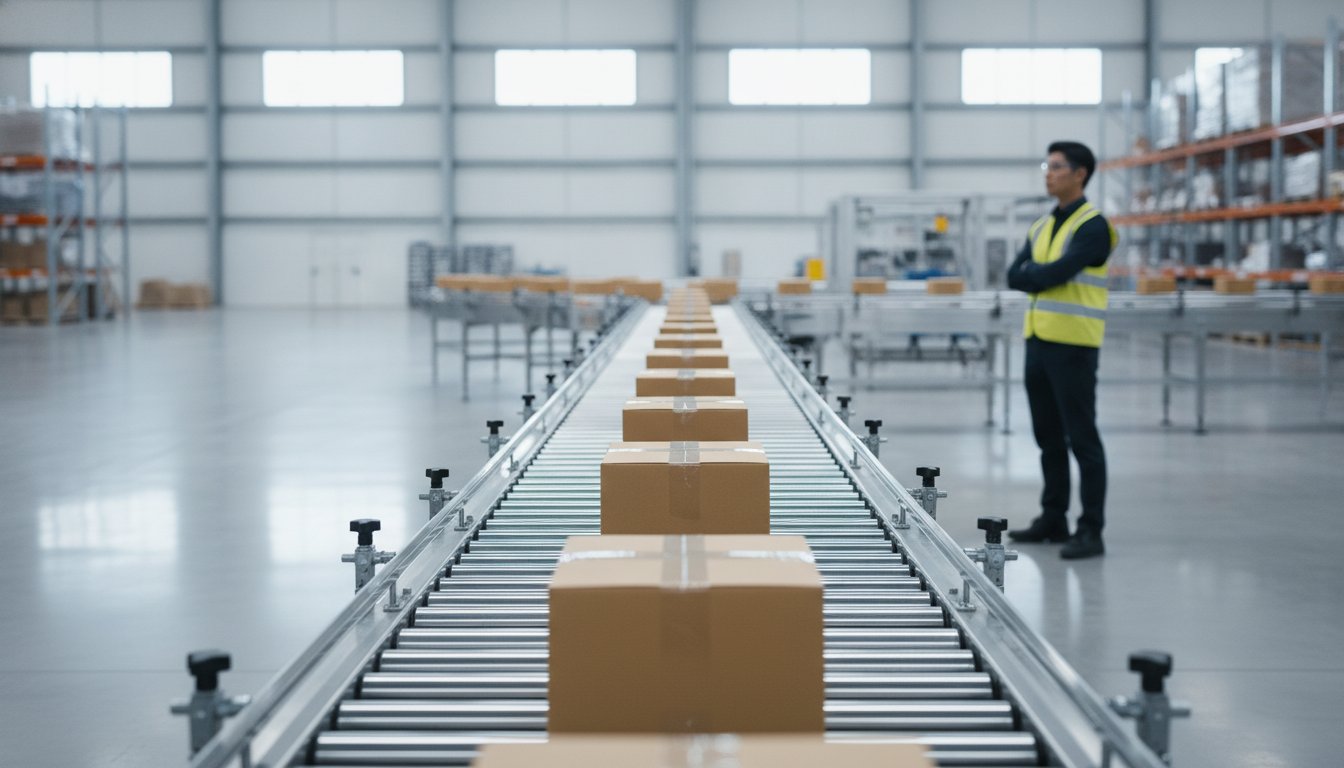
What if the most sophisticated component of your next material handling overhaul required exactly zero kilowatts to operate? In an era where automated facilities are grappling with skyrocketing energy costs, gravity roller conveyor systems represent a strategic, zero-energy engineering tool that many decision-makers overlook. You've likely seen how high maintenance requirements for powered systems can stall productivity, and you don't want to settle for the inefficiencies of manual handling in your sorting zones. It's a common challenge to balance the need for modern excellence with the reality of rising operational overhead.
This guide will show you how to leverage gravity rollers as a high-performance foundation for optimized industrial material handling. By applying seasoned expertise in process engineering, you can achieve a scalable, low-maintenance layout that reduces your energy footprint while integrating seamlessly with existing automated systems. We'll provide a roadmap for evaluating mechanical efficiency, meeting current safety standards, and implementing a steady, reliable flow that ensures your facility is prepared for long-term growth.
Key Takeaways
- Understand how unpowered rollers serve as a zero-energy foundation for the 2026 "Green Warehouse" initiative, reducing operational overhead.
- Learn the technical "three roller rule" to ensure stable product transport and match roller diameters to specific load requirements for maximum durability.
- Evaluate the strategic ROI of gravity roller conveyor systems by comparing their lower capital expenditure against the high maintenance costs of powered alternatives.
- Discover the precision engineering required to calculate the ideal pitch and slope to minimize roller lag and maintain consistent material throughput.
- See how custom gravity solutions integrate with modular conveyor systems to create a scalable and highly efficient facility footprint.
What are Gravity Roller Conveyor Systems?
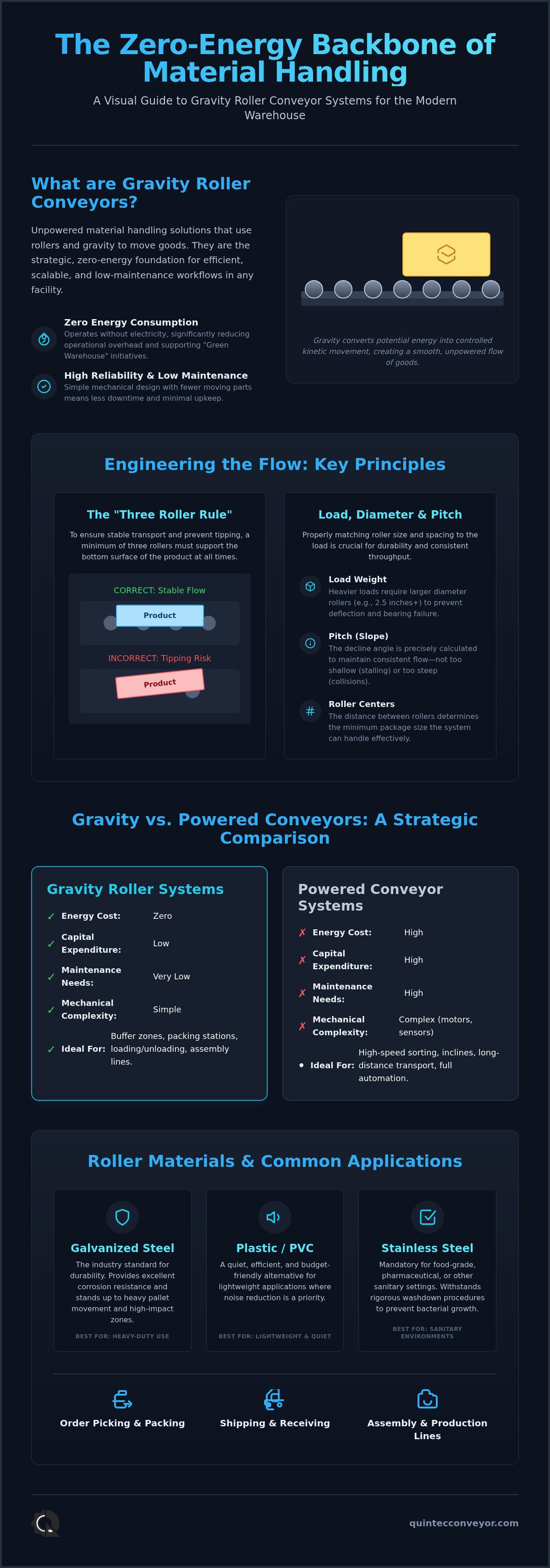
Gravity roller conveyor systems are unpowered material handling solutions that use a series of cylindrical rollers mounted within a frame to move products. Unlike their powered counterparts, these systems rely on the natural force of gravity or manual intervention to transport goods. As a foundational element of any conveyor system, they offer a level of mechanical simplicity that ensures long-term reliability. Within the context of the 2026 "Green Warehouse" initiative, these unpowered rollers have moved from being seen as simple hardware to being treated as strategic assets. They allow facilities to scale throughput without adding to their electrical load.
The architecture of these systems is straightforward but requires precision engineering to ensure longevity. Core components include heavy-duty frames, rollers with specific diameters, internal axles, and robust support structures. Gravity conveyors are the zero-energy backbone of modern material handling. By eliminating motors and sensors where they aren't strictly necessary, companies can focus their automation budget on high-value robotics while maintaining a steady flow of goods across the facility floor.
The Mechanics of Natural Product Movement
The physics behind gravity rollers is elegant. When a system is installed at a slight decline, it converts the potential energy of a stationary object into controlled kinetic movement. Achieving the correct decline angle is a critical engineering task that our team prioritizes. If the angle is too shallow, products will stall. If it's too steep, they risk colliding at high velocity. This makes unpowered systems the ultimate solution for "buffer" zones. These areas act as temporary storage between automated processes, allowing items to accumulate safely without consuming a single watt of power.
Common Industrial Applications
You'll find these systems in environments where human interaction and mechanical efficiency intersect. In order picking and packing stations, they allow workers to slide heavy cartons with minimal physical strain. Shipping and receiving docks utilize them for truck loading and unloading, often using telescopic frames to reach deep into trailers. They're also vital for assembly lines. Here, products move between workstations at a pace dictated by the technician. This ensures a seamless transition from one stage of production to the next without the complexity of timed belts or expensive controls.
Engineering the Flow: Key Specifications and Materials
Precision in component selection determines whether a system thrives or fails under industrial pressure. When designing gravity conveyors, matching roller diameters to the specific load weight is the first step in ensuring mechanical durability. Heavier loads generally require larger diameters, such as 2.5 inches or more, to prevent roller deflection and premature bearing failure. Conversely, the "three roller rule" is the baseline for stability; it dictates that at least three rollers must support the product's bottom surface at all times to ensure smooth movement without tipping. Roller centers, the distance between the center points of adjacent rollers, dictate the minimum package size a system can handle. Selecting the right frame material is equally vital. Steel frames offer the rigidity needed for heavy-duty permanent installations in high-traffic zones, while aluminum provides the portability required for flexible, temporary workflows that change with seasonal demand.
Roller Material Selection
Material choice directly impacts the system's lifespan in specific environments. Galvanized steel is the industry standard for high-impact zones because it provides excellent corrosion resistance and stands up to the rigors of heavy pallet movement. For lightweight applications where noise reduction is a priority, plastic or PVC rollers offer a quiet, efficient alternative that's easy on the ears and the budget. In food-grade or pharmaceutical settings, stainless steel is mandatory to withstand rigorous washdown procedures and prevent bacterial growth. If you're unsure which material suits your facility's unique conditions, our team at Quintec Conveyors specializes in process engineering to help you navigate these technical decisions.
Frame Styles and Support Structures
The skeleton of the system must accommodate both the floor layout and the vertical clearance of your facility. Standard C-channel frames are the workhorse of the warehouse, providing a robust platform for most material handling needs and offering easy mounting for accessories. In facilities with tight vertical constraints, low-profile frames allow for integration where traditional structures won't fit, such as under existing machinery. Stability and safety are maintained through adjustable H-supports, which are essential for precision pitch control. These supports allow engineers to fine-tune the decline angle, ensuring consistent product velocity and preventing the "roller lag" that can disrupt a high-efficiency sorting zone. When properly configured, gravity roller conveyor systems provide a reliable, unpowered foundation for any complex logistical network.
Gravity vs. Powered Conveyors: A Strategic Comparison
Choosing between unpowered and live roller systems is a fundamental decision in facility design. The initial capital expenditure (CAPEX) for gravity conveyor systems is notably lower than powered alternatives. While material costs for gravity rollers typically range between $30 and $80 per linear foot, powered systems require a much higher investment in motors, complex wiring, and sophisticated control logic. Beyond the initial purchase, operational expenses (OPEX) remain the primary driver for unpowered adoption in 2026. Without motors to power or sensors to calibrate, maintenance requirements drop significantly. You don't have to worry about electrical failures or high energy bills in sections where natural movement suffices.
Flexibility is another area where gravity excels. Reconfiguring an automated line often requires a team of electricians and programmers. In contrast, gravity sections can be moved or adjusted by a small maintenance crew in a fraction of the time. This makes them an ideal bridge during facility expansion. You can deploy gravity modules to handle immediate growth while planning for future automation. It's a pragmatic way to scale without committing to permanent, high-cost infrastructure too early.
When Gravity is the Superior Choice
Gravity is the best choice in zones with high human interaction. Picking and packing stations benefit from variable speeds that workers control manually. Decline paths are another obvious win for this technology. Why pay for electricity when physics provides free energy for movement? For seasonal peaks, unpowered rollers offer a modular setup that can be deployed or stored based on volume. This ensures your facility stays lean during slower months while maintaining the capacity to handle surges.
Hybrid Integration: The Best of Both Worlds
Modern engineering rarely relies on a single technology. We often use gravity rollers as "slug" builders. These areas allow products to accumulate safely before being released into high-speed automated sortation. Transitioning from a powered incline to a gravity decline is a standard way to maximize mechanical efficiency. For a deeper look at how these technologies work together, see our guide on Industrial Conveyor Systems: The 2026 Executive Guide to Integration. This hybrid approach ensures you invest in power only where it provides the highest return on investment. It creates a balanced system that is both cost-effective and highly capable.
Calculating ROI through System Design and Pitch
ROI in material handling is often won or lost during the engineering phase. When implementing gravity roller conveyor systems, the calculation of the ideal pitch is paramount. A slope that's too shallow leads to stalled products, while an overly aggressive incline causes velocity issues that damage goods. Determining this slope requires a precise understanding of the friction coefficient between the package and the roller surface. Our engineers also account for "roller lag," which is the momentary hesitation of a roller to reach full rotational speed. Minimizing this lag through precision bearing selection ensures that throughput remains consistent, even in unpowered zones.
The Math of the Decline
Pitch requirements vary significantly based on the material of the load. For standard corrugated cardboard boxes, a decline of 1/2 inch per foot is often the baseline. However, plastic totes with smoother bottoms might require a shallower pitch of 1/4 inch per foot to prevent excessive speed. If the system relies on manual push force rather than a decline, we calculate the exact starting force required to overcome static friction. It's also vital to consider environmental factors. Dust accumulation can increase friction over time, while extreme temperature fluctuations can affect the viscosity of bearing lubricants, altering the system's performance.
Maximizing Throughput without Motors
Strategic design extends beyond straight lines. We often integrate skatewheel conveyors into curved sections because the independent wheels allow for a differential effect that maintains package orientation. For multi-directional sorting, ball transfer tables provide a seamless way for operators to shift products between lines without lifting. These tools are essential components of our Strategic Warehouse Design Services: Engineering Flow for 2026 Logistics. For steep declines, we implement braking rollers or centrifugal speed controllers to maintain a safe, steady pace without electrical controls.
While these systems are inherently reliable, it's a mistake to assume they require zero attention. Regular maintenance cycles are necessary to inspect for debris in the rollers and to check the alignment of the support structures. A proactive approach to bearing inspection and frame stability prevents the minor inefficiencies that can erode your ROI over time. If you're looking to optimize your facility's layout with a high-performance, low-energy solution, contact Quintec Conveyors for a comprehensive system assessment.
Integrating Gravity Systems with Quintec Conveyors
Successful facility optimization requires more than just purchasing hardware; it demands a strategic approach to systems integration. At Quintec Conveyors, we don't view gravity roller conveyor systems as standalone units. We treat them as integral components of a larger, high-performance ecosystem. Our custom engineering process ensures that every gravity section fits your specific facility footprint, maximizing every square foot of available space. This approach allows for seamless integration with modular conveyor systems, providing the flexibility to scale your operations as market demands evolve. By aligning unpowered rollers with automated lines, we create a balanced workflow that prioritizes energy efficiency without sacrificing throughput.
From Design to Installation
Our comprehensive process begins with a detailed site audit to identify bottlenecks and flow opportunities. Following this, we utilize advanced CAD design to map out a solution that addresses your unique logistical challenges. Every proposed layout undergoes rigorous stress-testing to ensure mechanical reliability under peak loads. Engaging a professional conveyor system integrator is essential for large-scale projects where precision alignment is the difference between a smooth flow and constant jams. Our national installation services ensure that all equipment meets strict safety standards. We strictly adhere to OSHA regulations, including 29 CFR 1910.212 for machine guarding and ANSI/ASME B20.1 standards. This ensures your facility remains compliant and your workforce stays safe.
The Quintec Advantage
Choosing a partner with a deep well of collective experience is vital for long-term stability. Quintec Conveyors brings over 100 years of industry knowledge to every project. We apply veteran insight to modern material handling challenges. We don't act as a passive vendor. We position ourselves as a proactive problem-solver and strategic guide for your organization. Our national reach allows us to execute large-scale installations with local-level precision. This ensures your system is built to last. Beyond the initial setup, our proactive maintenance plans provide the ongoing support needed to ensure long-term mechanical reliability. This steady, high-level competence allows you to focus on your core business while we manage the complexities of your logistical infrastructure.
Future-Proofing Your Material Handling Strategy
Operational excellence requires a balance between sophisticated automation and the strategic simplicity of unpowered mechanics. Gravity roller conveyor systems are far more than a budget-friendly alternative; they're a zero-energy foundation for high-efficiency facilities aiming to reduce their energy footprint and maintenance overhead. By prioritizing precision in pitch calculation and material selection, you can ensure a steady, reliable flow of goods that scales with your business needs. It's about making the most of every square foot without increasing your utility bills.
Quintec brings over 100 years of collective industry expertise to every project, ensuring that your custom-engineered solutions are built for high-throughput performance. With our national installation and maintenance coverage, you can trust that your logistical challenges are in capable hands from design to execution. We're committed to acting as your strategic guide, helping you navigate complex industrial planning with confidence. Consult with a Quintec System Integrator Today to start optimizing your facility's layout. Let's work together to build a more efficient, sustainable, and profitable operation.
Frequently Asked Questions
How do I calculate the required pitch for a gravity roller conveyor?
You calculate the required pitch by evaluating the weight and surface texture of your lightest package. A standard starting point is 1/2 inch of drop per linear foot for corrugated boxes. For plastic totes, you might reduce this to 1/4 inch. It's vital to test the flow with a sample load. Factors like bearing friction and roller lag must be accounted for during the engineering phase to ensure consistent movement.
What is the maximum weight capacity of a standard gravity roller?
Weight capacity depends on the roller diameter and wall thickness. A standard 1.9 inch diameter roller might handle 250 pounds, while heavy-duty 2.5 inch or 3.5 inch rollers can support over 1,000 pounds each. You must ensure the frame and support structures are rated for the total cumulative load. Our engineers match these specifications to your heaviest anticipated unit to ensure the longevity of your gravity roller conveyor systems.
Can gravity conveyors be used for heavy pallets?
Yes, gravity systems are frequently used for pallet flow racking and heavy-duty staging areas. These systems utilize larger diameter rollers and reinforced steel frames to manage weights exceeding 2,000 pounds. Safety is paramount here, so we often integrate centrifugal speed controllers or braking rollers. These components maintain a safe, controlled velocity as the pallet moves down the decline, preventing dangerous accelerations in your high-throughput warehouse environment.
What is the difference between skatewheel and roller gravity conveyors?
Skatewheel conveyors use individual wheels mounted on axles, while roller systems use full-width cylinders. Skatewheels are ideal for lightweight items and curved sections because they allow for better tracking and differential speed. Roller systems provide a more stable surface for heavier loads or items with uneven bottoms. Choosing between them depends on your specific product dimensions and the complexity of your facility's footprint. Both offer excellent zero-energy material handling efficiency.
How do I prevent packages from moving too fast on a decline?
You prevent excessive speed by integrating mechanical braking rollers or centrifugal speed controllers into the line. These unpowered devices provide resistance that increases as the roller speed rises, effectively governing the velocity of the package. You can also adjust the pitch of the support stands to create a shallower decline. These precision adjustments ensure that goods arrive at their destination safely without requiring expensive sensors or electronic motor controls.
Are gravity conveyors suitable for washdown environments?
Are gravity conveyors suitable for washdown environments?
Yes, but you must select the appropriate materials for these conditions. Stainless steel rollers and frames are required for food-grade or pharmaceutical washdown zones to prevent corrosion and bacterial growth. We also utilize sealed bearings or specialty lubricants that resist moisture and chemical cleaners. These configurations ensure that your gravity roller conveyor systems remain sanitary and functional even under the most rigorous cleaning protocols in high-hygiene facilities. To find out more about specialized industrial cleaning and sanitation solutions for these environments, consider exploring advanced hygiene systems.
The replacement cycle depends on the intensity of use and the environmental conditions. In a standard clean warehouse, high-quality rollers can last for several years with minimal intervention. However, in high-impact zones or dusty environments, bearings may wear out sooner. We recommend annual inspections to check for debris and bearing noise. Proactive maintenance ensures your system continues to operate at peak mechanical efficiency without the need for sudden, costly overhauls.
Can I integrate gravity sections into an existing powered conveyor line?
Absolutely, gravity sections are often used as "slug" builders or accumulation zones within automated lines. This hybrid approach allows you to save energy in areas where powered movement isn't strictly necessary. Integration requires precision alignment of the frames and a clear understanding of the transition points between powered belts and unpowered rollers. Our team specializes in this type of systems integration to create a seamless, cost-effective workflow for your facility.