
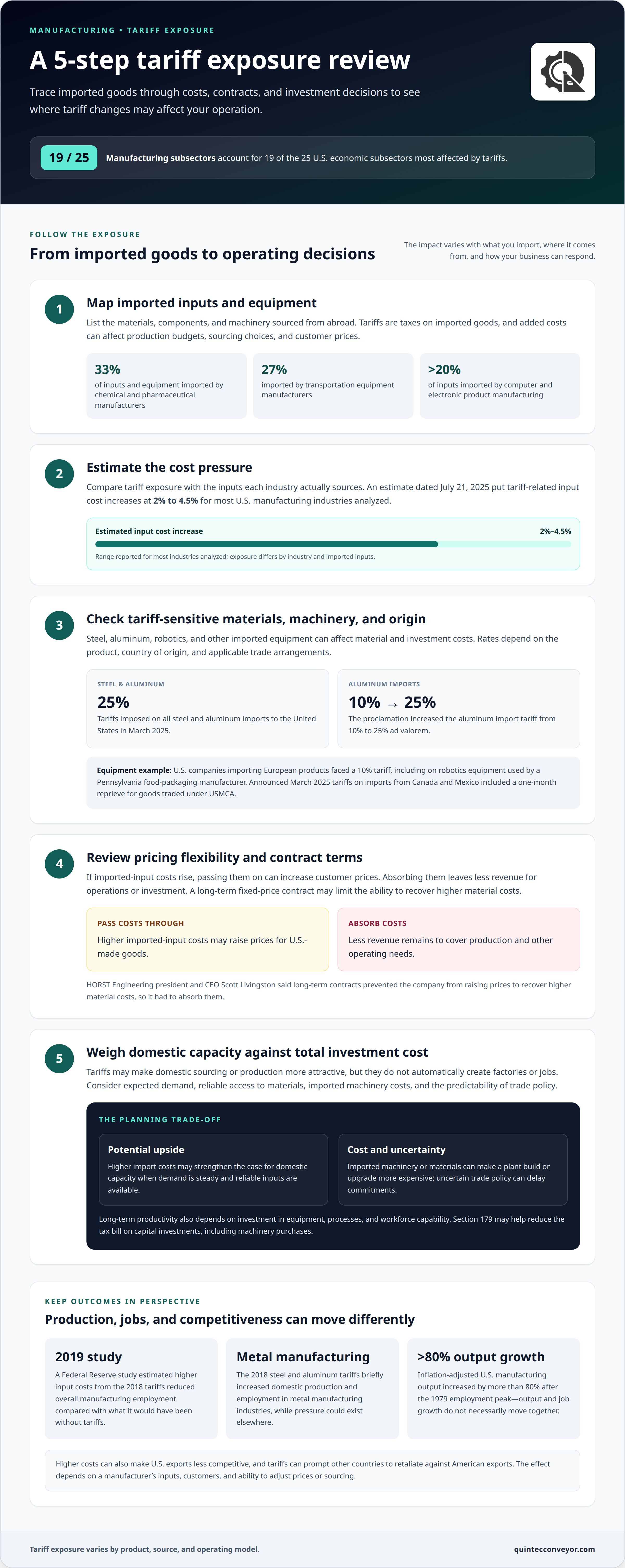
Nineteen of the 25 U.S. economic subsectors most affected by tariffs are in manufacturing. Tariffs raise the cost of imported inputs and equipment, which can pressure budgets, disrupt supply chains, and complicate production planning. How tariffs are affecting the manufacturing industry in the United States depends in part on what a manufacturer imports and how much of its operation relies on those goods.
For manufacturers, higher input costs are only part of the decision. Tariffs may encourage domestic production, but shifting suppliers or investing in capacity takes careful planning, especially when costs and trade conditions can change. Long-term contracts add another constraint when selling prices are fixed but material expenses rise.
This article explains how tariffs can affect manufacturing costs, domestic investment, contract decisions, and agricultural and industrial equipment. It also considers the implications for operational planning, helping you identify where tariff exposure may influence facility priorities.
Key Takeaways
- Map imported materials and equipment across your operation to identify where tariff changes could put pressure on production costs.
- Assess domestic investment decisions alongside the costs and supply-chain trade-offs of changing equipment or sourcing plans.
- Review how fixed-price, long-term contracts may affect your ability to respond when material costs rise.
- Consider how tariffs on agricultural and industrial equipment could shape facility planning, material handling, and automation decisions.
US Tariffs: What’s the Impact?
Understanding how tariffs are affecting the manufacturing industry in the United States starts with imported inputs and equipment. Tariffs are taxes on imported goods, and the added cost can affect production budgets, sourcing decisions, and customer prices. The impact varies according to the materials and machinery a manufacturer buys from foreign suppliers.
Reliance on Imported Manufacturing Inputs
Manufacturers that use imported inputs may pay more when tariffs apply to those goods. This matters because higher component or material costs can influence production plans and sourcing choices. Chemical and pharmaceutical manufacturers import 33% of their inputs and equipment, while transportation equipment manufacturers import 27%. Computer and electronic product manufacturing imports more than 20% of its inputs.
July 21, 2025 estimates put tariff-related input cost increases at 2% to 4.5% for most U.S. manufacturing industries analyzed. Exposure depends on the inputs each industry sources.
Tariffs on Steel, Aluminum, and Robotics
Tariffs on imported steel, aluminum, and robotics equipment can affect the cost of materials and machinery used in production. The White House states that the proclamation increased the tariff on aluminum imports from 10 percent to 25 percent ad valorem. In March 2025, the administration imposed 25% tariffs on all steel and aluminum imports to the United States.
U.S. companies importing European products faced a 10% tariff, including on robotics equipment used by a Pennsylvania food-packaging manufacturer. Such charges can factor into equipment investment and supply-chain planning.
Differences in Tariff Exposure
Tariff exposure varies because manufacturing industries rely on imported inputs to different degrees. Nineteen of the 25 U.S. economic subsectors most affected by tariffs are in manufacturing. For manufacturers, assessing how tariffs are affecting the manufacturing industry in the United States means considering both sector-specific imports and the goods’ origin.
There is no single rate that describes U.S. tariffs compared with other countries’ tariffs on manufactured products. Rates depend on the product, country of origin, and applicable trade arrangements. In March 2025, announced tariffs on imports from Canada and Mexico included a one-month reprieve for goods traded under USMCA.
Effects on Prices and Competitiveness
Tariffs can raise prices for U.S.-made goods if manufacturers pass higher imported-input costs on to customers. Absorbing those costs instead leaves less revenue available for operations or investment. The result depends on input costs and pricing decisions.
Higher costs can also make U.S. exports less competitive against foreign producers. The U.S. Chamber of Commerce notes that tariffs can prompt other countries to retaliate against American exports. A manufacturer’s exposure depends on its inputs, customers, and ability to adjust prices or sourcing. For businesses seeking to maintain cross-border trade and reach new buyers amidst changing trade barriers, export trading services like get-b2b.com help facilitate connections between domestic and international markets.
Investment and growth in domestic manufacturing
Tariffs can encourage domestic production by making imports more expensive, but they do not automatically create factories or jobs. Investment depends on expected demand, access to materials, equipment costs, and the predictability of trade policy. For a manufacturer considering U.S. expansion, higher costs for foreign inputs may make local sourcing more attractive while also increasing production costs.
Employment and wages can shift as factories adjust output and staffing, but tariffs alone don't determine either outcome. A 2019 Federal Reserve study estimated that higher input costs from the 2018 tariffs reduced overall manufacturing employment compared with what it would have been without tariffs. The 2018 steel and aluminum tariffs briefly increased domestic production and employment in metal manufacturing industries, showing that gains in a protected sector can coexist with pressure elsewhere.
Factory investment follows a similar trade-off. A tariff may strengthen the case for domestic capacity when manufacturers expect steady demand and can secure reliable inputs. Yet higher prices for imported machinery or materials can raise the cost of building or upgrading a plant. The inflation-adjusted value of U.S. manufacturing output increased by more than 80% after the 1979 employment peak, illustrating that output growth and job growth do not necessarily move together.
Long-term productivity depends on investment in equipment, processes, and workforce capability, not just where a product is made. Section 179 may help U.S. manufacturers reduce their tax bill on capital investments, including machinery purchases. But tax treatment is only one factor: uncertain trade policy can delay commitments, while sustained demand can support them. The central risk is a mismatch between the cost of domestic expansion and the future sales needed to make that investment productive.
Long-term contracts and manufacturers absorbing costs
A long-term contract can lock in a selling price even as the cost of imported materials changes. If a manufacturer must deliver at the agreed price while paying more for inputs, less revenue remains to cover production and other operating needs. Scott Livingston, president and CEO of HORST Engineering, said long-term contracts prevented his company from raising prices to recover higher material costs, so it had to absorb them.
The impact depends on contract terms, purchase timing, and the materials involved. A fixed-price agreement can leave the manufacturer carrying tariff costs if there is no practical way to adjust customer prices. For example, a supplier facing higher costs for imported components may still have to fulfill an existing order at its contracted price. Margins can tighten even when the order remains important to the customer relationship.
Manufacturers can account for this exposure when planning contracts. Before committing to a long-term price, model possible changes in input costs, identify purchases that depend on foreign sources, and review whether contract terms allow adjustments when material costs shift. Businesses with cross-border supply relationships should also consider how changing federal trade policy may affect those commitments. The key is to know which agreements leave the business responsible for cost increases.
When repricing is not possible, companies may seek savings elsewhere, change suppliers, or delay discretionary spending. Each response involves trade-offs: a supplier change can require operational adjustments, while spending cuts may constrain investment or productivity improvements. Raising prices may recover some added costs, but customers can respond by postponing purchases or considering alternatives. The right approach depends on the contract term remaining, the customer relationship, and how much cost the manufacturer can absorb without undermining operations.
Tariffs on agricultural and industrial equipment
Tariffs can affect agricultural and industrial equipment through imported machines, replacement parts, and production inputs. The impact depends on a machine’s components and country of origin, not simply whether it is used in farming or manufacturing. When considering imported equipment, distinguish the machine from its parts and materials, since tariff treatment may differ across goods.
For agricultural operations, higher prices for imported machinery or components can affect replacement timing and investment plans. Delaying a purchase may mean keeping existing equipment in service longer, while an essential replacement may require a larger budget. Industrial facilities can face similar pressure on production machinery and equipment used to move materials. If purchases rely on supply chains spanning several countries, added costs can also affect project timing.
International sourcing can create costs beyond the initial purchase. If parts come from multiple foreign sources, changes in trade policy may affect the cost of future maintenance or upgrades. Consider the full equipment plan: purchase, parts availability, expected production demand, and the operational consequences of delaying a replacement. Tariffs may encourage domestic sourcing, but alternatives depend on the required equipment and available supply; for instance, facilities upgrading industrial pumping and fluid management systems may look to specialized domestic suppliers like Water Services, Inc. for critical infrastructure.
The impact extends beyond the equipment buyer. If higher acquisition costs increase a producer’s operating expenses, the business may absorb them, adjust investment, or pass some costs on through higher prices. Agricultural producers may face increased machinery costs, while industrial manufacturers may reassess facility upgrades. The outcomes depend on equipment origin, tariff coverage, sourcing options, and the buyer’s ability to adapt. Include tariff exposure in equipment planning rather than treating purchase price as the only decision factor.
For a facility evaluating material movement needs, discuss additional material handling equipment as part of its equipment planning.
Quintec Conveyors
Quintec Conveyors helps manufacturers plan facility operations when tariff exposure leads them to reassess equipment investments. For projects involving material movement, automation, or facility infrastructure, Quintec’s engineering and integration services can align equipment decisions with operational needs. Conveyors, Robotics & Automation, Infrastructure, and Additional Material Handling Equipment can all contribute to a broader facility plan.
Consider Quintec Conveyors when evaluating an operational upgrade or planning how equipment should fit into a production environment. Clarifying workflow requirements helps frame the project while you weigh sourcing and cost pressures.
Contact Quintec Conveyors to discuss your facility’s equipment and operational needs.
Plan Your Next Operational Move
Understanding how tariffs are affecting the manufacturing industry in the United States can inform facility decisions. The next step is to turn that insight into an operational plan by considering how equipment fits your production flow, facility requirements, and longer-term investment priorities. A coordinated view keeps operational needs central as trade conditions change.
Quintec Conveyors supports industrial projects involving conveyors, Robotics & Automation, and infrastructure. Its design, engineering, and installation services connect equipment decisions with facility operations, helping manufacturers plan changes and upgrades. Contact Quintec to discuss your material handling project.
Contact Quintec Conveyors to discuss your operational plans and explore a suitable next step for your facility.
Frequently Asked Questions
How do tariffs work?
A tariff is a tax on imported goods, generally paid by the U.S. business or individual receiving them at the port of entry, according to the U.S. Chamber of Commerce. For manufacturers, the added charge can affect a component’s landed cost before production begins. The importer may absorb the cost, negotiate with suppliers, or pass some of it on to customers.
How are U.S. tariffs affecting manufacturing costs and output in 2025-2026?
Tariffs can raise input expenses, while changes in trade policy can make production and purchasing plans harder to forecast. In April 2025, an Institute for Supply Management survey reported that U.S. manufacturing activity had declined to its lowest point in five months. That finding describes activity at that time, not a full-year result. For an individual manufacturer, effects depend on imported inputs, demand, and the ability to adjust operations.
How have tariffs changed prices for steel, aluminum, semiconductors, and other manufacturing inputs?
Tariffs add costs to covered imports, but they don't establish one universal price increase for each material. The White House stated that a proclamation increased the tariff on aluminum imports from 10 percent to 25 percent ad valorem. A July 21, 2025 estimate put tariff-related input cost increases at more than 3.5% for computer and electronic product manufacturing. Actual price effects vary with sourcing and supplier decisions.
How are tariffs affecting U.S. manufacturers’ supply chains and sourcing decisions?
Tariffs can prompt manufacturers to reconsider where they source components and how much they rely on a single supplier or region. Trace imported parts through production, identify feasible substitutions, and weigh supplier changes against operational requirements. Domestic and international alternatives may differ in availability and suitability. Because trade policy can change, sourcing plans should account for possible adjustments or new agreements.
Which U.S. manufacturers benefit from tariffs, and which face higher costs or losses?
Domestic producers competing with tariffed imports may benefit from reduced import competition, while manufacturers that buy affected materials or equipment can face higher expenses. The 2018 steel and aluminum tariffs briefly increased domestic metal production and employment in metal manufacturing industries. However, a 2019 Federal Reserve study estimated that higher input costs from those tariffs reduced overall manufacturing employment compared with what it would have been without them. Effects vary across industries.

Article by
Jon Huang