MDR Conveyor Systems: How Motor-Driven Rollers Improve Material Flow
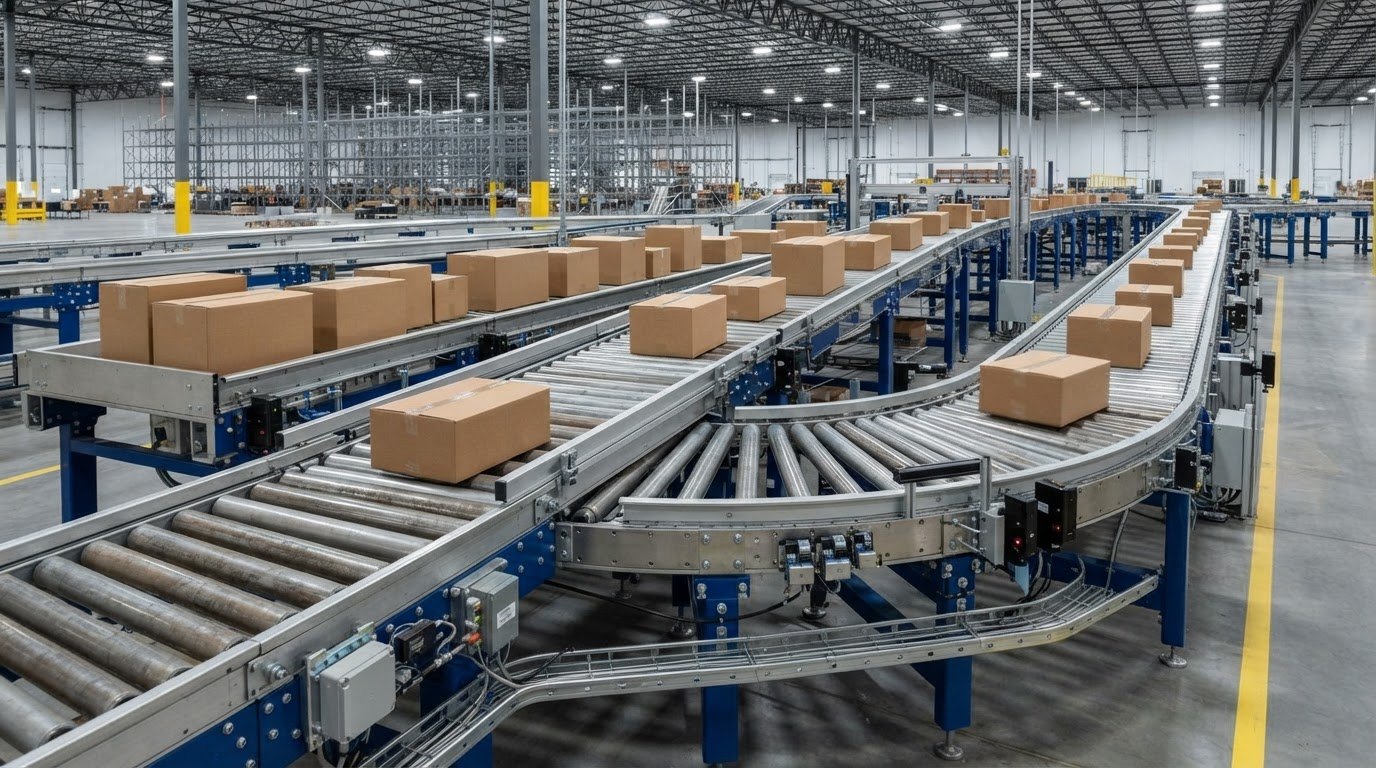
MDR conveyor systems use motor-driven rollers and zoned controls to move, pause, and accumulate products without running an entire line continuously. Their performance depends not only on the rollers, but also on how each zone responds to product flow. That difference can shape how materials travel through a facility.
If you’re comparing MDR with other conveyor types, start by asking whether zoned movement suits your products, accumulation needs, and operating processes. The right choice depends on how the system supports your flow, including where products stop, merge, and move to the next process.
This article explains how MDR operation and conveyor zones work, where these systems may fit, and what trade-offs to consider. It also outlines the facility and flow details to gather before planning an integrated solution, from product characteristics and staging needs to connections with broader material handling and automation systems.
Key Takeaways
- MDR conveyor systems use powered rollers and controls to move products through defined zones. Operation depends on the system’s configuration.
- Compare MDR with gravity, belt, and chain-driven live roller conveyors by considering product characteristics, accumulation needs, layout, and process requirements.
- Map how products enter, pause, merge, and exit each process before selecting conveyor components. Let flow requirements guide the design.
- Plan for sensors, controls, and connections to other facility systems as part of the complete material handling solution.
- Evaluate MDR alongside broader automation, robotics, infrastructure, and material handling needs to determine how it fits your operation.
MDR Conveyor Systems and Their Role in Material Flow
MDR conveyor systems use motor-driven rollers to move products along a conveyor path, with controls coordinating movement through selected sections. They are one option within a broader material handling system, where the goal is to move products between work areas in an order that supports the facility’s operating sequence.
The rollers provide the conveying surface, while motors and controls determine how products move along the line. Configurations vary in how rollers are powered, how sections are divided, and how movement is coordinated. MDR is therefore best understood as a system approach, not simply a roller specification. A general overview of the conveyor system places motorized drive rollers within the wider family of equipment used to transport materials.
In a warehouse workflow, product movement needs to match the pace and sequence of operations. A carton might travel from picking to scanning, then wait before packing. If the next work area is occupied, controlled staging can help keep the handoff orderly rather than sending more product into a constrained space. Whether MDR supports that flow depends on the layout, product, and operating requirements.
How does a motor-driven roller conveyor move products?
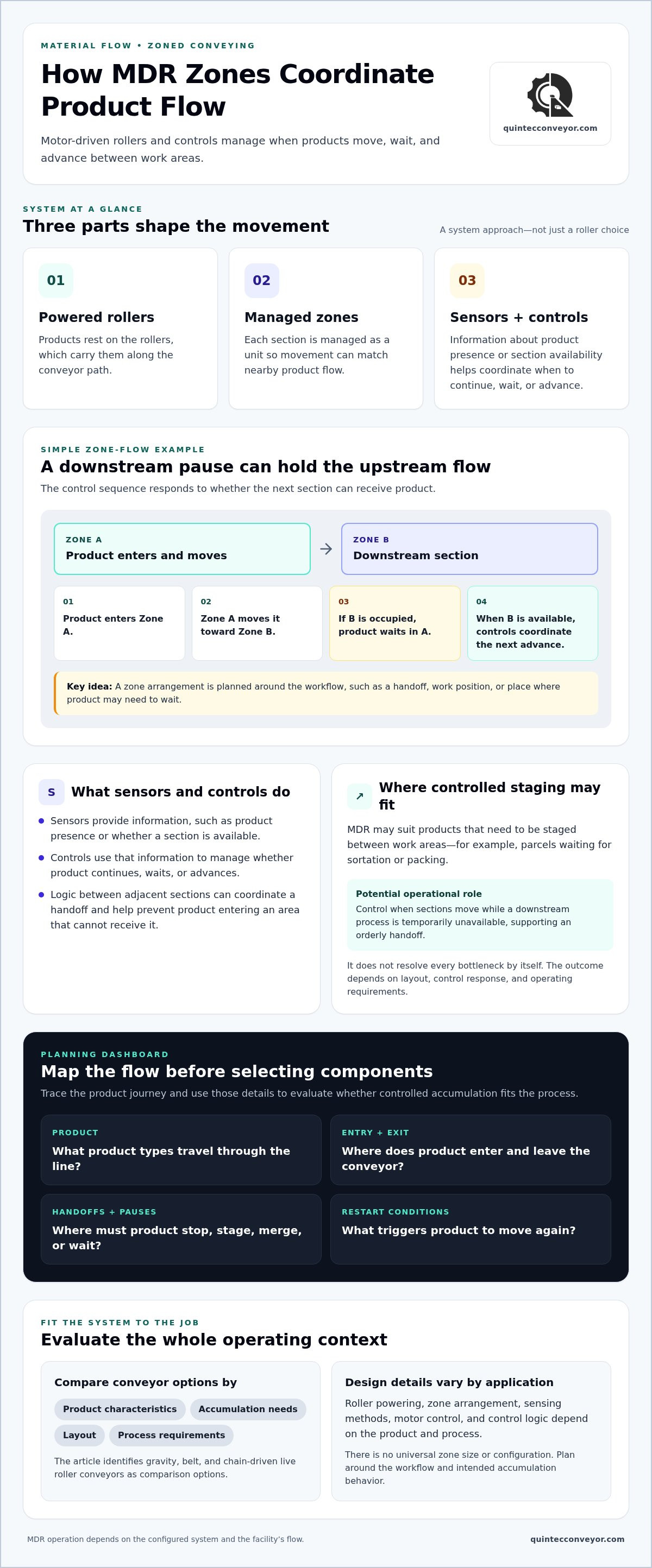
Products rest on the rollers, and powered rollers carry them along the conveyor path. Depending on the system design, sensors and controls coordinate when a section runs and when product advances. In an accumulation setup, a section holds product while downstream flow is paused, then releases it when movement can continue. Components and control methods vary by application, so no single configuration defines every MDR conveyor.
What operational problem can MDR help address?
MDR may suit processes where products need to be staged between work areas, such as parcels waiting for sortation or packing. Controlling when sections move can limit unnecessary conveyance while a downstream process is temporarily unavailable. This can support an orderly handoff, but it doesn’t resolve every bottleneck by itself. The outcome depends on the conveyor layout, how controls respond to the process, and what the operation requires.
For planning, trace a product’s journey: where it enters, where it needs to pause, what triggers it to move again, and where it exits the conveyor. Note the product types and tasks at each handoff. These details help distinguish a need for controlled accumulation from a need for straightforward transport, and give engineers a practical basis for evaluating MDR within an integrated material handling design.
How MDR Conveyor Systems Use Zones, Rollers, and Controls
The defining design decision in a zoned conveyor is how product movement is divided and coordinated along the route. A conveyor zone is a section of conveyor managed as a unit to control product movement through part of the material flow. In MDR conveyor systems, each section’s behavior depends on the operating sequence, controls, and conditions at neighboring sections. There is no universal zone size or arrangement.
Consider a carton traveling toward a work area that is temporarily occupied. A sensing device may register the carton, and the control logic may stop movement in that section or prevent the carton from advancing. Once downstream flow is available, the controls can signal movement to resume. The exact response depends on the design, including the sensing method, motor control, and communication between sections.
Simple zone-flow example
Product enters Zone A → Zone A moves product toward Zone B → Zone B is occupied, so product waits in A → Zone B becomes available → controls coordinate the next advance
What does a conveyor zone do in an MDR system?
A zone groups a section of conveyor so its movement can be coordinated with nearby product flow. Zone boundaries are planned around operational needs, such as a handoff, work position, or point where products may need to wait. Zone length and capacity aren’t universal. They should reflect the product, process sequence, and intended accumulation behavior.
This is where system design moves beyond choosing rollers. If a work area needs a product staged before processing, the zone arrangement must support the pause and subsequent release. If the route includes several handoffs, zones can be planned around those transitions. The objective is to coordinate movement with the workflow, not divide the conveyor into arbitrary sections.
How do sensors and controls support MDR operation?
Sensors provide information about conditions such as product presence or whether a section is available. Controls use that information to manage movement, including whether a product should continue, wait, or advance. Between adjacent sections, control logic can coordinate a handoff so product doesn’t move into an area that can’t receive it. Specific hardware, communication protocols, and logic depend on the application.
For example, a line connecting inspection and packing may need to hold product when packing is paused, then resume as the next section becomes available. The control sequence must reflect how those work areas operate, including what triggers a stop and what permits movement to resume. Broader automation context, including system coordination and safety considerations, is discussed in Material Handling Automation Systems.
When planning zones, map product entry and exit points, process handoffs, waiting locations, and the conditions that allow flow to restart. That operational picture gives engineers a basis for matching the controls to the facility, rather than assuming one configuration will suit every line. Quintec connects conveyor engineering with wider facility processes. Explore integrated conveyor system design as part of that planning.
MDR vs. Other Conveyor Types: Match the System to the Job
No conveyor type is right for every product or process. MDR, gravity, belt, and chain-driven live roller systems move materials differently, so selection should begin with the task the conveyor must perform. Consider what the product rests on, whether it needs to pause, how the route is laid out, and how the conveyor connects to upstream and downstream operations.
| Selection factor | MDR | Gravity | Belt | Chain-driven live roller |
|---|---|---|---|---|
| Product characteristics | Products must be suited to roller conveying and the system design. | Products must move on rollers with the planned slope or applied push. | A continuous belt can support products that need a more continuous conveying surface. | Products must be suited to a powered roller surface and the selected design. |
| Accumulation needs | Zones can be coordinated to manage movement and product staging. | Staging depends on layout and how product movement is controlled. | Accumulation depends on the conveyor and process design. | Accumulation depends on the drive and system arrangement. |
| Layout considerations | Route and zones are planned around product flow and work areas. | Route must support gravity-driven movement or manual advancement. | Route is designed around the required path and conveying task. | Route and drive arrangement are designed for the required transfer. |
| Process requirements | May suit workflows that need coordinated movement between sections. | May suit transfers where powered movement isn’t required. | May suit tasks that call for a belt conveying surface. | May suit tasks that call for powered roller conveying. |
When might MDR suit cartons, totes, or staged workflows?
Cartons or totes moving between work areas are useful examples when evaluating MDR. If a process needs product to wait before a scan, sort, or packing step, coordinated sections may help manage when it advances. These examples aren’t a universal fit: product dimensions, base condition, load, and process requirements all affect suitability and should be assessed as part of the system design.
For a practical comparison, identify where accumulation is needed and what triggers product to move again. A workflow with defined handoffs may call for more controlled section-to-section movement than a route designed only to transfer items from one point to another. Choose based on the actual flow, not just the product category.
When might another conveyor type be a better fit?
Gravity can be considered where powered movement isn’t required and the layout supports product travel. A belt may be appropriate when the task calls for a continuous belt surface. Chain-driven live roller uses powered rollers for product movement, with the drive arrangement selected for the application. None is a universal winner; suitability depends on the conveyed product and full system design.
Compare options against operating needs, including product stability, accumulation, transfers, route constraints, and how each section must interact with the process. MDR conveyor systems may be one element in a larger material handling plan rather than the answer for every section. For broader context on conveyor configurations and integration, review this industrial conveyor systems guide.
How to Plan an MDR Conveyor System Around Your Facility Flow
Start with the work the conveyor must support, not a preferred roller or control component. An MDR layout should reflect product routes, process handoffs, accumulation needs, and facility constraints. A structured review helps separate essential operating requirements from component preferences and shows where MDR may fit within the wider material handling system.
What information should a facility map capture?
Map each product’s route from entry to exit, including workstations, transfers, waiting areas, and points where flow may pause. Record product types and relevant operating patterns, such as when processes run or when volume changes. Note physical constraints and interfaces with existing equipment so the proposed route reflects actual facility conditions.
- Trace the process. Document product entry and exit points, each handoff, and the task performed at every stop. Note where products need to wait and what condition allows them to move again.
- Describe the products. Record product types and characteristics relevant to conveying, including how items are presented and any variation in the mix. This helps frame equipment requirements without assuming every product can travel on the same conveyor arrangement.
- Define operating needs. Separate required outcomes, such as staging product before a work area, from preferences about particular components. Identify process constraints and operating patterns that affect when and how products should move.
- Mark facility constraints. Capture available floor space, route changes, access needs, and existing equipment interfaces. These details can affect conveyor placement and transitions between conveyor sections and other processes.
- Plan accumulation and transitions. Identify where product may collect, how much staging the process calls for, and how flow should resume. Consider both upstream supply and downstream capacity at each handoff.
- Review integration and change. Map how the conveyor will interact with adjacent equipment and facility processes. Consider likely workflow or product-mix changes so the design can account for future operating needs. A modular conveyor systems guide can provide useful context when adaptability is part of the planning discussion.
How should MDR fit into the wider system design?
Treat MDR as one possible element in the complete flow, rather than an isolated equipment decision. Review how its sections connect with upstream supply, downstream work areas, and existing material handling equipment. Let integration requirements follow the process; don’t assume a particular control platform before understanding the facility’s needs.
Facility-level planning can connect conveyor routes with available space, process sequence, and broader automation requirements. Quintec brings conveyor design, engineering, installation, and integration together with facility processes. To develop an integrated plan around your operation, discuss your conveyor system design.
How Quintec Integrates MDR Conveyor Systems Into Material Handling Operations
MDR works as part of a material handling plan built around the facility’s processes. Quintec Conveyors provides conveyor design, engineering, installation, and integration, evaluating how each section fits with upstream and downstream work. This keeps planning focused on the movement and handoffs the operation needs, rather than treating a conveyor component as a complete solution.
Depending on the facility, MDR may be considered alongside warehouse automation, robotics, infrastructure, and other material handling equipment. The design review can account for how products enter and leave the conveyor, where work takes place, and how adjacent equipment affects flow. Quintec’s team brings over 100 years of collective industry experience to this work.
What does an integrated MDR project involve?
An integrated project connects process understanding with engineering and equipment decisions. The team considers MDR’s role within the complete route, including interfaces with nearby equipment and facility processes. For a wider view of the coordination involved in an integration partnership, see this conveyor system integrator guide.
- Understand the process. Establish how materials move through the relevant work areas and where handoffs occur.
- Develop the system design. Connect operational requirements to conveyor layout and engineering decisions.
- Review interfaces. Consider how MDR sections relate to other conveyors, automation, robotics, infrastructure, and material handling equipment in the facility.
- Coordinate installation and integration. Plan the equipment within the larger system and consider how it fits the facility’s processes.
This sequence keeps the design tied to operational needs. It also makes clear that an MDR decision involves more than selecting rollers: interfaces, workflow, and adjacent equipment all influence how the complete system is planned.
How can engineering support long-term system performance?
Engineering can account for maintenance access and anticipated process needs during system planning. Quintec’s process engineering capabilities connect equipment decisions with facility workflows, while conveyor maintenance supports attention to equipment over its operating life. The right design remains specific to the facility and its requirements.
Integrated material handling projects benefit from a clear view of the current process and the changes the operation may need to accommodate. If you’re evaluating MDR as part of a broader conveyor or automation plan, bring your material flow requirements into the discussion. Discuss your conveyor project with Quintec.
Turn Your Flow Requirements Into a Practical Next Step
Turn your operation’s current and anticipated needs into a clear project brief. Note the workflows you’re aiming to support, where process changes could affect material movement, and which facility interfaces should shape the design. This gives the engineering discussion a useful starting point and keeps decisions about MDR conveyor systems connected to operational priorities.
Quintec brings over 100 years of collective industry experience to conveyor projects, with capabilities spanning design, engineering, installation, and integration. This work can be considered alongside warehouse automation, robotics, process engineering, and conveyor maintenance to connect a conveyor project to the wider facility plan.
Bring your material flow requirements and project objectives to Quintec. Discuss your material handling project with Quintec and plan a system around your facility’s needs.
Frequently Asked Questions
Is an MDR conveyor system suitable for every warehouse?
No, an MDR conveyor system isn’t the right fit for every facility. It may be worth evaluating where the workflow calls for controlled movement or staging, but product characteristics, handoffs, layout, and equipment interfaces all affect suitability. For example, a warehouse with a narrow transfer area may have different design priorities from one with several processing stages. Start by documenting the flow problem to solve, then assess equipment options against it.
Can MDR conveyors handle mixed product sizes?
They may be designed for operations with varied products, but the actual range and system configuration determine suitability. Assess the smallest and largest items, packaging types, product stability, and how consistently items are positioned at conveyor entry. A tote and a flexible parcel, for example, may interact differently with the conveying surface. Mapping these variations helps engineers identify where one configuration may work and where the flow needs a different approach.
How do MDR conveyor systems support accumulation?
MDR conveyor systems can coordinate sections to manage product waiting between process steps. If a downstream station is occupied, product may be held upstream, depending on the sensing and control design. For example, a staging point before a quality check could support the work sequence without feeding items forward prematurely. Zone count and arrangement aren’t automatic outcomes of choosing MDR; they’re design decisions based on required flow and accumulation behavior.
What happens if a downstream process stops?
The response depends on the control logic and how connected equipment is accounted for in the design. A system may pause or manage upstream movement when a downstream area can’t accept more product, but the exact sequence must be specified. During engineering, define the stop condition, what happens to items already in transit, and how movement restarts. Include upstream equipment in this review so the response reflects the connected process, not just the conveyor section.
Can MDR conveyors be integrated with existing material handling equipment?
Integration depends on the equipment, product route, physical interfaces, and control requirements. A practical review might trace an item from an existing takeaway conveyor to a new MDR section, then identify transfer points and the signals needed to coordinate movement. Document clearances, elevations, product orientation, and process ownership at each handoff. Evaluating the full workflow helps determine how new equipment should connect with the operation already in place.
Does MDR eliminate conveyor maintenance?
No, MDR doesn’t eliminate the need to maintain a conveyor system. Maintenance planning should reflect the installed configuration, operating conditions, and surrounding equipment. For example, plan inspection access to avoid disrupting adjacent processes, and make equipment documentation available to the people responsible for upkeep. The maintenance approach should follow the completed system’s documentation and procedures. Considering access during design can help make routine attention part of the operating plan.
What information is useful before planning an MDR project?
Prepare a product and process map before discussing equipment preferences. Include representative product dimensions and packaging, operating patterns, handoff locations, desired staging points, and the facility layout. Add information about existing equipment and known interface constraints, such as where products transfer between systems. A clear map helps engineers see how materials move through the operation and where design questions remain, making early planning discussions more focused and grounded in real workflow needs.