Process Engineering: Turning Material Handling into Measurable Improvement

What if the warehouse slowdown isn’t caused by a lack of equipment, but by how work moves between steps? Delays, repeated handling, and unclear handoffs can be hard to trace from daily observations alone. Process engineering helps identify where material handling workflows lose time and which targeted changes could improve flow.
When operations fall behind, it’s understandable to look first at new equipment. But without a clear picture of the process, an equipment change may address a symptom rather than the constraint. A structured assessment combines operational data with observations from the floor, helping teams identify and prioritize changes that fit their goals.
This article explains how process engineering applies to warehouse and material handling operations, from mapping the current state to defining a practical future state. You’ll learn how workflow analysis can guide decisions about conveyors, automation, robotics, and infrastructure, and how integrated system design can translate operational needs into measurable improvement. Quintec Conveyors combines process engineering with material handling system design and installation to support this work.
Key Takeaways
- Use process engineering to connect the movement of materials and information with the operational goals your warehouse needs to meet.
- Map the current workflow before selecting a solution to uncover handoff friction and constraints that may be easy to miss.
- Compare process changes, layout updates, and equipment integration by fit, dependencies, disruption, scalability, and measurement needs.
- Turn each constraint into a clear operational objective, then prioritize potential responses by impact, feasibility, dependencies, and risk.
- Use process findings to inform integrated decisions across conveyors, automation, robotics, infrastructure, racking, and maintenance.
What Process Engineering Means for Material Handling Operations
Process engineering examines how work is performed and how information and materials move through a system, then identifies ways to improve that flow. In a warehouse or industrial facility, the focus extends beyond the task at each workstation. It includes the routes, decisions, queues, and handoffs that connect activities from receiving through shipping.
The discipline has broad applications across industrial operations. A general overview describes process engineering as a field focused on the development and optimization of industrial processes, applying fundamental scientific principles to transform raw materials into useful products. In material handling, the same perspective applies to the movement and staging of goods, the flow of operational information, and the coordination of people and systems. The scope depends on the facility’s objectives, layout, products, and constraints. A warehouse with congestion at receiving may need a different analysis from a distribution operation delayed during order consolidation.
How process engineering applies beyond manufacturing lines
Material handling involves connected stages, not just production equipment. A product may be received, checked, moved into storage, retrieved for picking, consolidated, and prepared for shipping. Each step can work well on its own while the overall operation loses time at a handoff, such as when inbound goods wait for putaway or completed picks queue before packing.
Looking across the workflow helps operations and engineering teams see how one decision affects the next. Changing storage locations, for example, can influence travel paths, replenishment work, and picking activity. The aim is to understand the facility as an operating process while keeping the investigation proportionate to its goals. Not every site needs a broad redesign. Some improvement efforts can focus on one recurring delay or a specific transition between work areas.
Process engineering versus equipment engineering
Process improvement starts by defining the operational need: what must move, where delays occur, which information or handoffs are required, and what the workflow needs to achieve. Equipment engineering translates those needs into system requirements and design choices. Addressing these questions in sequence helps teams avoid choosing machinery before they understand the constraint.
Process improvement defines what the operation needs to do better; equipment procurement selects tools to support that need. This distinction matters because equipment works best when it fits the flow, rather than forcing the workflow to accommodate an isolated purchase. If analysis shows that repeated transfers between areas are creating friction, the findings could inform conveyor routing, capacity needs, automation, or system interfaces. If the main constraint is a handoff or task sequence, a process change may be the more relevant response.
For operations and engineering teams evaluating workflow improvements, this approach connects observed performance with practical design decisions. It gives equipment choices a clear operational purpose and provides a basis for assessing whether a change addresses the identified constraint.
How Process Engineering Diagnoses and Redesigns Material Flow
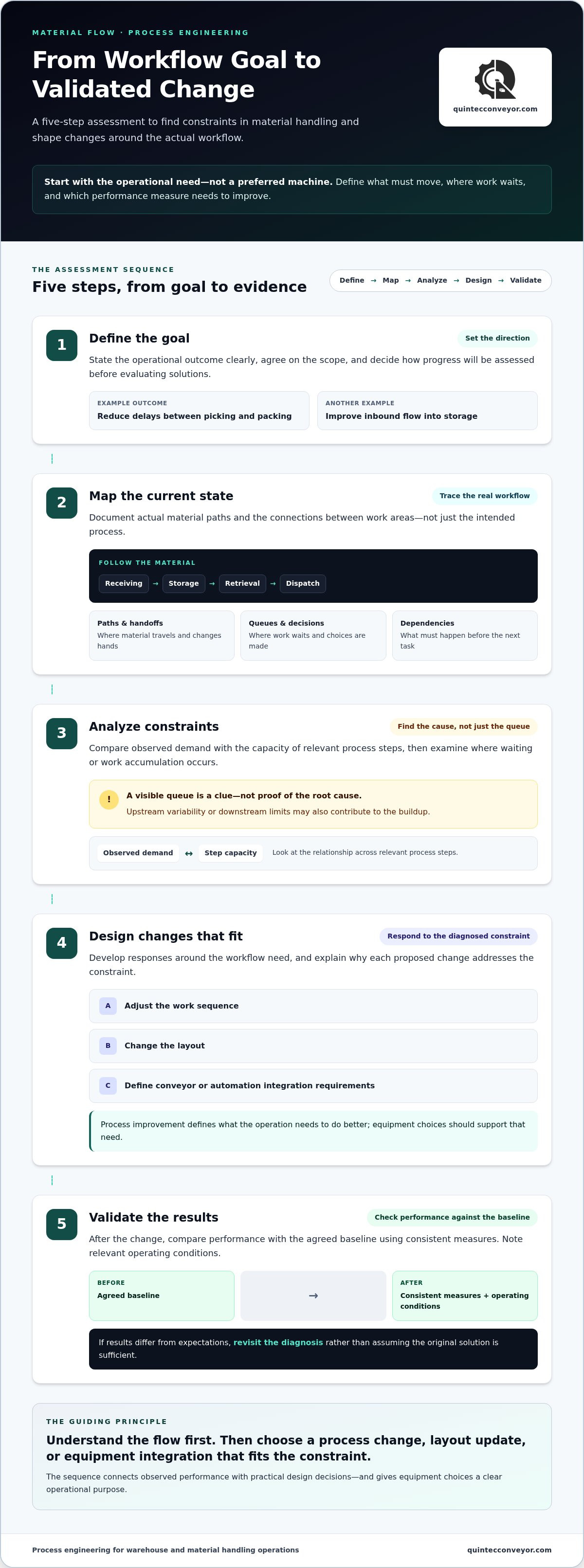
A disciplined assessment starts with operational questions, not a preferred machine or automation technology. What needs to move? Where does work wait? Which performance measure needs to improve? Process engineering uses these questions to guide a practical sequence: define goals, map the current state, analyze constraints, design changes, and validate results. Adapt the steps to the facility and the information available.
- Define the goal. State the operational outcome clearly, such as reducing delays between picking and packing or improving the flow of inbound goods into storage. Agree on the scope and how progress will be assessed before evaluating solutions.
- Map the current state. Document how materials move through the operation, including actual paths, handoffs, decision points, queues, and dependencies between work areas. An industrial conveyor systems guide can provide context when considering how conveyors fit into a broader material flow.
- Analyze constraints. Compare observed demand with the capacity of relevant process steps, then examine where waiting or work accumulation occurs. Treat the first visible queue as a clue, not proof of the root cause. Upstream variability or downstream limits may also contribute.
- Design changes. Develop responses that address the diagnosed constraint. Options may include adjusting a work sequence, changing a layout, or defining requirements for conveyor or automation integration. Explain why each proposed change fits the workflow.
- Validate results. Compare performance after the change with the agreed baseline, using consistent measures and noting relevant operating conditions. If results differ from expectations, revisit the diagnosis rather than assuming the original solution is sufficient.
Mapping the current-state workflow
Trace material from its entry into the process through receiving, storage, retrieval, and dispatch. Record how work is released, where it changes hands, and what must happen before the next task can begin. When available, process times, volumes, travel paths, and queue observations add useful detail. The level of measurement will vary by facility, so build the baseline from relevant evidence that is accessible rather than assuming a standard set of metrics.
The National Institute of Standards and Technology (NIST) Process Engineering Group focuses on manufacturing efficiency and supply chain traceability. Those themes reinforce why a workflow map should show both movement and the information or decisions that direct it.
Finding constraints before proposing changes
Look for patterns across operating periods, shifts, or workload conditions when records allow a comparison. A measured baseline helps teams distinguish recurring constraints from temporary variation. Recording process times, volumes, travel paths, and waiting points also makes it easier to assess whether a change addresses the intended issue.
Once the constraint is clearer, the findings can inform integrated system planning. Quintec’s conveyor system design and engineering connects operational requirements with material handling solutions.
How to Compare Process Improvement Options for Warehouse Flow
Once a workflow constraint is understood, decide how to address it. The response may involve changing how work is assigned, modifying the layout or infrastructure, or integrating material handling equipment and automation. Process engineering helps compare these options against the same operational objective instead of treating new equipment as the default answer.
| Improvement option | Workflow fit and dependencies | Disruption and scalability | Measurement needs |
|---|---|---|---|
| Process change | May suit constraints tied to task sequence, handoffs, work allocation, or information flow. Depends on clear roles and coordination between affected teams. | Can be limited in scope, though updated responsibilities or routines may require adjustment. Scalability depends on whether the revised method works across other shifts or areas. | Track the operational objective, such as waiting between steps or completion time, using a consistent baseline and comparison method. |
| Layout or infrastructure change | May fit constraints related to distance, access, storage locations, or the relationship between work areas. Depends on space, facility conditions, and adjacent workflows. | Physical changes may affect work during planning or implementation. Future needs and connections to other areas shape how adaptable the change will be. | Assess relevant travel paths, queues, and handoffs before and after the change, alongside the intended workflow outcome. |
| Equipment or automation integration | May address persistent movement or handling demands. Depends on upstream supply, downstream capacity, interfaces, and how work is released to the system. | Integration can require coordination across connected processes. Scalability depends on the facility’s requirements and how the system relates to future operational needs. | Define measures for the targeted flow and connected processes, so a local change doesn’t obscure new waiting points elsewhere. |
When process changes may be enough
Before adding equipment, examine sequencing, handoffs, work allocation, and information flow. If a recurring delay appears to stem from unclear task ownership or work arriving in an unsuitable sequence, a limited workflow adjustment may be appropriate. Define the intended outcome, the area affected, and the measures for review, then compare operations with the baseline. This makes a small change testable without implying a guaranteed result.
When integrated material handling may be appropriate
If movement remains a constraint after workflow factors are understood, evaluate whether conveyor, robotics, or infrastructure requirements are part of the response. Consider how materials enter the system, how work is released, and whether the next process can receive the resulting flow. Warehouse robotics integration is one way to assess how automation connects with operating processes.
There’s no universal ranking of these options. Compare each against the diagnosed constraint, dependencies, disruption, adaptability, and a practical measurement plan. Quintec connects process engineering with conveyor design, engineering, and installation, helping translate operational needs into integrated material handling considerations. Explore Quintec’s material handling capabilities as you shape an improvement approach.
How to Turn Process Engineering Findings into an Action Plan
A diagnosis becomes useful when it leads to a decision the team can act on and evaluate. For each constraint, write a concise statement that connects the observed issue with an operational objective and a potential response. For example, if work regularly waits between picking and packing, the objective might be to reduce that queue. Possible responses could include adjusting work release, reviewing the handoff, or assessing whether the layout contributes to the delay.
Keep the objective separate from the proposed solution. This lets stakeholders compare different responses without losing sight of the operational need. A practical action plan should identify an owner, relevant dependencies, the evidence needed to evaluate the change, and how it may affect continuity of operations. It should also distinguish a staged implementation approach from any promise about results or fixed project timelines.
Prioritizing changes around operating objectives
Group actions into process, layout, equipment, and integration workstreams. Then assess each against its impact on the stated objective, dependencies, feasibility, and operational risk. A change to work sequencing may depend on updated team responsibilities; a layout adjustment may affect nearby work areas; equipment integration may rely on upstream supply and downstream capacity. Making these relationships visible helps stakeholders sequence work and identify where coordination is needed.
A simple decision matrix can support discussion without creating a universal ranking. For each action, record:
- Expected contribution: How directly it addresses the diagnosed constraint and objective.
- Dependencies: The processes, systems, teams, or facility changes that must align.
- Feasibility and disruption: The resources involved and potential effect on ongoing operations.
- Measurement plan: The evidence that will indicate whether the change is addressing the intended issue.
Use the matrix to clarify trade-offs, not to imply precision the available evidence can’t support. If facility layout is part of the scope, strategic warehouse design services can help connect space planning with workflow considerations.
Validating changes and learning from results
Before implementation, agree on the baseline, the measures tied to the objective, and how observations will be gathered. Afterward, compare like with like: use consistent definitions and note relevant shifts in demand, product mix, staffing, or operating conditions. A change in queue length, for example, may need to be interpreted alongside the volume moving through the process.
Review the findings with the people responsible for affected work areas. If the intended measure hasn’t changed, or a new delay appears downstream, capture that evidence and refine the next action rather than assuming the intervention succeeded or failed for only one reason. This is how process engineering supports a measured improvement cycle: define the objective, coordinate the work, observe the results, and use what the operation reveals to guide the next decision.
For support connecting operational findings with material handling system design and installation, discuss your material handling engineering needs with Quintec.
How Quintec Connects Process Engineering with Material Handling Integration
Operational findings are most useful when they inform decisions across the full material handling system. Quintec brings process engineering together with conveyor system design, engineering, and installation, connecting workflow requirements with the systems intended to support them. The focus stays on the operation’s needs: what must move, where flow is constrained, and how connected work areas need to function.
This integrated perspective helps teams consider related requirements together. A workflow review might identify a need to improve movement between areas, storage access, or coordination between manual tasks and automated processes. Depending on the operation, relevant considerations may include conveyors, robotics and automation, infrastructure, warehouse racking, or conveyor maintenance. The objective is not to prescribe a standard package, but to relate design decisions to the facility’s process goals and constraints.
From workflow requirements to integrated solutions
System planning starts with operational requirements and uses them to guide design. For example, when a facility is assessing how materials move between work areas, planning can consider the conveyor path alongside the space it uses, the work that feeds it, and the process receiving materials downstream. These elements influence one another. Treating them as parts of a connected material handling system helps keep design aligned with workflow needs rather than treating each equipment decision in isolation.
Quintec provides custom conveyor system design, engineering, and installation, alongside capabilities in automation, robotics, infrastructure, and racking. Maintenance is also part of the broader material handling picture, since system needs continue beyond initial design. The right scope depends on the operational challenge, facility requirements, and how proposed changes relate to existing processes. This approach supports informed planning without promising a particular result before the operation and its requirements are understood.
Plan a process engineering conversation around your operation
A focused discussion can begin with the operating goal, the material movement or handoff causing concern, and any constraints already identified by the team. Available information about process times, volumes, travel paths, or waiting points can help clarify the situation, but a complete data set isn’t required to describe the challenge. It’s also useful to identify which work areas or systems depend on the process under review.
Quintec’s team brings over 100 years of collective industry experience to material handling projects. That experience supports a considered connection between operational requirements, engineering, and system integration. For additional context on integration planning, the conveyor system integrator guide outlines factors that can inform facility-level decisions.
If you’re evaluating a workflow constraint or a system integration need, discuss your material handling challenge with Quintec. A conversation grounded in your process goals can help frame the engineering and integration questions that matter to your operation.
Make Your Next Material Handling Decision with Confidence
Operational improvement doesn’t end with a single change. As order profiles, workflows, and facility needs evolve, teams can keep using process engineering principles to assess whether material still moves in line with operating goals. Start by identifying one challenge that matters now, such as a recurring handoff delay or a difficult connection between work areas, and define what a better outcome would look like.
That focus gives engineering discussions a practical starting point. Bring the people closest to the workflow into the conversation, along with the information already available about the issue. Then evaluate potential process and system changes in context, including how each may affect connected operations.
Quintec helps connect material handling needs with engineering and system integration. Discuss your material handling engineering needs to take the next step toward a workflow designed around your operation. A well-defined challenge is a useful starting point for a more informed decision.
Frequently Asked Questions
Is process engineering only used in manufacturing plants?
No. Process engineering also applies to warehouses, distribution centers, and other industrial operations where materials, information, and work move through connected steps. A team might examine how inbound goods are received, stored, picked, and prepared for dispatch, or focus on a single transfer between work areas. The methods and scope depend on the operation’s purpose, so the work doesn’t have to involve a manufacturing line or production process.
What is the difference between process engineering and industrial engineering?
Process engineering focuses on how a particular process operates and how it can be designed or improved. Industrial engineering takes a broader view of systems, often examining how people, equipment, materials, and information work together across an organization. The disciplines overlap: a warehouse project might use process engineering to study order flow and industrial engineering principles to consider labor, space, and system-wide performance. The practical distinction often depends on the project’s scope.
Can process engineering focus on one warehouse workflow instead of an entire facility?
Yes. An improvement effort can focus on one workflow, such as replenishment from reserve storage to picking locations or the transfer of packed orders to shipping. A focused scope helps teams examine the people, steps, information, and equipment involved without redesigning unrelated areas. It’s also useful to define where the workflow begins and ends, since changes at those boundaries may affect connected teams or activities.
How much does a process engineering project cost?
There isn’t one standard cost for a process engineering project. Scope can vary from examining a defined workflow to developing requirements connected with system design and installation. The work involved, the number of processes and interfaces considered, the available operating information, and whether equipment or infrastructure is part of the project all shape its scope. Quintec’s process engineering and material handling work is shaped around the operation’s needs.
What qualifications do process engineers typically have?
Process engineers commonly have an engineering degree, often in fields such as industrial, mechanical, chemical, or manufacturing engineering. Relevant experience may include analyzing workflows, interpreting operating data, designing processes, and working with equipment or systems. Qualifications vary with the industry and project. For warehouse material handling, familiarity with facility operations and how storage, movement, and information systems interact can be especially relevant alongside formal engineering education.
Can process engineering help determine whether warehouse automation is appropriate?
Yes. Process engineering can help assess whether automation addresses an identified operational need or whether the issue lies elsewhere, such as work sequencing, a handoff, or a downstream capacity constraint. For example, if material regularly waits before a task, the team can investigate what causes the queue before considering technology. This helps frame automation requirements around the work it must support and its relationship to connected processes.
What information is useful when starting a process engineering discussion?
Start with the workflow you want to improve, the outcome that matters, and what the team has observed so far. Useful context may include a simple process sketch, examples of recurring delays, operating schedules, and available records of volumes or process times. Note any recent changes that could affect the pattern, such as a different product mix or revised work assignments. Partial information can still help define the right questions for an initial discussion.