Robotic Pick and Place Systems: The 2026 Guide to Integrated Warehouse Automation
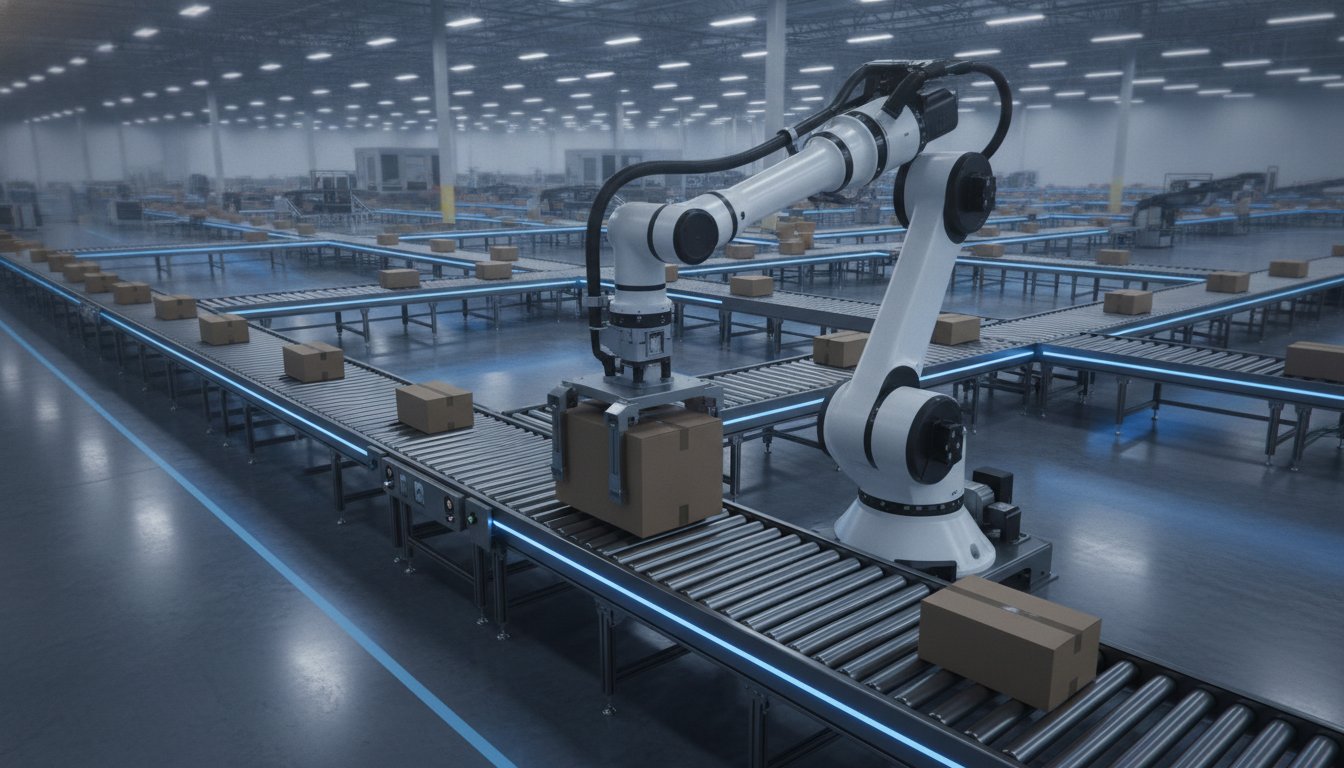
As of July 2026, 80% of U.S. factories still operate without any robotics or automation, including modern robotic pick and place systems. This statistic is staggering when you consider the persistent labor shortages and high turnover rates currently plaguing the material handling industry. If your facility struggles with bottlenecks at sortation points or the complexity of manual picking, you're certainly not alone. It's frustrating to watch your throughput stall because you can't keep repetitive roles staffed or your legacy equipment can't keep up with modern demand.
The leap to integrated automation often feels daunting, especially when you're trying to synchronize sophisticated technology with existing conveyor lines. This guide shows you exactly how to bridge that gap. You'll discover how these advanced systems integrate with industrial conveyors to maximize your units-per-hour (UPH) throughput, slash labor costs, and effectively future-proof your operations. We'll explore the latest 2026 market trends, practical integration strategies, and the technical insights needed to transform your warehouse into a high-efficiency fulfillment center.
Key Takeaways
- Define the core synchronized components-sensors, controllers, and end-effectors-that drive high-speed precision in modern robotic pick and place systems.
- Compare various mechanical architectures to determine the best balance of payload capacity and reach for your specific industrial workflow.
- Identify why the conveyor-robot interface is a common system bottleneck and how to utilize precision indexing to maintain seamless material flow.
- Apply a strategic five-step framework to transition from manual picking to automated cells while maximizing your return on investment.
- Leverage professional process engineering to identify the optimal pick points within your facility for long-term scalability and efficiency.
What is a Robotic Pick and Place System?
A robotic pick and place system isn't just a mechanical arm bolted to a floor; it's a highly synchronized ecosystem of sensors, controllers, and end-effectors working in perfect unison. While traditional manual picking relies on human dexterity and visual confirmation, modern robotic pick and place systems leverage advanced vision technology to identify, grasp, and position items with sub-millimeter precision. In 2026, the standard for warehouse throughput has shifted. High-speed identification now happens in milliseconds, allowing facilities to handle thousands of units per hour without the fatigue or error rates inherent in manual labor. This transition from human-centric to machine-led picking is the foundation of the modern automated warehouse.
Key Components of Modern Robotic Cells
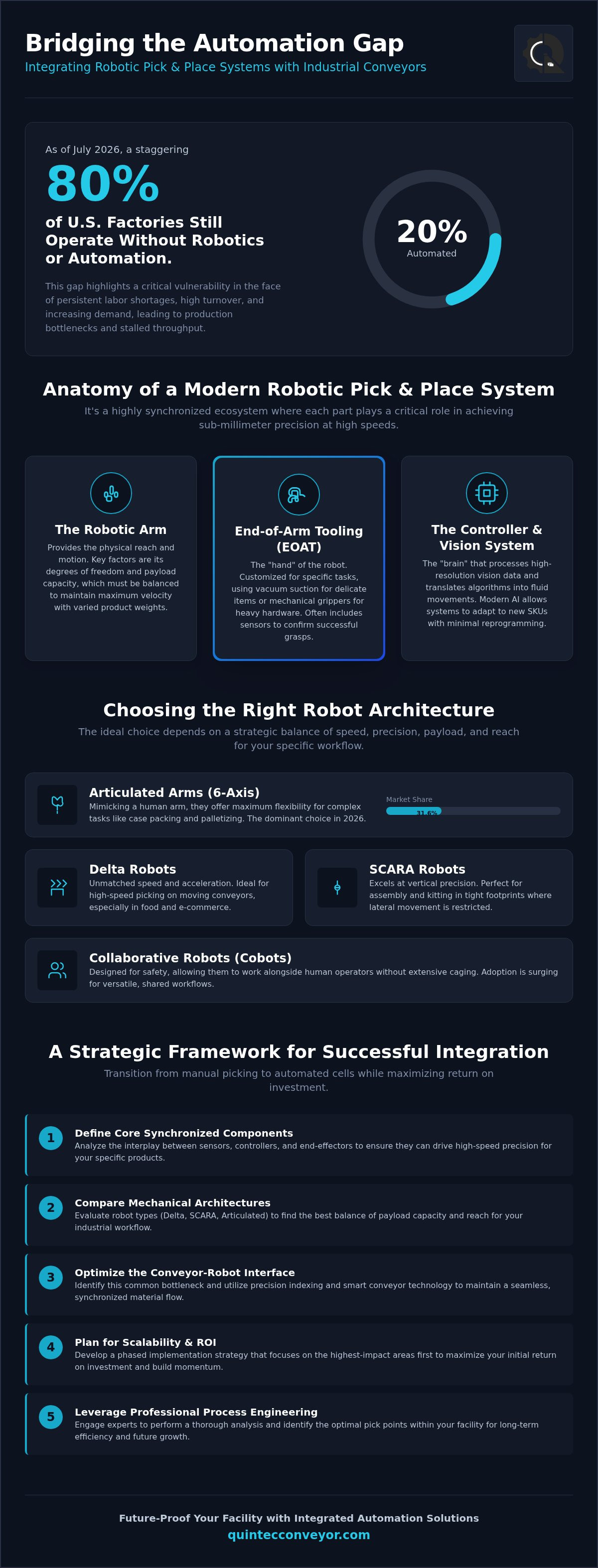
The efficiency of these systems depends on three primary pillars that must work together without friction. First, the robotic arm provides the necessary degrees of freedom to reach across conveyors and into deep bins. Payload capacity is a critical engineering factor here, as the arm must maintain its maximum velocity while handling varied product weights. Second, the End-of-Arm Tooling (EOAT) acts as the hand of the system. Whether using vacuum suction for delicate packaging or mechanical grippers for heavy hardware, the EOAT is often customized with specialized sensors to detect successful grasps and prevent product damage. Finally, the controller serves as the system's brain. It processes high-resolution vision data and translates complex algorithms into fluid mechanical movements, ensuring the robot adapts to changing product orientations in real-time.
The Shift from Standalone Robots to Integrated Cells
Buying a robot is easy, but integrating it into a functional facility is where the real engineering expertise is required. A standalone robot often becomes a bottleneck if it isn't paired with a smart conveyor system that can index products at matching speeds. Structural stability is another factor that's often overlooked. High-speed operations generate significant kinetic energy, so the base and surrounding infrastructure must be engineered to dampen vibrations that could throw off sensor accuracy. By 2026, AI integration has revolutionized these cells. Instead of hours of manual reprogramming for new inventory, modern systems use machine learning to "see" and adapt to new SKUs almost instantly. This intelligence transforms a static piece of hardware into a dynamic asset that grows with your product catalog, ensuring your investment remains relevant as your business evolves.
Types of Pick and Place Robots for Industrial Workflows
Selecting the ideal architecture is the first step toward optimizing industrial workflows. It's a strategic decision based on the physics of your product and the specific rhythm of your line. Engineers must weigh cycle times against payload requirements and reach. In modern robotic pick and place systems, the mechanical design dictates how effectively the system integrates with your material handling hardware. As of 2026, articulated robots remain the dominant choice, holding a 31.6% market share due to their immense flexibility in complex environments. Choosing the wrong robot type can lead to mechanical strain or underutilized throughput, so understanding these categories is vital.
Delta and SCARA Robots: Speed and Precision
Delta robots use parallel kinematics to achieve incredible accelerations. They're the gold standard for high-speed picking on moving belt conveyors, particularly in food processing and e-commerce fulfillment. Because they're typically mounted above the workspace, they don't consume valuable floor space. SCARA robots offer a rigid vertical axis that's perfect for precise assembly and kitting. They excel in tight footprints where lateral movement is restricted but vertical precision is paramount. For these high-speed applications, pairing the robot with a precision-indexed belt conveyor is essential to maintain accuracy at high units-per-hour rates. This synergy ensures that the robot isn't waiting on the material flow or vice versa.
Articulated Arms and Cobots: Versatility and Safety
6-axis articulated arms provide the greatest range of motion, mimicking a human arm's flexibility. They're the preferred choice for heavy palletizing and complex case packing at the end of a conveyor line. While traditional articulated robots often require extensive safety cages, 2026 has seen a massive surge in collaborative robot (cobot) adoption. New advancements, such as the ultra-lightweight Fanuc CRX-3iA introduced in April 2026, have made it possible to deploy automation in shared workspaces without the need for bulky guarding. These cobots now handle more complex assembly tasks while maintaining a lower barrier to entry for smaller facilities. If your operation requires a balance of safety and high-capacity throughput, the experts at Quintec can engineer a turnkey integration that maximizes your floor space and operational efficiency.
The Integration Factor: Synchronizing Robotics with Conveyors
The interface between mechanical handling hardware and automated arms is where the most significant operational failures occur. While many vendors treat the robot as an isolated unit, the reality is that robotic pick and place systems are only as effective as the conveyor hardware feeding them. If the conveyor lacks the precision to index a product exactly where the vision system expects it, the entire cell fails. This is why high-performance belt conveyors or live roller systems are non-negotiable for automated environments. These systems provide the vibration-free stability needed for the robot to achieve its maximum cycle rate without losing grip or orientation.
Strategic integration often involves using advanced sortation conveyors to pre-categorize items before they reach the robotic cell. By organizing the product flow upstream, you reduce the "cognitive load" on the robot's vision system. This directly increases units-per-hour (UPH) and maximizes your return on investment. At Quintec, we focus on the "Conveyor-to-Robot" handoff as a single, unified engineered process. We don't just place a robot next to a belt; we design a synchronized workflow where the hardware and software act as one. This approach eliminates the common integration gaps that lead to downtime and mechanical wear.
PLC Integration and Communication Logic
Successful synchronization requires a deep level of communication between the conveyor's Programmable Logic Controller (PLC) and the robot's internal software. If the conveyor speed doesn't perfectly match the robot's cycle time, bottlenecks are inevitable. We utilize high-speed sensors to determine the best picking logic for the specific application. For example, "stop-and-pick" logic is often best for heavy or awkward items that require precise orientation. Conversely, "pick-on-the-fly" logic allows for continuous movement and higher throughput on lighter items. A unified software control layer ensures that these two distinct pieces of equipment share data in real-time, preventing collisions and missed picks.
Optimizing the Facility Footprint
Space is a premium in any modern warehouse. We often utilize suspended conveyor systems to feed robotic cells from above, reclaiming valuable floor space for other operations. This vertical approach also helps reduce the "dead zone," which is the physical gap between the conveyor discharge and the robotic intake where products can lose their orientation. By designing with modularity in mind, we ensure that your facility can scale. You can add additional robotic cells to existing lines as your volume grows without needing to overhaul your entire infrastructure. This forward-thinking design is backed by our team's 100 plus years of collective industry experience.
Strategic Implementation: ROI, Scalability, and Engineering
Successful deployment of robotic pick and place systems requires more than just capital; it demands a rigorous process engineering approach. We identify the "optimal pick point" by analyzing where the mechanical handling system and the robotic reach overlap with the highest efficiency. Placing a robot at a random point on a line often creates new bottlenecks. Instead, we look for high-traffic convergence zones where automation can displace the most labor-intensive manual touches. This strategic placement ensures that your investment addresses the root cause of facility slowdowns rather than just moving the problem further down the line.
The 5 Steps to Automated Integration
A structured approach minimizes risk during national deployments and ensures long-term reliability. Our framework follows a logical progression:
- Workflow Audit: We analyze current conveyor paths to find where manual picking creates the most friction and delays.
- System Design: Engineers select the robot and End-of-Arm Tooling (EOAT) based on your specific SKU variety and weight requirements.
- Engineering: We create the mechanical and software interface between the hardware to ensure seamless data flow and synchronization.
- Installation: Our teams handle national deployment, ensuring every cell is calibrated for precision and site-specific needs.
- Maintenance: We establish a rigorous schedule to target 99.9% uptime, protecting the system's longevity and performance.
Calculating the Real ROI of Automation
In 2026, the metrics for success have evolved beyond simple speed. While increased units-per-hour (UPH) is a primary driver, the true value lies in drastic error reduction and the ability to reallocate labor to higher-value tasks. High labor turnover in repetitive picking roles often costs facilities more in training and recruitment than the initial price of a robotic cell. Automation provides 24/7 operational capability, effectively doubling or tripling throughput without increasing the headcount. Total Cost of Ownership in 2026 is defined as the sum of initial integration costs and long-term maintenance, minus the savings gained from eliminated turnover and increased fulfillment accuracy.
Lifecycle engineering is the final piece of the puzzle. We don't just walk away after the first pick. Our team leverages over 100 years of collective experience to provide turnkey automation solutions and maintenance that ensure your facility remains at peak performance for years to come.
Future-Proofing Your Facility with Quintec Solutions
As automation technology accelerates, the difference between a functional facility and a market leader often comes down to the quality of the integration partner. Quintec Conveyors positions itself as more than just an equipment supplier. We act as a strategic engineering partner that bridges the gap between raw hardware and operational excellence. By focusing on custom-engineered solutions, we ensure that modern robotic pick and place systems are not just bolted onto your floor but are deeply integrated into your facility's DNA. This holistic approach is why we emphasize national installation capabilities and a turnkey philosophy that covers everything from initial process engineering to long-term conveyor maintenance.
For multi-site industrial operations, the value of a national integrator is immense. Maintaining consistency across various geographic locations requires a partner with the reach and resources to deploy standardized, high-performance solutions. Quintec Conveyors provides this national coverage, ensuring that a robotic cell in one facility performs with the same precision and reliability as those in your other locations. This uniformity simplifies maintenance schedules and employee training, creating a cohesive operational standard that protects your bottom line across the entire organization.
Why Experience Matters in Systems Integration
With over 100 years of collective industry experience, our team has seen every iteration of warehouse automation. This deep well of knowledge allows us to navigate the complexities of integrating robotic pick and place systems with legacy conveyor systems, which is a frequent challenge for established facilities. While a simple equipment vendor might sell you a standalone robot, Quintec Conveyors solves the underlying logic of the workflow. In high-volume e-commerce environments, we've successfully resolved throughput bottlenecks at sortation points by synchronizing robotic cycles with precise conveyor indexing. We don't just provide hardware; we deliver a stable, future-proof workflow that remains efficient as your SKU variety grows.
Getting Started with a Workflow Audit
Every successful automation journey begins with a comprehensive workflow audit. Our engineers assess your current infrastructure for robotic readiness, evaluating everything from warehouse racking layouts to advanced sortation capabilities. We identify the specific material handling equipment needed to support your new robotic cells, ensuring that every piece of hardware works toward the same goal of increased units-per-hour. This customization prepares your facility for 2027 and beyond, providing the scalability needed to handle future market shifts. Contact Quintec Conveyors today to optimize your material handling flow.
Elevating Your Operational Standards Through Integrated Automation
The transition toward fully automated material handling is a strategic evolution that requires more than just high-speed hardware. The true value of robotic pick and place systems is unlocked through the seamless synchronization of robotics with precision conveyor technology. By prioritizing process engineering and identifying optimal pick points, your facility can overcome persistent labor shortages while achieving unprecedented throughput levels. This methodical approach ensures that your automation investment is both scalable and resilient against future market demands.
Quintec Conveyors brings over 100 years of collective industry experience to every project, providing turnkey solutions that bridge the gap between complex robotics and functional facility workflows. With our national reach for installation and maintenance, we act as a strategic partner for multi-site industrial operations. It's time to move beyond standalone equipment and embrace a unified system designed for modern excellence. Request a Custom Automation Audit from Quintec Conveyors today to begin your facility's transformation. We're ready to help you future-proof your operations with confidence and precision.
Frequently Asked Questions
What is the average speed of a robotic pick and place system in 2026?
Average speeds vary significantly based on the robot's mechanical architecture and the product's weight. High-speed Delta robots often achieve rates exceeding 200 picks per minute for lightweight items on continuous conveyors. In contrast, articulated arms typically operate at 20 to 60 picks per minute when handling heavier payloads or complex orientations. These cycle times are highly dependent on the synchronization between the robotic pick and place systems and the underlying material handling hardware.
Can pick and place robots handle fragile or irregularly shaped items?
Modern systems easily handle delicate or non-uniform objects using advanced End-of-Arm Tooling (EOAT). Soft robotic grippers and adaptive vacuum attachments provide a secure yet gentle hold on fragile goods like glass or produce. Integrated AI vision systems allow the robot to identify the optimal grasping point on irregularly shaped items in real-time. This adaptability ensures that automation can be applied to a wider variety of SKUs than was possible in previous years.
How much floor space does a typical robotic pick and place cell require?
Space requirements are dictated by the robot's reach and the necessary safety perimeter. A compact SCARA or cobot cell might only require a 4-by-4 foot footprint, while large articulated arms with safety fencing can occupy 100 square feet or more. Many facilities now utilize suspended Delta robots to reclaim floor space, mounting the system directly above the conveyor line. Quintec's process engineering team specializes in optimizing these layouts to fit within existing facility constraints.
What is the difference between a Delta robot and a SCARA robot for conveyors?
Delta robots utilize a parallel arm design mounted above the workspace, making them the fastest option for high-speed picking on moving belts. SCARA robots feature a horizontal jointed arm that is ideal for vertical assembly and picking in a fixed, circular work envelope. While Deltas excel at rapid throughput, SCARA units are often preferred for their smaller vertical footprint and higher precision in kitting applications. Both require precise conveyor indexing for maximum efficiency.
Do I need to replace my existing conveyor system to add robotics?
You don't necessarily need to replace your entire infrastructure, but modifications are often required for successful integration. Legacy conveyors may lack the precision indexing or vibration control necessary for robotic pick and place systems to function accurately. We often upgrade specific sections of a line with high-performance belts or precision rollers to create a stable pick zone. This targeted approach allows you to leverage existing assets while meeting modern automation standards.
How long does it take to see a return on investment (ROI) for robotic automation?
Most industrial facilities realize a full return on investment within 12 to 24 months of deployment. This timeline is accelerated by the reduction in labor turnover costs and the elimination of human error in high-volume fulfillment. By operating 24/7 without fatigue, these systems significantly lower the cost-per-pick compared to manual operations. The long-term stability provided by turnkey automation often results in a lower total cost of ownership over the system's lifecycle.
What kind of maintenance do robotic pick and place systems require?
Maintenance typically involves a combination of routine mechanical inspections and software updates. Mechanical tasks include lubricating joints, inspecting End-of-Arm Tooling for wear, and checking conveyor belt tension. Software maintenance ensures that vision systems and PLC logic remain optimized for changing SKU profiles. Establishing a preventative maintenance schedule is critical for achieving 99.9% uptime. Quintec offers comprehensive maintenance services to ensure your integrated system continues to operate at peak performance levels.
Can these systems be integrated with existing Warehouse Management Systems (WMS)?
Yes, seamless integration with your Warehouse Management System is a standard requirement for modern automation. We use unified communication protocols to ensure the robotic cell receives real-time order data and reports fulfillment status back to the WMS. This connection allows for dynamic inventory tracking and automated sortation based on current shipping priorities. Robust software integration transforms a standalone robot into a data-driven asset that enhances your entire facility's visibility and control.