
The fastest route to warehouse automation ROI may not be the most automated one. There is no standard payback period: results depend on order volume, labor savings, equipment and installation costs, maintenance, and integration expenses. A sound estimate compares the full investment with measurable gains in productivity, operating costs, and service.
Equipment costs are a reasonable starting point, but software, installation, infrastructure changes, training, and integration also shape the investment. The right system must fit the facility and its workflows, not simply promise faster processing.
This article explains how to assess costs, estimate payback from operational data, and decide whether automation fits your warehouse and growth plans. You’ll see which baseline measures clarify the opportunity, how integration affects implementation, and why addressing a specific process bottleneck can be more useful than automating for its own sake.
Key Takeaways
- Build a clear operational baseline, including cost per order, picking accuracy, and labor hours per order, so projected gains have a meaningful comparison.
- Assess integration alongside equipment selection; system compatibility affects how smoothly automation fits into existing workflows.
- Compare expected savings with the full investment over time, then weigh the result against your order volume, maintenance needs, and growth plans.
- Match the solution to your facility and bottlenecks: robotics, conveyors, and warehouse racking can each support different operational needs.
Labor costs and distribution center productivity
Set a labor baseline using cost per order, picking accuracy, labor hours per order, and orders per hour. One illustrative warehouse handles 1,000 orders daily, while demand could rise to 1,500 or 2,000.
Robotics, automated guided vehicles, conveyors, and warehouse management systems address different workflow constraints. Their ROI depends on measurable gains, such as faster picking, less manual handling, or better coordination.
Labor Savings and Workforce Redeployment
Labor savings and workforce redeployment come from reducing time spent on routine handling and assigning employees to higher-value work. Savings depend on how the operation uses freed capacity, not simply on positions removed. Automation can shift workers from repetitive picking to replenishment, exception handling, or system oversight, while reducing reliance on seasonal recruiting, training, and overtime.
Goods-to-person picking brings inventory to workers, rather than requiring them to travel through the warehouse for each item. Compare lines picked per hour, labor hours per order, and throughput to determine whether it improves productivity in your operation.
Peak-season flexibility matters when order volume rises faster than staffing capacity. Review seasonal overtime and temporary staffing needs to assess the potential value of more consistent capacity.
Ergonomic Safety and Labor Costs
Ergonomic safety and labor costs are connected through the physical demands of daily travel and handling. In a typical warehouse, pickers can spend up to 70% of their time walking and searching for items. Goods-to-person picking changes that travel pattern. Assess task design and safe operator interaction alongside productivity, so efficiency improvements support a workable process.
To compare automation with hiring or outsourced fulfillment, model labor hours, overtime, training, and turnover alongside external fulfillment costs and flexibility. Automation may support higher throughput without labor increasing at the same rate, while outsourcing can change the capacity model. Compare both options with your order volume and service requirements.
In the United States, assess state or local economic-development grants and potentially applicable tax deductions as separate scenarios in your ROI model. Availability and eligibility depend on location, project details, and current tax rules, so keep projected operating savings separate from incentive assumptions.
Automation installation and integration costs
Model the initial investment alongside projected operational savings. Equipment is only one part of the total: software, infrastructure changes, installation, training, and integration also affect project costs.
Investment and Installation Expenses
Investment and installation expenses include equipment, software, site changes, installation labor, training, and other costs required to put automation into operation. Include each category because an equipment-only estimate can understate the resources needed to deliver a working system.
Integration with existing warehouse management systems (WMS), transportation management systems (TMS), and inventory platforms helps prevent data silos. Map how order and inventory information moves between systems, then account for the work needed to connect them. Effective integration can reduce implementation disruptions and support the intended operational benefits.
Inventory visibility affects replenishment, storage decisions, and carrying costs. Automated systems can provide real-time inventory information to support demand forecasting and stock management. Include these potential improvements in the business case, while distinguishing measurable labor costs and inventory outcomes from expected benefits.
Accuracy also shapes the investment case. Automated warehouse systems can achieve inventory accuracy rates above 99%. Barcode scanning, RFID, or system-driven verification can help reduce discrepancies. Track error and return rates alongside inventory accuracy to understand whether changes improve fulfillment operations.
Order errors create costs beyond the initial picking mistake. Reducing the rate to 1.5% lowers mispicks to 15,000 orders. Use your own order and error data to estimate how accuracy improvement could affect returns, reshipping, and extra handling.
Risks and Hidden Costs
Risks and hidden costs are expenses or disruptions an equipment-only estimate misses. Software integration, infrastructure changes, training, and auxiliary expenses can add to the initial investment, while maintenance affects ongoing operating costs.
Account for each cost category before comparing projected savings with the investment. A mismatch between automation workflows and existing inventory or order systems can also limit expected benefits. Warehouse automation planning can connect system integration and facility requirements to the operational case.
Payback periods for warehouse automation
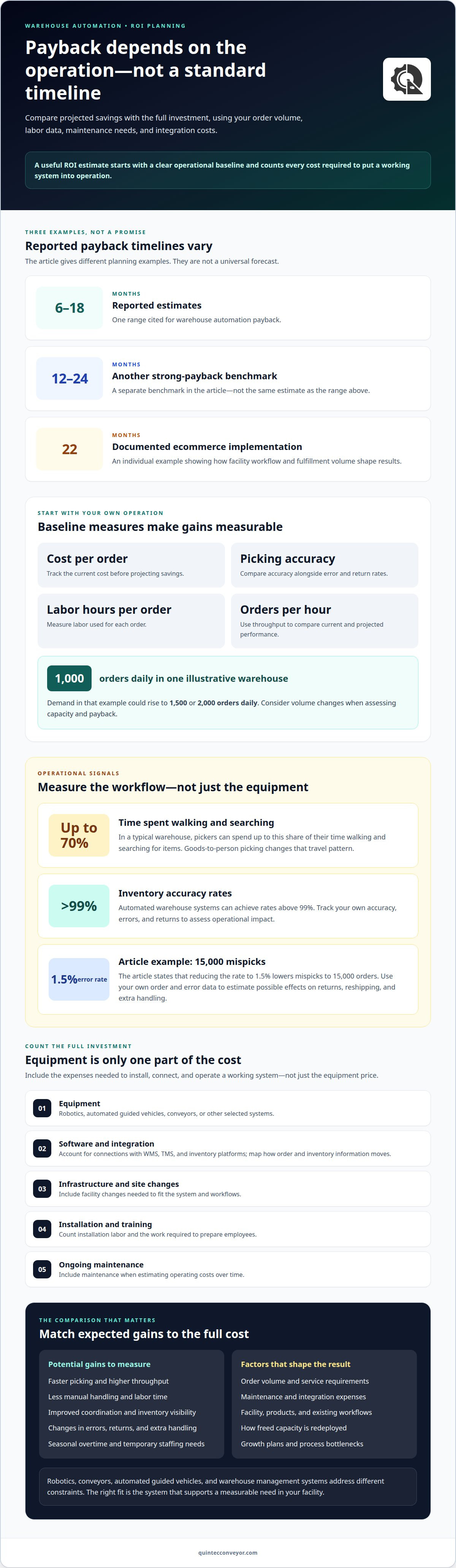
There’s no standard ROI or payback period for warehouse automation; results depend on investment, order volume, labor savings, maintenance, and integration. Reported estimates range from six to 18 months, while another benchmark describes strong payback within 12-24 months. Treat these as different planning examples, not a universal forecast.
For a useful comparison, calculate projected savings against the full initial investment, then assess whether benefits persist across the analysis period. A documented ecommerce implementation achieved payback in 22 months, illustrating how an individual facility’s workflow and fulfillment volume shape the result.
IRR and NPV Measures
Internal rate of return (IRR) estimates the annualized return implied by projected cash flows, while net present value (NPV) expresses those future flows in today’s dollars. Both add context to payback, which shows when cumulative benefits recover the initial investment.
Use consistent assumptions for all three measures, including savings, operating costs, and the analysis period. A calculator may compare five-year and seven-year periods. Testing both can show whether the business case depends on benefits continuing over time.
Payback periods vary across operations. One estimate places most customer returns within six to 18 months, while another describes two to three years for third-party logistics facilities, depending partly on client contract terms. These examples differ, so base the decision on measurable facility data rather than selecting the shortest reported period.
Implementation and Benefit Timing
Implementation and benefit timing cover the work needed to install, integrate, test, and bring automation into productive use. This matters because savings begin as processes improve, not simply when equipment arrives at the facility.
The timing and pace of benefits depend on integration with existing systems, workflow changes, and operational readiness. Track fulfillment volume, labor hours, and error rates during ramp-up, then compare them with the manual baseline. This separates early productivity changes from sustained savings and clarifies how implementation affects payback.
For a more complete view, model cash flows across five-year and seven-year analysis periods. Include implementation time and the gradual arrival of inventory and customer-service benefits, which may emerge after initial productivity gains.
System fit with facility, processes, products, and growth plans
Automation fits best when it addresses a specific constraint in the facility, rather than adding technology without a workflow goal. Compare current demand with future volume: an illustrative operation processing 1,000 orders daily may need capacity for 1,500 or 2,000. The right design should support that growth while matching the products handled, order profile, and existing process flow.
Space can shape the investment as strongly as labor cost. Automated storage and retrieval systems use vertical space, while pallet shuttles can reduce floor-space requirements or increase throughput. A cited study found that changing storage methods can increase warehouse capacity by 54% without adding floor space. Vertical lift modules can operate in aisles three to five feet wide, compared with 12-foot forklift lanes. These examples show why facility layout belongs in the ROI calculation.
Product characteristics and picking patterns also matter. Assess item dimensions, storage needs, order frequency, and movement between receiving, storage, picking, packing, and shipping. Dynamic slotting software can position frequently picked inventory for faster access, while automated storage systems may suit operations constrained by space. The best fit targets a slow, costly, or error-prone process rather than automating every step.
Growth plans affect how much capital to commit and how to plan future capacity. Automation may delay an addition, off-site storage, relocation, or another warehouse lease. Modular expansion can add capacity without redesigning the entire operation, while adaptable systems can accommodate changes in products and processes. Consider inbound freight timing, inventory placement, fulfillment velocity, and transportation workflows together. A faster picking stage alone may not resolve a downstream constraint.
Process engineering connects facility limits, product flow, and demand forecasts into one operating design. Map where work accumulates, then evaluate how equipment and software change the full path from receiving through fulfillment. Plan a warehouse process assessment to align automation decisions with your facility and growth requirements.
Quintec Conveyors: Robotics & Automation
Quintec Conveyors helps warehouse teams assess how automation can address workflow constraints and support operational growth. Its Robotics & Automation offering connects with broader material-handling needs, including conveyors, warehouse racking, and infrastructure. This integrated perspective is useful when projected savings depend on equipment, facility layout, and processes working together.
Turn to Quintec Conveyors when evaluating a warehouse automation project and aligning system design with your facility and operating goals. The right scope depends on your processes, products, space, and growth plans. A focused discussion can clarify the requirements that matter for your project.
Contact Quintec Conveyors to discuss your warehouse automation plans.
Turn the business case into a practical next step
A strong warehouse automation ROI case helps guide operational decisions, not just set a target on a spreadsheet. Treat the business case as a planning tool: it should clarify what to change, how the system fits, and which outcomes to monitor.
Use the financial model as a living decision framework. As product mix, demand, and operating constraints shift, revisit assumptions and track whether changes continue to support service, capacity, and workforce objectives. This keeps future capital decisions connected to warehouse performance rather than an outdated forecast. Before selecting equipment, define operational priorities, then align process design, facility requirements, and system integration around them. Make the next phase actionable with a clear scope and success measures to guide planning.
Start a focused project discussion with Quintec Conveyors and move your warehouse plans forward with clarity.
Frequently Asked Questions
Identify What Drives ROI?
Warehouse automation ROI depends on how effectively a system improves measurable operating outcomes. Beyond labor savings, evaluate order errors and returns, inventory turnover, peak-season stability, and customer-service performance. For example, reducing picking errors may also lower reshipping and customer-service workloads. Include only benefits your operation can track, and distinguish direct savings from broader service improvements.
What’s a “Good” Payback Period?
A good payback period meets your organization’s investment criteria and remains credible under realistic operating assumptions. Compare projected cash flows with other capital priorities, and test whether the case still works if order demand or savings change. A shorter payback may be attractive, but it should not outweigh operational fit, long-term value, or the ability to support planned growth.
How do you calculate warehouse automation ROI and payback period?
Calculate ROI by comparing net benefits over a chosen period with the total investment. A practical formula is: (total benefits minus total costs) divided by total investment, multiplied by 100. Estimate payback by dividing the initial investment by expected net savings per period. Include implementation and ongoing costs, then use consistent time units for costs, benefits, and payback.
What are the costs of warehouse automation systems by type?
Costs vary by system type and project scope, so compare complete configurations rather than equipment categories alone. Conveyors, robotics, automated storage, and warehouse software can require different infrastructure, installation, training, and integration work. Costs also depend on how a system connects to existing operations. Model these components together instead of assuming one equipment price represents the full investment.
How much can warehouse automation reduce labor costs and improve productivity?
The impact depends on which tasks are automated, how workflows are designed, and how the operation uses released capacity. Compare labor hours per order and orders processed per labor hour before and after implementation. For example, workers may shift from repetitive item movement to replenishment or exception handling. Reduced labor hours do not automatically mean lower payroll; savings depend on staffing decisions and added throughput.
What factors affect warehouse automation ROI, such as order volume and labor costs?
Order volume and labor costs matter because they influence how much work a system can absorb and how quickly efficiency gains accumulate. Product mix, picking patterns, facility layout, software integration, maintenance, and seasonal demand also shape results. For example, frequent product changes may call for a different process design than stable, predictable flows. Evaluate these factors together to understand the project’s operational fit.