
What is Packsize? Understanding On Demand Packaging
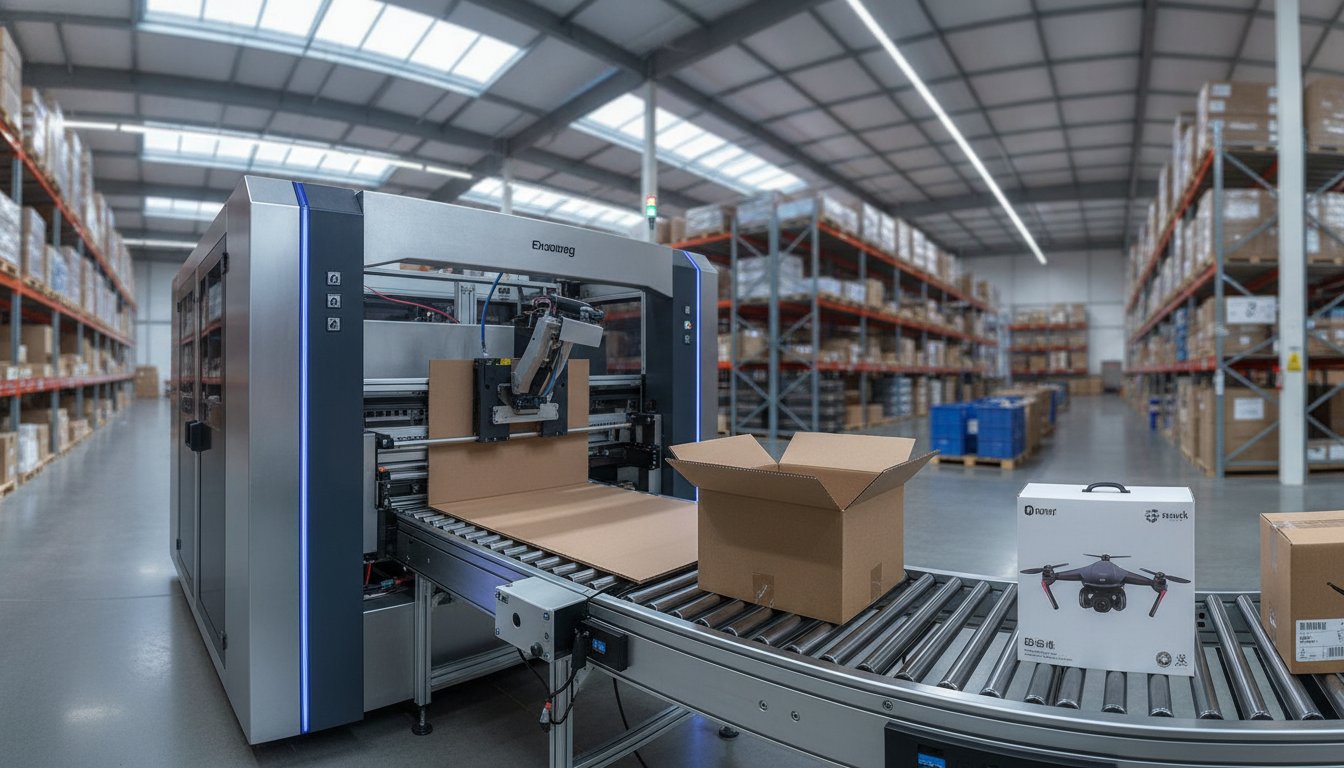
Shipping empty air isn't just a waste of space; it's a direct tax on your bottom line that has already cost the logistics industry billions in unnecessary DIM weight charges. You've likely felt the mounting pressure of rising freight costs and the persistent struggle to staff manual packing stations. It's frustrating to watch oversized boxes leave your dock, knowing you're paying to transport filler instead of product. Understanding Packsize and what their company does is the first step toward reclaiming those lost margins through automated, on-demand packaging.
We'll show you how Packsize technology revolutionizes warehouse efficiency by creating custom-fit boxes in real time, which drastically reduces corrugated waste and lowers shipping expenses. This guide details how to seamlessly integrate these sophisticated systems into your conveyor workflow, ensuring your material handling setup operates at peak performance. We'll preview the latest 2026 innovations, such as the X6 automated system and the strategic impact of the Panotec acquisition, to help you transition from a passive equipment user to a proactive leader in industrial efficiency. Discover how to transform your packaging line into a high-throughput asset that scales with your business needs.
Key Takeaways
- Gain a clear understanding of Packsize and what their company does by exploring how they replace traditional box inventories with custom, on-demand manufacturing at the point of fulfillment.
- Identify the specific mechanical pillars and sensor technologies that allow for precise product measurement and real-time parcel creation.
- Discover how to achieve a 40% reduction in corrugated waste while significantly lowering shipping costs through the mitigation of dimensional weight charges.
- Understand the critical role of process engineering in successfully integrating automated packaging hardware into a seamless, high-speed conveyor workflow.
- Apply a strategic decision framework to evaluate if your facility's throughput and inventory diversity align with the requirements for an on-demand packaging system.
What is Packsize? Understanding the On-Demand Packaging Revolution
Packsize is a global leader in automated, on-demand packaging technology, providing sophisticated systems that produce custom-sized boxes in real-time. This approach represents a fundamental shift in how fulfillment centers operate. Instead of maintaining a massive inventory of static box sizes, warehouses now manufacture the exact enclosure required at the specific moment of shipment. Understanding Packsize and what their company does is essential for any facility manager looking to transition from traditional stocking models to a leaner, more responsive manufacturing model at the packing station.
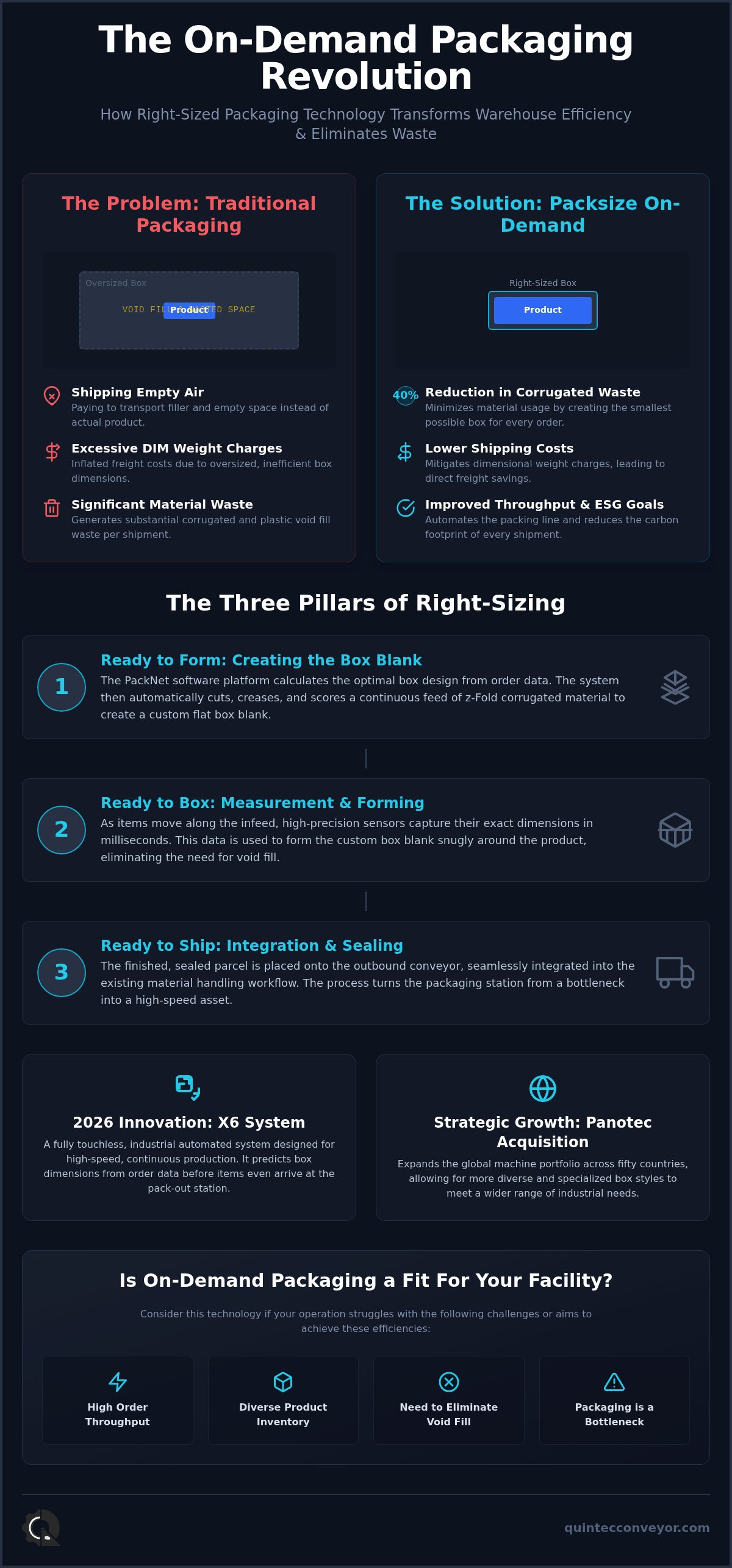
By 2026, this technology has become a cornerstone of "Right-Sized" logistics. It utilizes a continuous feed of corrugated material, known as z-Fold, to construct parcels that mirror the dimensions of the contents. This process eliminates the need for excessive plastic void fill and significantly reduces the overall carbon footprint of every shipment. It's a proactive solution for businesses aiming to meet aggressive ESG goals while simultaneously improving their operational throughput.
The Problem Packsize Solves: Excess and Waste
Traditional e-commerce fulfillment relies on a limited selection of standard box sizes. This often results in "shipping air," where a small item is placed in a large container with excessive padding. This inefficiency inflates freight costs due to dimensional weight charges and damages brand reputation when customers receive wasteful, oversized packaging. The environmental impact is equally severe. Traditional methods generate substantial waste and require extra energy to transport the unnecessary volume. By applying the engineering logic of corrugated box design to every individual order, on-demand systems ensure that the box is only as large as it needs to be.
The Evolution of On-Demand Packaging in 2026
The landscape of automated packaging has shifted from simple box selection to fully integrated, automated box-forming nodes. Modern systems, such as the X6 system, now use advanced software to predict box dimensions based on incoming order data before the item even reaches the pack-out station. The acquisition of Panotec in June 2026 further expanded the global machine portfolio, allowing for more diverse box styles across fifty countries. These advancements ensure that the packaging process is no longer a bottleneck but a high-speed, value-added component of the conveyor workflow. Facilities can now maintain continuous production without the frequent downtime associated with restocking pre-formed containers.
How Packsize Technology Works: The Three Pillars of Right-Sizing
The mechanical efficiency of an on-demand system relies on a synchronized workflow that transforms raw materials into finished parcels in seconds. To truly grasp Packsize and what their company does, one must look at the mechanical precision that defines their three-pillar workflow: Ready to Form, Ready to Box, and Ready to Ship. This cycle begins with the PackNet software platform, which acts as the central intelligence hub, calculating the optimal box design based on real-time order data and routing instructions to the hardware nodes.
High-precision sensors capture product dimensions in milliseconds as items move along the infeed. This data allows the system to select the most efficient box style from a library of hundreds of designs, ensuring the enclosure is a perfect match for the contents. Major global retailers have already proven the value of right-sizing packaging to eliminate the wasted volume that traditionally plagues high-velocity fulfillment centers. Whether using semi-automated stations or fully touchless industrial lines like the X6 system, the goal remains the same: total volumetric efficiency.
Ready to Form: Creating the Box Blank
The process starts when the machine receives instructions to cut, crease, and score the corrugated board. The system draws from a continuous feed of material to create a flat box blank tailored to the specific dimensions of the order. z-Fold corrugated is the fan-folded raw material that allows for continuous box production without the need for frequent manual reloading. This versatility enables the production of varied box styles, from simple slotted containers to complex folder-type boxes, all from the same stack of material. Proper process engineering is vital here to ensure the material handling system feeds these machines at a rate that matches your facility's peak throughput.
Ready to Box: The Packing Process
Once the blank is formed, the system transitions to the packing phase. In semi-automated setups, an operator places the item onto the blank, while fully automated lines use robotics to handle product insertion. These systems are remarkably adept at handling non-conveyables and irregular shapes that typically require manual intervention. Because the box is built around the product, it provides natural structural integrity. This eliminates the need for plastic air pillows or paper dunnage, as the tight fit prevents the item from shifting during transit.
Ready to Ship: Closing and Labeling
The final pillar involves securing the parcel for the carrier network. Automated gluing and sealing mechanisms apply hot melt adhesive with surgical precision, creating a bond that is often stronger than traditional packing tape. Integrated print-and-apply labeling systems then attach shipping documents and tracking barcodes while the parcel is still in motion. A final weight check ensures the package matches the expected manifest before it's diverted to the correct sortation lane, ready for immediate outbound loading.
The Business Case: Calculating ROI and Efficiency Gains
Analyzing Packsize and what their company does reveals a multi-layered financial benefit that extends far beyond the simple cost of cardboard. The transition to on-demand box production represents a strategic shift from variable, often unpredictable packaging expenses to a controlled, high-efficiency process. While the initial capital investment in automated hardware is a consideration, the return on investment is typically driven by a drastic reduction in material consumption and shipping overhead. Most facilities see a reduction in corrugated use of up to 40% because boxes are no longer oversized by default.
Warehouse space is at a premium in modern logistics. Traditional fulfillment models require vast areas of high-value floor space to store hundreds of different box SKUs, many of which may sit idle for months. By switching to a just-in-time manufacturing model, you can reclaim this footprint for more productive uses, such as additional racking or expanded sortation lanes. This consolidation of inventory into a few select widths of z-Fold material simplifies procurement and reduces the administrative burden of managing complex packaging supply chains.
Dimensional Weight and Freight Optimization
Dimensional (DIM) weight remains the most significant hidden cost in modern shipping. Carriers increasingly charge based on the space a parcel occupies rather than its actual weight. Oversized boxes aren't just wasteful; they're expensive. A 20% reduction in box volume can lead to a 15% reduction in total freight spend. By right-sizing every parcel, you maximize truckload density and reduce the number of vehicles required to move the same volume of product. This optimization directly offsets the impact of rising fuel surcharges and carrier rate hikes, making your entire outbound logistics chain more resilient. Truly understanding Packsize and what their company does provides a clear path to reclaiming this wasted overhead.
Sustainability as a Competitive Advantage
By 2026, corporate ESG targets have evolved from optional marketing points to strict operational requirements. Implementing an on-demand packaging solution allows facilities to align their shipping practices with these modern expectations. Consumers are increasingly vocal about their disdain for plastic void fill and excessive packaging waste. Providing a minimal, plastic-free experience improves brand reputation while simultaneously reducing the carbon footprint associated with your logistics. Better cube utilization means fewer trucks on the road, which is a tangible metric for any sustainability report. This engineering-led approach to packaging ensures that your facility isn't just faster, but also more responsible.
Integrating Packsize into Your Conveyor Workflow
A box-making machine remains an island of automation without a cohesive material handling strategy. To truly leverage Packsize and what their company does, you must treat the packaging station as a critical node within your larger conveyor ecosystem. A standalone unit can't manage the complex timing required to meet high-volume fulfillment goals on its own. This is where the role of a conveyor integrator becomes vital, ensuring the physical flow of goods matches the digital stream of order data without interruption.
Managing infeed logic requires precise synchronization. The right product must meet its custom-formed box at the exact millisecond to maintain throughput. Once the box is sealed, the outfeed logic takes over, directing finished parcels toward robotic pick and place systems for automated palletizing. This level of coordination prevents the packaging node from becoming a bottleneck in an otherwise fast-moving facility. It's about creating a unified system where hardware and software work in tandem.
WCS and WES Software Integration
Modern systems rely on Warehouse Control Systems (WCS) and Warehouse Execution Systems (WES) to synchronize order data with machine instructions. Tracking parcels via barcode scanning and RFID ensures every item is accounted for as it moves through the custom box-forming process. Robust error handling is also essential. If a box fails to form or seal correctly, the system must immediately divert the product for manual inspection without halting the entire line. This digital oversight provides the transparency needed for 2026 logistics standards, allowing for real-time adjustments to throughput speeds.
Physical Flow and Sortation
Designing a layout that handles varying box sizes requires deep expertise in physical sortation. Standard conveyors often struggle with the diverse dimensions produced by on-demand systems, leading to potential jams at transfer points. Integrating these lines with automated warehouse racking system services allows for efficient replenishment of corrugated materials and z-Fold stacks. Success depends on rigorous process engineering to map the flow of every SKU. If your facility isn't designed for this variability, you won't see the full ROI. Successful implementation requires more than just a machine purchase. Consult with an expert to design a seamless conveyor integration for your next automated packaging project.
Is Packsize Right for Your Facility? A Decision Framework
Implementing a right-sized packaging solution is a significant capital commitment that requires a strategic evaluation of your current operational profile. It isn't a universal fix for every warehouse; instead, it's a specialized tool for facilities facing specific logistical pressures. Understanding Packsize and what their company does requires a critical look at your daily throughput volumes. If your facility processes a high volume of diverse SKUs, the reduction in manual labor and material waste often justifies the initial expenditure. Conversely, operations with highly standardized product dimensions may find that traditional pre-formed boxes remain more cost-effective for their specific needs.
Technical readiness is the second major hurdle in the decision process. Your existing industrial conveyor systems must be robust enough to handle the variable output generated by on-demand machines. You also need to account for the physical footprint of the hardware and the necessary staging area for z-Fold corrugated material. A successful deployment depends on whether your infrastructure can support the sophisticated infeed and outfeed logic required to keep these machines running at peak capacity.
Evaluating Your Current Packing Bottlenecks
The first step in any feasibility study is a comprehensive throughput audit. You must identify exactly where manual packing stations are failing to keep pace with outbound demand. Analyze your historical shipping data to calculate the "air percentage" in your current parcels. If a large portion of your freight spend is dedicated to shipping void fill or empty space, the business case for automation becomes undeniable. We recommend consulting with a conveyor system integrator to conduct a formal study. This ensures that the integration of new hardware won't create unforeseen disruptions in your existing workflow.
Planning for Future Scalability
Scalability is a core advantage of modern on-demand systems. Many 2026 models offer modular configurations that allow you to increase throughput as your order volume grows. However, automation only provides value if it's reliable. Ensuring 99.9% uptime requires a rigorous ongoing maintenance schedule and a deep understanding of the software layer managing the machine. To achieve the best results, look for a turnkey automation solution that covers everything from initial process engineering to long-term system support. Partnering with a veteran integrator ensures that your Packsize implementation is built on a foundation of industrial-grade reliability and seasoned expertise.
Revolutionizing Your Fulfillment Workflow for 2026
Transitioning to an on-demand packaging model isn't just about adding a new machine; it's about re-engineering your facility's entire material flow to meet the demands of modern commerce. By now, you understand Packsize and what their company does to eliminate corrugated waste and mitigate the rising costs of dimensional weight charges. However, the hardware is only as effective as the system that supports it. A truly optimized line requires a sophisticated blend of mechanical precision and software synchronization to ensure every custom-fit box moves through your facility without friction.
To unlock the full potential of this technology, you need a partner who understands the complexities of systems integration. With over 100 years of collective engineering experience and a specialized focus on WES/WCS communication, our team provides the national installation and maintenance support required for large-scale success. We invite you to consult with Quintec Conveyors for an integrated automation strategy that transforms your packaging node into a high-performance asset. Let's build a more efficient, sustainable future for your logistics operations today.
Frequently Asked Questions
How much can Packsize actually save on shipping costs?
Packsize systems typically reduce corrugated usage by up to 40% and can lead to a 15% reduction in total freight spend. These savings are achieved by eliminating the "shipping air" that triggers expensive dimensional weight charges from carriers. By creating a custom box for every order, you maximize truckload density and reduce the need for expensive void fill materials. The actual ROI depends on your specific product mix and current outbound volume.
Does Packsize work with any type of conveyor system?
Packsize hardware can be integrated into most industrial conveyor systems, but the success of the installation depends on proper process engineering. It isn't just about the machine; it's about the infeed and outfeed logic that connects the pack-out station to your sortation lanes. A professional integrator ensures that your existing infrastructure can handle the variable box sizes and high throughput rates required for a truly automated 2026 fulfillment workflow.
What is z-Fold corrugated and why is it used?
z-Fold corrugated is a continuous fan-folded stack of material that serves as the raw feedstock for on-demand box production. It's used because it allows the machine to create boxes of virtually any length without frequent reloading or material waste. Understanding Packsize and what their company does involves recognizing how this continuous material feed replaces the need to store hundreds of pre-formed box SKUs, significantly reducing your facility's storage footprint.
Can Packsize handle heavy or fragile industrial products?
Yes, on-demand systems can handle a wide variety of industrial goods, including heavy and fragile items. Because the box is built to the exact dimensions of the product, it provides superior structural integrity and minimizes movement during transit. This precise fit reduces the risk of damage without requiring excessive plastic padding. For specialized industrial applications, the system can be configured to use heavy-duty corrugated grades to ensure maximum protection.
How long does it take to integrate a Packsize machine into an existing line?
The timeline for integrating a new packaging node varies based on the complexity of your WES/WCS requirements and physical layout. A standard installation might take several weeks to fully synchronize with your material handling systems and sortation logic. Working with an experienced integrator helps streamline this process, as they manage the technical communication between the packaging hardware and your existing conveyor infrastructure to ensure a seamless transition without disrupting daily operations.
Is on-demand packaging more sustainable than recycled standard boxes?
On-demand packaging is often more sustainable because it addresses the root cause of logistics waste: excessive volume. While recycled boxes are helpful, shipping oversized containers still requires more fuel and generates more carbon emissions per parcel. Understanding Packsize and what their company does highlights the environmental benefit of "right-sizing," which has already saved over 1.3 billion pounds of CO2 by optimizing truckload density and eliminating plastic void fill from the supply chain.
What happens if the Packsize machine goes down during a shift?
If a machine experiences downtime, your facility needs a robust contingency plan managed through your Warehouse Execution System. Most automated lines include bypass conveyors or manual pack-out stations to maintain throughput while repairs are conducted. To minimize these risks, we recommend a proactive maintenance schedule and consistent technical monitoring. High-speed 2026 models are designed for industrial-grade reliability, but having a redundant material handling strategy is essential for maintaining your shipping deadlines.