The Strategic Guide to Spiral Conveyor Systems in Modern Warehouse Automation
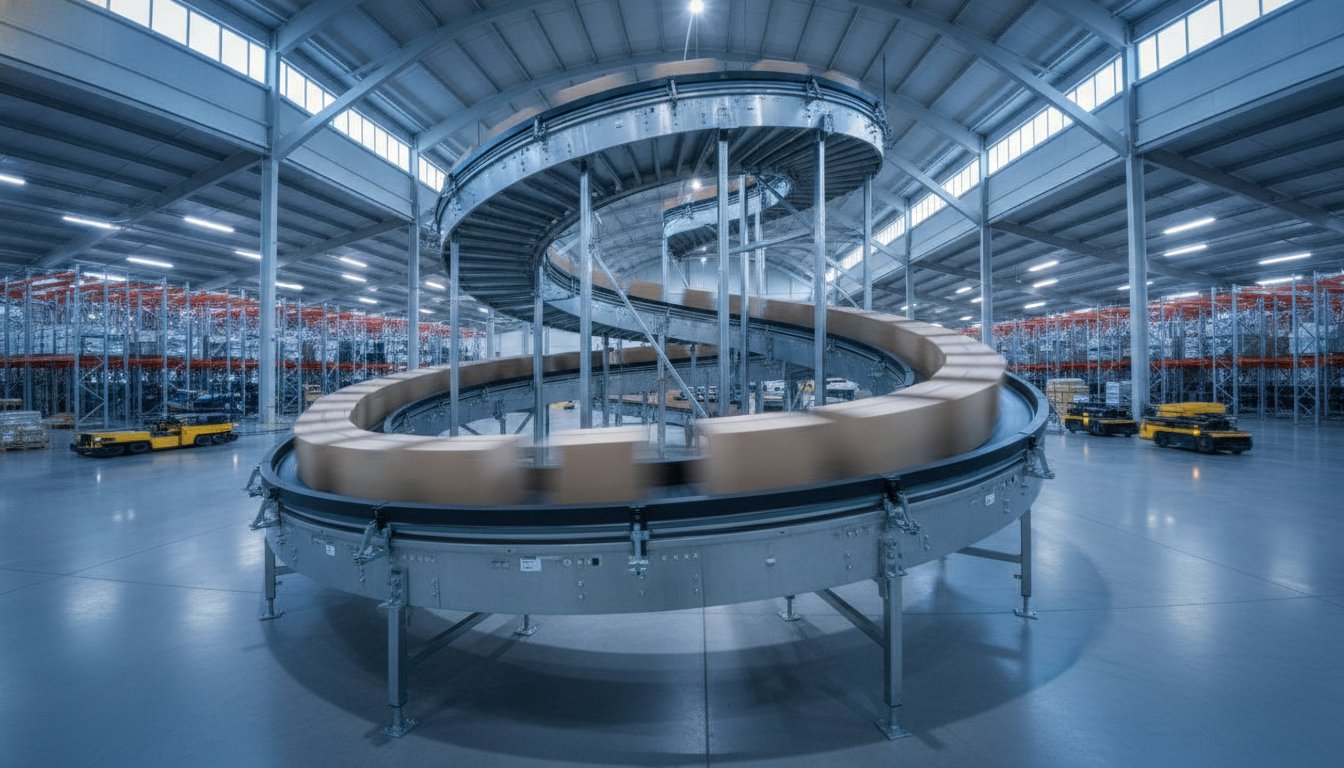
What if your facility's most significant operational constraint isn't the square footage on the ground, but the untapped cubic volume above your head? In an era where rapid fulfillment is the standard, an underutilized vertical strategy or a reliance on sluggish elevators creates a physical bottleneck that slows your entire supply chain. Integrating a high-performance spiral conveyor system solves the common frustration of losing valuable floor space to bulky equipment. It also eliminates the risk of product damage that often occurs during steep, unstable elevation changes. It's a critical shift for growing operations that need to scale throughput without the expense of a facility expansion.
This strategic guide demonstrates how precision-engineered vertical solutions serve as the high-speed arteries of a modern automated warehouse. By leveraging deep industry expertise, you can maximize your vertical cube utilization and maintain a continuous product flow that traditional lifts can't match. We'll examine the technical integration strategies that reduce facility footprint requirements while protecting your operational rhythm. From mechanical efficiency to seamless system-wide synchronization, you'll discover how to turn vertical logistical challenges into a distinct competitive advantage for your infrastructure.
Key Takeaways
- Understand how a spiral conveyor system provides continuous vertical transport, eliminating the throughput delays common with batch-based elevators.
- Discover the engineering principles of helical slats and rolling friction technology that minimize mechanical wear while maximizing load capacity.
- Learn how vertical spiral solutions can reclaim up to 75% of your facility's floor space compared to traditional incline conveyors.
- Identify critical integration strategies for infeed and discharge points to ensure seamless transitions and eliminate upstream bottlenecks.
- Explore the comprehensive process engineering approach provided by Quintec Conveyors, backed by over 100 years of collective experience in complex material handling.
What is a Spiral Conveyor System? Defining Vertical Flow
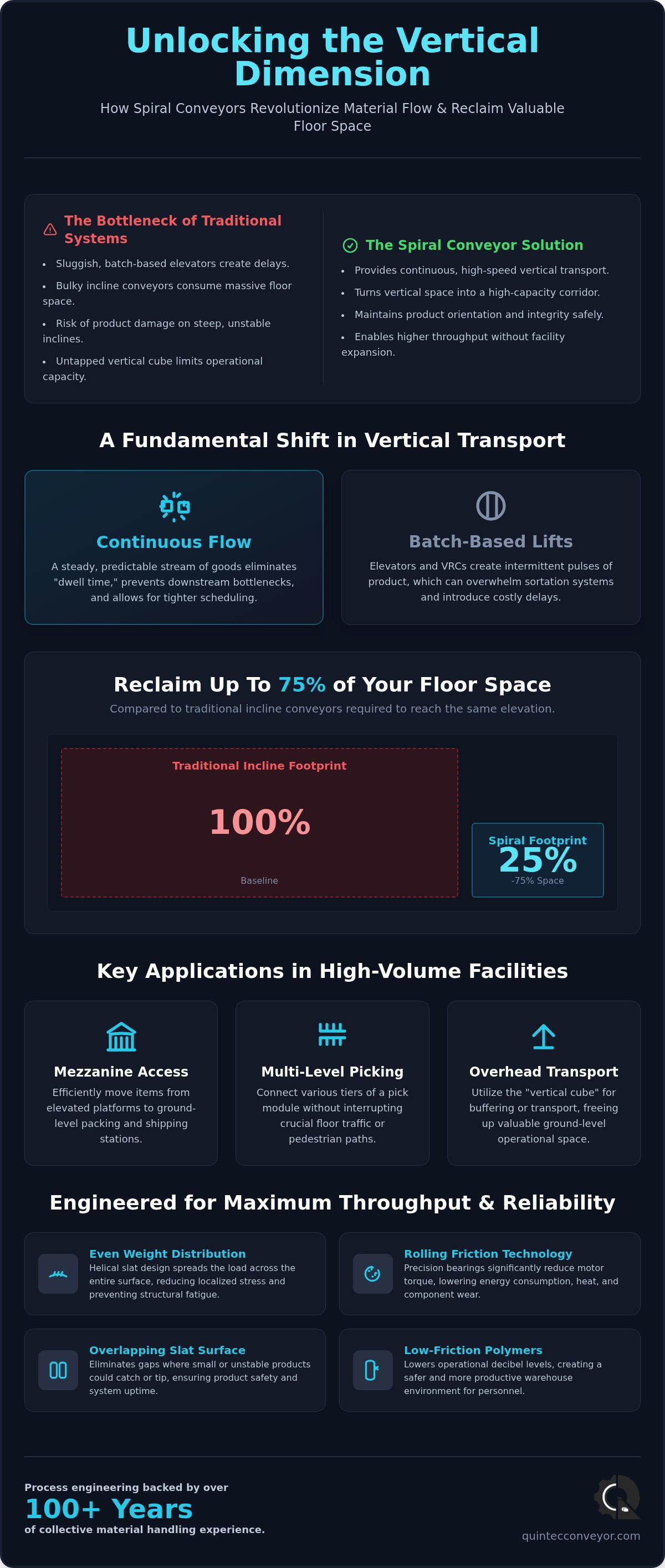
A spiral conveyor system represents a sophisticated evolution in vertical material handling. Unlike traditional freight elevators or vertical reciprocating conveyors (VRCs) that operate on a batch basis, a spiral maintains a continuous, helical flow. This design allows goods to transition between elevations without stopping, making it an essential component for high-speed sortation. It effectively turns vertical space into a high-capacity transit corridor. Efficiency is the priority. By utilizing a compact vertical footprint, these systems often save up to 75% of the floor space required by standard incline conveyors.
Facilities often reach a tipping point where traditional inclines are no longer viable. A standard incline requires a significant horizontal run to achieve height without causing product slippage. In contrast, the spiral's tight radius allows for steep elevation changes within a minimal diameter. This makes them the primary choice for several key applications:
- Mezzanine Access: Efficiently moving picked orders from elevated platforms to ground-level packing stations.
- Multi-Level Picking: Connecting various tiers of a pick module without interrupting floor traffic or pedestrian paths.
- Overhead Storage: Utilizing the "vertical cube" for temporary buffering or transport to clear ground-level floor space.
Core Components of a Helical System
The architectural foundation is the central support tower, which houses the drive mechanism and ensures stability. The conveyance surface typically utilizes slat-type belts for heavier loads or flexible chain designs for lighter items and tighter radii. Precision at the infeed and discharge tangents is critical. These interface points must align perfectly with takeaway lines to prevent product jams, ensuring a seamless transition that preserves product integrity and orientation throughout the climb.
The Role of Continuous Flow in Modern Logistics
In the high-pressure environment of 2026 logistics, every second of "dwell time" is a cost. Batch-based lifts create intermittent pulses of product that can overwhelm downstream sortation. A spiral conveyor system provides a steady, predictable stream of goods, allowing for tighter scheduling and higher throughput. This consolidated drive approach also reduces energy consumption compared to multiple incline motors, supporting the "always-on" requirement of modern warehouse automation while reducing mechanical complexity.
The Engineering Behind High-Throughput Spiral Systems
High-throughput environments demand more than just vertical movement; they require mechanical precision that ensures reliability under heavy loads. A modern spiral conveyor system achieves this through meticulous weight distribution across its helical slats. By spreading the load evenly across the entire surface, engineers reduce localized stress on the chain and central tower, preventing the structural fatigue that plagues lesser systems. This engineering focus is what allows these units to operate continuously without the frequent resets required by older lift technologies. It's the difference between a temporary fix and a long-term infrastructure investment.
The implementation of rolling friction technology is a game-changer for drive motor longevity. By utilizing precision bearings rather than sliding surfaces, the torque required to move the belt is significantly reduced. This results in lower energy consumption and less heat generation, which is a primary driver of component failure. When paired with automatic tensioning systems that adjust for belt stretch and temperature changes, the system maintains a consistent grip. This prevents slippage and keeps the line moving at peak efficiency even during high-volume shifts.
Material Handling Precision and Slat Engineering
The design of the conveyance surface directly impacts product safety and system noise. Overlapping slat configurations are essential for small item stability, as they eliminate the gaps where products might catch or tip during the climb. Modern slats often use low-friction polymers that lower operational decibel levels, making the warehouse floor a more productive environment. For facilities handling heavy palletized goods, wide-track options offer the structural integrity needed to maintain stability during steep elevation changes without sacrificing line speed.
Automation and Control Logic in 2026
Looking toward 2026, the standard for vertical flow is defined by Variable Frequency Drives (VFDs) and smart sensor arrays. These VFDs allow for precise speed modulation, ensuring the spiral matches the exact pace of upstream robotics or manual induction. Integration into a Warehouse Control System (WCS) enables a level of synchronization that prevents downstream pile-ups. Smart sensors now go beyond simple jam detection; they monitor vibration and heat signatures to provide predictive maintenance data. This connectivity means you don't have to wait for a breakdown to take action. Partnering with experts for conveyor maintenance ensures these high-tech systems remain optimized for the long haul.
Spiral Conveyors vs. Incline Conveyors vs. VRCs
Selecting the correct vertical transport method is a decision that dictates the logistical geometry of your entire facility. While several options exist, the spiral conveyor system is often the superior choice for high-volume environments where floor space is at a premium. The most immediate advantage is the footprint. By wrapping the transport path around a central column, spirals can reclaim up to 75% of the floor area that a traditional incline conveyor would otherwise consume. This reclaimed space can be repurposed for additional racking, robotics, or packing stations, directly increasing the revenue-generating potential of your square footage.
Beyond space, the choice involves a deep look at throughput and product integrity. High-speed operations can't afford the jarring transitions or the inconsistent pacing of older technologies. A spiral maintains a constant speed, ensuring that the gap between products remains uniform as they change elevations. This level of control is vital for protecting fragile goods that might otherwise shift or tumble during more aggressive elevation changes. It's about moving more product, more safely, in less space.
When to Choose a Spiral Over an Incline
The decision between a spiral and an incline often comes down to the "angle of repose." To move products safely without them tumbling backward, a standard incline requires a gradual, shallow slope. This results in a long horizontal run that cuts through the facility, creating significant barriers for floor traffic and personnel. Over a 10-year equipment lifecycle, the Total Cost of Ownership (TCO) for an incline often exceeds that of a spiral when you factor in the cost of that wasted square footage. A spiral provides the same elevation change within a compact diameter, allowing for a more open and navigable warehouse layout.
Spirals vs. Vertical Reciprocating Conveyors (VRC)
The comparison between a spiral conveyor system and a VRC is primarily a matter of throughput. VRCs operate as batch processors. They require a product to wait for a carriage, stop for loading, move vertically, and then stop again for unloading. This stop-and-go cycle creates an inherent bottleneck that can't keep pace with modern high-speed sortation systems. In contrast, a spiral offers uninterrupted flow. It eliminates the dwell time associated with lifts, ensuring your line speed remains consistent. While VRCs have their place for very heavy, oversized pallets, they simply cannot match the continuous operational uptime required for high-volume e-commerce or distribution centers.
Strategic Integration: Maximizing ROI in Your Facility
A spiral conveyor system only delivers its full value when it functions as a synchronized component of a larger material handling ecosystem. Many facilities treat the spiral as a standalone purchase, yet its true ROI is realized through precise process engineering. This strategic approach ensures the unit doesn't become a high-speed bottleneck for upstream or downstream equipment. Designing the infeed and discharge tangents requires an intimate understanding of the total system flow, particularly when transitioning goods into high-speed sortation. If the transition isn't seamless, the speed advantages of the helical path are lost to mechanical friction or product misalignment.
Scalability is equally vital. In the volatile 2026 market, your infrastructure must adapt to shifting volumes without requiring a total overhaul. Incorporating spirals into a modular conveyor system allows for future throughput increases and physical layout adjustments. This foresight prevents the "locked-in" effect of rigid, legacy installations. Reliability starts with expert conveyor installation. Even a minor deviation in floor leveling or support tower alignment can lead to premature belt wear or increased operational noise. Precision is the baseline for performance.
System Balancing and Flow Optimization
Balanced flow is the hallmark of a well-integrated facility. Managing accumulation on the spiral is essential to prevent upstream jams, especially during peak fulfillment windows. This requires synchronizing the spiral's speed with primary industrial conveyor systems through advanced control logic. Buffer zones at the discharge point act as a relief valve, absorbing surges in product volume before they reach critical sortation zones. This multi-level vertical integration ensures that line speed remains consistent across all elevations, maintaining the pulse of your operation.
The Integrator’s Role in Successful Deployment
Successful deployment moves beyond simple equipment delivery; it requires a strategic system partner. A veteran integrator doesn't just sell hardware. They customize discharge heights and angles to fit your specific existing infrastructure, ensuring a turnkey handover. This includes coordinating the complex electrical and mechanical integration necessary for immediate operational readiness. If you're ready to optimize your facility's vertical flow, consider reaching out for a professional process engineering assessment to identify your highest-impact improvements.
Quintec Conveyors’ Approach to Vertical Integration and Maintenance
With over 100 years of collective industry experience, Quintec Conveyors approaches every spiral conveyor system project as a strategic engineering challenge rather than a simple equipment sale. We recognize that vertical transport is often the most critical link in a multi-level facility. Our team manages the entire lifecycle of your infrastructure, from the initial conceptual design and process engineering to the final physical installation. This comprehensive oversight ensures that every mechanical component and software interface aligns with your broader operational goals. We don't just deliver machinery; we implement high-performance solutions designed for long-term stability and maximum throughput.
Operational uptime is the primary metric for success in high-volume distribution. Our approach to conveyor maintenance prioritizes proactive inspections and real-time monitoring to prevent the mechanical failures that lead to costly downtime. By identifying wear patterns in helical slats or drive chains before they reach a critical state, we help you maintain 24/7 reliability. As you look toward future-proofing your facility, Quintec Conveyors integrates advanced robotics and automation that allow your vertical flow to scale alongside your business growth. We ensure your system isn't just ready for today's volume, but for the demands of the 2026 logistical landscape.
Engineering Excellence for National Operations
Standardized equipment rarely meets the specific needs of a complex industrial workflow. We develop customized configurations tailored to your unique product mix, weight requirements, and ceiling heights. Every installation undergoes rigorous testing and commissioning protocols to verify that the system performs under peak load conditions. This commitment is supported by a national network that provides ongoing engineering expertise and rapid access to critical parts. It ensures your infrastructure remains a reliable asset regardless of your location, providing a level of security that smaller vendors can't match.
The Quintec Conveyors Partnership Model
We believe the most successful projects are built on a foundation of deep collaboration. During the design phase, our engineers work closely with your team to ensure the selected technology delivers the highest possible long-term operational ROI. We provide expert guidance on selecting the specific drive mechanisms and control logic suited to your specific volume and product types. Our steady, high-level competence values long-term stability, positioning Quintec Conveyors as a proactive partner dedicated to your facility's modern excellence and professional standards. We act as a steady hand for clients navigating large-scale automation projects.
Optimizing Your Vertical Strategy for Long-Term Scalability
Deploying a spiral conveyor system represents a long-term investment in operational agility. Throughout this guide, we've examined how vertical movement, when executed with precision engineering, transforms facility constraints into throughput advantages. By shifting from batch-based lifts to continuous helical flow, you protect product integrity while reclaiming valuable floor space for core activities. This transition isn't merely about equipment; it's about establishing a high-performance artery that scales with your business demands.
Quintec Conveyors leverages over 100 years of collective experience to guide these complex transitions. Our national installation and maintenance coverage ensures that your vertical infrastructure remains optimized long after the initial commissioning. Through comprehensive process engineering, we help you synchronize every elevation change with the broader pulse of your warehouse automation. Ready to elevate your facility's performance? Partner with Quintec Conveyors for Your Custom Spiral Integration. Let's build a more efficient, future-ready operation together.
Frequently Asked Questions
How much floor space does a spiral conveyor typically save?
A spiral conveyor system typically saves up to 75% of the floor space required by a traditional straight incline conveyor. This is achieved by wrapping the transport path vertically around a central tower. In a facility with limited square footage, this allows you to maintain high throughput while freeing up ground space for additional packing stations or robotics. It effectively turns your vertical cube into a high-density transit corridor.
What is the maximum throughput capacity of a modern spiral conveyor?
Throughput capacity depends on the specific belt width and motor configuration, but modern systems often exceed 2,000 units per hour. Unlike batch-based elevators, the continuous flow design allows for high-speed sortation without dwell time. By synchronizing the drive speed with your primary conveyor lines, a spiral can handle the same volume as your high-speed horizontal transport, ensuring that vertical transitions don't become a bottleneck.
Can spiral conveyors handle different product sizes and weights simultaneously?
Yes, provided the system is engineered with overlapping slats and appropriate friction surfaces. Overlapping slats provide a continuous surface that prevents small items from catching, while the robust helical drive handles heavier cartons or totes. This versatility is essential for e-commerce facilities where the product mix varies significantly between shifts. Engineers calibrate the pitch and speed to ensure stability for both light envelopes and heavy boxes.
What are the main maintenance requirements for a vertical spiral system?
Primary maintenance focuses on the central drive chain, slat tensioning, and rolling friction bearings. Regular lubrication of the main chain and inspections of the automatic tensioning system are critical to prevent belt stretch. Additionally, smart sensors should be calibrated quarterly to ensure jam detection and vibration monitoring remain accurate. Partnering with experts for scheduled conveyor maintenance prevents the mechanical fatigue that can lead to unexpected downtime in high-volume environments.
How does a spiral conveyor integrate with an existing warehouse control system?
Integration occurs through Variable Frequency Drives (VFDs) and PLC interfaces that communicate directly with your Warehouse Control System (WCS). This allows the WCS to modulate the spiral's speed in real-time, matching the pace of upstream induction or downstream sortation. Smart sensors provide data on product gapping and line pressure, allowing the system to automatically adjust flow or trigger accumulation logic when a downstream surge occurs.
Are spiral conveyors suitable for heavy palletized loads?
Specialized high-capacity spiral conveyor system units are specifically engineered for heavy palletized loads. These units utilize wide-track slats and reinforced central towers to support weights that exceed standard carton-handling capabilities. While lighter systems prioritize speed, pallet-handling spirals focus on structural integrity and torque management. They provide a continuous alternative to freight elevators, allowing for a steady stream of palletized goods between multi-level storage zones or mezzanines.
What is the typical incline angle for a helical conveyor system?
The typical incline angle for a helical system ranges between 8 and 12 degrees, though this varies based on product friction and stability requirements. This relatively shallow angle ensures that goods remain stable without sliding backward during the climb. Because the path is wrapped in a spiral, the system achieves significant height in a compact footprint, unlike a straight incline that would require a much longer horizontal run to maintain that same safe angle.
How do I determine if a spiral is better than a standard incline for my facility?
The decision hinges on your available floor space and throughput goals. If your facility has limited square footage or requires continuous flow for high-speed sortation, a spiral is almost always the superior choice. Standard inclines are often more cost-effective for low-volume applications with ample floor space. However, when you factor in the cost of wasted square footage over a 10-year lifecycle, the spiral typically offers a higher long-term ROI.