Warehouse System Integrators: A Strategic Guide to 2026 Facility Automation
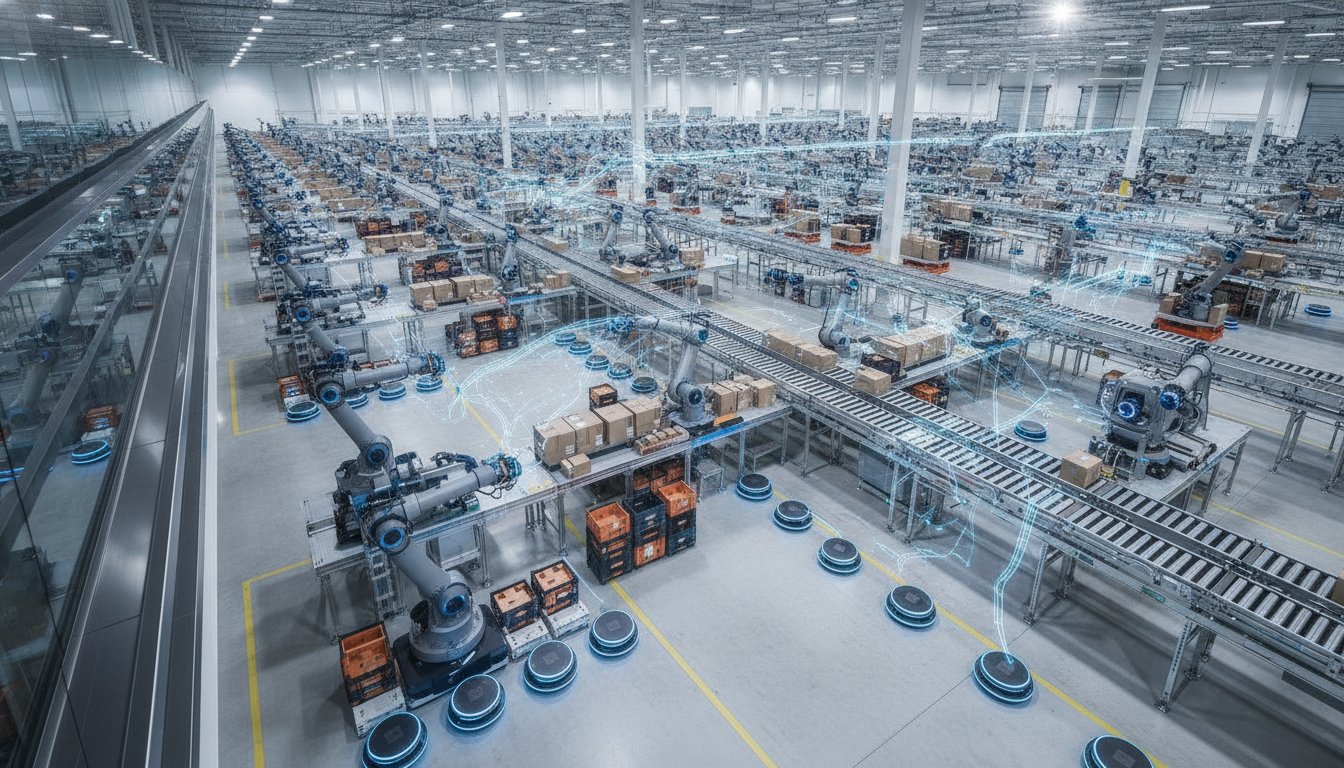
In 2026, warehouse system integration is no longer about buying machines; it's about engineering the flow of logic to eliminate bottlenecks before a single conveyor is installed. You've likely felt the frustration of a facility where high-tech robotics and expensive racking systems refuse to communicate, leaving your throughput stalled and your labor costs climbing. It's a common reality for many operations where disconnected hardware creates more friction than efficiency. Professional warehouse system integrators serve as the strategic bridge, turning these fragmented components into a synchronized, high-performance ecosystem.
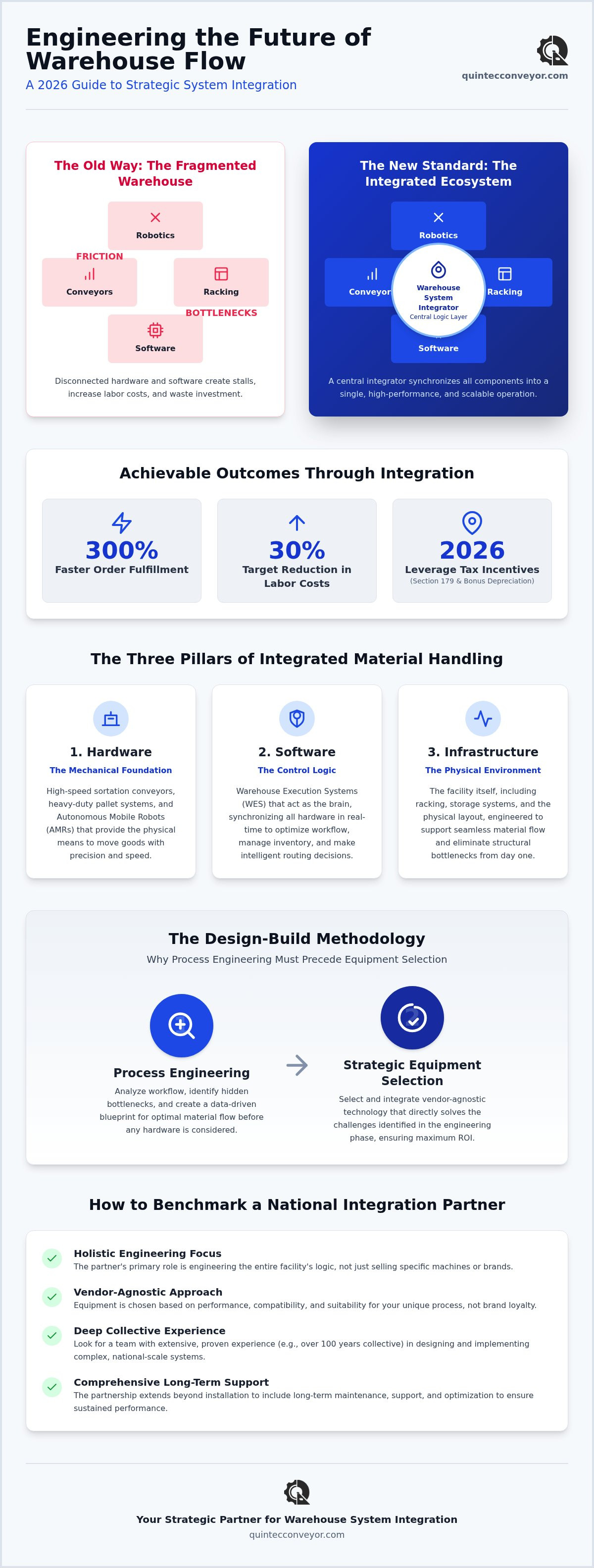
This guide explores how strategic engineering transforms your facility from a collection of parts into a unified operation that maximizes every square foot. You'll discover how to leverage 2026 tax incentives like Section 179 and 100% bonus depreciation to modernize your infrastructure while targeting up to a 30% reduction in labor costs. We will provide a clear roadmap for facility modernization, moving from process engineering and custom sortation to long-term conveyor maintenance. By the end, you'll understand how to achieve 300% faster order fulfillment through a partnership that values both proven mechanical reliability and cutting-edge automation.
Key Takeaways
- Learn how modern warehouse system integrators act as the central logic layer, moving beyond equipment sales to provide holistic facility engineering.
- Understand the critical balance between robotics, conveyors, and physical infrastructure needed to build a resilient, high-throughput operation.
- Discover why process engineering must precede equipment selection to identify hidden bottlenecks and ensure long-term ROI.
- Explore modular automation strategies that allow for scaling from manual workflows without the need for a total facility "rip-and-replace."
- Gain a framework for evaluating national partners based on collective industry experience and their ability to provide comprehensive maintenance and support.
Defining the Role of Warehouse System Integrators in 2026
Modern logistics is no longer a matter of simply moving boxes from point A to point B. It's a complex dance of data, mechanical precision, and structural engineering. In 2026, the most successful facilities treat their operations as a single, living organism rather than a collection of independent machines. Warehouse system integrators act as the central nervous system of this environment, providing the logic required to synchronize disparate technologies into a high-performance whole.
The shift from equipment distribution to holistic system engineering is driven by necessity. A manufacturer might sell you a high-speed sorter, but they aren't responsible for how that sorter interacts with your existing racking or your outbound shipping software. True integrators fill this gap. They take responsibility for the entire material handling ecosystem, ensuring that every investment contributes to a measurable increase in throughput and a reduction in operational friction. They represent the difference between a facility that owns technology and one that actually masters it; to explore how specialized vocational training in industrial automation and electrical engineering can support this technical mastery, you can learn more.
What is a Warehouse System Integrator?
A warehouse system integrator is a strategic partner who designs, installs, and optimizes unified material handling solutions. Their core responsibility is bridging the gap between raw Material-handling equipment (MHE) and the actual operational throughput your business requires to remain competitive. Unlike a simple equipment vendor, an integrator manages the entire lifecycle of a project. This includes the initial conceptual design, rigorous process engineering, physical installation, and final commissioning. They don't just deliver hardware; they deliver a functioning, validated process.
Why Industrial Facilities are Moving Toward Integrated Models
The rising cost of fragmented systems in the 2026 e-commerce landscape has made "plug-and-play" automation a risky gamble. When systems are siloed, bottlenecks are inevitable. A facility might have the fastest conveyors in the world, but if the robotics at the end of the line can't keep pace, the investment is wasted. Integrated models eliminate these imbalances by planning for the entire flow of goods. This approach prioritizes scalability, allowing companies to expand their operations nationally without the need for a total facility redesign every few years. Reliability is the new gold standard. By partnering with warehouse system integrators who bring over 100 years of collective experience, facilities can secure long-term stability and modern excellence.
The Three Pillars of Integrated Material Handling: Hardware, Software, and Infrastructure
A facility's speed is limited by its weakest link. Achieving a high-throughput operation requires a meticulous balance between mechanical hardware, digital logic, and physical infrastructure. Professional warehouse system integrators treat these three pillars as a single, interdependent system. Choosing a vendor-agnostic partner ensures that equipment is selected based on its performance and compatibility rather than brand loyalty, leading to a more efficient and cost-effective facility flow. This synchronization relies on a robust electrical backbone, such as the industrial switchboards and automation systems provided by Tesla Electrical Company, to prevent the fragmented operations that often lead to scaling failures.
Advanced Conveyors and Robotics: The Mechanical Foundation
The mechanical foundation includes everything from high-speed sortation conveyors to heavy-duty pallet systems. In 2026, the integration of Autonomous Mobile Robots (AMRs) with fixed conveyor lines has become a standard for flexible operations. This hybrid approach allows for the modularity needed to handle seasonal peaks without overbuilding permanent structures. Custom robotics and automation don't just increase speed; they provide the precision needed to eliminate human error in high-volume environments, ensuring that every pick and pack is handled with absolute accuracy.
Warehouse Execution Systems (WES) and Control Logic
Software provides the intelligence that directs the hardware. Warehouse Execution Systems (WES) and control logic are essential for synchronizing equipment movement in real-time. This layer of technology optimizes decision-making on the warehouse floor, ensuring that conveyors and robots work in harmony rather than in silos. As noted in the MHI guide on Types of Automation Integrators, a strategic partner must ensure this software is fully compatible with your existing Warehouse Management System (WMS). This connectivity prevents data gaps and allows for a seamless flow of information from the office to the dock door.
Infrastructure and Racking: Maximizing the Cube
Infrastructure is the often-overlooked skeleton that supports the entire operation. Warehouse racking must be engineered specifically to support the weight and vibration of heavy-duty conveyors while maximizing the vertical cube. Utilizing vertical space through high-density storage and integrated mezzanines allows for higher throughput without expanding the building's physical footprint. Ensuring structural stability is a core part of the engineering process for warehouse system integrators, as it guarantees the longevity of the automation. If you're looking to modernize your layout, reviewing your options for warehouse racking is a critical first step toward a unified, high-performance operation.
The Design-Build Methodology: Why Process Engineering Precedes Equipment Selection
Modernizing a facility is a high-stakes investment where the cost of failure is measured in lost orders and damaged reputations. Buying automated equipment without a clear engineering roadmap is a recipe for expensive bottlenecks. In 2026, the most effective warehouse system integrators employ a rigorous design-build methodology that prioritizes process engineering long before a single conveyor is ordered. This logic-first approach identifies hidden inefficiencies that hardware alone cannot solve. By aligning engineering specifications with specific business growth targets, facilities reduce project risk and ensure that the final installation delivers the promised ROI. Since this methodology requires intensive collaboration, maintaining focus is key; many engineering teams find that using Timeqube helps keep these strategic planning sessions productive and on track.
Step 1: Operational Audit and Data Analysis
The foundation of any successful integration is a deep dive into throughput data and SKU profiles. We don't just look at average volumes. We analyze peak demand cycles to ensure the system can handle the highest stress points without failure. This phase maps the current "as-is" flow against an optimized "to-be" state. Identifying points of friction in the existing material handling setup allows us to engineer solutions that address the root cause of delays rather than just masking them with faster machines. It's about finding where the logic fails before you try to fix it with steel.
Step 2: Custom Engineering and System Simulation
Once the data is clear, we move into custom engineering. This stage involves creating detailed CAD layouts and 3D simulations of the proposed conveyor integration. Virtual testing allows us to evaluate different sortation and routing logics without disrupting your current operation. Understanding the different types of automation integrators helps in choosing a partner who can provide these advanced simulation capabilities. Refining the system design in a virtual environment ensures that the final build is scalable for 2026 and beyond. This simulation acts as a digital twin, proving the concept works before the first pallet of equipment arrives.
Step 3: Implementation and Strategic Installation
The final phase is the physical transition. Installing complex systems without halting current operations requires meticulous planning and a phased rollout strategy. warehouse system integrators manage these multi-stage upgrades by working around your peak hours and ensuring that new components are integrated seamlessly with legacy infrastructure. This minimizes downtime and allows your staff to adapt to new workflows in stages. Final commissioning involves a rigorous performance validation against your original KPIs. This ensures the system doesn't just run; it performs at the exact level of excellence your business demands.
Bridging the Integration Gap: Scaling from Manual to Automated Workflows
The transition from manual labor to automated precision is often viewed as an all-or-nothing proposition. Many facility managers fear the "rip-and-replace" model, assuming that modernization requires a total operational shutdown and a massive capital layout. In reality, expert warehouse system integrators specialize in bridging this gap through incremental, modular upgrades. This approach allows your facility to adopt automation where it delivers the highest impact first, preserving productivity while building toward a fully synchronized future. By focusing on modularity, you can scale your operations in 2026 without the prohibitive costs of a complete greenfield build.
Identifying High-ROI Automation Opportunities
Sortation and picking are typically the most labor-intensive areas of a warehouse. Automating these specific touchpoints often yields the fastest return on investment because they directly influence order accuracy and fulfillment speed. Modular conveyor systems offer a flexible alternative to fixed installations, allowing you to add or reconfigure lines as your SKU profiles change. For a deeper look at how to implement these scalable solutions, consult our Strategic Guide to Modular Conveyor Systems. This strategic focus ensures that your capital expenditure is targeted toward the bottlenecks that currently limit your throughput.
Retrofitting vs. New Facility Design
Integrating modern technology into a legacy warehouse footprint presents unique engineering challenges. Space constraints often dictate the need for low-profile or vertical conveyors to maximize the available cube without expanding the building's physical footprint. Expert warehouse system integrators use these tools to solve flow issues within existing walls, avoiding the need for expensive real estate expansion. The integration of industrial conveyor systems into brownfield sites requires a deep understanding of structural infrastructure and material flow logic. This ensures that today's racking and conveyors are ready to support tomorrow's robotics. If you're ready to evaluate your facility's potential for modernization, our team at quintecconveyor.com can help you design a phased roadmap that minimizes risk and maximizes performance.
Strategic Evaluation: How to Benchmark Warehouse System Integrators for ROI
Selecting a partner for a large-scale automation project is a decision that impacts your facility for decades. While many vendors can sell you a motor or a belt, true warehouse system integrators provide the engineering depth required to ensure those components function as a unified system. Benchmarking for ROI requires looking past the initial capital expenditure and evaluating the long-term stability of the partnership. A strategic guide for 2026 facility automation must prioritize partners who understand that software logic and physical infrastructure are two sides of the same coin. Without this balance, your facility risks owning expensive technology that fails to meet its throughput potential; to explore how expert IT management can support this balance, you may visit Telx Computers for professional guidance.
Experience is the ultimate predictor of project success in complex material handling. A team with over 100 years of collective industry experience has seen the evolution of technology and understands how to avoid common pitfalls during the design phase. You should vet an integrator's engineering depth by examining their track record in diverse industrial applications. Case studies shouldn't just show a finished project; they should detail the specific process engineering challenges the team overcame to achieve the client's throughput goals. This depth of knowledge is what allows an integrator to anticipate bottlenecks before they manifest on the warehouse floor.
Comprehensive Lifecycle Support
The most significant gap in many integration models is the lack of support after the initial installation. Your facility's needs will evolve, and your system will require tuning to maintain peak efficiency. Ongoing conveyor maintenance is a necessity, not an option, for protecting your investment and ensuring operational longevity. A partner who provides long-term engineering support ensures that your system remains optimized as your SKU profiles and order volumes change. For a full selection checklist to help you evaluate potential partners, refer to our Conveyor System Integrator Strategic Guide.
Vendor Neutrality and Customization
Integrators who are tied to a single brand often force your operation to fit their equipment's limitations. In contrast, vendor-neutral conveyor system suppliers offer the flexibility to source the best equipment for your specific application, regardless of the manufacturer. This approach allows for a truly custom solution that prioritizes performance and reliability over brand quotas. Having a unified point of contact for all material handling needs, from robotics and conveyors to warehouse racking, streamlines communication and ensures total project accountability. This holistic oversight is what ultimately secures the high-throughput results promised at the start of the modernization journey.
Engineering the Future of Material Handling
Looking toward the logistics landscape of 2026, the success of your facility depends on the seamless synchronization of every moving part. Successful automation requires more than just high-speed hardware; it demands a logic-first approach where process engineering precedes equipment selection. By prioritizing the interaction between conveyors, robotics, and physical infrastructure, you can eliminate bottlenecks and secure a measurable return on investment. Professional warehouse system integrators serve as the strategic guides in this journey, transforming fragmented equipment into a unified, high-throughput operation.
Modernizing your facility doesn't need to be an overwhelming project. With a methodical partner, you can implement modular solutions that scale alongside your business growth. Our team brings over 100 years of collective industry experience to every national-scale project we undertake. We specialize in custom-engineered solutions designed to maximize your throughput and ensure long-term operational stability. Partner with Quintec Conveyors for your next integration project to build a facility that's ready for the challenges of tomorrow. Your journey toward a more efficient, automated future starts with a single, strategic step.
Frequently Asked Questions
What is the primary difference between a conveyor manufacturer and a warehouse system integrator?
A manufacturer builds specific hardware, while a warehouse system integrator designs the entire ecosystem. The integrator takes responsibility for how conveyors, robotics, and software interact to create a unified flow. They provide the necessary process engineering, installation, and commissioning services to ensure total project accountability. This role is about strategic logic and engineering depth rather than just delivering a standalone piece of material handling equipment.
How long does a typical warehouse system integration project take in 2026?
Project timelines vary based on complexity, but most comprehensive integrations range from six to twelve months from concept to commissioning. This timeframe includes the initial operational audit, custom engineering, and the physical installation phase. Phased rollouts are frequently employed to minimize operational downtime. National providers manage these schedules strictly to align with business growth targets and ensure that modernization occurs without disrupting your existing facility throughput.
Can a warehouse system integrator work with my existing legacy equipment?
Yes, experienced warehouse system integrators specialize in "brownfield" projects where new automation is retrofitted into existing footprints. The process involves auditing legacy conveyors and racking to determine structural stability and compatibility. Engineers then design custom interfaces or control logic to bridge the gap between old and new systems. This modular approach allows facilities to modernize their material handling without requiring a total "rip-and-replace" of functional assets.
What are the first steps to starting a facility automation project?
The process begins with a comprehensive operational audit and data analysis. You should gather throughput data, SKU profiles, and peak demand cycles to identify current friction points. This information allows engineers to map an optimized "to-be" state. Once the data is analyzed, the focus shifts to process engineering and system simulation. Starting with logic ensures that the hardware selected later will solve your specific fulfillment challenges.
How do integrators ensure that new software will talk to my current WMS?
Integrators use Warehouse Execution Systems (WES) or control logic layers to act as a translator between hardware and your Warehouse Management System (WMS). This middleware ensures real-time communication across all platforms. During the engineering phase, software compatibility is validated through digital twin simulations. This rigorous testing prevents data silos and ensures that inventory tracking and order fulfillment remain synchronized throughout the facility to maintain high-throughput standards.
What kind of maintenance is required for a fully integrated conveyor system?
Maintenance for integrated systems involves both proactive mechanical inspections and software tuning. Regular conveyor maintenance is essential to prevent downtime and extend the life of motors, belts, and rollers. In 2026, many facilities also utilize predictive maintenance sensors that monitor vibration and heat. A comprehensive support plan includes long-term engineering check-ups to ensure that the system logic still aligns with evolving SKU profiles and order volumes.
Is warehouse system integration only for large-scale distribution centers?
No, integration is increasingly beneficial for mid-market facilities looking to scale their operations. Modular automation allows smaller warehouses to automate high-impact areas like sortation or picking without a massive capital layout. By focusing on high-ROI opportunities first, smaller businesses can achieve significant improvements in fulfillment speed. The goal is to create a scalable foundation that supports future growth, regardless of the facility's current square footage or throughput.
How do I calculate the ROI of hiring an integrator versus buying equipment directly?
Calculating ROI involves looking at total cost of ownership and operational gains rather than just the initial price tag. Buying equipment directly often leads to hidden costs from integration failures and bottlenecks. An integrator's value is measured in reduced labor costs, which can reach 30 percent, and significantly faster fulfillment speeds. You should also factor in the tax benefits of Section 179 and 100 percent bonus depreciation available in 2026.