When to Upgrade Your Conveyor System: A Strategic Guide
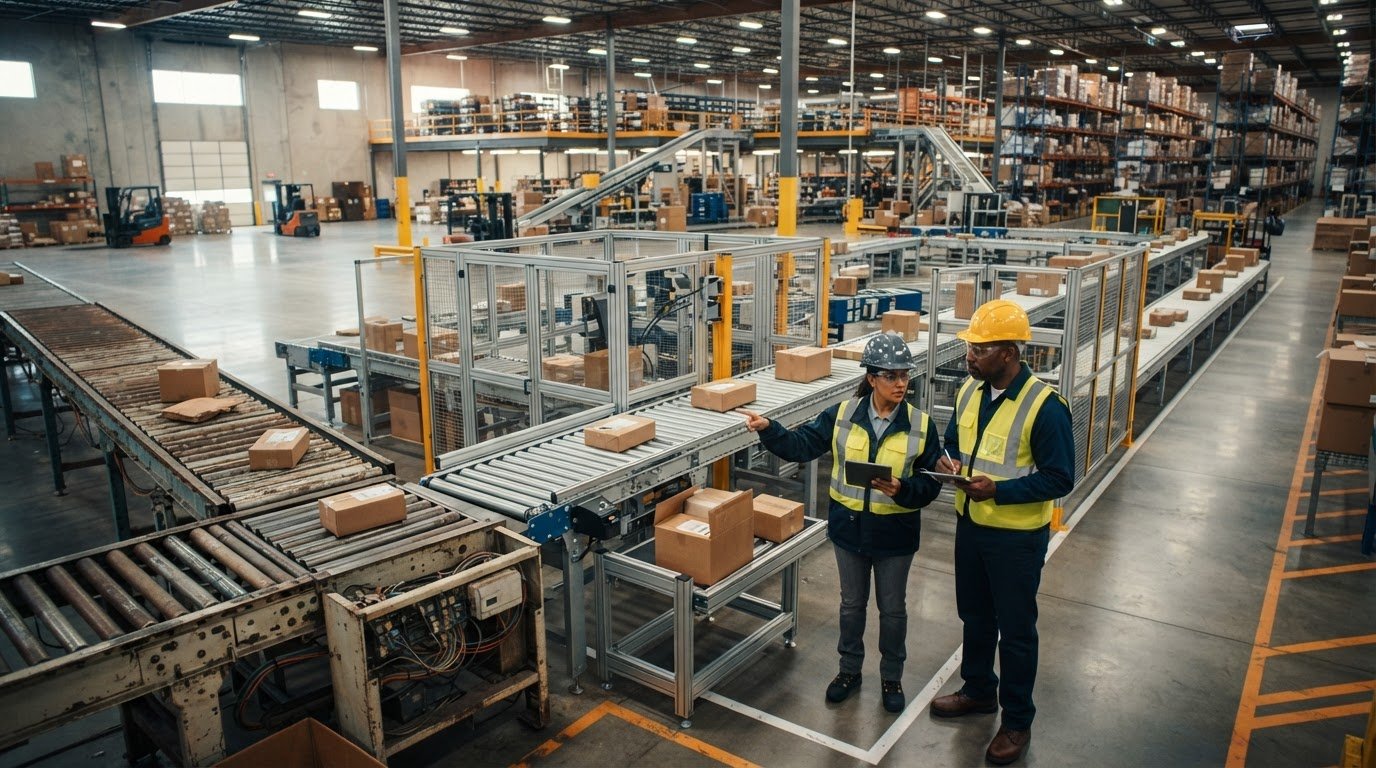
Mechanical wear rarely kills an industrial conveyor; throughput ceilings and obsolete controls do. When unscheduled downtime strikes during peak fulfillment hours and maintenance budgets vanish into discontinued replacement parts, it's natural to question the status quo. Pinpointing exactly when is it time to upgrade your conveyor system requires looking past surface-level mechanics to evaluate whether your existing setup can support evolving SKU profiles and higher volume targets.
Keeping legacy equipment on life support drains maintenance labor and leaves modern warehouse management systems disconnected from the floor. This guide delivers the critical operational benchmarks, financial indicators, and lifecycle metrics that reveal when to modernize your industrial conveyor system. You'll gain a proven framework to evaluate repair versus replacement viability, calculate modernization ROI, and execute phased integrations that preserve everyday operational continuity. Here is how forward-looking engineering transforms material handling bottlenecks into scalable advantages.
Key Takeaways
- Identify the operational thresholds, such as persistent throughput ceilings and mounting downtime, that signal when is it time to upgrade your conveyor system.
- Apply a structured Total Cost of Ownership framework to determine whether ongoing component repairs or capital retrofits deliver stronger lifecycle value.
- Uncover how legacy programmable logic controllers and aging drive components introduce major supply chain vulnerabilities before failure occurs.
- Use a strategic facility audit checklist to evaluate carton flow, dimensional matrices, and software integration requirements for future growth.
- Discover why collaborating with a turnkey systems integrator de-risks implementation and protects operational continuity through phased execution.
Operational Tipping Points: Core Signs It Is Time to Upgrade Your Conveyor System
Every facility reaches a stage where routine mechanical fixes no longer sustain operational pace. Recognizing when is it time to upgrade your conveyor system requires looking beyond component failures to examine systemic throughput limits. In industrial distribution and manufacturing, a modern conveyor system must synchronize perfectly with upstream automation and downstream fulfillment goals. When physical chokepoints multiply, equipment ceases to be an asset and becomes a growth constraint.
Throughput Stagnation and Flow Bottlenecks
Facilities often outgrow their material handling infrastructure long before the mechanical steel wears out. Throughput stagnation happens when upstream picking technologies surge, yet downstream accumulation lines lack the transport capacity to clear the volume. Dynamic volume spikes cause line backups, forcing operators into manual interventions at critical merge points. These manual workarounds disrupt line balancing and sharply decrease your facility's units-per-hour benchmarks, creating persistent delivery delays during peak periods.
Escalating Downtime and Maintenance Labor Drain
Unscheduled downtime directly threatens order fulfillment. While isolated belt wear or roller replacements are normal, chronic drive failures and recurring line stops indicate structural fatigue across the entire conveyor bed. Knowing the warning signs your conveyor needs maintenance helps teams stabilize immediate issues, but constant emergency interventions drain internal resources. When maintenance technicians spend their shifts patching recurring faults instead of performing planned servicing, labor costs compound rapidly while system reliability collapses.
Evaluate your facility against these core mechanical and operational diagnostic thresholds:
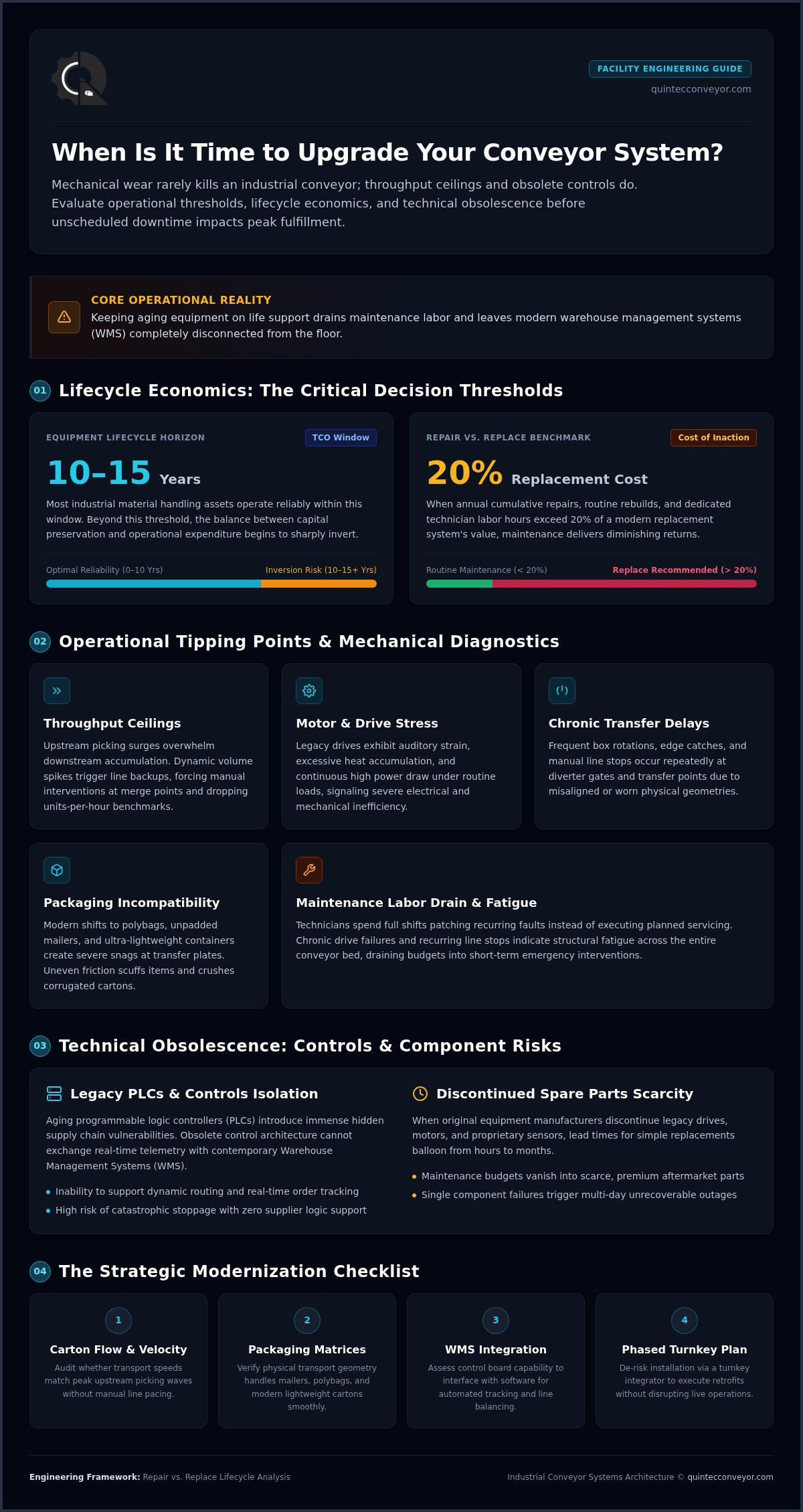
- Throughput ceilings: Inability to meet design velocity during regular shift peaks without causing system backlogs.
- Motor and drive stress: Auditory strain, excessive heat, and continuous power draw across legacy motors under routine loads.
- Chronic transfer delays: Frequent box rotations, edge catches, and manual line-clearing stops at diverter points.
Product Damage and Incompatible Packaging Formats
Packaging formats evolve rapidly, but legacy conveyors rarely adapt automatically. Belt tracking drift, worn bed plates, and uneven roller friction frequently crush corrugated cartons or scuff product surfaces. Modern shifts toward polybags, unpadded mailers, and ultra-lightweight containers create severe snags at transfer plates and high-speed diverters. When your line cannot cleanly transport current packaging matrices, it signals that simple adjustments won't suffice; you need upgraded sorting and transport geometry.
Lifecycle Economics: Calculating Equipment ROI and the Cost of Inaction
Most industrial material handling assets operate reliably for a 10-to-15 year lifecycle threshold. Beyond that window, the balance between capital preservation and operational expenditure begins to invert. Deciding when is it time to upgrade your conveyor system requires a structured Total Cost of Ownership (TCO) calculation. Relying on short-term mechanical patches masks the cumulative financial drain of lost operational momentum, making rigorous financial modeling vital for operations leaders.
Total Cost of Ownership: Repair Versus Replace Matrix
A reliable benchmark in facility lifecycle economics is the twenty percent threshold. When annual cumulative repairs, routine component rebuilds, and dedicated technician hours exceed 20% of a modern replacement system's value, continued maintenance delivers diminishing returns. Patching aged steel preserves immediate capital, yet it locks your operations into higher utility rates and ongoing labor waste. Modernizing infrastructure also unlocks capital expenditure benefits, including favorable depreciation schedules that offset investment costs while upgrading overall facility throughput.
The Hidden Operational Costs of Operating Legacy Systems
Direct repair invoices represent only a fraction of legacy equipment expenses. When an aging line halts unexpectedly, the true costs emerge through missed order fulfillment windows and expedited freight charges required to meet customer service level agreements. Outdated continuous-run AC induction motors continuously consume power regardless of load presence, driving up utility bills. Compliance risks also increase as older framing struggles to meet current OSHA conveyor safety standards, exposing facilities to ergonomic claims and acoustic violations.
Structure your modernization economic analysis across these four financial pillars:
- Direct maintenance velocity: Tracking the monthly escalation of replacement parts versus capital overhaul projections.
- SLA recovery expenditures: Quantifying premium freight fees and overtime payroll triggered by system halts.
- Energy efficiency ratings: Comparing continuous-duty power draw against run-on-demand motorized drive rollers.
- Safety and liability mitigation: Eliminating exposed mechanical pinch points through modern machine guarding.
Quantifying Modernization ROI and Payback Periods
Modernization return on investment centers on labor redeployment, reduced package damage, and expanded picking speeds. Deploying 24V DC motorized drive roller (MDR) zones ensures conveyor segments operate only when sensing an incoming item, drastically lowering energy overhead compared to legacy continuous drives. Operations leaders evaluating major line retrofits often consult the definitive guide to custom conveyor systems to model realistic payback periods and identify key technical milestones. When calculating lifecycle viability, partnering with experienced process engineers at quintecconveyor.com ensures your retrofit balances capital allocations with long-term line efficiency.
Technical Obsolescence: Controls, Motors, and Spare Part Scarcity
While mechanical frames can endure for decades, electrical architecture rarely enjoys the same lifespan. When assessing when is it time to upgrade your conveyor system, the most dangerous vulnerabilities often hide inside your control cabinets. Outdated electrical infrastructure leaves high-throughput facilities exposed to sudden shutdowns that mechanical maintenance cannot prevent. As industrial software progresses toward unified architectures, legacy panels quickly become silent operational liabilities.
The Critical Risk of Discontinued PLC and Electrical Controls
Programmable logic controllers (PLCs) govern modern material flow, but older generations eventually reach vendor end-of-life. Once original manufacturers terminate firmware updates and engineering support, securing replacement processors or communication cards forces facilities onto secondary marketplaces. Sourcing unverified, refurbished circuit boards creates serious reliability risks and leaves control networks vulnerable to cybersecurity threats. Upgrading to modern programmable automation controllers introduces distributed I/O, native industrial Ethernet protocols, and frictionless integration with contemporary Warehouse Execution Systems (WES).
Motor Efficiency and Variable Frequency Drive Upgrades
Mechanical drivetrains on aging systems consume substantial utility budgets. Traditional continuous-run line-shaft, chain-driven, and centralized belt-drive configurations pull heavy electrical loads regardless of package density. In contrast, modern motor upgrades drastically curb facility power draw. Transitioning to variable frequency drives (VFDs) dynamically adjusts mechanical velocity based on real-time carton volume, while distributed 24V DC motorized rollers remove parasitic line friction entirely by operating solely when product is present.
Consider these critical indicators of systemic technical obsolescence:
- End-of-life controls: PLCs and human-machine interfaces (HMIs) no longer supported by active manufacturer software patches.
- Diagnostic blind spots: Inability to extract real-time telemetry, thermal metrics, or remote sensor diagnostics.
- Extended procurement windows: Specialized drive sprockets, proprietary gearboxes, or legacy photo eyes requiring multi-week manufacturing cycles.
Supply Chain Fragility and Conveyor Spare Parts Strategy
Scarcity transforms routine component replacements into enterprise-level operational hazards. Auditing your storeroom often reveals that legacy gearboxes, specific sprockets, and proprietary sensors carry procurement lead times extending into months. Maintaining a dedicated cache of essential conveyor spare parts provides immediate protection, but custom engineering obsolete hardware is an unsustainable long-term strategy. Standardizing modern, modular components across your transport lines streamlines stock requirements, simplifies internal technician training, and eliminates long procurement delays.
The Strategic Modernization Checklist: Auditing Facility Flow and Scalability
Modernization begins with objective diagnostic measurements across your current operation. Determining when is it time to upgrade your conveyor system requires a methodical facility audit that compares actual physical velocity against your three-to-five-year commercial targets. Rather than reacting to localized breakdowns, operations leaders must audit their end-to-end transport network to uncover spatial, dimensional, and throughput restrictions.
Auditing Volume, SKU Velocity, and Dimensional Data
Begin by compiling twelve months of trailing operational data. Focus on hourly carton throughput, peak shipping surges, and SKU weight variations. Changes in packaging substrates directly impact friction coefficients, causing tracking drift on older belts. Physical layout constraints must be documented simultaneously; if older conveyor frames choke forklift passageways or restrict personnel egress, the physical footprint must be reconfigured to restore operational balance.
Maximizing Cubic Footprint with Advanced Layouts
Floor space constraints often limit horizontal conveyor expansion. Deploying vertical conveyors for multi-level flow allows facilities to reclaim valuable warehouse square footage by elevating transport corridors. Ceiling-hung conveyors buffer empty packaging overhead, keeping ground-level corridors open for order consolidation. Modern accumulation zones eliminate mechanical line shock by dynamically gapping parcels, ensuring smooth transitions around structural uprights, mezzanine supports, and automated vehicle pathways.
Execute your internal facility audit using this strategic engineering sequence:
- Phase 1: Flow audit: Measure actual peak units per hour against original engineered line specifications.
- Phase 2: Dimensional profiling: Map modern packaging variances to identify required belt widths, incline limits, and curve radiuses.
- Phase 3: Spatial liberation: Assess ceiling heights and mezzanine integration to elevate secondary material transfers.
- Phase 4: Sortation evaluation: Pinpoint labor-intensive manual sorting zones suitable for high-speed automated upgrades.
- Phase 5: Cutover scheduling: Plan phased physical installations during off-peak windows to preserve continuous fulfillment.
Assessing Automated Sortation and Robotics Integration
Manual diverting creates natural operational drag as fulfillment volumes expand. When carton volume exceeds the handling thresholds of manual sort lanes, integrating automated high-speed shoe sorters or modular cross-belt systems removes the bottleneck. Precision infeed belts meter product spacing, ensuring continuous alignment for automated barcode scanners, print-and-apply labelers, and robotic palletizing cells. To evaluate your facility flow against advanced automation benchmarks, schedule an engineering consultation with Quintec to design an optimized integration strategy.
Partnering for Success: Executing Your Conveyor System Modernization
Pinpointing when is it time to upgrade your conveyor system solves only half the equation; execution determines whether that investment yields sustainable operational velocity. Industrial retrofits present distinct brownfield complications, requiring rigorous alignment between mechanical assemblies, field wiring, and supervisory software. Transforming legacy lines into high-efficiency fulfillment corridors demands an integration strategy focused on operational preservation rather than simple catalog ordering.
Integrator vs. Manufacturer: Selecting the Right Strategic Partner
Selecting equipment directly from a single-brand manufacturer often restricts your facility to that vendor's proprietary limitations. Strategic integrators maintain an agnostic vantage point, selecting best-of-breed machinery tailored directly to your building constraints and SKU characteristics. Reviewing the core differences in the conveyor manufacturer vs. integrator comparison highlights why single-source accountability matters. A qualified integration partner manages end-to-end electrical commissioning, safety compliance, and mechanical structural mounting under one roof.
Phased Deployment to Prevent Extended Operational Shutdowns
Halting shipping operations for multi-week installations is simply unacceptable in modern distribution. De-risking physical modernization requires careful phasing, validating material flow through digital simulation before removing a single anchor bolt. Physical tear-outs and tie-ins should occur during low-volume shifts, planned holiday pauses, or over compressed weekend windows. Running parallel control architectures allows engineering teams to test new automated diverts while preserving immediate rollback options, ensuring morning shifts launch without shipping interruptions.
Ensure your chosen integration team delivers these turnkey project capabilities:
- Process engineering audits: Detailed modeling of current carton velocities, line balances, and future dimensional growth.
- Cross-disciplinary execution: Unified in-house mechanical assembly, PLC programming, and electrical field wiring.
- National installation footprint: Verified industrial safety certifications and seasoned field crews capable of multi-site execution.
- Post-commissioning support: Comprehensive lifecycle optimization, operator training, and structured preventive care schedules.
Engaging Quintec for Custom Material Handling Solutions
Executing successful brownfield transformations requires veteran insight into legacy mechanical systems and advanced industrial automation. Quintec Conveyors leverages over a century of collective industry experience to engineer turnkey material handling solutions across the nation. Consulting our industrial conveyor systems executive guide provides wider context on unifying custom conveyors, warehouse racking, and robotics into high-efficiency workflows. Contact Quintec today to collaborate with seasoned process engineers and modernize your facility with precision.
Securing Your Operational Future Through Strategic Modernization
Operating an aging material handling network creates chronic friction across your entire supply chain. Deciding when is it time to upgrade your conveyor system comes down to recognizing when maintenance expenditures outpace asset value, electrical controls reach vendor end-of-life, and mechanical throughput chokepoints suppress facility growth. Modernizing your facility doesn't require risking weeks of downtime; methodical, phased integration preserves everyday fulfillment while unlocking substantial throughput gains.
As an independent systems integrator backed by over 100 years of collective industry material handling expertise, Quintec delivers turnkey design, mechanical engineering, custom controls programming, and nationwide installation. We help operations leaders move past temporary patches to deploy high-efficiency automation built for scalable growth. Partner with Quintec Conveyors to engineer and execute your system upgrade and turn aging equipment into a reliable competitive advantage.
Frequently Asked Questions
How many years does an industrial conveyor system typically last before needing an upgrade?
Most industrial conveyor systems operate effectively for 10 to 15 years under typical multi-shift demands. Beyond this operational threshold, fatigue across mechanical drives, elevated structural wear, and component obsolescence accelerate sharply. While steel channel frames can endure for decades, the accompanying electrical controls, sensing arrays, and motor drives require strategic modernization much earlier to maintain peak throughput efficiency.
What is the 50 percent rule when deciding whether to repair or replace a conveyor?
The 50 percent rule states that if a major repair estimate exceeds half the cost of purchasing new equipment, replacement is the more financially sound path. This metric protects facilities from sinking capital into an asset nearing end-of-life. Applying this benchmark helps plant managers evaluate when is it time to upgrade your conveyor system rather than continuing to patch an unreliable, high-maintenance line.
Can you modernize conveyor controls and electrical systems without replacing the physical conveyor bed?
Yes, controls retrofits are a standard method for extending equipment lifecycle without tearing out solid steel framework. Upgrading outdated programmable logic controllers, replacing mechanical relay panels, and integrating modern variable frequency drives can happen directly on existing frames. This targeted approach connects older conveyors to modern warehouse management systems, improving diagnostic tracking and operational velocity without the expense of total mechanical reconstruction.
How do shifting packaging formats like polybags impact the need for conveyor upgrades?
Polybags and flexible mailers lack the rigid flat bottom of traditional corrugated boxes, causing them to catch on traditional roller transfers and mechanical diverters. Older conveyor layouts struggle with these ultra-lightweight items, resulting in frequent package jams and product damage. Modernizing transfers with tight-pitch micro-rollers, modular plastic belting, or specialized slide beds ensures these shifting packaging types flow without human intervention.
What steps can facilities take to minimize downtime during a major conveyor system overhaul?
Facilities can drastically cut downtime by utilizing phased implementation strategies and pre-testing software controls via digital simulation models. Demolition and physical tie-ins should be scheduled during off-peak weekend windows or planned holiday shutdowns. Running parallel control architectures allows engineers to commission new accumulation sections alongside existing lines, ensuring immediate operational rollback capability if unexpected field challenges arise.
How does motorized driven roller (MDR) technology compare to traditional continuous-run conveyor drives?
Motorized driven roller technology uses low-voltage DC motors embedded directly within the conveyor rollers to power discrete accumulation zones on demand. Traditional drives use a centralized motor that runs continuously, turning belts and drive shafts whether cartons are present or not. MDR zone systems cut facility power draw, eliminate excessive mechanical pinch points, and reduce line noise across high-throughput industrial environments.
What role does a systems integrator play during an industrial conveyor modernization project?
A strategic systems integrator manages the complete project lifecycle, from initial process engineering audits to nationwide mechanical installation and controls programming. Unlike single-brand equipment manufacturers, an integrator selects the best technology for your specific facility layout and volume requirements. This partnership de-risks brownfield projects by providing single-source accountability for mechanical setup, electrical field wiring, and final software commissioning.