A live roller conveyor is the tactical heartbeat of your automated facility, yet it's often the most misunderstood asset in the material handling ecosystem. You've likely experienced the frustration of high maintenance costs or product damage caused by drive systems that weren't designed for your specific throughput demands. These inefficiencies don't just slow down your operations; they compromise your ability to scale when market demand spikes.
We're here to help you bridge the gap between basic equipment and strategic engineering. This guide will empower you to master the principles of live roller conveyors to optimize your facility's performance for 2026. You'll learn how to select the correct drive mechanism, whether it's MDR, CDLR, or BDLR, while gaining a deep understanding of Zero Pressure Accumulation (ZPA) logic. We'll provide the technical insights needed to design a scalable material handling system that eliminates bottlenecks and ensures your facility operates with the quiet confidence of a leader in the field. This roadmap is designed to transform your conveyors from simple transport tools into high-performance assets.
Key Takeaways
- Define the critical differences between powered movement and manual systems to ensure consistent, controlled facility flow.
- Compare CDLR, BDLR, and MDR drive types to align your equipment selection with specific energy efficiency and noise reduction requirements.
- Master Zero Pressure Accumulation (ZPA) logic to eliminate back pressure and protect inventory during high-density staging.
- Calculate precise load torque and throughput speeds to engineer a live roller conveyor system that scales with your 2026 growth projections.
- Adopt a strategic integration approach that prioritizes comprehensive facility flow mapping before hardware procurement.
What is a Live Roller Conveyor? Defining the Powered Standard
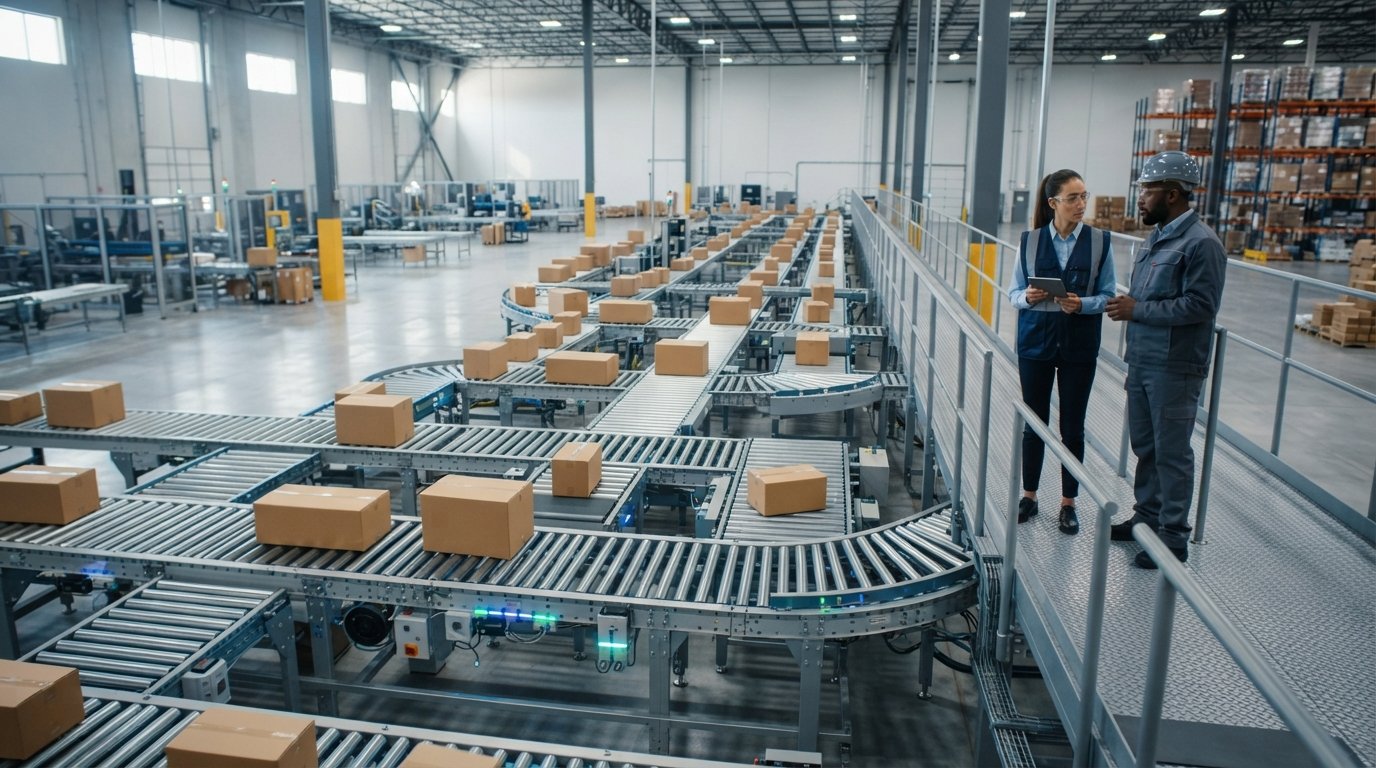
A live roller conveyor is defined by its ability to exert active control over product movement. Unlike gravity-based systems that rely on incline or manual force, this technology utilizes a series of rollers powered by a dedicated drive system to transport loads at precise, controlled speeds. It's the foundational component of modern warehouse material handling solutions, acting as the primary mechanism for moving goods through complex facility layouts.
The "live" designation refers specifically to the rollers being under power. This allows for horizontal transport and even slight inclines without the risk of product stagnation. By integrating a live roller conveyor into a broader conveyor system, operators gain the ability to manage throughput with high accuracy. This is essential for facilities where timing, spacing, and volume are critical to operational success. These systems are considered the workhorse of the industry because they provide a unique combination of high weight capacity and sophisticated accumulation capability.
Key Components of a Live Roller System
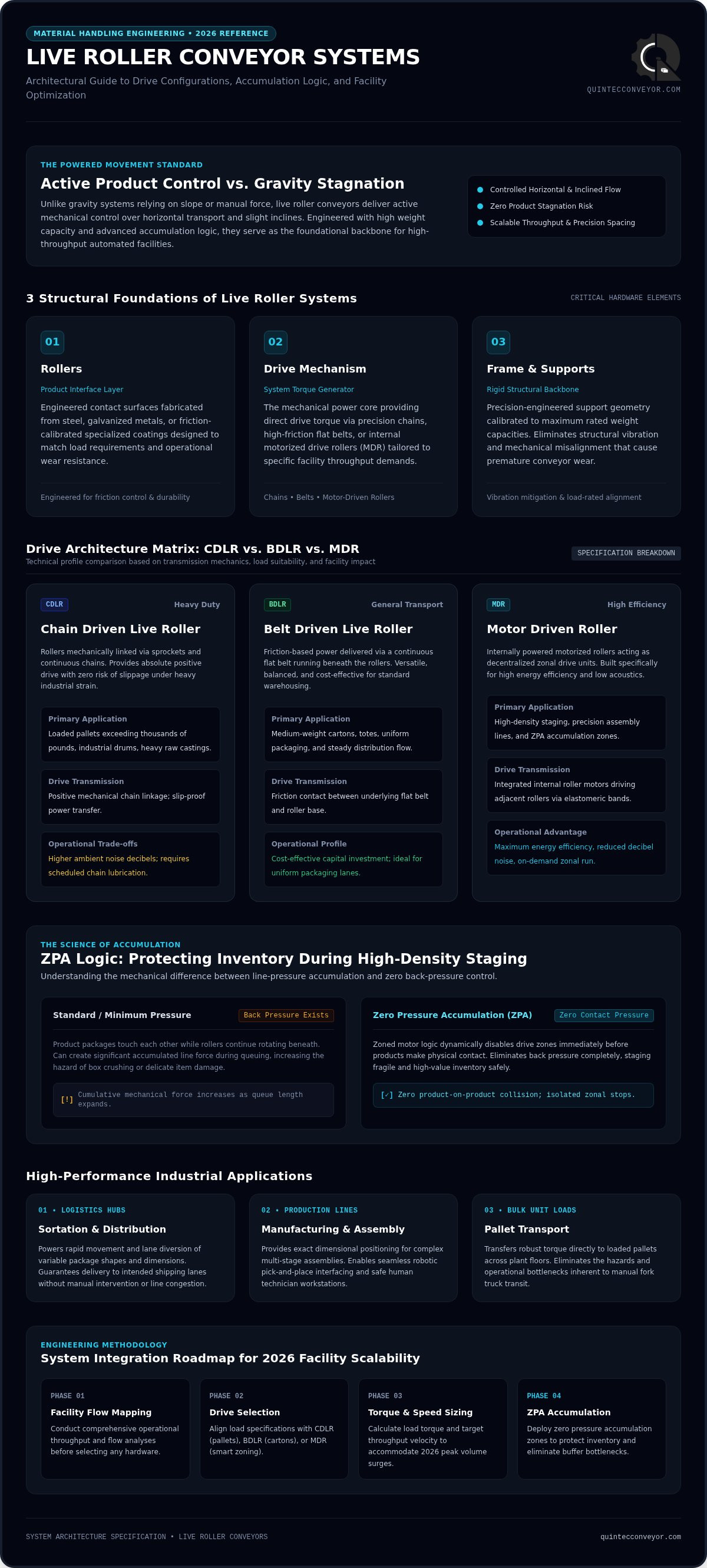
Building a reliable system requires an understanding of its structural and mechanical foundation. A high-performance unit consists of three primary elements:
- Rollers: These serve as the interface between the machine and the product. Depending on the environment, rollers are engineered from steel, galvanized metals, or specialized coatings to handle specific friction and durability requirements.
- Drive Mechanism: This is the heart of the system. It provides the necessary torque through motors connected via belts, chains, or internal motor-driven rollers.
- Frame and Supports: The structural backbone must be rated for the maximum expected load. Precision-engineered frames prevent vibration and misalignment, which are common causes of premature wear.
Common Industrial Applications
The versatility of powered rollers makes them suitable for several demanding environments where efficiency is non-negotiable:
- Sortation and Distribution: In high-volume centers, these systems facilitate the rapid movement and diversion of varied package sizes. They ensure items reach the correct shipping lane without delay or manual intervention.
- Manufacturing and Assembly: Precision is paramount during the build process. Powered rollers allow for exact positioning, enabling seamless interaction between the conveyor and robotic arms or human technicians.
- Pallet Handling: Moving heavy, bulky loads requires significant power. Live systems provide the robust torque needed to transport loaded pallets safely across a facility floor without the inconsistencies of manual transport.
Comparing Live Roller Drive Types: CDLR, BDLR, and MDR
Selecting the optimal drive mechanism for a live roller conveyor determines your facility's long-term operational costs and mechanical reliability. In 2026, drive technology has bifurcated into three distinct categories, each engineered for specific load profiles and throughput requirements. While the core function remains the same, the engineering differences between Chain Driven, Belt Driven, and Motor Driven systems impact everything from decibel levels to motor-driven systems efficiency. Understanding these technical nuances is essential for any professional looking to optimize facility flow.
Chain Driven Live Roller (CDLR)
CDLR systems are the heavy-duty standard for industrial environments. These conveyors utilize rollers linked together by a series of sprockets and chains, providing a positive drive that eliminates the risk of slippage. This makes them the ideal choice for automated pallet conveyor systems where weights often exceed several thousand pounds. Because the torque is transferred directly through mechanical linkage, CDLR is the preferred solution for drums, heavy castings, and large industrial components. However, this power comes at the cost of higher noise levels and a more rigorous lubrication schedule for the chains.
Belt Driven Live Roller (BDLR)
BDLR technology offers a versatile and cost-effective solution for general transport. This system uses a flat belt running beneath the rollers to provide friction-based power. It's exceptionally well-suited for medium-weight boxes and consistent package sizes over long distances. While BDLR cannot match the raw torque of chain-driven systems, it operates with significantly less noise. Maintenance teams should monitor belt tension and wear regularly, as friction-based drive efficiency can degrade if the system isn't tuned correctly. If you're unsure which drive matches your load profile, consulting with a process engineer can prevent costly misapplications.
Motor Driven Roller (MDR)
MDR represents the cutting edge of smart warehouse technology. Unlike traditional systems that rely on a single large motor, MDR utilizes individual 24V or 48V DC motors embedded directly within the rollers. This allows for "on-demand" power, where specific zones only activate when a product is present. The result is a system with superior energy efficiency and nearly silent operation. MDR is the 2026 standard for high-density staging because it provides unmatched control over accumulation. While the initial investment may be higher, the reduction in maintenance and energy consumption often provides a superior return on investment for high-throughput facilities.
The Science of Accumulation: Minimum vs. Zero Pressure
Accumulation is a critical function within any sophisticated material handling environment. It allows a live roller conveyor to act as a buffer, holding products in a queue while upstream or downstream processes continue without interruption. Without this capability, a single bottleneck would force an entire line to stop, destroying throughput efficiency. However, improper accumulation leads to "back pressure," a cumulative force where products push against each other. This pressure often results in crushed packaging, damaged contents, or system jams that require manual intervention. Live roller systems provide tactical buffering, which is essential during high-speed sortation or palletizing. By creating a temporary reservoir of products, the system can smooth out surges in volume, ensuring that downstream robotics or human operators aren't overwhelmed by erratic flow.
Zero Pressure Accumulation is the engineering practice of preventing physical contact between individual products while they are queued on a conveyor line.
Minimum Pressure Accumulation (MPA)
Minimum Pressure Accumulation (MPA) utilizes friction-based drive systems where a small amount of contact is permitted between items. In an MPA setup, the drive force is reduced but not entirely eliminated when a product stops. It's an acceptable solution for durable goods or uniform, rigid packaging that can withstand light pressure without compromising the integrity of the product. The primary drawback is the risk of "shingling," where one package slides over or under another, leading to sortation errors or significant jams. It also tends to be noisier due to the constant friction between the drive mechanism and the rollers. If your facility handles delicate items or varying package sizes, the limitations of MPA often outweigh the lower initial cost.
Zero Pressure Accumulation (ZPA)
Zero Pressure Accumulation (ZPA) is the gold standard for modern distribution centers seeking maximum protection and precision. It relies on a series of sensors, typically photo-eyes, and logic controllers to divide the conveyor into discrete zones. When a zone is occupied, the system communicates with the upstream zone to stop the motor before a second product can make contact. This level of control is most effectively achieved with Motor Driven Roller (MDR) technology, where each zone operates independently. Implementing ZPA significantly improves ROI by virtually eliminating product loss and ensuring that downstream sortation systems receive perfectly spaced items. It transforms the conveyor from a simple transport tool into an intelligent staging system that adapts to real-time facility conditions.
Selection Criteria: How to Engineer Your Live Roller System
Engineering a live roller conveyor requires a shift from general logistics to precise mechanical calculation. You must account for the maximum possible load to determine the necessary drive torque. If your system encounters its heaviest pallet during a cold start, the motor must provide enough initial force to overcome inertia without stalling. Calculating this "worst-case" scenario prevents premature motor failure and ensures consistent uptime. Throughput speed is another critical variable. You must match the roller RPMs to your required units-per-minute (UPM) to avoid creating bottlenecks at downstream sortation points.
Product characteristics dictate the physical specifications of the rollers. Fragile items require smoother acceleration profiles, while products with uneven bases might need closer roller spacing to maintain stability. Environmental factors also play a decisive role in the engineering process. If you're designing for a washdown environment, stainless steel components and sealed bearings are non-negotiable. Similarly, systems in cold storage or high-dust areas require specialized lubricants and drive protections to maintain mechanical integrity over time.
Weight and Footprint Analysis
Precision engineering starts with calculating the load per roller. This prevents deflection, which is the slight bending of the roller under weight that causes friction and wear. A standard rule of thumb is that the smallest item being conveyed must always be supported by at least three rollers. This determines your roller centers. When integrating curves and spurs into your layout, you must ensure that the drive power is maintained through the transition. Improperly engineered curves often lead to "dead zones" where products lose momentum, requiring manual intervention that slows your entire facility flow.
Energy Efficiency and Sustainability in 2026
In 2026, sustainability has moved from a corporate goal to a core engineering requirement. The industry is seeing a massive shift toward 24V and 48V DC systems. These low-voltage solutions offer a significantly reduced carbon footprint compared to traditional AC motors. By implementing run-on-demand logic, smart rollers only activate when a sensor detects an approaching product. This can reduce energy waste by up to 60% in many high-volume facilities. Beyond energy, long-term sustainability involves selecting new material handling equipment that is designed for modular repair rather than total replacement.
Properly engineering these variables requires a deep understanding of how hardware interacts with facility software. To ensure your system is optimized for both current loads and future growth, you should partner with an experienced engineering team that can map your entire process flow before equipment is purchased.
Integration Strategy: The Quintec Approach to Live Rollers
A live roller conveyor is only as effective as the system it inhabits. Many vendors treat equipment as a commodity, but standalone units often fail to deliver expected results without a custom material handling system design. At Quintec, we view hardware as one component of a larger strategic puzzle. Our process engineering team maps your facility's entire operational flow before a single roller is selected. This ensures that every piece of equipment aligns with your labor workflows, warehouse racking, and Warehouse Control System (WCS) logic, preventing the integration friction that often plagues poorly planned projects.
Success in modern logistics requires total system harmony. This means integrating powered rollers with advanced robotics and automated sortation lanes to create a unified throughput engine. Professional installation is the final, critical step in this process. Without precise mechanical alignment, even the most advanced drive systems will suffer from belt tracking issues, excessive vibration, and premature bearing failure. We prioritize structural integrity and precision during every installation to ensure your system provides the long-term stability required for 2026 operational standards.
Beyond the Belt: Engineering Seamless Flow
Modern facility planning requires a seamless transition between horizontal transport and vertical movement. We specialize in connecting live roller systems to automated sortation lanes and high-speed vertical lifts, ensuring products move through the facility without manual intervention. By utilizing data from smart rollers, operators can implement predictive maintenance schedules and identify hidden bottlenecks in real-time. This level of technical insight allows us to customize frames and supports for specific facility infrastructure constraints, maximizing your available square footage without compromising on mechanical performance.
Partnering for Long-Term Reliability
Reliability is built on a foundation of experience and proactive care. With over 100 years of collective industry expertise, our team acts as a strategic guide for clients navigating large-scale automation projects. We don't just install hardware; we provide comprehensive conveyor maintenance services designed to ensure maximum system uptime. This commitment to professional excellence ensures that your material handling ecosystem remains efficient and scalable as your business grows. Our goal is to provide the quiet confidence of a leader, delivering high-level results that protect your investment for years to come.
Ready to optimize your facility's throughput with a professionally engineered system? Consult with a Quintec engineering expert today.
Optimizing Your Facility for the Next Generation of Throughput
The evolution of the live roller conveyor has transformed it from a simple mechanical tool into a sophisticated, data-driven asset. Mastering the technical nuances between drive mechanisms like CDLR and MDR, while implementing precise Zero Pressure Accumulation logic, ensures your facility remains competitive through 2026 and beyond. Success doesn't come from purchasing individual components. It's the result of a comprehensive strategy that aligns hardware with your specific operational goals.
Quintec brings over 100 years of collective industry experience to every project, offering full-scale engineering and installation services. We specialize in warehouse automation and robotics, acting as a strategic partner to help you navigate complex logistical challenges. Our team ensures that your system isn't just functional, but optimized for long-term scalability and reliability. We provide the steady hand and technical insight required to turn logistical obstacles into competitive advantages.
Ready to transform your material handling ecosystem? Schedule a Strategic Integration Consultation with Quintec today to build a foundation for modern excellence. Your facility's future depends on the precision you implement today.
Frequently Asked Questions
What is the difference between a belt conveyor and a live roller conveyor?
A belt conveyor utilizes a continuous loop of fabric or rubber to move items, making it ideal for loose or small products. In contrast, a live roller conveyor uses powered rollers to transport rigid items like boxes or pallets. This design allows for sophisticated accumulation and easier integration with sortation gates. While belt systems are simpler, the roller based approach provides significantly more control over product spacing and individual zone management.
Can live roller conveyors handle heavy pallets?
CDLR systems are the industrial standard for pallet handling. These conveyors utilize a positive drive mechanism where sprockets and chains link the rollers together. This ensures that even the heaviest pallets, often weighing over 3,000 pounds, move consistently without the risk of belt slippage. It's a robust solution for manufacturing plants and distribution centers that require high torque to manage bulky loads across the facility floor.
How do I know if I need Zero Pressure Accumulation (ZPA)?
You should implement Zero Pressure Accumulation if your facility experiences product damage or shingling during high density staging. ZPA is essential for fragile items or varying package sizes that can't withstand back pressure. If your downstream sortation requires precise gaps between units, ZPA provides the necessary logic to hold products in queue without them touching. This technology is a cornerstone of modern warehouse automation and robotic integration.
What are the maintenance requirements for a chain-driven live roller (CDLR)?
CDLR maintenance focuses primarily on the mechanical linkage of the drive system. You'll need to establish a regular schedule for lubricating the chains and sprockets to prevent metal on metal wear. It's also vital to check chain tension and roller alignment to ensure the system operates smoothly. Professional maintenance services can help identify worn sprockets before they cause a total system failure, preserving the longevity of your industrial infrastructure.
Are motor-driven rollers (MDR) energy efficient?
MDR systems are exceptionally energy efficient due to their decentralized control logic. Unlike traditional conveyors that run a single large motor continuously, MDR zones only activate when a sensor detects an approaching product. This run on demand capability significantly reduces idle time and power draw. Modern 24V and 48V DC rollers are engineered to meet the latest 2026 standards for operational sustainability in high volume distribution centers.
Can live roller conveyors be used in cold storage environments?
Yes, these systems can be engineered for cold storage, but they require specific component ratings. Standard lubricants will thicken in freezing temperatures, so you must use low viscosity greases and sealed bearings designed for sub zero use. Additionally, the drive motors must be rated for high moisture or freezing environments to prevent electrical failure. Professional engineering ensures that your system maintains throughput even in the harshest thermal conditions.
How do I choose between a 24V and 48V MDR system?
Selecting between 24V and 48V depends on your specific load and layout requirements. A 48V system provides more torque for heavier items and allows for longer cable runs with minimal power loss. This makes it suitable for larger facilities with complex routing. Conversely, 24V systems are the industry standard for lightweight package handling and offer a cost effective solution for high speed sortation where raw torque is less critical.
What is the typical lifespan of a live roller conveyor system?
A well engineered live roller conveyor system typically lasts 10 to 15 years, though many remain operational much longer with proactive care. The actual lifespan is heavily influenced by the accuracy of the initial load calculations and the consistency of the maintenance schedule. Regular audits by a process engineering team can identify early signs of wear in the drive mechanism, allowing for modular repairs that extend the total system life.