Sorting Conveyors: The Ultimate Guide to Automated Sortation Systems in 2026
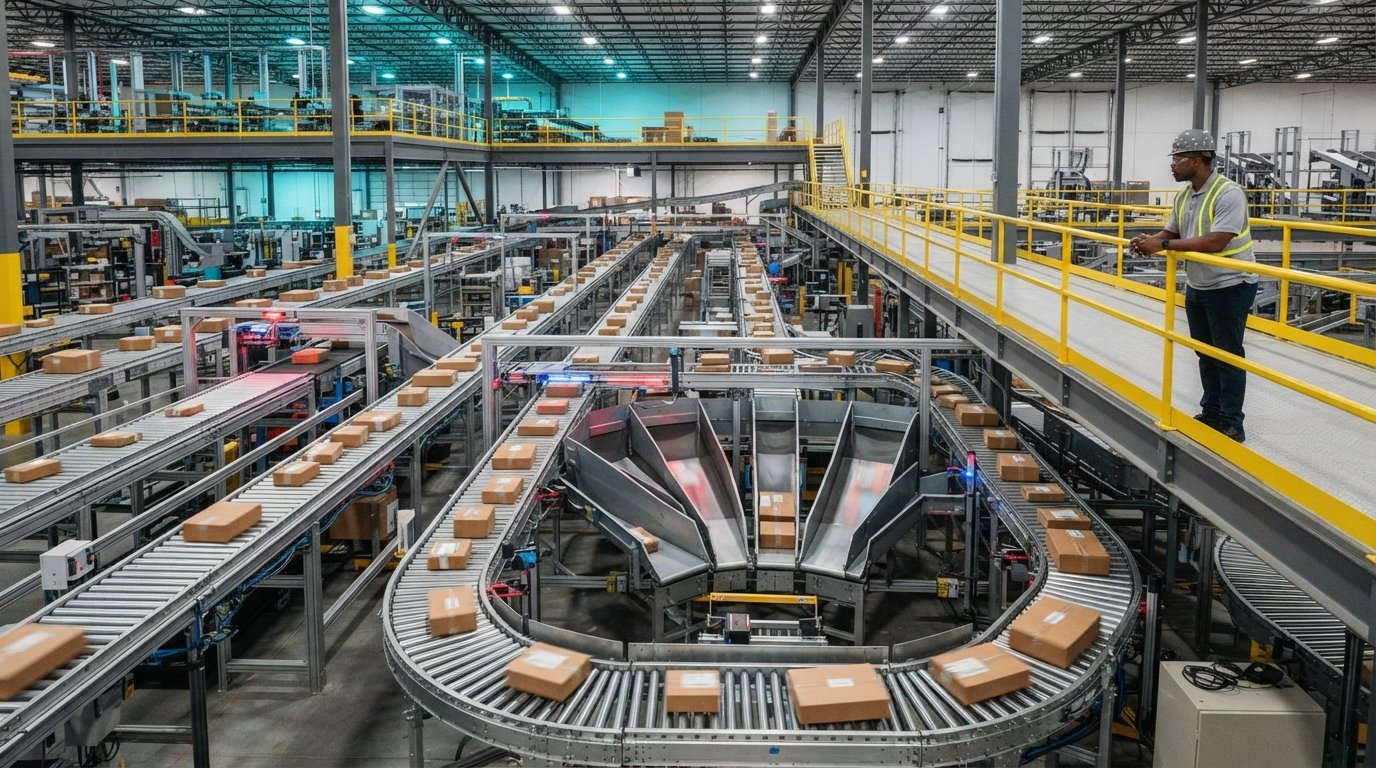
If your facility is still relying on manual sortation to meet 2026 delivery expectations, you aren't just falling behind; you're essentially planning for an operational bottleneck. A high-performance sorting conveyor is no longer a luxury for large-scale operations; it's a fundamental requirement for maintaining precision while scaling volume. Shipping windows are now measured in minutes rather than days, and you likely recognize that rising labor costs and frequent errors during peak seasons are significant risks to your facility's long-term stability.
This guide explores how advanced sortation technology serves as the strategic backbone of high-throughput facilities, driving increased cartons-per-minute (CPM) rates while slashing processing errors. We'll examine the latest automated technologies, the nuances of seamless robotics integration, and the rigorous maintenance strategies required to protect your equipment's ROI. By the end of this article, you'll understand how to choose an integration strategy that transforms your material handling from a cost center into a powerful engine for growth. We'll walk through the technical specifications and process engineering insights needed to ensure your facility remains at the cutting edge of industrial excellence.
Key Takeaways
- Understand how a high-speed sorting conveyor serves as the central nervous system of modern automated facilities by synchronizing induction and scanning.
- Identify the specific mechanical sortation technologies that align with your unique SKU profiles, product fragility, and volume requirements.
- Learn to calculate the operational tipping point where manual sorting liabilities justify the transition to automated systems to reduce mis-ships.
- Discover why successful sortation depends as much on process engineering and layout design as it does on the hardware itself.
- Leverage a century of collective industry experience to navigate complex multi-vendor integrations and protect equipment longevity through proactive maintenance.
What is a Sorting Conveyor? The Heart of Automated Flow
A sorting conveyor is the mechanical engine of a modern warehouse, acting as the primary decision maker for every parcel that enters the system. Unlike standard transport belts, these high-speed systems use sophisticated logic to identify, track, and divert individual items to specific destinations based on real-time data. This process transforms a chaotic stream of inventory into an organized, high-throughput flow. In the context of industrial conveyor systems, sortation represents the peak of mechanical integration where hardware meets high-level software control.
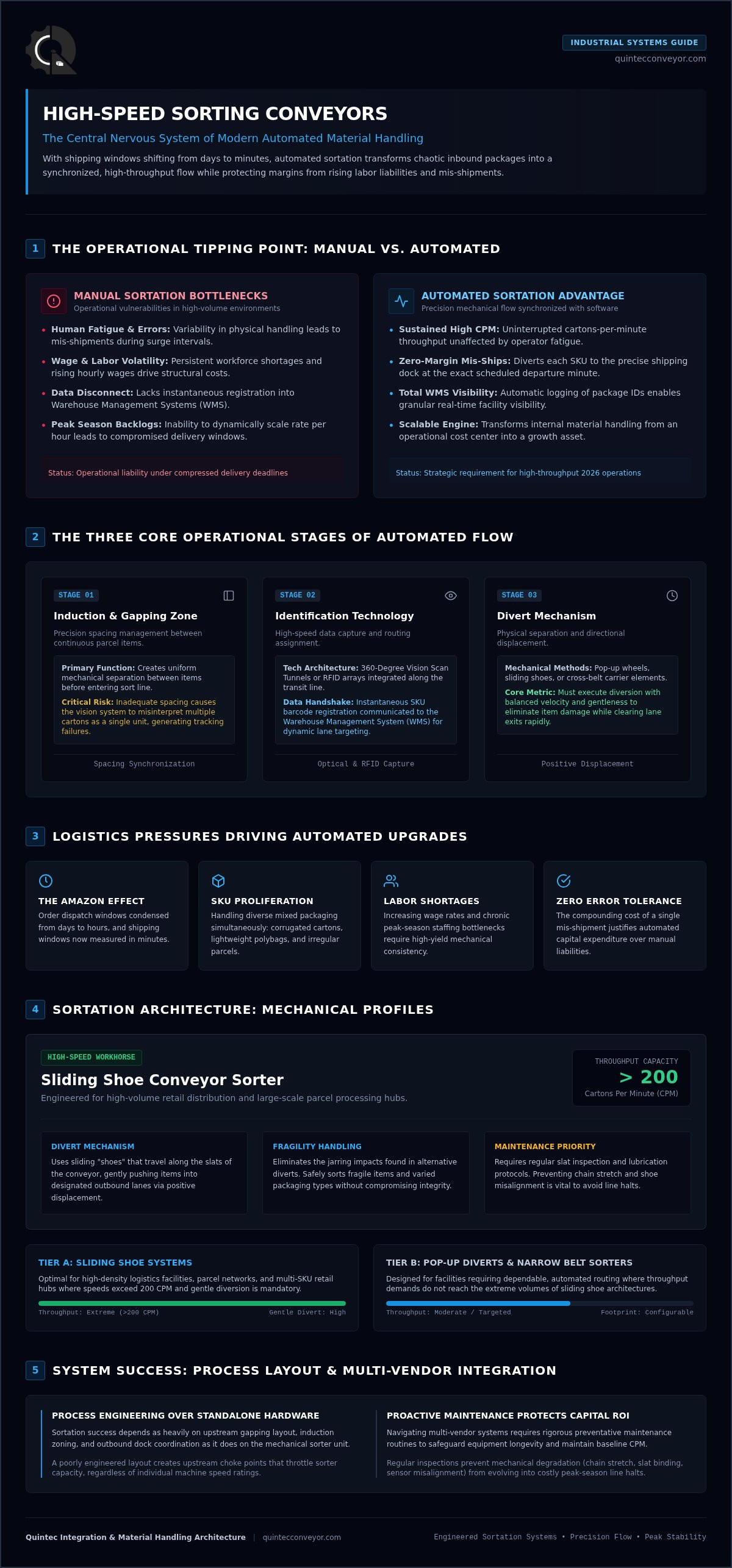
While manual sorting relies on human eyes and physical handling, automated sortation removes the variability of fatigue and human error. The ROI becomes clear when you analyze the cost of a single mis-shipment. In 2026, the margin for error is nearly zero. Automated systems ensure that every carton reaches the correct shipping dock at the precise moment required for outbound logistics. The decision to automate isn't just about speed; it's about the reliability of your data. When a sorter identifies a package, it registers that event in your Warehouse Management System (WMS), providing a level of visibility that manual processes simply can't match.
The Core Components of a Sortation System
To achieve high-speed efficiency, a sortation system relies on three distinct operational stages. First, the induction zone manages the gapping or spacing between items. This is a critical engineering challenge. If items are too close, the system misinterprets them as a single unit, leading to tracking failures. Second, identification technology, such as 360-degree vision tunnels or RFID arrays, captures the routing data for each SKU. Finally, the divert mechanism executes the physical movement. Whether using pop-up wheels, sliding shoes, or cross-belt carriers, this mechanical action must be both fast and gentle to prevent product damage.
Why Industrial Sortation is Essential in 2026
The Amazon Effect has fundamentally altered consumer expectations, forcing facilities to process orders in hours rather than days. This pressure is compounded by SKU proliferation, where warehouses must handle everything from heavy corrugated boxes to flimsy polybags and oddly shaped parcels. A modern sorting conveyor provides the versatility needed to manage these diverse packaging types without slowing down the line or requiring constant manual intervention.
Relying on manual labor for these high-volume tasks is increasingly risky. Persistent labor shortages and rising wages make automation a strategic necessity for long-term stability. By implementing automated sortation, facilities can maintain consistent cartons-per-minute (CPM) rates regardless of labor availability. This ensures that peak season surges don't result in shipping delays, backlogs, or operational collapse.
Types of Sorting Conveyors and Their Optimal Applications
Selecting the right mechanical architecture is a pivot point for warehouse efficiency. Engineers must evaluate product characteristics, such as fragility and dimensions, against the performance benchmarks defined in the Conveyor and Sortation Systems industry guidelines. High-speed systems offer immense throughput but require precise maintenance to avoid costly downtime. Choosing a sorting conveyor is a decision that impacts your facility's scalability for the next decade. You must weigh the initial capital expenditure against the long-term operational savings provided by reduced error rates and higher processing speeds.
Sliding Shoe Sorters: The High-Speed Workhorse
These systems are designed for high-volume environments where speed cannot compromise product integrity. They utilize sliding "shoes" that travel along the slats of the conveyor, gently pushing items into their designated lanes. This positive displacement method is remarkably effective for fragile goods because it avoids the jarring impact associated with other divert methods. With the ability to achieve rates exceeding 200 cartons per minute, shoe sorters are the standard for large-scale retail distribution and parcel hubs. Regular lubrication and slat inspection are essential to keep these complex machines running at peak performance. Neglecting these small details can lead to chain stretch or shoe misalignment, which halts the entire line.
Pop-up Diverts and Narrow Belt Sorters
When your facility requires reliable sorting but doesn't reach the extreme volumes of a national hub, pop-up diverts and narrow belt systems offer a compelling alternative. These designs are frequently more compact, making them suitable for facilities with restricted floor space. Pop-up diverts represent the ideal balance of cost and efficiency for mid-range throughput. Because they use fewer moving parts than high-speed counterparts, they often present a lower barrier to entry for growing operations looking to automate their flow. They provide a modular approach to growth, allowing you to add more diverts as your SKU count increases.
Cross-Belt and Tilt-Tray Sorters
Modern e-commerce has introduced a surge in non-conveyable items, including small polybags and circular packages that tend to roll or slide. Cross-belt and tilt-tray sorters excel here by providing a dedicated carrier for every item. This individual control ensures maximum accuracy, which is vital for complex e-commerce returns processing where SKU variety is at its highest. These systems are highly specialized, often requiring a strategic partner for custom conveyor maintenance and integration to ensure the carriers remain perfectly synchronized over years of heavy use. Investing in this technology pays dividends when handling high-density sortation points where every square inch of the facility must be optimized.
When to Invest: Calculating the ROI of Automated Sortation
Determining the exact moment to transition from manual processes to an automated sorting conveyor requires a rigorous, data-driven analysis. Most facilities reach a tipping point where the rising cost of labor and the frequency of processing errors exceed the amortized expense of a high-speed system. It's a strategic shift from variable, unpredictable costs to a fixed, high-performance asset. You aren't just buying equipment; you're purchasing the ability to scale your operations without a linear increase in headcount. This investment protects your bottom line by eliminating the financial penalties associated with shipping delays and mis-ships.
Throughput Triggers: Signs You Need to Automate
If your facility experiences consistent bottlenecks during peak seasons, it's a clear indicator that your manual sorting capacity has been outpaced by demand. You should analyze your current error rates. Even a 1% error rate in a high-volume environment can lead to thousands of dollars in lost revenue from returns, reshipping fees, and diminished customer trust. Learning How to Identify Bottlenecks in Your Warehouse Flow is the first step in quantifying these losses. When the cost of these inefficiencies matches or exceeds the monthly financing of an automated system, the ROI case becomes undeniable.
Safety and regulatory compliance also factor into the ROI equation. Integrating automation simplifies your adherence to OSHA conveyor safety regulations by reducing the physical strain on your workforce. Manual sorting often involves repetitive motion and heavy lifting, which increases workers' compensation risks. An automated system, while requiring its own safety protocols like emergency stops and mechanical guarding, creates a more controlled and predictable environment. Reducing workplace injuries isn't just a moral imperative; it's a significant cost-saving measure that stabilizes your insurance premiums and labor availability.
Future-Proofing Your Investment for 2026 and Beyond
Modern sortation projects must prioritize Total Cost of Ownership (TCO) over the initial purchase price. In 2026, energy efficiency is a primary driver of TCO. The industry is rapidly shifting toward 24V DC motor-driven roller (MDR) technology. These systems only run when a product is present, which slashes energy consumption compared to traditional AC motors that run continuously. This "run-on-demand" capability reduces wear and tear, extending the intervals between maintenance cycles and further improving your long-term ROI.
Scalability is the final piece of the ROI puzzle. Your sorting conveyor must be capable of handling SKU proliferation and changing packaging types without requiring a total system overhaul. This requires seamless integration with your Warehouse Management System (WMS) to ensure that digital data flow perfectly mirrors physical product flow. A system that can't communicate with your existing robotics or software will quickly become a legacy liability. By choosing an integration strategy that values modularity and data connectivity, you ensure your facility remains competitive as logistical demands continue to evolve.
The Integrator’s Perspective: Designing a Seamless Sortation Flow
Successful sortation projects depend on more than just high-quality hardware. While the physical sorting conveyor is the visible component, it represents only about 50% of the total solution. The remaining half lies in the process engineering and control logic that synchronize the equipment with your facility's specific operational needs. A poorly integrated system, regardless of the brand of the rollers or belts, will inevitably create upstream bottlenecks or downstream jams. Professional integrators approach these projects by analyzing the entire product lifecycle, from the moment an item enters the warehouse to its final departure on an outbound truck.
Designing a layout requires a deep understanding of how physical space impacts velocity. You can't simply drop a high-speed sorter into a legacy environment and expect instant results. The surrounding infrastructure, including the take-away lines and accumulation zones, must be scaled to match the sorter's maximum throughput. If your downstream lanes can't handle the speed of the primary line, the system will frequently stop, negating the benefits of automation. This is why a holistic engineering approach is non-negotiable for large-scale logistics projects.
Induction and Gapping Logic
Precise spacing is mandatory for high-speed scanning and diverting. Without consistent gaps between items, vision systems cannot accurately read barcodes, and mechanical diverts may trigger too early or too late. Modern systems utilize a series of servo-driven belts that make micro-adjustments in real-time, accelerating or decelerating individual packages to create the perfect window for the sorter. This sophisticated gapping logic prevents system jams and ensures 99.9% sort accuracy by maintaining the physical integrity of the product flow. If your induction zone isn't properly engineered, even the fastest sorter in the world will be limited by the slowest gap.
System Integration and Control Logic
The "brain" of the operation is the Warehouse Control System (WCS) and the Programmable Logic Controllers (PLCs) that manage real-time divert commands. These controls must process data in milliseconds to ensure that a heavy carton and a lightweight polybag are handled with equal precision. A major challenge in 2026 is ensuring compatibility between different conveyor manufacturers, as many facilities utilize a multi-vendor environment. A strategic integrator ensures these disparate systems communicate flawlessly, preventing data silos that lead to operational blind spots.
Understanding How to Choose a Conveyor System Integrator is critical for any facility manager looking to avoid the pitfalls of a fragmented installation. The right partner provides the bridge between mechanical hardware and digital intelligence. If you are ready to optimize your facility's layout, you can partner with Quintec for expert process engineering and seamless system integration. This holistic approach ensures that your investment provides the high-level results your business requires for long-term growth.
Partnering with Quintec for Custom Sortation Solutions
Quintec positions itself as a strategic partner rather than a simple equipment vendor. We leverage over 100 years of collective industry experience to navigate the complexities of modern material handling. Every project begins with a deep dive into process engineering, where we analyze your specific SKU profiles and volume requirements to design a custom sorting conveyor solution. This engineering-first approach allows us to solve challenges that standardized systems don't always catch. Our national coverage across the United States ensures that we can provide consistent engineering and installation excellence for multi-site operations, maintaining a unified standard of quality regardless of your facility's location. We take pride in acting as a steady guide for clients navigating large-scale projects, ensuring that every mechanical and digital component is optimized for maximum efficiency.
Engineering Excellence and Robotics Integration
In the 2026 logistics environment, sortation can't exist in a vacuum. It must communicate flawlessly with upstream and downstream automation. Quintec specializes in this high-level synchronization, integrating advanced sortation systems with sophisticated robotics to create a truly autonomous flow. We also provide the necessary infrastructure, such as custom racking and mezzanine levels, to support high-density sortation layouts. This ensures your facility maximizes every cubic foot of available space. You can learn more about these complex synergies in our Warehouse Robotics Integration: The 2026 Guide. Our engineering team ensures that your hardware and software work as a single, cohesive unit, providing the visibility and control needed for modern distribution.
The Quintec Installation and Maintenance Advantage
A successful installation is just the beginning of our partnership. High-throughput environments place immense physical stress on mechanical components, making proactive care essential for protecting your initial investment. Quintec offers comprehensive conveyor maintenance programs specifically designed to support facilities running high-volume, 24/7 operations. These preventative strategies identify potential wear in belts, shoes, and divert mechanisms before they lead to system failure. It's a proactive stance that ensures your sortation system remains the reliable heartbeat of your facility, even during the most demanding peak seasons. By focusing on long-term mechanical health and process optimization, we help you maintain peak cartons-per-minute (CPM) rates year-round.
Ready to transform your warehouse throughput and reduce operational errors? You can Contact Quintec for a Custom Sortation System Consultation to begin your facility's transformation with a team that values precision and modern excellence.
Strategic Excellence in Automated Sortation
Achieving operational excellence in 2026 requires more than just high-speed equipment. It demands a sophisticated synchronization of mechanical hardware and digital control logic. Selecting the appropriate sorting conveyor architecture is a foundational decision that impacts your facility's scalability for years to come. Whether you're implementing sliding shoe sorters for high-volume retail or cross-belt systems for complex polybag handling, the success of your investment hinges on precise process engineering and seamless robotics integration.
Quintec provides the seasoned authority and innovative spirit needed to navigate these complex logistical challenges. With over 100 years of collective industry experience and national US installation and service coverage, we act as a strategic guide for your facility's evolution. We don't just sell equipment; we deliver comprehensive solutions that include expert robotics support and long-term maintenance strategies to protect your ROI. It's time to transform your material handling into a high-performance engine for growth. Scale Your Throughput with a Custom Quintec Sortation Solution today. Your facility is in capable hands.
Frequently Asked Questions
How much does a sorting conveyor system cost to install?
Installation costs depend on the system's complexity, the required throughput, and the level of integration with existing robotics. A comprehensive project includes custom process engineering, infrastructure like mezzanines, and the mechanical hardware itself. Because every facility has unique SKU profiles and volume requirements, a strategic consultation is necessary to determine the total investment needed for a scalable solution that meets your long-term operational goals.
What is the difference between a shoe sorter and a pop-up divert?
A sliding shoe sorter uses positive displacement to gently push items into lanes, making it ideal for high-speed, fragile product handling. In contrast, a pop-up divert uses wheels or rollers that rise to redirect items, serving as a cost-effective solution for medium-speed operations. Shoe sorters generally offer higher throughput capacities, while pop-up diverts are often preferred for smaller footprints and lower initial capital requirements for growing facilities.
Can a sorting conveyor handle different sized boxes at the same time?
Modern sorting conveyor systems are specifically engineered to handle a wide variety of SKU sizes and packaging types simultaneously. Advanced induction zones use sensors to measure dimensions and weight in real-time, adjusting the gapping logic to ensure each item is correctly spaced for scanning. This versatility allows facilities to process everything from small polybags to large corrugated cartons on the same primary line without manual intervention or frequent system stops.
What is the maximum speed of a high-speed sortation system?
High-speed sortation systems, such as sliding shoe sorters, can achieve throughput rates exceeding 200 cartons per minute (CPM). The actual speed of a sorting conveyor depends on the length of the items being processed and the efficiency of the induction gapping. In 2026, these systems are often synchronized with automated warehouse robotics to maintain consistent velocity during peak periods, ensuring that outbound shipping windows are met with high precision and reliability.
How do I integrate a new sorter with my existing Warehouse Management System (WMS)?
Integration is achieved through a Warehouse Control System (WCS) that acts as the communication bridge between your WMS and the conveyor's PLCs. This digital handshake ensures that the physical movement of a package matches the data instructions in your software. Professional integrators focus on creating a seamless data flow, allowing the sorter to receive real-time routing commands based on the barcode or RFID data captured at the induction point for total visibility.
What are the maintenance requirements for a sorting conveyor?
Maintenance requirements focus on preventative care to ensure maximum uptime for 24/7 operations. This includes regular lubrication of mechanical chains, checking belt tension, and cleaning vision sensors to prevent identification errors. Quintec provides professional maintenance programs that identify wear in divert mechanisms before they lead to system failure, protecting the long-term ROI of the equipment and preventing costly downtime during high-volume seasons when your facility is under the most pressure.
How much space does an automated sortation system require?
The space required for an automated sortation system varies based on the number of divert points and the throughput volume. While high-speed sorters often require significant linear footage, process engineering can optimize the layout through the use of mezzanines and multi-level racking. This vertical expansion allows facilities to implement complex sortation flows without increasing their physical building footprint, making it possible to scale operations within existing warehouse walls effectively.
What is the ROI period for an automated sorting conveyor?
The ROI period for an automated system is typically reached when the savings in labor costs and reduced shipping errors offset the initial capital expenditure. Many facilities find that the ability to handle SKU proliferation and peak season surges without adding headcount accelerates this timeline. A strategic partner can help you calculate the specific tipping point for your facility by analyzing current cartons-per-minute rates against the amortized cost of high-performance automation.