
Slat Conveyor Systems: The 2026 Guide to Heavy-Duty Material Handling Integration
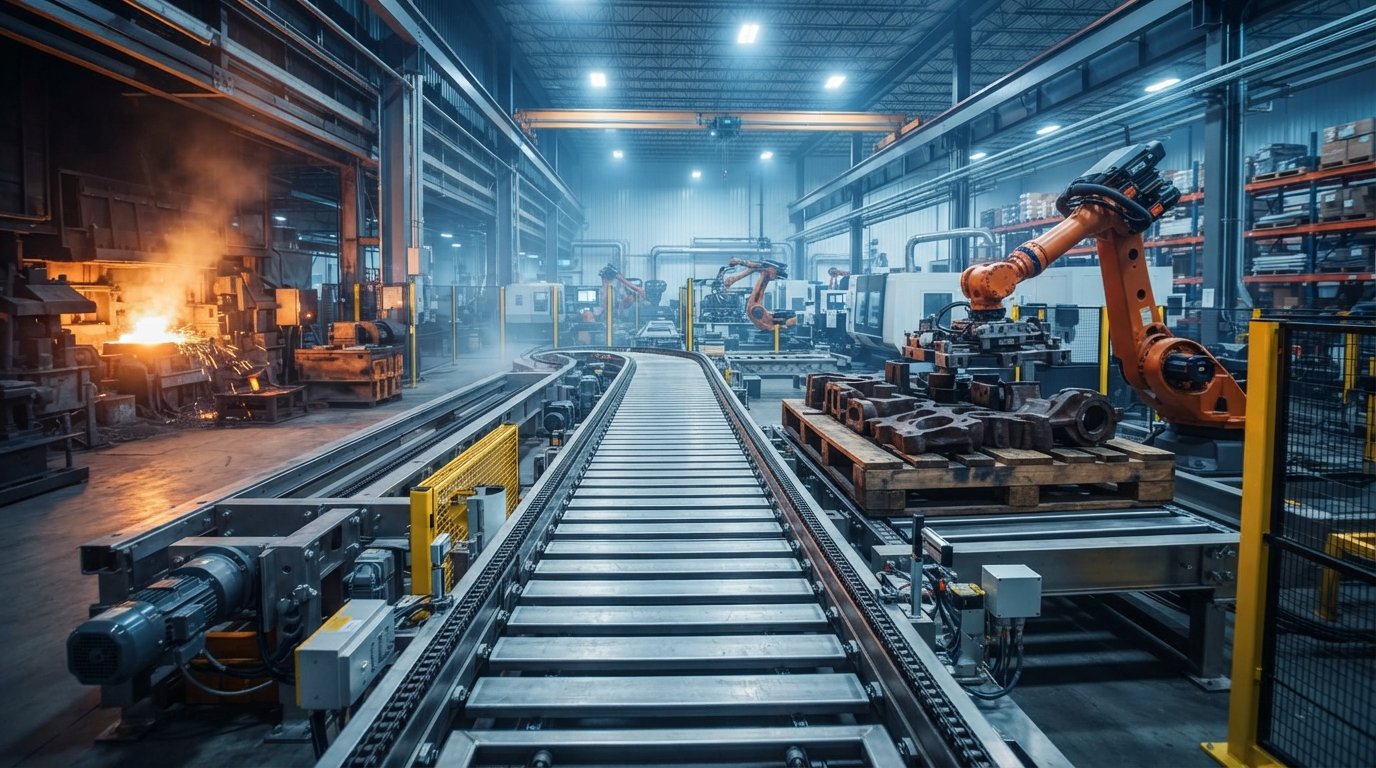
How many times has your production line stalled because a standard belt simply couldn't withstand the heat of the forge or the weight of a five-ton pallet? You likely recognize that in high-stakes industrial environments, equipment failure isn't just an inconvenience; it's a direct hit to your operational bottom line. When standard setups fail under heavy loads, slat conveyor systems offer the structural integrity needed to maintain movement. Traditional conveyor surfaces often buckle under extreme temperatures or irregular footprints, leading to frequent maintenance and costly downtime.
This guide will show you how to leverage this robust technology to master your most demanding material handling challenges and streamline your automated warehouse workflows for the 2026 regulatory landscape. We'll explore the engineering advantages of rigid slat designs, their seamless integration with modern robotics, and how to ensure your system remains compliant with upcoming 2027 energy and safety standards. By shifting from passive equipment to custom-engineered integration, you'll gain the durability and precision required to handle awkward items with improved throughput. We'll examine the specific technical requirements for IE4 motor transitions and ASME B20.1-2024 safety compliance to keep your facility at the cutting edge of industrial excellence.
Key Takeaways
- Learn why slat conveyor systems provide the mechanical advantage and durability required for industrial loads that exceed the physical limits of traditional belt-driven equipment.
- Identify how to select specific slat materials and configurations to withstand extreme thermal or chemical conditions while maintaining high-torque load stability.
- Compare total cost of ownership across different conveyor types to determine the exact thresholds where heavy-duty slat solutions offer superior long-term ROI.
- Discover strategies for integrating discrete slat technology with advanced warehouse robotics to ensure precise positioning and seamless material flow in automated workflows.
- Explore how professional process engineering and modern predictive maintenance protocols minimize system vibration while extending the lifecycle of your chain-driven infrastructure.
Understanding Slat Conveyor Systems: The Heavy-Duty Alternative
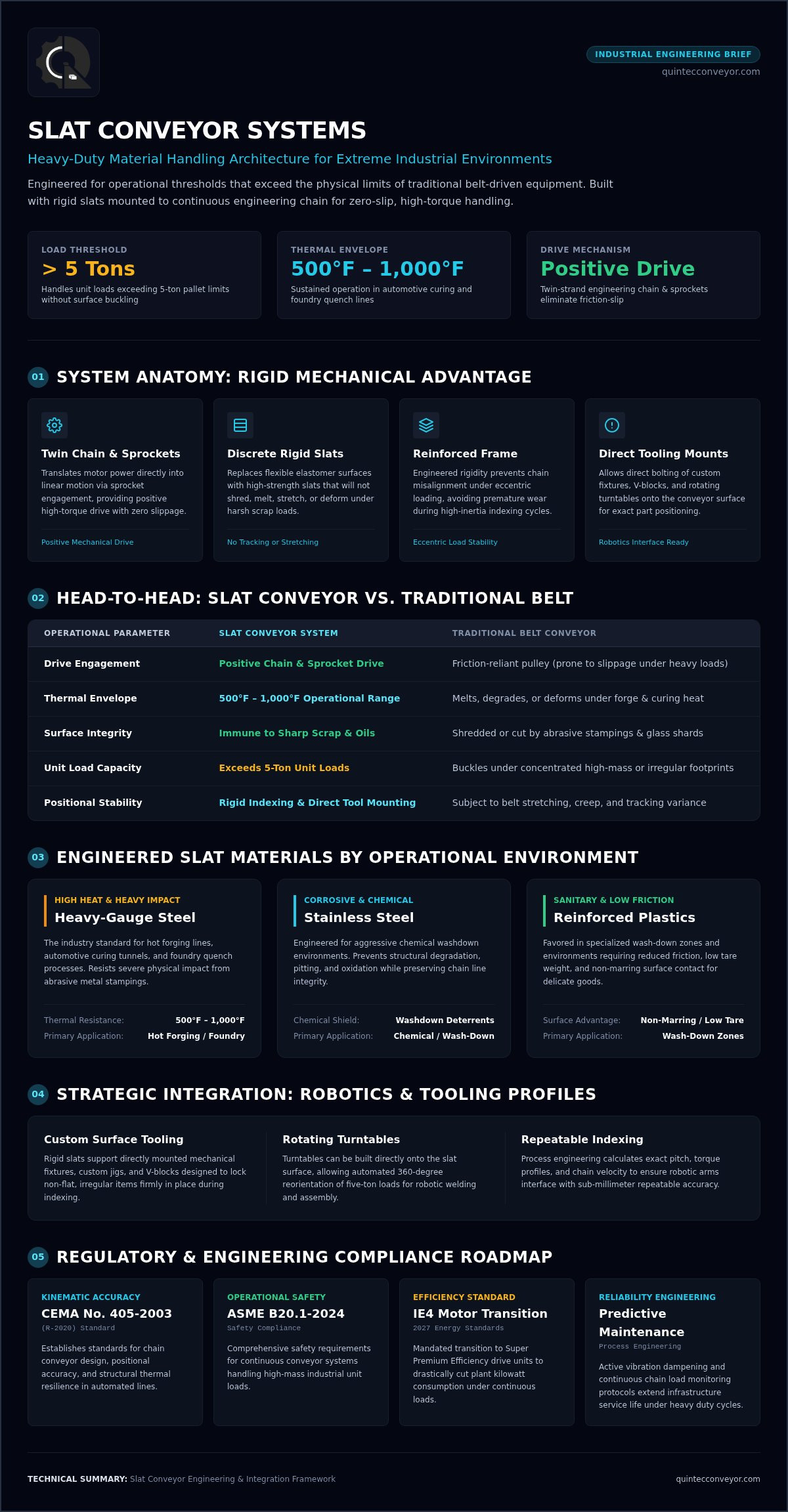
Slat conveyor systems represent a robust departure from traditional belt-driven layouts. Instead of a continuous elastomer surface, these systems utilize discrete, rigid slats attached to twin strands of continuous engineering chain. This architecture allows the system to move unit loads that would otherwise shred, melt, or deform a standard belt. The primary mechanical benefit lies in the positive drive mechanism. Unlike friction-reliant belts, the sprocket and chain assembly provides high-torque capabilities without slippage. It's an essential distinction for heavy-duty manufacturing where load weights frequently exceed five tons.
While standard industrial conveyor systems excel in high-speed parcel sortation, they often lack the structural rigidity required for assembly fixtures or oily scrap removal. In 2026, industrial engineering standards like CEMA No. 405-2003 (R-2020) prioritize these systems for environments where positional accuracy and thermal resilience are non-negotiable. By moving away from flexible materials, facilities gain a platform capable of supporting intense industrial workflows without the risk of belt stretching or tracking issues.
Anatomy of a Slat Conveyor
The drive chain and sprocket assembly serve as the system's heart. These components translate motor power into linear motion with exceptional efficiency. Slat materials vary by application; heavy-gauge steel is the industry standard for hot forging, while reinforced plastics are favored in wash-down environments. For specific industrial conveyor systems, frame construction must be exceptionally rigid. A sturdy frame prevents chain misalignment under eccentric loading, ensuring the drive components don't experience premature wear or catastrophic failure during high-inertia indexing.
Core Benefits for Industrial Workflows
Durability is the hallmark of this design. It easily handles abrasive metal stampings or sharp glass shards that would compromise a synthetic belt. For facilities looking to optimize the recovery value of such industrial materials, Carbide Kings offers a comprehensive guide to the tungsten and carbide scrap market. Additionally, these systems thrive in extreme thermal envelopes, often operating between 500°F and 1,000°F in automotive curing or foundry quench lines. Because slats are rigid, they allow for the mounting of mechanical fixtures, v-blocks, and rotating turntables directly onto the surface. This enables the precision positioning required for modern robotic interfaces, which is a critical factor in 2026 automated assembly workflows. When you need a surface that stays predictable under pressure, slats are the logical choice.
Technical Configurations: Engineering Slats for Extreme Environments
Engineering slat conveyor systems for extreme environments requires a deep understanding of thermal dynamics and chemical interactions. Standard configurations often fall short when faced with the rigors of heavy manufacturing. Selecting the right material is the first step in ensuring long-term stability. For instance, heavy-duty steel slats are essential for foundry quench lines where unit loads encounter temperatures between 500°F and 1,000°F. In contrast, stainless steel slats provide the necessary corrosion resistance for chemical washdown zones, preventing the structural degradation common in less robust setups.
System stability depends heavily on the configuration of pitch and width. A wider pitch may reduce the number of moving components; however, it can compromise the smooth movement of irregular product bases. Custom profiles, such as V-blocks or specialized jigs, allow the system to secure non-flat items during high-speed indexing. This level of customization is where process engineering becomes indispensable. It allows designers to calculate the precise torque requirements and speed profiles needed to prevent mechanical strain during peak operational hours.
High-Temperature and Chemical Resistance
Foundry and heat-treating applications place immense stress on conveyor components. Beyond the slats themselves, the drive chains must be engineered to withstand significant thermal expansion. Utilizing targeted high-temperature dry-film coatings or automated single-point lubricators ensures that the chain remains fluid under intense heat. In corrosive environments, 304 or 316-grade stainless steel components prevent oxidation that could lead to structural failure. These choices are critical for maintaining a high-ROI system that avoids the frequent replacements seen with lower-grade materials.
Precision and Control Options
Modern systems in 2026 rely on advanced electronic integration to manage high-torque loads. Incorporating Variable Frequency Drives (VFDs) allows for soft start-stop cycles, which reduces the shock load on chain links and sprockets. With the 2027 DOE IE4 motor mandate approaching, it's vital to engineer current systems with frame sizes that accommodate these high-efficiency motors. Precision positioning is achieved through encoder integration, allowing articulated robots to interact with the line with millimeter accuracy.
Safety remains a top priority for any heavy-duty installation. Compliance with OSHA conveyor safety regulations requires the strategic placement of emergency stops and robust mechanical guarding around nip points and chain drives. These features protect personnel while maintaining the high throughput expected in automated facilities. If you're planning a complex integration, consulting with a seasoned material handling partner can ensure your configuration meets both operational and regulatory demands.
Slat vs. Belt vs. Roller: Choosing the Right Solution
Selecting the optimal material handling platform requires a shift in perspective from initial capital expenditure to total cost of ownership (TCO). While standard belt conveyors offer a lower entry price, they reach a definitive physical limit when unit loads exceed several tons or involve sharp, oily debris. Slat conveyor systems provide the mechanical certainty that elastomer belts lack. In high-torque applications, belts are prone to stretching, slipping, and tracking issues that lead to unplanned downtime. By contrast, the positive drive of a chain-driven slat system ensures consistent movement regardless of load weight or surface contaminants.
Surface contact analysis is equally critical when protecting heavy or delicate finishes. Roller conveyors, while efficient for pallets, can leave pressure marks or "witness marks" on products with softer bases. Slats provide a continuous, rigid surface that supports the entire footprint of the item. This stability is vital for maintaining the integrity of large appliances or automotive body panels during transport. Adhering to ASME B20.1 conveyor design standards ensures that your choice between these technologies meets the rigorous safety and inspection requirements necessary for industrial environments in 2026.
The ROI of Slat Systems in Heavy Manufacturing
In heavy manufacturing, the cost of a single line stoppage often dwarfs the price difference between conveyor types. Engineered slat systems are designed for a 10-year plus lifecycle, significantly outlasting synthetic belts that may require replacement every 18 to 24 months in abrasive conditions. Maintenance for these systems focuses on routine chain lubrication rather than constant tensioning and tracking adjustments. The ROI of slat conveyors is primarily realized through the drastic reduction in equipment replacement cycles and the elimination of catastrophic belt failure costs over a ten-year operational horizon.
Identifying the Best Use Cases
Automotive assembly lines remain the primary proving ground for this technology. Transporting car bodies through various stages of production requires the rigid positional repeatability that only slats can provide. Similarly, appliance manufacturing and large-format logistics rely on slats to move heavy unit loads without the risk of surface deformation. These environments demand a level of durability that standard rollers can't match, especially when dealing with irregular footprints. For facilities navigating complex requirements, slats are often the preferred foundation for custom material handling system design because they offer a versatile, high-capacity platform that integrates easily with specialized fixtures and heavy-duty automation.
Strategic Integration: Designing Slat Conveyors for Automated Workflows
Integrating slat conveyor systems into a modern facility requires more than just high-torque hardware; it demands sophisticated process engineering. Successful automation hinges on the interaction between rigid mechanical slats and intelligent control logic. By incorporating PLC-driven sensors, facilities can achieve smart material movement that adapts to real-time production demands. Utilizing IO-Link vibration and thermal sensors directly in the chain path allows for condition monitoring that prevents the catastrophic stoppages mentioned in previous sections. These smart drive systems, paired with VFDs, ensure that transfers between disparate conveyor types remain fluid and synchronized. With automated lines holding over 53% of total material handling installations in 2026, the demand for smart sensor integration has never been higher.
Optimizing your facility's footprint often involves navigating tight spaces with custom incline and curve configurations. Unlike standard belt systems that struggle with steep angles under heavy loads, slats provide the structural grip necessary for vertical movement. This capability is central to maximizing vertical cube space in modern warehouse designs. Proper integration ensures that these elevation changes don't compromise load stability or throughput speeds.
Robotics and Automated Interface
Articulated robot arms require a rigid, predictable surface for successful warehouse robotics integration. Slat conveyor systems provide the sub-millimeter precision necessary for high-speed pick-and-place operations. Because slats don't stretch or shift like elastomer belts, robotic cycle times stay perfectly synchronized with the conveyor's indexing. This stability makes them the ideal foundation for automated sortation zones where heavy unit loads must be diverted with absolute accuracy. It's the difference between a system that merely moves product and one that functions as a high-performance robotic platform.
System Scalability and Future-Proofing
Future-proofing an industrial facility means designing for expansion before the first slat is installed. Modular design principles allow for the addition of new zones as production volumes grow. It's critical to engineer the initial infrastructure to support future load increases, ensuring your drive motors and frames don't become obsolete. Partnering with a veteran conveyor system integrator ensures that your long-term planning accounts for upcoming 2027 energy efficiency mandates and safety regulations. Expert integration transforms a series of machines into a cohesive, high-performance ecosystem. Schedule a strategic engineering consultation to optimize your automated workflow today.
Optimizing Performance with Professional Engineering and Maintenance
The transition from a successful installation to long-term operational excellence depends on the precision of the initial engineering. Professional installation significantly mitigates the harmonic vibration and noise pollution often associated with high-torque drives. When drive chains are misaligned by even a fraction of an inch, the resulting vibration can compromise the structural integrity of the frame and lead to premature component failure. By prioritizing exact alignment and rigid mounting, slat conveyor systems operate with a level of mechanical quietness that reflects their internal efficiency. This focus on precision doesn't just protect the equipment; it creates a safer, more productive environment for your floor personnel.
In 2026, predictive maintenance has evolved beyond simple scheduled checks. Modern strategies utilize the sensor data discussed in previous sections to identify wear patterns in real time. Quintec Conveyors brings over 100 years of collective experience, allowing us to interpret these data points to prevent common integration failures, such as sprocket pitch-wear or chain elongation, before they cause a line stoppage. We balance high-performance torque with the energy efficiency requirements of the upcoming 2027 IE4 motor mandate. It ensures your system remains powerful enough for five-ton loads while staying compliant with evolving environmental standards.
Lifecycle Maintenance and Support
Maintaining uptime requires a proactive approach to spare parts and inspections. Facilities should maintain a strategic inventory of essential components, including master links, replacement slats, and drive sprockets, to minimize recovery time during unexpected events. Scheduled inspections must focus on three critical areas:
- Chain Tension: Monitoring for elongation to prevent sprocket jumping or "cogging."
- Lubrication: Ensuring automated systems are delivering the correct volume of high-temp or dry-film lubricants as per ASME B20.1-2024 standards.
- Slat Integrity: Checking for surface deformation or loose fasteners that could snag on robotic interfaces.
Our national maintenance coverage ensures that expert support is available regardless of your facility's location. This consistent oversight is a key lifecycle benefit that protects your capital investment and maintains high throughput over a ten-year operational horizon.
The Quintec Advantage in Slat Integration
Quintec Conveyors positions itself as a strategic integrator rather than a simple equipment vendor. Our process begins with comprehensive process engineering to ensure the system is tailored to your unique industrial challenges. Whether you're navigating extreme thermal environments or complex robotic handoffs, we design solutions that prioritize long-term stability. From the first CAD drawing to the final safety certification, we handle every detail of the project management lifecycle. Contact Quintec Conveyors to discuss how we can engineer a durable, high-ROI solution for your next heavy-duty integration project.
Securing Your Operational Future Through Strategic Integration
Mastering heavy-duty material handling in 2026 requires more than just robust hardware; it demands a forward-looking approach to system design. Slat conveyor systems provide the structural foundation necessary to handle extreme unit loads and high-temperature environments that compromise traditional belt setups. By integrating these systems with advanced PLC logic and robotic interfaces, you ensure your facility maintains the precision and throughput required for modern automated workflows. It's no longer about simply moving products; it's about engineering a predictable, high-performance ecosystem.
Success hinges on moving beyond simple equipment procurement toward comprehensive process engineering. Quintec brings over 100 years of collective industry experience to every project, acting as a strategic guide for specialists in complex warehouse automation. With national engineering and installation services, we provide the steady hand needed to navigate large-scale logistical challenges. Partner with Quintec for Custom Slat Conveyor Integration to build a durable, high-ROI infrastructure that stands the test of time. Your most demanding loads are in capable hands.
Frequently Asked Questions
What is the maximum load capacity for a standard slat conveyor system?
Heavy-duty steel slat conveyor systems routinely support unit loads ranging from 10,000 to 50,000 lbs. These high capacities are essential for transporting car bodies, heavy machinery, and industrial pallets. The final capacity depends on the specific engineering of the chain pitch and frame rigidity. Custom process engineering ensures the system maintains structural integrity under these high-torque conditions without the slippage or deformation common in lighter belt-driven alternatives.
Can slat conveyors handle high-temperature materials like those in foundries?
Yes, slat conveyors are specifically engineered to thrive in extreme thermal environments ranging from 500°F to over 1,000°F. This makes them the industry standard for hot forging, foundry quench lines, and automotive curing processes. While traditional elastomer belts would melt or degrade, steel or cast iron slats maintain their shape. Proper lubrication systems and thermal expansion joints are integrated to ensure consistent movement during intense heat-treating cycles.
How do slat conveyors compare to belt conveyors in terms of maintenance?
Slat conveyors require less frequent surface replacement but more specialized chain maintenance compared to belt systems. While belts often need constant tensioning and tracking adjustments, slat systems focus on routine lubrication of the drive chain and sprocket assembly. Utilizing automated single-point lubricators or sealed-for-life roller chains in 2026 has significantly reduced manual labor. Professional maintenance programs help identify chain elongation early, preventing the catastrophic failures often seen with over-stressed synthetic belts.
Are slat conveyors suitable for food-grade or washdown environments?
Slat conveyors are suitable for washdown environments when configured with stainless steel or reinforced plastic slats. These materials resist the corrosive effects of cleaning chemicals and high-pressure water. However, the open architecture of the slats requires careful engineering to ensure drainage and prevent bacterial traps. For 2026 facilities, we recommend custom-engineered profiles that allow for thorough sanitation while maintaining the high load-bearing capacity required for large-format food processing or chemical manufacturing.
What materials are commonly used for conveyor slats in 2026?
In 2026, the most common materials for slat conveyor systems include heavy-gauge steel, 304 or 316 stainless steel, and high-impact reinforced plastics. Steel is favored for high-torque manufacturing; stainless steel is the standard for corrosive or sanitary applications. Some facilities also utilize treated hardboard slats for lighter unit loads where cost-effectiveness is a priority. Choosing the correct material involves balancing thermal resistance, chemical exposure, and the specific footprint of the product being transported.
How much floor space is required for a custom slat conveyor installation?
The floor space required for a custom installation depends entirely on your facility's specific workflow and throughput requirements. Slat systems are highly versatile and can be engineered with tight curves or steep inclines to maximize vertical cube space and reduce the overall footprint. Because they handle heavy loads with precision, they often require less horizontal run-off than gravity-fed systems. A strategic engineering consultation helps determine the most efficient layout for your infrastructure and automated equipment.
Can slat conveyors be integrated with robotic arms for automated assembly?
Slat conveyors are the preferred foundation for robotic integration due to their rigid, non-slip surface. Unlike belts that stretch and shift, slats provide the sub-millimeter positional repeatability required for articulated robotic arms to perform pick-and-place or assembly tasks. In 2026, these systems are frequently paired with encoders and PLC logic to synchronize conveyor speed with robotic cycle times. This level of precision is critical for high-performance automotive and EV battery assembly lines.
What are the primary safety considerations for chain-driven slat systems?
Primary safety considerations focus on mechanical guarding of in-running nip points, chain drives, and sprockets to comply with OSHA 1910.212 standards. Systems must also integrate audible start-up warnings and strategically placed emergency stops as per ASME B20.1-2024 guidelines. Because these are high-torque machines, lockout/tagout protocols are essential during maintenance. Modern installations in 2026 often include remote monitoring and automatic shut-off sensors to detect obstructions or mechanical strain, protecting both personnel and valuable products.