Conveyor Technologies 2026: A Strategic Analysis of Industrial Innovation
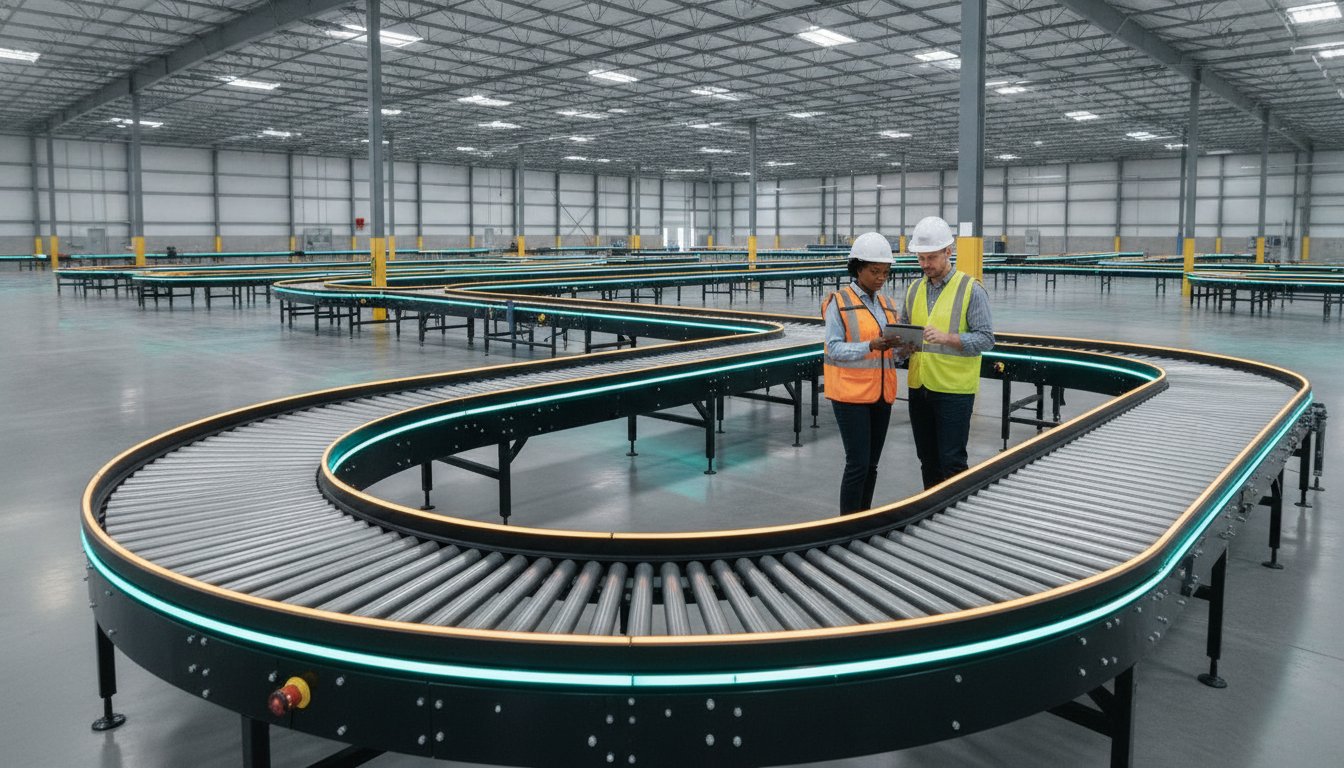
Industrial facilities deploying IoT-based predictive monitoring on conveyor drive chains and roller bearings now experience up to 70% reductions in unplanned downtime. This data highlights a significant shift where material handling hardware is no longer a passive asset but an intelligent participant in your workflow. You've likely felt the mounting pressure of rising labor costs and the frustration of inflexible legacy systems that create bottlenecks during peak demand. It's often difficult to choose between competing automation technologies when your operational stability is at stake.
We recognize that you need a scalable system that grows with demand without requiring a larger facility footprint. This strategic analysis explores how the latest advancements in conveyor technologies are reshaping warehouse efficiency for 2026 and beyond. You'll discover how to integrate these innovations to reduce maintenance costs and drive higher throughput. We'll examine the industry move toward modular motor driven rollers, the impact of new DOE IE4 efficiency mandates, and how predictive maintenance protects your long-term capital investments.
Key Takeaways
- Understand how modern conveyor technologies have evolved from simple transport belts into intelligent, data-driven ecosystems that optimize entire facility flows.
- Learn how to leverage modular designs and Motor Driven Roller (MDR) technology to achieve superior energy efficiency and layout flexibility.
- Discover the "intelligence layer" of AI and robotics integration that enables autonomous sortation logic and seamless warehouse automation.
- Identify practical strategies for retrofitting legacy infrastructure with modern technology to increase throughput within your existing facility footprint.
- Recognize the importance of partnering with a seasoned systems integrator to navigate complex engineering challenges and ensure long-term operational stability.
The Evolution of Conveyor Technologies in 2026
In 2026, the definition of conveyor technologies has shifted from simple hardware to sophisticated, integrated mechanical and digital ecosystems. We no longer view these systems as isolated tracks for moving goods; instead, they function as the central nervous system of the facility. This year represents a critical tipping point because AI integration is now a standard requirement for maintaining competitive throughput. High-speed data transmission allows these systems to make real-time adjustments, preventing bottlenecks before they manifest on the floor. The transition from "dumb" belts to "smart" sortation means that every parcel is tracked and routed with microscopic precision.
From Mechanical Transport to Digital Ecosystems
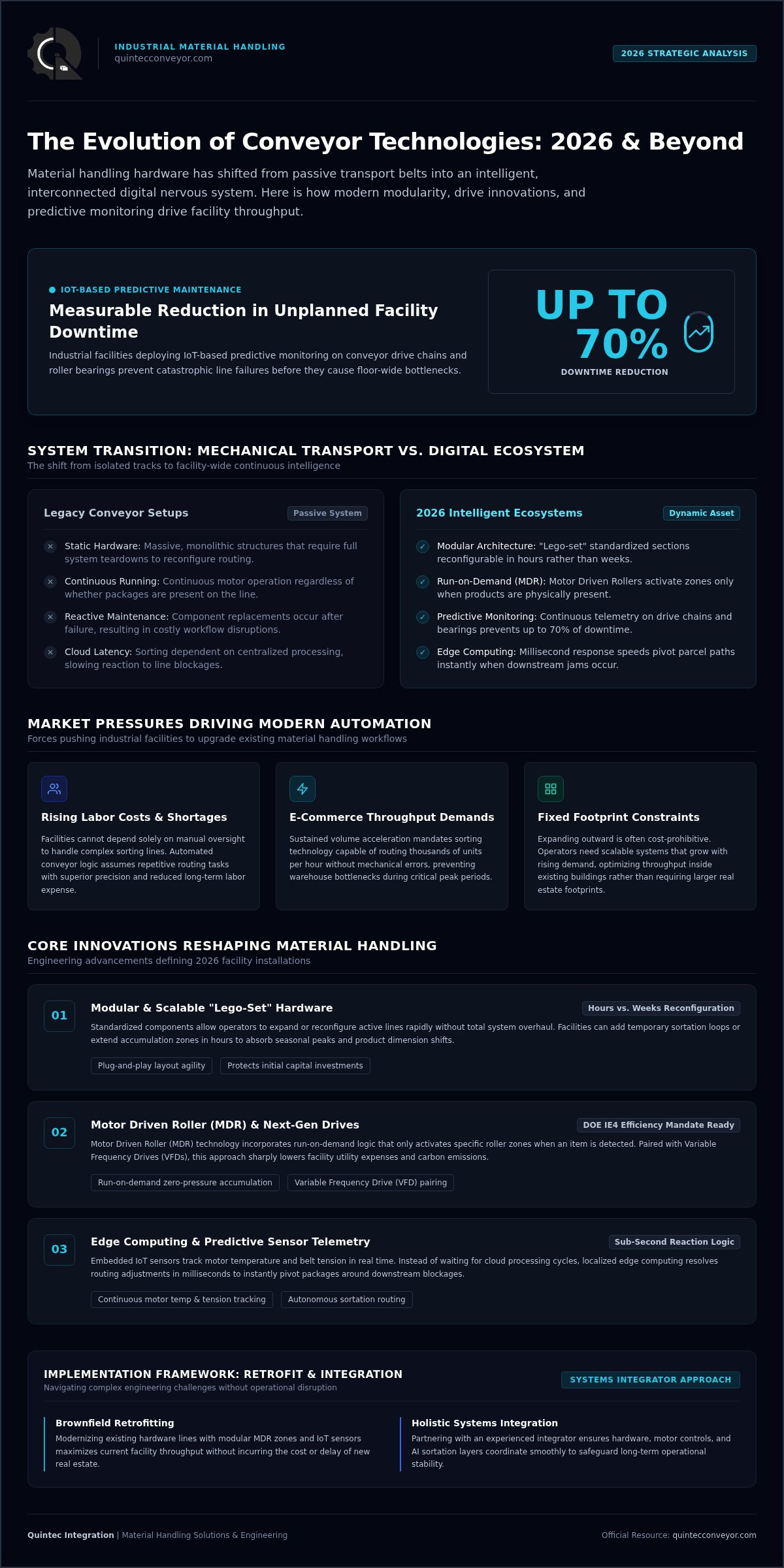
IoT sensors have fundamentally transformed the basic conveyor belt into a source of actionable intelligence. These sensors monitor everything from motor temperature to belt tension, providing the real-time visibility necessary for modern industrial conveyor systems to operate at peak efficiency. By referencing the foundational principles of industrial conveyor systems, we can see how far the industry has moved beyond simple gravity rollers. Smart Conveyors are systems that self-optimize based on throughput data. This digital layer ensures that every component communicates, allowing for predictive adjustments that were impossible just a few years ago. Edge computing now processes this data locally, ensuring that system responses happen in milliseconds rather than waiting for cloud-based instructions. This high-speed data transmission is the backbone of real-time sortation, allowing the system to pivot instantly when a downstream blockage occurs.
Drivers of Innovation: Labor, Speed, and Scalability
The global labor shortage remains a primary driver for automated conveyor logic. Facilities can't rely on manual oversight to manage the complex routing required by modern logistics. Automated systems fill this gap by handling repetitive tasks with higher precision and lower long-term costs. E-commerce demand continues to accelerate, requiring sortation technology that can process thousands of units per hour without error. Modularity provides the final piece of the 2026 scalability puzzle. By using standardized components, operators can expand or reconfigure their lines quickly as demand fluctuates. This flexibility is essential for businesses that need to remain agile in a volatile market. High-performance modularity ensures that your facility can adapt to new product dimensions or volume spikes without a complete system overhaul. This shift toward adaptable, intelligent design is what defines the current state of conveyor technologies and industrial material handling.
Core Innovations: From Modular Design to Smart Drives
Modern infrastructure requires a shift from rigid, permanent installations to fluid, adaptable systems. The current advancements in conveyor technologies focus on this need for agility; they ensure that a facility remains productive even as market demands shift. We're seeing a move away from the massive, monolithic structures of the past in favor of components that can be swapped, scaled, and synchronized with ease. This evolution allows operators to treat their hardware as a dynamic asset rather than a static expense.
Modular and Scalable Hardware
Modularity has become the "lego-set" of 2026 warehouse design. By implementing modular conveyor systems, operators can reconfigure entire lines without massive capital reinvestment. This plug-and-play approach allows for rapid response to seasonal peaks. For example, a facility can add a temporary sortation loop or expand an accumulation zone in a matter of hours rather than weeks. This flexibility protects your initial investment by ensuring the hardware evolves alongside your business needs. It's no longer necessary to tear down an entire line to make a simple routing change.
Next-Generation Drive Systems
The drive systems powering these lines have also undergone a significant transformation. Motor Driven Roller (MDR) technology now leads the way in energy efficiency by only activating specific zones when a product is present. This run-on-demand logic reduces the carbon footprint of large distribution centers and lowers utility costs. When paired with Variable Frequency Drives (VFDs), these systems offer precision speed control that minimizes product damage. The industry's move toward brushless DC motors further reduces maintenance requirements. These components lack the wear-prone parts found in traditional motors. To ensure these systems operate at peak performance, many firms are adopting AI-enhanced monitoring and predictive analytics to detect mechanical anomalies before they cause a shutdown.
Beyond the drive systems, the physical footprint of the hardware is shrinking. The strategic use of low profile conveyor designs is essential for multi-tier facilities where vertical space is at a premium. These compact units are uniquely suited for integration with warehouse robotics. They can be positioned in tight gaps where traditional frames wouldn't fit, creating a seamless handoff between fixed conveyance and autonomous mobile robots (AMRs). Finally, advancements in belt materials, such as high-friction and anti-static surfaces, ensure that even the most delicate items are handled safely. If you're looking to optimize your facility's layout, partnering with a systems integration expert can help you select the right conveyor technologies for your specific application.
The Intelligence Layer: AI, Robotics, and Predictive Analytics
Modern conveyor technologies are no longer defined solely by their mechanical components; they're governed by an increasingly sophisticated digital layer. While physical hardware provides the muscle, the software serves as the brain, coordinating complex movements across vast facility footprints. Edge computing has become a standard in 2026, allowing data to be processed directly at the conveyor level. This decentralized approach enables millisecond response times, ensuring that the system can react to flow changes without waiting for instructions from a distant central server. This speed is essential for maintaining the high-velocity throughput required in modern distribution.
A strategic advantage is found in the seamless integration of warehouse robotics with traditional conveyor lines. Rather than treating robotics as an isolated silo, we view them as an extension of the conveyance flow. This unified approach allows autonomous mobile robots (AMRs) to dock directly with fixed lines, creating a continuous loop of material movement. This synchronization eliminates the friction often found in legacy setups where robots and conveyors operate on disparate platforms. By bridging these technologies, facilities achieve a level of automation that is both scalable and highly reliable.
AI-Driven Sortation and Routing
The industry has moved beyond simple barcode scanning toward advanced computer vision. AI now allows for package recognition based on dimensions, weight, and even branding, reducing the reliance on perfectly aligned labels. Dynamic routing logic enables conveyors to "decide" the most efficient path in real-time based on current congestion levels within the facility. AI reduces sortation errors by 99% in 2026 environments. This precision ensures that high-volume fulfillment centers can maintain accuracy even during the most demanding seasonal peaks. It's a fundamental shift from reactive transport to proactive, intelligent routing.
Predictive Maintenance and System Longevity
The era of "run-to-fail" maintenance models has ended. Industrial facilities now utilize vibration and heat sensors to monitor the health of every critical component. These smart sensors identify bearing wear or motor fatigue weeks before a failure occurs, allowing for scheduled repairs during off-hours. Following established conveyor design and safety standards ensures that these monitoring systems are integrated into the hardware without compromising structural integrity. Software-monitored health provides a significant return on investment by protecting the lifespan of the equipment. Facilities deploying these IoT-based predictive tools experience up to 70% reductions in unplanned downtime, ensuring that conveyor technologies remain a reliable asset for years to come.
Strategic Implementation: Integrating Tech into Existing Workflows
Implementing 2026-level conveyor technologies requires a rigorous evaluation of existing workflows through professional warehouse design services. Most operational failures occur not because of the hardware itself, but because the integration logic doesn't align with the facility's physical realities. A successful strategy prioritizes the mapping of material flow before a single motor is installed. This methodical approach ensures that new investments actually resolve bottlenecks rather than simply moving them to a different part of the line.
The Process Engineering Framework
Hardware choice must follow process logic, not lead it. We start by identifying specific bottlenecks that restrict throughput or inflate labor costs. Simulation tools and digital twins are essential in this phase. They allow us to test the impact of new conveyor paths in a virtual environment before making physical changes. This data-driven approach ensures that the chosen technology solves a specific problem. By validating the flow logic early, we reduce the risk of costly post-installation adjustments. It's about engineering a solution that fits your specific volume and product profile.
Overcoming Integration Obstacles
The "Brownfield" challenge is the most common hurdle for established facilities. Retrofitting new tech into legacy infrastructures requires precise engineering to manage physical constraints like support pillars or low ceilings. Successful integration of conveyor technologies into a legacy layout depends on the seamless communication between the hardware and the facility's control software. You must ensure total compatibility between the conveyor's PLC and your existing WMS or ERP systems to avoid data silos. Often, this involves custom warehouse infrastructure solutions that bridge the gap between old and new hardware.
Phased implementation strategies are also vital. By rolling out updates in stages, you can maintain operations while modernizing your system. This minimizes disruption and allows your team to adapt to the new equipment gradually. Finally, don't overlook the human-machine interface. Staff training is critical to ensure your team can manage the advanced diagnostics provided by modern systems. If you're ready to modernize your facility without disrupting current operations, contact the experts at Quintec for a comprehensive process engineering consultation.
Partnering for Innovation: The Quintec Approach to Integration
Selecting the right conveyor technologies is only the first step toward operational excellence. The true challenge lies in the integration of these systems into a cohesive, functional whole that meets the specific demands of your facility. Quintec leverages over 100 years of collective industry experience to vet emerging innovations, ensuring that we only implement solutions that offer proven reliability. We act as a strategic guide, helping you move past the noise of competing marketing claims to find the hardware that truly drives results.
There's a fundamental difference between an equipment vendor and a conveyor system integrator. While a vendor focuses on individual component sales, Quintec takes ownership of the entire material handling ecosystem. Our national reach across the United States allows us to provide consistent engineering excellence and support, ensuring that your operations remain stable and scalable. We don't just walk away once the installation is complete; we provide customized maintenance and engineering support throughout the lifecycle of your system.
Why Experience is the Ultimate Technology
Our methodology blends time-tested mechanical principles with the cutting-edge innovations of 2026. We follow a rigorous "Design, Engineer, Install, Maintain" framework that ensures every project is grounded in practical reality. This approach allows us to deliver high-level results that protect your long-term stability. By maintaining national service standards without regional limitations, we provide a reliable partnership that grows with your demand. We're committed to delivering precise, thorough solutions that reflect our status as a veteran leader in the field.
Next Steps for Your Facility
Preparing for the future requires a proactive evaluation of your current capabilities. You can initiate a facility audit to determine your 2026 readiness and identify areas where automation can yield the highest ROI. Consulting with our experts allows you to explore custom-engineered material handling solutions tailored to your unique throughput needs. Whether you're retrofitting a legacy site or planning a new installation, we have the expertise to navigate the complexities of modern conveyor technologies. Contact Quintec Conveyors to discuss your 2026 automation strategy and ensure your logistical challenges are in capable hands.
Strategic Readiness for 2026 and Beyond
The shift from simple mechanical transport to intelligent digital ecosystems is no longer optional. It's a requirement for staying competitive in a high-velocity market. By prioritizing modularity, you ensure facility scalability without the need for massive capital reinvestment. Integrating AI and predictive analytics protects your hardware from unplanned downtime while increasing sortation precision. Successful implementation ultimately depends on rigorous process engineering that aligns technology with your specific material flow logic.
Quintec brings over 100 years of collective industry experience to every project. We offer custom-engineered solutions for national industrial applications through a comprehensive design-to-maintenance service model. As you navigate the complexities of modern conveyor technologies, you need a partner that combines proven reliability with a forward-looking perspective. Partner with Quintec Conveyors for your next system integration project to ensure your facility is engineered for long-term excellence. We look forward to helping you optimize your material handling flow.
Frequently Asked Questions
What are the most significant conveyor technologies emerging in 2026?
Leading innovations include decentralized 24V and 48V Motor Driven Rollers (MDR) that utilize run-on-demand logic. These conveyor technologies reduce energy consumption by up to 50% by only activating specific zones when a product is present. We're also seeing the rise of modular hardware that allows for rapid reconfiguration. These systems integrate with AI layers to enable real-time routing and high-speed sortation, ensuring your facility remains adaptable to changing e-commerce demands.
How does AI affect the efficiency of industrial conveyor systems?
AI serves as the intelligent layer that coordinates complex sortation and routing logic. By utilizing computer vision, systems can identify packages based on dimensions and weight rather than just barcodes. This technology enables dynamic routing, where the conveyor "decides" the most efficient path in real-time to avoid bottlenecks. Industrial facilities adopting these automated logic systems report sortation error reductions of up to 99%, significantly increasing overall warehouse throughput and operational accuracy.
Can I integrate new automated conveyor tech into an older warehouse?
Yes, integrating modern automation into legacy infrastructures is a common practice known as "Brownfield" retrofitting. Success depends on professional process engineering to map material flow logic within existing physical constraints. Modular components are particularly effective here because they can be scaled to fit tight footprints. You must ensure that the new hardware's PLC is fully compatible with your current WMS or ERP systems to maintain a unified data flow across the facility.
What is predictive maintenance in the context of conveyor systems?
Predictive maintenance uses IoT sensors to monitor vibration, heat, and motor current in real-time. This data-driven approach allows you to identify bearing wear or belt fatigue weeks before a mechanical failure occurs. By moving away from "run-to-fail" models, facilities can schedule repairs during off-peak hours. This strategy protects your long-term capital investment and has been shown to reduce unplanned downtime and safety incidents by as much as 70%.
Are modular conveyor systems more expensive than custom-built ones?
While the initial purchase price for modular systems can vary, they often provide a superior return on investment compared to rigid, custom-built lines. Modular hardware acts like a "lego-set" that can be reconfigured or expanded without massive capital reinvestment. This flexibility reduces the cost of future facility changes and speeds up deployment times. When evaluating conveyor technologies, it's essential to consider the total cost of ownership, including maintenance and the ability to scale.
How do I choose between different conveyor technology manufacturers?
You should prioritize a manufacturer's ability to integrate their hardware with your existing digital and mechanical ecosystem. Look for partners who offer comprehensive design, engineering, and maintenance services rather than just equipment sales. It's vital to choose an integrator with a national reach and deep process engineering experience. This ensures that the technology you select is backed by a reliable support network that can manage the entire lifecycle of your system.
What role does robotics play in modern conveyor integration?
Robotics act as a flexible extension of fixed conveyance lines, bridging the gap between stationary tracks and autonomous movement. Autonomous Mobile Robots (AMRs) now dock directly with conveyor systems via automated transfer stations. This integration eliminates intra-facility forklift traffic and removes manual handling touchpoints. By unifying robotics with traditional material handling equipment, you create a seamless, automated flow that can adapt to high-volume fulfillment requirements without expanding your horizontal floor footprint.
How much should I budget for a mid-sized facility technology upgrade?
Budgeting for a technology upgrade depends on several variables, including your required throughput, the complexity of the automation, and the condition of your current infrastructure. Rather than focusing on a single number, you should evaluate the potential ROI from reduced labor costs and increased efficiency. A comprehensive facility audit can help identify which upgrades will yield the highest impact. Professional process engineering ensures that your budget is allocated to the most critical bottlenecks first.