Accumulation Conveyor Solutions: How to Buffer Flow Without Creating New Bottlenecks
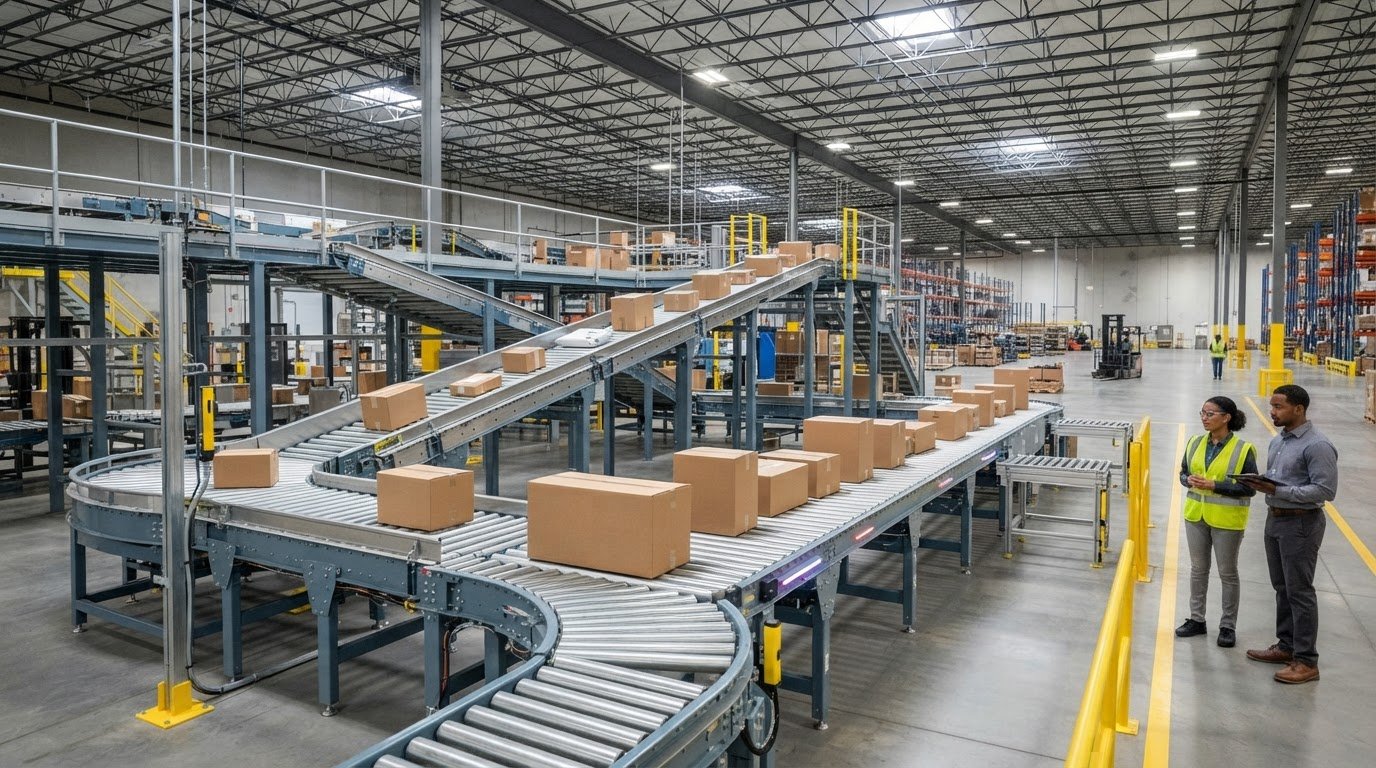
What if the buffer meant to protect production is quietly creating the next bottleneck? Accumulation conveyor solutions should absorb short-term differences in process rates, not pass pressure, product damage, or misalignment downstream. When a downstream stop leaves upstream equipment running, the right design can help keep production moving without forcing products into a crowded queue.
A buffer can create breathing room, but only when its design fits the products and process. Products vary in size, weight, and fragility, and the wrong accumulation method can lead to collisions, compression, or blocked access. The right fit depends on more than conveyor type: product characteristics, required throughput, controls, safety, and the surrounding workflow all matter.
This article explains how accumulation buffers uneven flow, compares approaches such as zero-pressure accumulation with other methods, and outlines the design questions to answer before specifying a system. It also explains why assessing the process constraint and planning connections to upstream and downstream equipment can prevent a local fix from becoming a wider material handling problem.
Key Takeaways
- Use accumulation to manage temporary differences in process rates, while recognizing that a buffer doesn’t increase the capacity of adjacent operations.
- Compare accumulation methods by how they control product contact and spacing, then match the approach to your loads and operating conditions.
- When evaluating Accumulation conveyor solutions, assess product dimensions, weight, stability, packaging, orientation, and variation using verified operating data.
- Map upstream and downstream interfaces, controls, workstations, and automation before settling on a system design.
- Validate buffer objectives and system interfaces as part of the wider material handling workflow, not as an isolated conveyor decision.
What Accumulation Conveyor Solutions Do for Variable Material Flow
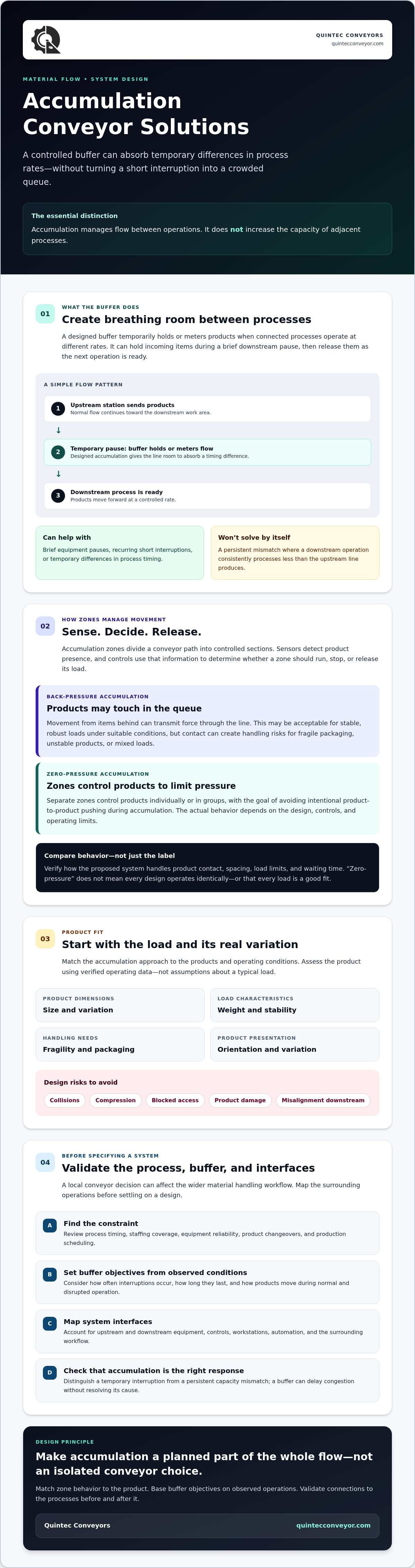
Accumulation is a controlled conveyor buffer that temporarily holds or meters products when connected processes operate at different rates. It gives a line room to absorb a short interruption or timing difference, then releases products as the downstream process is ready. Unlike permanent storage, it supports flow between operations rather than holding inventory for later retrieval.
Accumulation conveyor solutions can help when a discharge becomes blocked, a station is repeatedly starved, or equipment stops briefly and often. These symptoms point to a flow issue worth investigating, but they don’t automatically mean a buffer is the answer. Accumulation can manage temporary variation; it can’t, by itself, increase the capacity of an upstream or downstream process.
How an accumulation buffer supports a continuous process
Consider products leaving an upstream processing station and traveling toward a downstream work area. If the work area pauses briefly, a designed buffer can hold incoming products while the upstream station continues operating. Once the downstream area is ready, products move forward at a controlled rate. Some conveyor designs allow products to queue through mechanical movement, as described for lineshaft roller conveyors, where spools can slip on the shaft.
The key difference is control. Planned accumulation has a defined purpose and release behavior. Uncontrolled queueing is simply a growing line of products. It can obstruct access, complicate handling, or shift congestion to another point.
When accumulation helps, and when it only hides a constraint
First, determine whether interruptions are temporary, recurring, or a sign of a persistent mismatch in process capacity. A short equipment pause may be an appropriate case for buffering. If a downstream operation consistently processes less than the upstream line produces, adding buffer space alone could delay congestion rather than resolve its cause.
Review the conditions behind the stops before specifying equipment. Consider process timing, staffing coverage, equipment reliability, product changeovers, and production scheduling. Process engineering can help identify where flow is constrained and whether the interruption is isolated or systemic.
Set buffer objectives using observed operating conditions, not just available floor space or a single peak-flow estimate. Review how often interruptions occur, how long they last, and how products move during normal and disrupted operation. This context helps determine whether accumulation is warranted and what role it should play in the wider material handling workflow.
How Accumulation Conveyor Zones Control Product Movement
Accumulation zones divide a conveyor path into controlled sections. Sensors detect whether a product is present, and controls use that information to determine whether a zone should run, stop, or release its load. This coordination manages product spacing and movement as downstream equipment becomes ready to accept more items.
Zero-pressure accumulation uses controlled zones to hold products without intentionally allowing one item to push against the next; confirm the actual pressure behavior and operating limits in the system specifications. The term describes an operating goal, but design, controls, and performance can vary by conveyor type and integrator. Assess Accumulation conveyor solutions against the products and process they’ll serve, rather than selecting by label alone.
Back-pressure and zero-pressure accumulation compared
In a back-pressure arrangement, products may touch while queued, and movement from items behind them can transmit force through the line. That may be acceptable for stable, robust loads under suitable conditions. However, contact can create handling risks for fragile packaging, unstable products, or mixed loads.
Zero-pressure designs use separate zones to control products individually or in groups, limiting product-to-product pressure during accumulation. This can support more deliberate spacing, though it doesn’t make every load a good fit. Consider packaging strength, load stability, how long products may wait, and the conveyor’s mechanical design. Some systems also aim to avoid contact between queued products, so clarify how a proposed design behaves instead of assuming all “zero-pressure” systems operate identically.
What sensors and controls contribute to zone operation
Each zone’s sensor reports product presence to the control system. If the downstream zone is occupied or the receiving equipment isn’t ready, upstream zones can hold their products. When space becomes available, release logic can restart movement in sequence, maintaining the intended gap or flow pattern. The precise sequence depends on the application and control design.
During engineering, confirm what signals pass between the accumulation conveyor and connected equipment, how the system responds to a blocked or unavailable zone, and which operating modes are expected during startup or recovery. Terminology and implementation vary, so request documentation describing zone behavior and applicable specifications. Include safety in system planning. The linked OSHA conveyor safety standards address conveyors in construction, so confirm which requirements apply to the facility and project.
Clear zone logic is only one part of reliable operation. If you’re coordinating conveyors, controls, and facility requirements, reviewing conveyor system integration as part of the design process can help keep those interfaces in view.
How to Compare Accumulation Conveyor Solutions for Your Products
Choose an accumulation approach by matching product behavior and process needs, not by ranking conveyor types in the abstract. Start with verified operating data: product dimensions and weight, load stability, packaging sensitivity, orientation, and variation between loads. Then compare how each option manages pressure, contact, buffering, and system interfaces.
| Approach | Pressure and contact | Product range and buffering fit | Integration questions |
|---|---|---|---|
| Back-pressure accumulation | Products may contact, with force transmitted through queued items. | Assess for stable loads that can tolerate contact and the expected accumulation duration. | Confirm allowable product pressure and how the line restarts after a stop. |
| Zero-pressure accumulation | Controlled zones are intended to limit product-to-product pressure. | May suit loads that need spacing, subject to product and equipment design. | Check sensing, zone logic, release sequence, and control interfaces. |
| Zero-contact handling | Designed to keep products separated during accumulation. | Consider where preventing product-to-product contact is an explicit requirement. | Verify spacing, capacity, and interfaces against the complete process. |
These are comparison points, not universal performance guarantees. For a broader overview of choosing accumulation conveyor types, compare published descriptions with the actual operating requirements and specifications of the proposed system.
Which product and process characteristics change the choice?
Look beyond nominal product size. Record size variation, surface sensitivity, center of gravity, packaging strength, and whether products accumulate in a fixed orientation. Include changeovers, required accumulation duration, and operator access needs. Capture normal and peak flow rates at both adjacent processes so the design reflects how the line runs, not just an isolated estimate.
When should a design use pressure, spacing, or product separation?
Pressure and contact matter most when packaging can deform, loads can shift, or products could be damaged by touching. Where contact must be avoided, evaluate a zero-contact approach and confirm how it maintains separation. Calculate buffer requirements from observed interruptions and the time the downstream process needs to recover, rather than using floor space as the sizing rule. If product behavior or handling risk is uncertain, arrange sample testing or a system run-off before finalizing the design. Base selection on application engineering, considering the conveyor, controls, and adjacent equipment together.
How to Plan Accumulation Conveyor Integration and Project Validation
A reliable accumulation design starts with the full material flow, not just the section where products collect. Map the path from upstream equipment through the buffer to downstream conveyors, workstations, and automation. Then gather representative product and operating data, define what the buffer needs to accomplish, engineer the interfaces, and validate operation against agreed criteria.
Review facility conditions as part of the same discussion. Consider layout, operator and maintenance access, utilities, control architecture, safety requirements, and anticipated changes to products or production schedules. These details can affect equipment arrangement and how accumulation coordinates with connected processes. For broader context, see the industrial conveyor systems guide and the warehouse design services overview.
What information should the project team gather first?
Give the engineering team a practical picture of the products and process. Useful inputs include:
- Product dimensions, weight, packaging, handling restrictions, and representative samples.
- Normal and peak process rates, downtime patterns, shift profiles, changeovers, and current queue locations.
- Available layout drawings and known utility, controls, safety, maintenance, and operator-access constraints.
This information helps distinguish a buffer requirement from a broader process constraint and gives the design team a sound basis for evaluating system interfaces.
How should a proposed accumulation design be validated?
Before installation, review equipment drawings, product flow paths, control interfaces, and operating sequences with the people responsible for production, maintenance, safety, and automation. Confirm what should happen during routine accumulation, release, a downstream stop, and system recovery. If product behavior can’t be confidently predicted from specifications, sample testing or a run-off can reveal issues with orientation, contact, or movement before the design is finalized.
Agree on acceptance criteria before testing. Define how the team will assess flow, accumulation behavior, release logic, and product condition under representative operating conditions. Set numerical targets with project stakeholders using verified process requirements rather than assumptions. This makes validation specific to the application and clarifies what successful operation means.
For a project that needs coordinated conveyor, process, and facility planning, discuss custom conveyor system integration with Quintec Conveyors.
How Quintec Conveyors Can Support an Integrated Accumulation Solution
An accumulation conveyor affects more than the point where products wait. Its design can influence adjoining conveyors, workstation access, automation timing, and how material moves through the facility. Treating it as one engineered component of the wider workflow helps the project team consider those connections before equipment is specified.
Quintec Conveyors designs, engineers, and installs custom conveyor and material handling systems for industrial applications. Its capabilities also include process engineering, robotics and automation, and infrastructure. This combination is relevant when a project calls for evaluating the process constraint, coordinating equipment interfaces, and considering facility requirements alongside the accumulation function. The team brings more than 100 years of collective industry experience, while each application still needs to be evaluated against its own requirements.
Why treat accumulation as part of the whole material handling system?
A buffer can affect how products enter and leave connected equipment, how work areas remain accessible, and how automation responds to changing product flow. Process engineering can help distinguish a temporary buffering need from a deeper constraint, such as a persistent mismatch between adjacent operations. That assessment informs the design discussion, but it doesn't justify assuming a specific throughput, savings, uptime, or product-damage outcome without application evidence.
If you're comparing integration partners, the conveyor system integrator guide offers a broader framework for evaluating how a partner approaches system requirements. For accumulation conveyor solutions, focus on how the proposed equipment fits the complete material handling workflow, including controls and facility interfaces.
What to prepare before discussing an accumulation project
A focused first discussion is easier when the team can describe both the operating issue and the intended role of the buffer. Gather product specifications and samples where available, process-flow information, layout constraints, observed interruption patterns, and details about connected upstream and downstream equipment. Note whether the objective is to hold products during short stops, regulate release, or address another defined flow requirement.
Those inputs give the engineering team a starting point for reviewing product handling, process conditions, and integration needs. They can also clarify which project details require further validation before a design is finalized.
For a practical next step, discuss your accumulation conveyor application with Quintec Conveyors, including product characteristics, current interruptions, connected equipment, and operational objectives.
Build a Buffer That Supports the Whole Line
Effective Accumulation conveyor solutions do more than hold products during a stop. They’re designed around actual process variation, product-handling needs, and how upstream and downstream equipment work together. The right choice depends on verified operating data, clear buffer objectives, and careful validation of flow, release behavior, and product condition.
Quintec Conveyors brings more than 100 years of collective industry experience to custom conveyor system design, engineering, installation, and integration. Its capabilities also include process engineering, warehouse automation, robotics, infrastructure, and conveyor maintenance. This wider perspective can help teams assess the constraint and consider how an accumulation system fits the facility and material handling workflow, without assuming results before the application is evaluated.
Prepare your product details, process-flow information, layout constraints, and observed interruptions for a focused discussion. Discuss your accumulation conveyor application with Quintec and take the next step toward a system designed for your operation.
Frequently Asked Questions
What is an accumulation conveyor solution?
An accumulation conveyor solution is a controlled buffer that holds or meters products when connected processes run at different rates. Depending on system design, it can help absorb a temporary downstream stop while allowing upstream flow to continue. Unlike storage equipment, its purpose is to manage product movement between operations, not hold inventory indefinitely. Accumulation conveyor solutions don’t automatically increase the capacity of either connected process.
How does an accumulation conveyor work?
An accumulation conveyor uses its conveying surface, sensing, and control logic to manage products as they enter, wait, and move onward. In a zoned design, sensors detect whether products occupy sections of the conveyor, and controls coordinate which zones run or stop. When downstream equipment can receive product, the system releases items according to its programmed sequence. Exact behavior varies by design, so confirm zone logic and specifications for the application.
What is the difference between zero-pressure and back-pressure accumulation?
Back-pressure accumulation allows queued products to touch, so force may pass from one item to another as products continue moving behind the queue. Zero-pressure designs use controlled zones to limit product-to-product pressure while products wait. That can help where contact is a concern, but suitability depends on load stability, packaging, accumulation duration, and equipment design. Confirm how the proposed system handles and releases products rather than relying on terminology alone.
How do I choose the right accumulation conveyor for my products?
Choose based on product characteristics and process conditions. Record product dimensions, weight, packaging fragility, stability, orientation, and variation, then compare these with normal and peak flow rates at adjoining operations. Consider whether products can touch, how long they may accumulate, and what happens during a downstream stop. If behavior is uncertain, product testing or a system run-off can help validate the approach before finalizing the design.
Can an accumulation conveyor prevent a production bottleneck?
An accumulation conveyor can help isolate a temporary interruption, but it can’t automatically resolve a persistent capacity constraint. If a downstream process regularly handles less product than the upstream operation supplies, a buffer may postpone congestion rather than remove its cause. Review stop patterns, process rates, staffing, equipment, and scheduling to identify the constraint. Then determine whether accumulation is appropriate or whether the underlying process needs a broader engineering review.
How much accumulation capacity does my conveyor system need?
Determine capacity from actual interruption patterns and the time downstream equipment needs to recover, not simply from available floor space or a single peak-flow estimate. Review how often stops occur, how long they last, product spacing, and the rates of adjacent processes. Use representative operating data to define a buffer objective, then validate the proposed capacity against product behavior and system requirements. Confirm project-specific capacity through application engineering.
Can an accumulation conveyor integrate with existing equipment and automation?
Yes, an accumulation conveyor can be engineered to work with existing conveyors, workstations, controls, and automation, subject to equipment and interface requirements. The project team should review layout, product flow, control signals, operating sequences, safety, and maintenance access before specifying the system. Quintec Conveyors designs, engineers, installs, and integrates custom conveyor systems, with process engineering and automation capabilities to help assess how equipment fits the wider workflow.