
ASRS Integration Services: A Buyer’s Guide to Connected Warehouse Automation

An ASRS can move inventory efficiently and still create bottlenecks if it isn’t designed around the warehouse’s full material flow. Choosing ASRS integration services means looking beyond storage equipment to how the system will connect with conveyors, software, people, and existing processes.
Common concerns include unclear project boundaries, equipment and software that don’t work together, and installation that disrupts daily operations. A defined plan helps surface these risks before they reach the warehouse floor. This guide explains how to evaluate integrators, assign responsibilities, and shape an ASRS concept around current workflows and future growth.
You’ll also learn what to establish at each stage, from requirements and system interfaces to installation, testing, go-live, and ongoing support. Quintec Conveyors works in conveyors, robotics and automation, process engineering, infrastructure, and racking, and its team brings more than 100 years of collective industry experience. Confirm an integrator’s ASRS-specific technologies and project responsibilities before defining the scope.
Key Takeaways
- Evaluate automated storage by how it supports end-to-end warehouse flow, not by capacity alone.
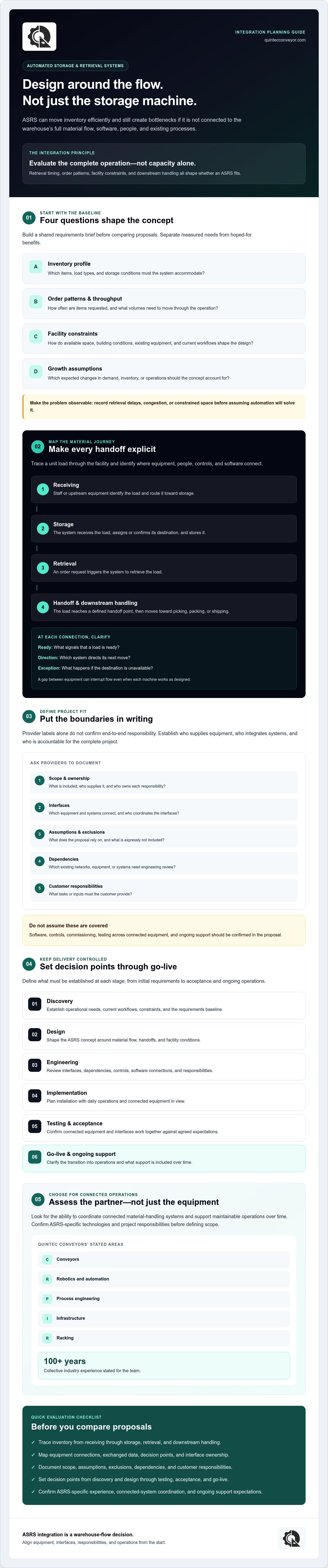
- Trace inventory through receiving, storage, retrieval, and downstream handling to identify key conveyor and software connections.
- When comparing ASRS integration services, ask providers to document scope, interfaces, assumptions, exclusions, dependencies, and customer responsibilities.
- Set decision points for discovery, design, engineering, implementation, and acceptance to keep the project controlled through go-live.
- Assess how well a potential partner can coordinate connected material-handling systems and support maintainable operations over time.
ASRS Integration Services: Start with the Warehouse Flow, Not the Machine
An automated storage and retrieval system (ASRS) is one part of a warehouse operation, not a stand-alone answer to every storage challenge. For a foundational overview of the technology and its applications, see Automated storage and retrieval system (ASRS). Integration coordinates the storage equipment with facility processes, controls, software interfaces, and the movement of materials in and out.
Storage capacity alone doesn’t show whether a system will meet operational needs. A design may hold the required inventory but still create a bottleneck if retrieval timing, order patterns, or downstream handling don’t align. Before comparing ASRS integration services, build a requirements baseline that covers:
- Inventory profile: Which items, load types, and storage conditions must the system accommodate?
- Order patterns and throughput: How often are items requested, and what volumes need to move through the operation?
- Facility constraints: How do available space, building conditions, existing equipment, and current workflows shape the design?
- Growth assumptions: Which expected changes in demand, inventory, or operations should the concept account for?
Separate measured requirements from hoped-for benefits. For example, record where retrieval delays occur or what space is constrained before assuming automation will solve the problem. This baseline gives providers a shared brief and lets you compare proposals against operational needs rather than headline capacity.
Clarify who supplies equipment, who integrates systems, and who is accountable for the complete project. An equipment supplier may provide a defined machine scope, while an integrator may coordinate connections among multiple systems. Neither label alone confirms responsibility for end-to-end delivery. Request a written scope that identifies ownership, assumptions, exclusions, dependencies, and customer responsibilities.
What does ASRS integration include?
Depending on the project, the scope may include storage equipment, inbound and outbound material flow, controls, and interfaces with warehouse software or other systems. Responsibilities vary by provider and project. Confirm which components and interfaces are included, who supplies anything not included, and who coordinates testing across connected equipment. Don’t assume software, controls, commissioning, or ongoing support are covered unless the proposal states so.
Which warehouse problems may justify evaluating ASRS?
Space constraints, difficulty accessing inventory, inconsistent handling, or material-flow demands can prompt an assessment, but none automatically justify automation. Define the problem in observable terms: where does congestion occur, or which process step limits movement? Then compare possible changes against that baseline. For broader context on how material moves through a facility, explore this industrial conveyor systems guide.
How ASRS Connects with Conveyors, Software, and Warehouse Processes
Trace a unit load through the facility to find where integration matters. At receiving, staff or upstream equipment identify the load and route it toward storage. The system receives the load, assigns or confirms its destination, and stores it. Later, an order request triggers retrieval. The load moves to a defined handoff point, where conveyors or other equipment can carry it to picking, packing, or shipping.
Make each handoff explicit: what signals that a load is ready, which system directs its next move, and what happens if the destination is unavailable? A gap between equipment can interrupt flow even when each machine works as designed. Understanding ASRS Software Integration offers further context on how ASRS software connects with a warehouse management system (WMS).
What should an ASRS integration interface map show?
Map upstream and downstream equipment, decision points, and material handoffs. For each connection, note the systems involved, the data exchanged, and who owns the interface. For example, record how a storage request reaches the controls and how a retrieval confirmation returns to warehouse software. Identify dependencies on existing networks, equipment, and systems for engineering review.
- WMS: Manages inventory and order information, such as which items need to be retrieved.
- WCS: Coordinates or directs work among automated equipment, depending on the system design.
- PLC: Controls equipment actions and responds to signals from connected devices.
- Equipment interfaces: Carry commands, status updates, and handoff signals between machines and control systems.
These roles vary by architecture. In the scope documents, assign responsibility for interface design, data definitions, control logic, and testing. Don’t assume that a provider handling equipment also owns software or controls connections. Confirm the boundaries with each party before detailed engineering begins.
How do conveyors and robotics fit into the flow?
Conveyors can connect storage equipment to work areas and reduce unnecessary handling between retrieval and the next process. Their layout and controls should reflect actual order flow, handoff locations, and downstream capacity. Robotics may also complement storage and conveyor systems when task requirements and process design support their use. Explore warehouse robotics integration guidance for related planning considerations.
For projects involving conveyor design or warehouse automation, review Quintec’s material-handling capabilities. Confirm any ASRS-specific scope and responsibilities directly with the project team.
How to Compare ASRS Integration Services and Define Project Fit
A useful comparison looks beyond equipment features. Evaluate each proposal against the same operational requirements, project boundaries, and decision criteria. The aim is to understand how a provider will turn your needs into a coordinated solution, and where your team or other vendors remain responsible.
Use a consistent scorecard to compare the work included at each stage:
| Area | What to compare | What to clarify |
|---|---|---|
| Discovery | Review of inventory, workflows, demand, and facility conditions | What data and site access must your team provide? |
| Engineering | How the proposed design addresses stated requirements | Which assumptions or constraints could change the design? |
| Interfaces | Coordination between software, controls, and equipment | Who defines, supplies, and verifies each connection? |
| Installation | Work sequencing and coordination with facility operations | Who manages dependencies and resolves cross-vendor issues? |
| Commissioning and acceptance | Test plans and evidence that agreed requirements are met | What criteria must be satisfied before acceptance? |
| Support | Documented services after handover | What support is included, and what requires a separate agreement? |
Which questions reveal an integrator’s project approach?
Ask who owns design decisions, interface coordination, installation planning, and issue resolution. Request an explanation of how each requirement becomes a measurable acceptance criterion, who approves it, and how it will be tested. The ASRS integration project stages can provide useful context for discussing project sequence and facility conditions. Ask providers for relevant examples and references, but treat other facilities’ outcomes as context, not a promise for your project.
How can buyers evaluate scalability and facility fit?
Compare proposals against current and anticipated demand scenarios, and record the assumptions behind each. Review layouts for space, access, existing infrastructure, and workflow constraints. A design suited to projected volume only under unverified assumptions may not be a sound fit. For broader facility-planning considerations, see this warehouse design services guide.
Look for clarity in the proposal. It should make inclusions, exclusions, dependencies, and customer responsibilities visible, then explain how the design supports agreed operational goals. Compare that evidence, not feature counts alone.
ASRS Integration Project Stages: From Discovery to Go-Live
A controlled implementation moves through defined stages, with customer inputs, decisions, deliverables, and approvals at each point. Agree on these checkpoints early so the team can resolve gaps before they affect installation or operations.
- Discovery: Provide inventory, order, throughput, facility, and workflow information. Confirm operational objectives and constraints. The deliverable is an agreed requirements baseline, approved by the customer.
- Solution design: Review the proposed system concept, layout, material flow, and key interfaces. Decide whether the approach fits current needs and documented growth assumptions. Approve the concept before detailed engineering.
- Detailed engineering: Provide existing system information and confirm decisions that affect design. Review drawings, interface details, site requirements, and acceptance criteria. Resolve open questions and approve the design package for implementation.
- Implementation: Confirm access, infrastructure readiness, safety coordination, and sequencing with facility activities. Document installation progress, dependencies, and changes for review against the approved plan.
- Acceptance: Participate in functional testing against agreed requirements. Record results, outstanding issues, training, and handoff documents. Approve acceptance based on the agreed criteria, with clear ownership and resolution steps for remaining items.
Protect operational continuity with practical planning. Discuss whether installation can be phased, which areas or access routes will be affected, and how staff and equipment will move around the work. Set out contingency steps for delays or unexpected site conditions. These details belong in the implementation plan, not in informal coordination during installation.
What should be agreed before installation begins?
Confirm site readiness, access, infrastructure dependencies, and each party’s coordination responsibilities. Document the work sequence and expected operational impacts so facility leaders can plan around them. Agree on change control, escalation contacts, and decision-making authority as well. If a dependency is incomplete, define who tracks it and what approval is needed before work proceeds.
What should commissioning and handoff establish?
Set measurable acceptance criteria tied to approved requirements, then identify who performs and witnesses each test. Agree on operator training, system documentation, handoff records, and how unresolved issues will be assigned and tracked. Ask what maintenance and post-installation support are available, and verify the scope directly with the provider rather than assuming it’s included.
For projects involving conveyor design, engineering, or installation, review Quintec’s conveyor and automation capabilities as you plan connected material flow.
Choose an ASRS Integration Partner for Connected, Maintainable Operations
The right partner should demonstrate more than familiarity with storage equipment. Evaluate whether they can connect the proposed system to operational requirements, explain interface boundaries, identify who owns delivery decisions, and define how acceptance will be measured. Ask what support is available after handoff rather than assuming it’s included. These criteria help you compare ASRS integration services on project fit and accountability, not broad capability claims alone.
A material-handling partner may help coordinate conveyor and automation scopes that affect how inventory moves to and from storage. That coordination can clarify responsibilities across connected equipment and facility processes. It doesn’t remove the need to verify who owns ASRS equipment, software, controls, testing, or ongoing support. Confirm those specific responsibilities directly with every provider involved.
Where can Quintec contribute to an ASRS-related project?
Quintec’s capabilities include custom conveyor design, engineering, and installation, along with warehouse automation and process engineering. These disciplines may be relevant when planning how material moves between storage and other parts of an operation. The team brings more than 100 years of collective industry experience, which can inform project discussions without promising a particular outcome. Quintec’s ASRS-specific technologies and responsibilities aren’t established here, so confirm the potential scope directly before treating it as part of a proposal.
What information should buyers bring to an initial discussion?
A focused conversation starts with useful facility and workflow information. Prepare what you have, and note where details still need to be confirmed:
- Facility layouts, access constraints, and relevant infrastructure information
- Inventory characteristics, order-flow data, and current handling processes
- Existing equipment and system information, including known interface dependencies
- Operational objectives, project constraints, and assumptions about future growth
- Names or roles of the people responsible for technical review and project decisions
With this context, a provider can discuss what needs assessment, which questions remain open, and whether its capabilities align with your project. Use the conversation to verify the proposed scope, responsibilities, and boundaries before moving toward design.
Discuss your material-handling project with Quintec and share the facility requirements and project scope you’re evaluating.
Build a Connected Automation Plan with Confidence
A strong ASRS project starts with warehouse flow, not equipment capacity alone. Define operational requirements, map how storage connects with conveyors and software, and compare providers on responsibilities, acceptance criteria, and support. A phased plan can help teams prepare for installation while managing impacts on current operations.
Assess ASRS integration services against your facility’s workflows and growth needs, and confirm ASRS-specific scope directly before assigning responsibilities. Quintec brings more than 100 years of collective industry experience, along with capabilities in custom conveyor design, engineering, and installation, warehouse automation, and process engineering. These strengths can support planning conversations about connected material flow without assuming a particular ASRS offering.
Bring your facility information, operational objectives, and project questions to the next planning discussion. Discuss your warehouse automation and conveyor integration requirements with Quintec. A well-defined scope is a practical first step toward a reliable, maintainable operation.
Frequently Asked Questions
What do ASRS integration services include?
ASRS integration services can cover planning, equipment coordination, connections to conveyors and warehouse systems, installation, testing, and handoff. The exact scope depends on the project and provider. One proposal may include controls and software interfaces, while another may leave those responsibilities to separate vendors or the customer. Ask for a written scope listing inclusions, exclusions, dependencies, customer inputs, and the party accountable for each connection.
How do ASRS systems integrate with conveyors and warehouse software?
Warehouse software typically provides inventory and order information, while controls coordinate how automated equipment responds to work requests. A warehouse control system may direct equipment activity, and programmable logic controllers manage machine actions. Conveyors can carry loads between storage and processes such as picking or shipping. The project team should map data exchanges and physical handoffs, then confirm who designs and tests each interface.
How do I choose an ASRS integration partner?
Compare providers against the same operational requirements. Ask them to explain project responsibilities, interface planning, installation coordination, acceptance criteria, and support scope. Request relevant project examples and references, but treat another facility’s results as context rather than a guarantee. A capable partner should clearly identify assumptions, exclusions, dependencies, and customer responsibilities. Confirm the provider’s specific ASRS experience and scope before relying on it in your decision.
What should I consider before integrating ASRS into an existing warehouse?
Start with facility layouts, inventory and order patterns, throughput needs, current equipment, software, and infrastructure constraints. Consider how installation access, work phasing, safety coordination, and temporary workflow changes could affect ongoing operations. Document growth assumptions and identify dependencies that need engineering review. Early agreement on these factors helps the team assess fit, plan installation impacts, and avoid basing design decisions on unverified assumptions.
Can ASRS be integrated with an existing conveyor system?
It may be possible, but compatibility must be assessed for the specific facility and equipment. Review conveyor condition, capacity, load characteristics, layout, controls, and the handoff between the conveyor and storage system. The integration plan should define signals, operating sequences, and testing responsibilities. Don’t assume an existing conveyor can connect without modification. Ask providers to document requirements, constraints, and any work outside their scope.
How long does an ASRS integration project take?
Project duration varies with system scope, facility conditions, interface complexity, site readiness, approvals, and installation sequencing. An existing warehouse may also require phasing to manage operational impacts. Rather than relying on a generic duration, request a project schedule that identifies milestones, customer decisions, vendor dependencies, and testing activities. Ask what assumptions the schedule depends on and how changes or delays will be communicated and managed.
What happens during ASRS commissioning and go-live?
Commissioning verifies that equipment and interfaces function against agreed requirements. Define test responsibilities, acceptance criteria, and how results will be recorded before testing begins. Before go-live, confirm operator training, operating documentation, handoff records, and ownership of unresolved issues. Ask the provider what maintenance and post-installation support are available, and verify which items are included in the project scope.