Overhead Conveyor Systems: Design, Applications, and Selection Guide
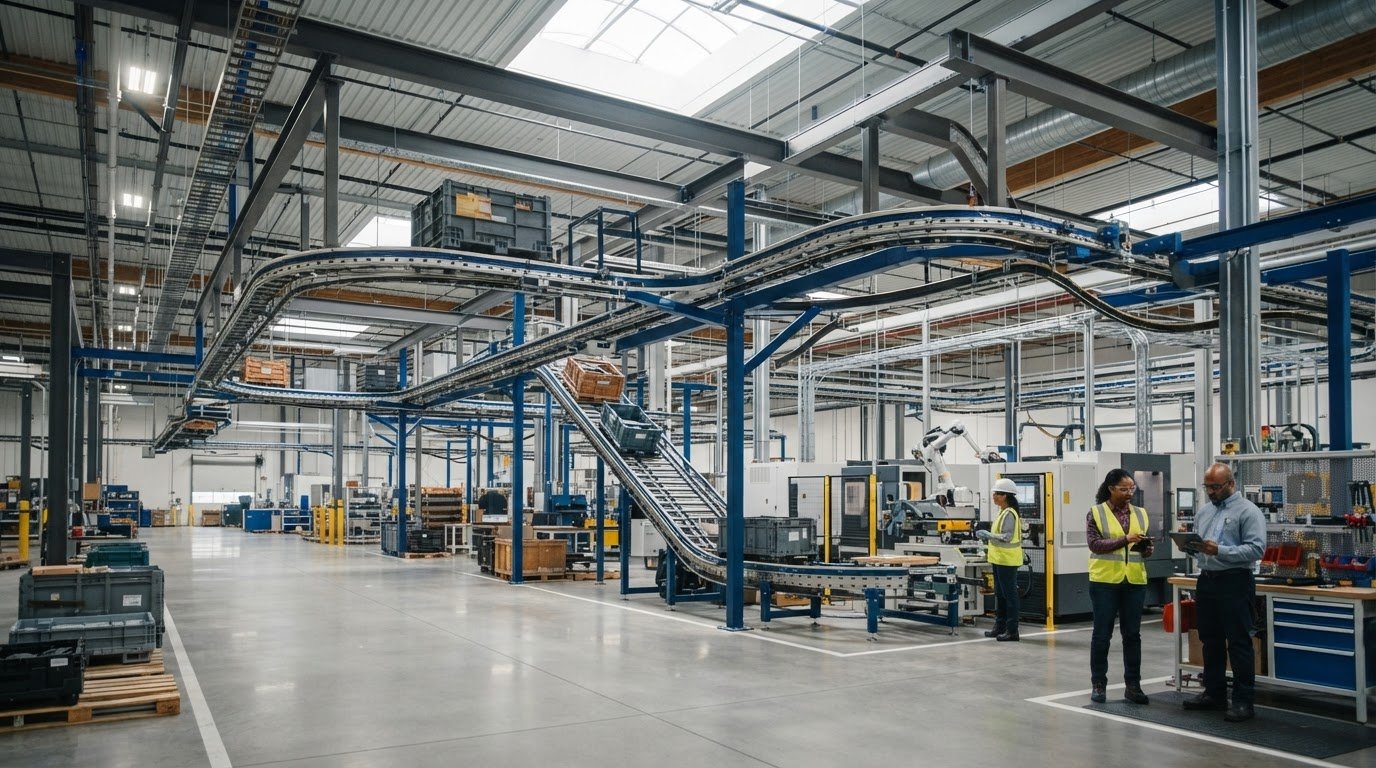
An overhead conveyor system can free valuable floor space, but that doesn’t automatically make it the right route. It works best when the products, travel path, and process align with the facility’s layout. Clearance limits, building structure, and connections to existing equipment all affect whether the design will fit.
If you’re weighing overhead routing, start by asking how products will be carried, where they need to go, and what happens at each handoff. This guide explains how overhead conveyors work, how common configurations differ, and which product and process requirements shape system fit.
You’ll also find practical planning steps for assessing loads, throughput, route and clearance needs, workflow, and facility conditions. Use them to compare overhead conveying with other options and prepare the information an integrator needs to assess the system.
Key Takeaways
- Understand how suspended carriers move products along elevated routes and how configuration affects routing and handling.
- Use product characteristics and process requirements to narrow down which overhead conveyor system may suit your operation.
- Compare overhead and floor-level conveyors by access, product handling, and layout rather than assuming one approach is always better.
- Plan in sequence: define loads and throughput, map the route, identify handoffs, and review operating conditions.
- Gather facility and process information so an integrator can assess equipment selection and system interfaces.
What Is an Overhead Conveyor System, and How Does It Move Materials?
An overhead conveyor system carries products or loads along an elevated, engineered route using carriers suspended from or connected to a track. It moves materials above floor-level work areas, unlike conveyors installed at floor level. For a broad foundation on conveyor technology and its uses, see this Conveyor system overview.
The purpose is more specific than simply lifting products off the floor. The route and carrier arrangement are designed around how goods need to travel between operations, such as from a loading point to a work area or onward to another process. Whether that routing fits depends on the product, facility, and workflow.
What components make up an overhead conveyor?
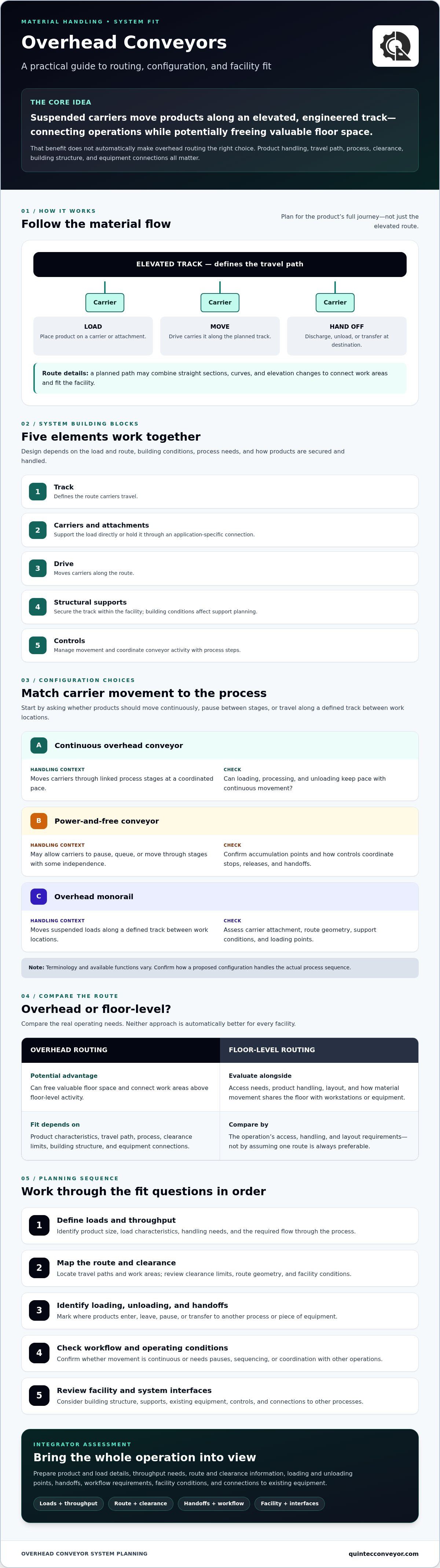
The track defines the travel path, while carriers or attachments connect products to the moving system. A carrier may support a load directly or hold it through a suitable attachment. A drive moves carriers along the route, and structural supports secure the track within the facility. Controls can manage movement and coordinate conveyor activity with process steps.
These components must work together, but their design isn’t universal. Load characteristics and route requirements influence carrier selection. Building conditions affect support planning, while process needs shape the drive and controls. A product might hang from a hook, rest on a carrier, or connect through another application-specific interface. Confirm how each item will be secured, oriented, and handled throughout its journey.
How does an overhead conveyor move products through a facility?
Movement begins at a loading point, where an operator or connected process places the product onto a carrier or attachment. The drive moves it along the track toward its next destination. A planned route may combine straight sections with curves or elevation changes to connect work areas and fit the facility layout.
At the destination, the product is discharged, unloaded, or transferred to another process. The layout determines where those handoffs happen, while controls determine how movement starts, stops, or coordinates with other operations. For example, a system may need to deliver carriers in sequence to a work area. The appropriate arrangement depends on the process and integration requirements.
Plan around the material flow, not just the overhead path. Identify product size and handling needs, loading and unloading points, building constraints, and interfaces with other equipment. Considering these as connected decisions makes it easier to assess whether overhead conveyance fits the wider operation.
Overhead Conveyor Types and Applications: Match the System to the Work
Overhead conveyor configurations differ in how carriers travel, whether they can pause independently, and how the route connects work areas. Start with the process: does material need to move continuously, wait between stages, or follow a sequence of operations? These questions matter in industrial conveyor system integration, where an overhead route must work alongside other equipment and material flows.
Which overhead conveyor configurations should you evaluate?
Two broad approaches to consider are continuous movement and power-and-free movement. In a continuous arrangement, carriers travel along the route as part of a moving flow. A power-and-free arrangement separates the means of propulsion from the carriers, which can allow carriers to stop or accumulate independently when the design includes the necessary controls and track features. Terminology and available functions vary, so confirm how each proposed configuration handles the actual process sequence.
| Configuration | Suitable handling context | Planning considerations |
|---|---|---|
| Continuous overhead conveyor | Moving carriers through linked process stages at a coordinated pace | Check whether loading, processing, and unloading can keep pace with continuous movement. |
| Power-and-free conveyor | Processes that may need carriers to pause, queue, or move through stages with some independence | Confirm where accumulation is needed and how controls coordinate stops, releases, and handoffs. |
| Overhead monorail | Moving suspended loads along a defined track between work locations | Assess the carrier attachment, route geometry, support conditions, and loading points. |
Where can overhead conveyors fit into industrial workflows?
Elevated routing may be worth evaluating when floor-level paths compete with workstations, equipment, or other material movement. For example, a facility could use an overhead route to connect production stages while keeping the floor available for other operations. It may also link work areas where products need to remain suspended or travel through a planned sequence. These are options to assess, not evidence that a particular design will suit every facility.
Before choosing a configuration, check the product and each transfer point. Consider its shape, how securely it can be carried, whether it remains stable in motion, and how it must be loaded and unloaded. Then map the route against process timing and interfaces with adjacent equipment. For further selection context, Conveyor Application, Selection, and Integration offers additional engineering discussion, including a chapter on overhead chain conveyors.
Configuration is only one part of the decision. Facilities evaluating a complete material flow can also review Quintec Conveyors' conveyor integration capabilities alongside their process and facility requirements.
Overhead Conveyor vs. Floor-Level Conveyors: Evaluate the Real Trade-Offs
Choosing between overhead and floor-level conveying is a layout and workflow decision, not a contest with one universal winner. An overhead conveyor system routes loads above the operating floor, while a floor-level conveyor moves them on equipment installed at or near floor level. The better fit depends on the route, product, handoffs, operator access, and facility conditions.
| Planning factor | Overhead routing | Floor-level routing |
|---|---|---|
| Space and path | May keep portions of the floor open, but needs a suitable elevated route and support points. | Uses floor area and must fit around work zones, traffic, and other equipment. |
| Access and handoffs | Loading, unloading, and service access may require planned access points and safe work arrangements. | Can suit processes with direct floor-level loading, unloading, or operator interaction. |
| Product handling | Requires a carrier or attachment that supports the product securely throughout the route. | May suit products and transfers that are easier to support or access at floor level. |
| Facility constraints | Depends on building structure, overhead obstructions, clearances, and maintenance access. | Depends on available floor space, traffic patterns, and clear paths for movement. |
Elevated routing doesn’t automatically save usable space or simplify operations. Supports, route clearances, loading stations, and service access all affect the facility layout. An overhead route may also create more complex handoffs if products must transfer back to floor-level processes. Include guarding and access in the design review. OSHA’s OSHA machine guarding requirements address protection from machine hazards, including moving parts.
When might overhead routing be a strong fit?
Consider overhead routing when the process has a practical elevated path and the product can be carried securely in the required orientation. A route above the floor may leave more room for workstations or other movement. Confirm that the building can accommodate supports, and plan access for inspection and maintenance. Clearances and facility conditions determine whether the apparent space advantage is practical.
When might a floor-level conveyor be more appropriate?
A floor-level approach may better support processes where people load or unload products directly, or where transfers happen at floor height. Compare product dimensions, stability, and handoff requirements rather than assuming one conveyor type is simpler. Evaluate the complete workflow, including upstream and downstream equipment, access, and operational interfaces. For other configuration approaches, see modular conveyor system design. Quintec’s conveyor integration capabilities may also be relevant when assessing how equipment fits into a broader material flow plan.
How to Plan an Overhead Conveyor System Around Your Facility
A sound plan begins with the work the conveyor needs to perform, then tests the proposed route against the products, process, and building. Treat the overhead conveyor system as one element of the wider material flow, not an isolated track to fit into available space. A warehouse design and material flow perspective can help connect conveyor decisions to storage, work areas, and other equipment.
What facility and product information should you gather first?
Collect product and process details before comparing layouts. Record dimensions, weight, packaging, stability, and any limits on how each item can be supported, oriented, or handled. Map the movement from loading through each operation and handoff to unloading. Note where queues, repeated handling, or workflow interruptions occur, so the proposed route addresses a defined process need.
How should integration, safety, and future needs be assessed?
Facility information is just as important. Document available headroom, obstructions, access points, and structural drawings or other building information for qualified review. Don’t assume existing structures can support a proposed installation without assessment. Identify where operators need access and where inspection or maintenance may take place.
Use this sequence to organize an initial review:
- 1. Define the process. Identify the operations to connect, the required handoffs, and the purpose of the conveyor route.
- 2. Characterize the loads. Gather product details and handling constraints for the items the system would carry.
- 3. Establish throughput needs. Describe expected flow and process timing, including points where products may need to wait or change direction.
- 4. Map the route. Mark loading and unloading points, straight runs, turns, elevation changes, clearances, and potential conflicts with facility activities.
- 5. Review operating conditions. Note the environment, operator access, maintenance needs, and relevant process requirements for the proposed equipment.
- 6. Check integration and safety. Review interfaces with existing equipment and controls. Have qualified professionals assess structural support, guarding, access, and applicable safety requirements.
- 7. Consider change over time. Discuss possible workflow changes and whether the layout can accommodate future operational needs.
This information gives an integrator a practical starting point for assessing constraints, equipment interfaces, and how the overhead route fits the wider operation. Quintec’s capabilities include conveyor integration, process engineering, and installation. Discuss your conveyor planning requirements as part of an integrated material flow review.
From Overhead Conveyor Concept to Integrated Material Handling Solution
An overhead conveyor is part of a larger operating system. Equipment selection affects how products enter and leave the route, how controls coordinate with connected processes, and how installation fits within facility constraints. Coordinating these decisions early helps turn a concept into a material handling plan, rather than treating the conveyor as a standalone component.
What should an overhead conveyor project brief include?
A useful project brief gives an integrator a clear picture of the required material flow and the conditions the design must address. Include:
- Products and loads: Describe the items to be conveyed, including their dimensions, weight, packaging, stability, and handling requirements.
- Process steps and objectives: Map the intended movement, throughput objectives, loading and unloading locations, and handoffs between stages.
- Facility constraints: Share available layout drawings and known information about headroom, obstructions, access, and building structure.
- Existing systems: Identify current conveyors, equipment, controls, infrastructure, and operational dependencies that may connect to or affect the proposed system.
- Open questions: List assumptions and unverified details, such as structural suitability or the exact requirements at a transfer point, for engineering review.
Clear documentation doesn’t need to resolve every design question. It should distinguish confirmed requirements from details that still need assessment. That makes it easier to focus the review on the proposed route and its interfaces.
How can an integrator support system design and implementation?
An integrator can coordinate process requirements with engineering, equipment selection, installation planning, and connections to existing operations. That coordination matters because a track layout alone doesn’t establish how products will be loaded, transferred, controlled, or accessed for maintenance. Consider each interface as part of the complete material flow.
Quintec designs, engineers, and installs integrated conveyor and material handling systems for industrial applications. Its capabilities include conveyor integration and process engineering, supporting evaluation of the overhead concept alongside the operation it must serve. The team brings over 100 years of collective industry experience. Confirm specific system dimensions, capacities, speeds, structural conditions, and safety requirements through appropriate engineering review rather than assuming them from an early concept.
To prepare for a project assessment, bring together process details, product information, facility constraints, and known equipment interfaces. Discuss your conveyor system requirements with Quintec as part of evaluating an integrated material handling solution.
Turn Your Overhead Conveyor Plan Into a Practical Next Step
An overhead conveyor system works when its route, carriers, and process requirements align. The right choice depends on more than available overhead space: product handling, loading and unloading points, facility clearances, support conditions, and connections to existing operations all affect whether the approach fits.
Start with the material flow. Document what needs to move, where it needs to go, how the process is sequenced, and which facility constraints require review. Then compare overhead and floor-level options against the complete workflow rather than judging either in isolation. This groundwork gives an engineering team clearer requirements to assess and connects equipment selection with installation and operational interfaces.
Quintec designs, engineers, and installs integrated conveyor and material handling systems for industrial applications. Its team brings more than 100 years of collective industry experience, with capabilities in conveyor integration, engineering, and installation. Discuss your overhead conveyor requirements with Quintec to evaluate an integrated material flow plan.
Frequently Asked Questions
What is an overhead conveyor system?
An overhead conveyor system transports loads along an elevated, engineered route using carriers or attachments connected to a track. Unlike a floor-level conveyor, which carries products on equipment positioned at or near the floor, an overhead design moves them above work areas. The route and carrier arrangement are planned around the products, facility, and process, so the configuration varies by application.
How does an overhead conveyor system work?
An overhead conveyor system typically uses a track to guide carriers, a drive to move them, and controls to coordinate operation. Products connect to carriers through an attachment or support suited to the load. In a basic flow, a product is loaded, transported along the route, then discharged or unloaded at its destination. Components and movement vary by design, and controls determine how travel coordinates with process steps.
What products can an overhead conveyor carry?
Suitability depends on the product and system design, not simply on whether an item can be suspended. Assess dimensions, weight, shape, packaging, stability, and how the load can attach to or rest on a carrier. Consider its orientation during travel and requirements at loading, unloading, and transfer points. A qualified design review should verify that the proposed carrier and system meet the application’s requirements.
Are overhead conveyors better than floor-level conveyors?
Neither approach is universally better. Overhead conveyance may suit a workflow with a practical elevated route and compatible load handling, while floor-level equipment may better support direct access or floor-height handoffs. Compare both options against the full process, including operator access, product characteristics, facility layout, and connections to other equipment. The preferred solution is the one that fits the operation’s requirements and constraints.
Can an overhead conveyor system save floor space?
An overhead route can leave some floor area available for workstations, equipment, or other movement, but it doesn’t guarantee a more efficient layout. Track supports, clearances, loading points, and maintenance access also affect usable space. Building structure and overhead obstructions may constrain routing. Evaluate the complete facility plan, including where products enter and leave the route, to determine whether elevated conveyance creates a practical space benefit.
What should I consider before installing an overhead conveyor?
Begin with the products to be handled, their dimensions, weight, stability, and attachment needs. Map the workflow, throughput objectives, routing, and handoffs, then document headroom, obstructions, structural information, and access requirements. Review interfaces with existing equipment and controls, as well as safety requirements and maintenance access. Have qualified professionals assess structural conditions, system design, guarding, and other application-specific requirements before making installation decisions.
How do you integrate an overhead conveyor into an existing facility?
Integration starts with assessing the process and mapping how products move between existing operations. Review the proposed layout, facility constraints, loading and unloading points, controls, equipment interfaces, and operational dependencies. Engineering and installation planning can then address how the conveyor fits into the wider material flow. Qualified professionals should verify relevant structural and safety requirements. Clear information about current equipment and process needs helps identify constraints and open questions early.