Belt Conveyors: Types, Applications, and System Design
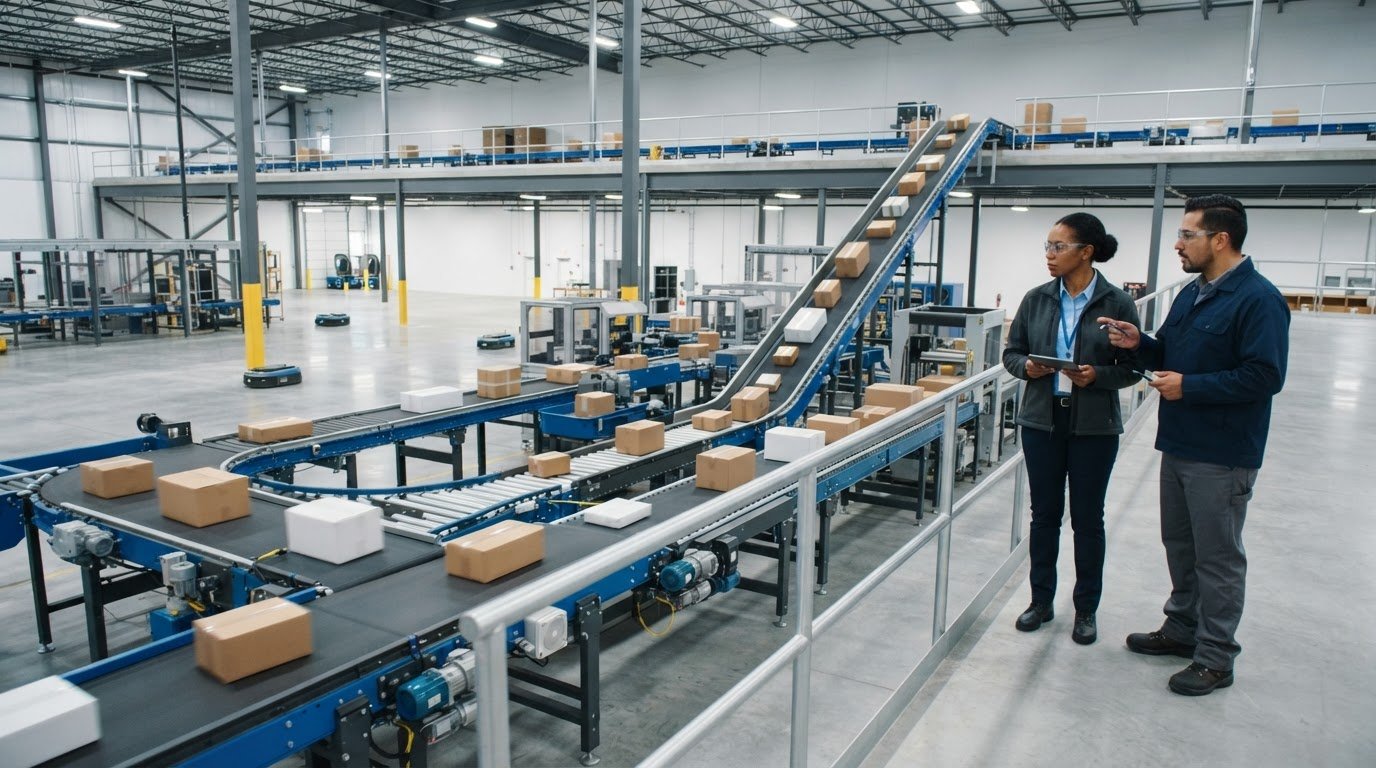
The belt is only one part of what determines whether a conveyor fits your operation. With belt conveyors, the bed design, belt surface, and route through the facility must suit the product and the way materials move. A mismatch can create problems at transfers, affect product handling, or complicate integration with the rest of the line.
Equipment listings often describe features without explaining how they’ll perform in a specific process. Start with the material flow: what the conveyor carries, where it travels, and how it connects with upstream and downstream equipment. Then assess how the load, route, and operating conditions affect the design.
This guide explains how common belt conveyor designs work and how their differences relate to industrial applications. You’ll learn which product, layout, and operating details influence system design, and why those decisions matter beyond the conveyor itself. Quintec Conveyors designs, engineers, and installs conveyor systems as part of integrated material-handling solutions, bringing more than 100 years of collective industry experience to facility requirements. Use the guidance below to compare designs in context and assess how a conveyor can support the wider workflow.
Key Takeaways
- Compare slider-bed and idler-bed designs by how each supports the belt and suits the conveyed load, not by name alone.
- Evaluate belt conveyors against essential operating requirements, including material, route, load, and process conditions.
- Map receiving, processing, accumulation, inspection, and discharge points to clarify how materials move through the facility.
- Separate required performance criteria from preferences such as a compact layout or room for future flexibility.
- Consider conveyor selection alongside adjacent equipment and transfers so the system aligns with the wider material-handling workflow.
Belt Conveyors: Role in Material Handling
A belt conveyor uses a continuous moving belt to carry products or materials along a planned route. In industrial facilities, belt conveyors can link production stages, move items toward packaging, present products for inspection, or transfer goods into distribution areas. The right configuration depends on the product and process: a design suited to packaged units may not suit loose bulk material or different operating conditions.
A conveyor is more than its belt. The belt provides the conveying surface, the frame supports the assembly, the bed supports the belt along its route, and the drive moves it. Infeed and discharge transfers matter too, because they determine how material arrives, leaves, and connects with adjacent equipment. These elements work as a system. Selecting a belt without considering its support and connections gives an incomplete view of the application.
How a Belt Conveyor Moves Products
The belt forms a continuous loop around pulleys. A powered drive turns a pulley, moving the belt and carrying products on its surface. Another pulley helps guide the return run. Along the carrying run, a slider bed or rollers support the belt, while the frame holds the components in position. Load characteristics, route, operating conditions, and system configuration all affect performance.
Understanding the complete arrangement makes it easier to evaluate design choices. A product’s size, shape, and weight affect how it sits on the belt and moves through transfers. The route influences the required support and layout, while the drive arrangement must suit the intended operation. For a broader overview of components, configurations, and uses, Conveyor belt systems provides additional background.
Common Belt Conveyor Applications
In production, a conveyor may carry work between process stages or bring items to a work area. In packaging, it can move products toward a packing station. Inspection lines may use a belt to present items for examination, while distribution operations may use conveyors to transfer goods between handling points. In each case, the planned route supports movement through the process, but suitability depends on the product and workflow.
Two broad application categories help frame the decision:
- Unit loads: Individual items such as cartons, packages, or components travel on the belt. Their dimensions, stability, and spacing influence how they can be conveyed and transferred.
- Bulk materials: Loose material moves as a continuous flow rather than as separate units. Material characteristics and the route shape what the system needs to handle.
Neither category means a belt conveyor is right for every task. Assess the actual material flow, including where items enter, what happens along the route, and where they discharge. Quintec’s conveyor design and engineering considers these connections within the wider facility process, aligning equipment decisions with adjacent material-handling stages.
How Belt Conveyor Designs and Components Shape Performance
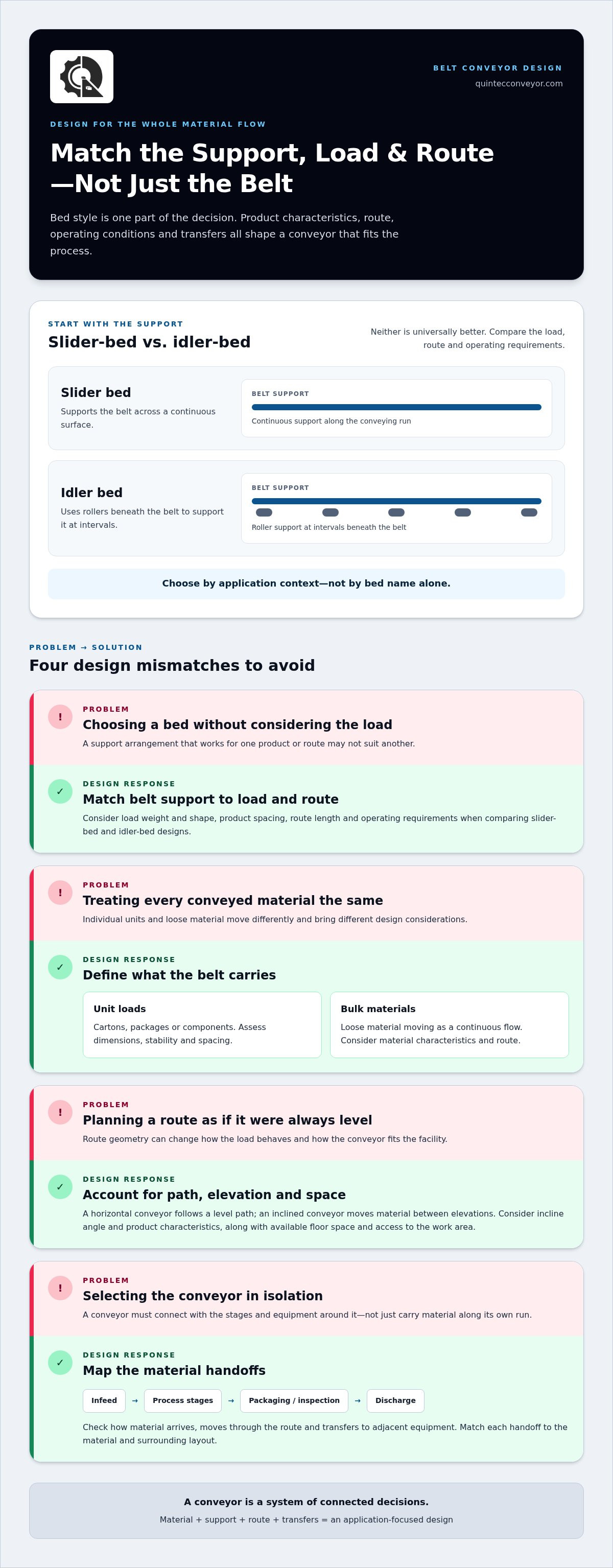
A conveyor’s performance depends on how its support, belt, drive, and route work together under the conditions of the application. A stable, supported surface may suit one product, while another material or a longer route may call for a different support arrangement. Load weight and shape, product spacing, transfer points, and available floor space all influence the design. Bed design should match both the conveyed load and the route it must travel.
Slider-Bed and Idler-Bed Belt Conveyors
A slider bed supports the belt across a continuous surface. This arrangement can provide consistent support for products traveling along the conveying run. An idler bed uses rollers beneath the belt instead, supporting it at intervals. The distinction affects how the belt is supported, but it doesn’t make one design universally better. Compare product characteristics, route length, load, and operating requirements to determine what suits the application.
For example, a process carrying individual items may prioritize stable product support, while a route carrying bulk material may call for a different balance of belt support and load handling. These are starting points, not fixed rules: the full operating context determines suitability. Bed style is also only one part of the system decision. Reviewing industrial conveyor systems can help put conveyor design in the context of the wider material-handling arrangement.
Belt, Drive, and Route Considerations
The belt must suit the conveyed material and operating requirements. Consider how the material rests on the surface, how it behaves during movement, and what happens at loading and discharge. The drive moves the belt around the conveyor route, while supporting components help maintain its path and carry the load. Select these elements to work together with the belt and product, rather than in isolation.
Route geometry adds another layer. A horizontal conveyor moves material along a level path; an inclined configuration carries it between different elevations. An incline can change how the load behaves on the belt, so the angle and product characteristics belong in the design discussion. Transfers need attention as well: a handoff between conveyors or process equipment must suit the material’s movement and the surrounding layout.
Space constraints can shape where a conveyor runs, where equipment connects, and how people access the work area. A compact route may affect transfer locations or the arrangement of adjacent equipment. That’s why the full path from receiving to discharge matters more than a standalone equipment description. Compare layouts alongside product flow to see where bed style, drive arrangement, and route choices need to work together.
For projects that require a conveyor to fit a wider facility process, Quintec’s conveyor design and engineering connects equipment decisions with layout and adjacent material-handling stages.
How to Compare Belt Conveyor Designs for Your Application
Equipment listings make it easy to compare visible specifications, such as belt width or rated capacity. Those details are useful, but they don’t show whether a design fits the material, route, and surrounding process. Treat specifications as inputs for evaluation, not a substitute for application engineering. Separate essential operating requirements from preferences: the conveyor must handle the material and connect to the process, while a compact footprint or room for future flexibility may be desirable rather than mandatory.
Match the Conveyor to the Material and Load
Document the product’s dimensions, weight, shape, handling sensitivity, and how consistently it arrives. Packaged goods move as individual units, while bulk material behaves as a flowing load, so support and transfer requirements can differ. Record relevant environmental and process conditions as well. These details give engineering a practical basis for evaluating the application, rather than relying on assumptions from a catalog description.
| Comparison factor | What to assess | Why it matters |
|---|---|---|
| Bed style | Slider bed or idler bed; support needs along the carrying run | Relates belt support to the product and operating conditions |
| Conveyed material | Packaged units or bulk material; size, shape, weight, and sensitivity | Clarifies how material rests, moves, and transfers |
| Route | Path, elevation changes, handoffs, and available floor space | Shows how the conveyor fits the facility and connects to equipment |
| Load and flow | Expected loading pattern and required movement through the process | Helps frame capacity and speed for the actual workflow |
| Process context | Operating environment, adjacent stages, and future needs | Distinguishes essential requirements from design preferences |
A listed speed or capacity describes a specification, not necessarily the performance of the complete process. The usable rate depends on what arrives, how it is spaced or accumulated, and whether downstream equipment can accept the flow. Include project-specific load, speed, and throughput requirements in engineering review, alongside operating conditions and transfer details.
Compare Route, Throughput, and System Connections
Map the conveyor from receiving to discharge. Mark turns, elevation changes, handoffs, and space restrictions, then trace how material moves from upstream equipment through each process stage to downstream operations. This makes interruptions and connection requirements visible before you select a model. If expansion or reconfiguration is a priority, modular conveyor systems offer useful context for assessing flexibility as part of the larger design.
Keep requirements in two groups: must-haves that determine whether the system can perform its role, and preferences that guide layout or future adaptability. Quintec’s conveyor design and engineering considers equipment within the facility process. Integrated conveyor system design connects these comparison points to layout and adjacent material-handling equipment.
What to Define Before Specifying a Belt Conveyor
A clear specification starts with the job the conveyor must perform, not a preferred model or isolated catalog filter. Document the flow, material, load, route, and operating context together so design decisions reflect how the facility works. For belt conveyors, begin with what moves, how it moves, where it travels, and what equipment it must connect to.
Use this sequence to assemble the key requirements:
- Map the flow. Trace material from receiving through each process stage to discharge. Mark where it enters, moves, pauses, accumulates, transfers, undergoes inspection, and leaves the operation.
- Describe the material. Record whether it arrives as packaged units or bulk material, along with relevant dimensions, weight, shape, and handling sensitivity. Include variations in the product mix.
- Define the load and movement pattern. Note how often material arrives, whether it moves steadily or in batches, and how loading changes during normal operation. Describe expected operating shifts and process changes.
- Plot the route. Identify the conveyor path, elevation transitions, handoff points, available floor space, and nearby equipment. Include access routes and the space needed around the equipment.
- Document the operating context and interfaces. Record relevant environmental conditions and identify the upstream and downstream systems the conveyor must connect with, including process or inspection equipment.
Document the Material Flow and Operating Requirements
Build a process map that shows more than the start and end points. Include receiving, processing, accumulation, inspection, and discharge, along with every point where material changes direction or transfers to another system. Record pauses and variations in flow, too. The map helps clarify whether the conveyor needs to support continuous movement, a staged process, or transitions between different operating steps.
Describe the product and operating rhythm alongside the map. A process handling multiple product types, for example, may have different load patterns or transfer needs from one moving a consistent item. Capture the interfaces that affect movement so conveyor requirements reflect the full workflow.
Account for Facility Layout and Future Change
Review the route against the facility plan, including available space, access, elevation changes, and surrounding equipment. A layout constraint can affect where transfers occur and how material reaches the next stage. If warehouse planning shapes the movement path, warehouse design services provide relevant context for aligning facility layout with material flow.
Consider likely changes in volume, product mix, or workflow as design inputs, not afterthoughts. Separate operating requirements from preferences, then assess how each affects the others. Quintec designs and engineers conveyor systems around facility processes and adjacent material-handling equipment. Plan your conveyor system with Quintec to connect specification decisions with the wider workflow.
How Quintec Integrates Belt Conveyors Into a Material-Handling System
A conveyor performs its role within a larger process. Its route, transfers, and operating requirements need to align with the facility layout and the equipment before and after it. Quintec Conveyors designs, engineers, and installs custom conveyor systems and integrated material-handling solutions for industrial applications, connecting equipment decisions to the way materials move through a facility.
From Workflow Requirements to Integrated Design
Planning begins with the workflow: where material enters, what happens at each stage, and where it needs to go next. Quintec uses those requirements to develop a coordinated conveyor-system design, considering the route alongside transfer points, facility infrastructure, and adjacent material-handling equipment. This system-level view brings practical layout and process needs into the design instead of treating the conveyor as a standalone machine.
The surrounding process also shapes the integration. A conveyor linking work areas may need to connect with other equipment at defined handoff points. Where a workflow calls for it, robotics or warehouse automation can be part of the wider material-handling arrangement. Process engineering helps frame these choices around facility operations and how each stage relates to the next.
For broader context on evaluating integration expertise, conveyor system integrator guidance can help clarify the role of coordinated planning in an industrial project.
Engineering, Installation, and Ongoing System Support
Quintec’s role spans conveyor design, engineering, and installation. These are connected stages: design translates workflow needs into a system concept, engineering develops that concept in relation to the facility and its interfaces, and installation puts the designed system in place. The details depend on the application, including its layout, process requirements, and connections to surrounding equipment.
Integration also means considering how the system will be maintained during ongoing operations. Quintec offers conveyor maintenance alongside design, engineering, and installation. This connects equipment planning with continued attention to the conveyor system and its role in the facility’s material flow.
Quintec brings more than 100 years of collective industry experience to industrial conveyor and material-handling projects. To define an application, document the material, the route it needs to travel, the process stages involved, and the equipment at each connection. These details help frame system planning around the facility’s workflow.
Discuss your conveyor system requirements with Quintec to explore how a belt-conveyor application can fit within your facility’s material-handling workflow.
Plan the Next Step for Your Material Flow
Turn your conveyor requirements into a practical design conversation by bringing together the details that shape daily operation: the products being moved, changes in workflow, facility constraints, and connections between process stages. This gives your team a stronger basis for evaluating how belt conveyors can fit within a broader material-handling plan.
Quintec provides conveyor design, engineering, installation, and maintenance, backed by more than 100 years of collective industry experience. The team can connect equipment decisions with your facility’s operating needs and wider system. Start with your application and the challenges the design needs to address.
Discuss your conveyor system requirements with Quintec to take the next step toward a carefully planned material-handling solution.
Frequently Asked Questions
Can belt conveyors be designed to run in reverse?
Yes, a belt conveyor can be designed for reversible operation if its drive and controls support movement in both directions. Define when reversal occurs and whether loads must travel both ways during normal operation or only during clearing or repositioning. Consider how the belt behaves in reverse, where products will discharge, and whether guards, sensors, and transfer arrangements work safely and reliably in either direction.
What causes a conveyor belt to slip on its drive pulley?
A belt may slip when the drive pulley can’t maintain enough traction to move it against the load. Possible causes include incorrect belt tension, a wet or contaminated pulley surface, excessive loading, or a belt and drive arrangement that isn’t suited to operating conditions. Note when slippage occurs and whether it coincides with startup, a change in load, or contamination. A maintenance assessment can help identify the underlying issue.
How can a belt conveyor reduce product spillage at transfer points?
Reduce spillage by controlling how material lands on the receiving belt. Align the incoming flow with the direction of travel, limit abrupt changes in movement, and design the transfer area to contain material as it settles. Cartons arriving from an upstream conveyor, for example, may need a well-aligned handoff, while loose material may require containment suited to its flow. Review spillage patterns at startup and during normal operation to locate problem areas.
Can belt conveyors follow curved paths through a facility?
Yes, some conveyor systems can follow curves, but a standard straight-running belt conveyor isn’t automatically suitable for a curved route. The design must account for belt tracking, product stability, curve geometry, and connections to incoming and outgoing sections. If a floor plan includes a tight turn, assess the complete route and transfer points together. In some layouts, a combination of straight conveyor sections and other conveying equipment may be more appropriate.
What information is needed to plan a conveyor belt splice?
Start with the belt’s identification and construction details, its dimensions, the conveyor configuration, and the location where the splice will be made. The splice method also depends on the operating load, belt tension, pulley arrangement, and conditions around the conveyor. Record the belt manufacturer’s guidance and the system’s service history if available. This information helps maintenance personnel plan suitable materials, tools, access, and downtime without relying on assumptions about the existing belt.
Are belt conveyors suitable for handling food products?
Yes, belt conveyors can be used for food products when the belt and system design suit the product, cleaning process, and facility hygiene requirements. The specification should consider whether food contacts the belt directly, how the equipment is cleaned, and whether surrounding components support the required sanitation practices. A dry packaged-goods line and a process handling exposed food, for example, may have different design priorities. Assess the full application before selecting equipment.