
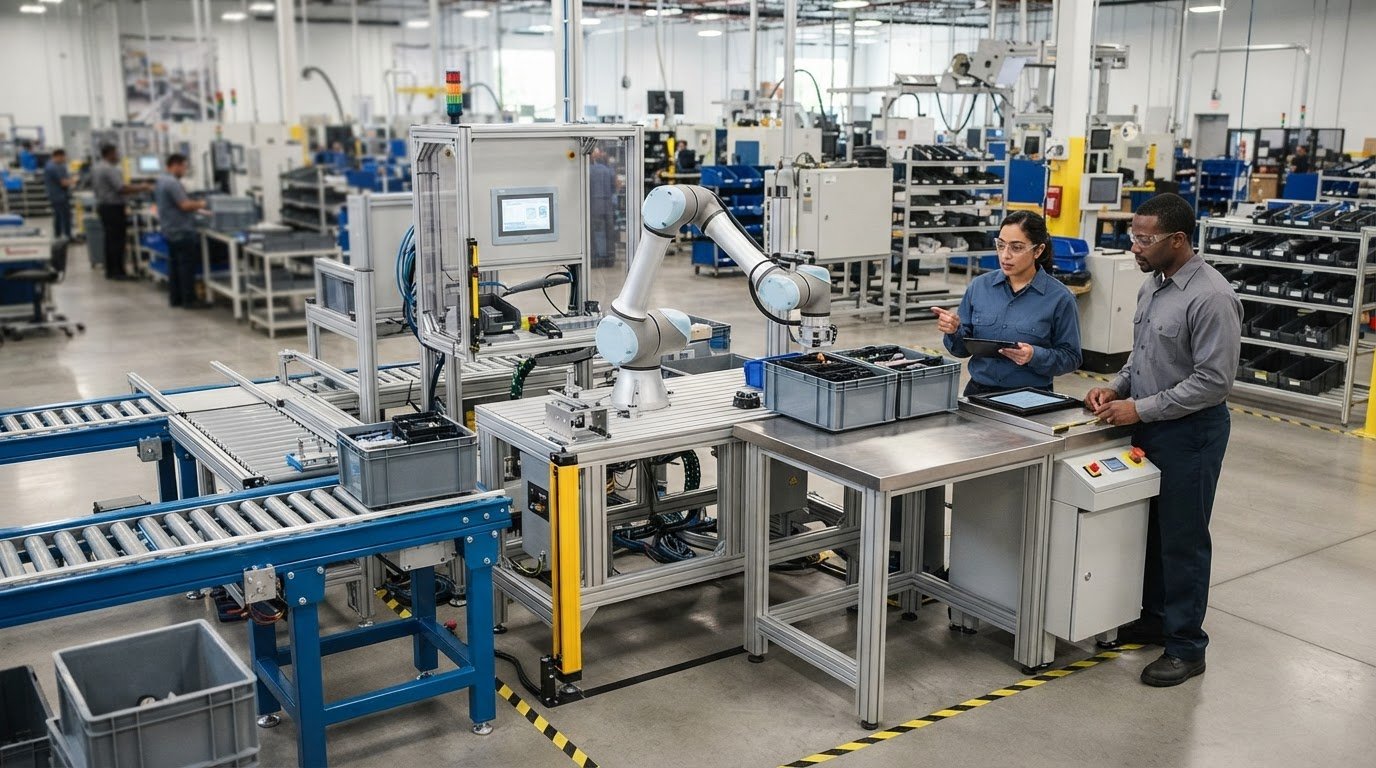
What if the value of a collaborative robot depends less on the arm itself and more on how well it fits the material flow around it? Collaborative robot material handling can suit repetitive tasks that benefit from flexible automation, but a cobot still needs to meet the operation’s throughput, payload, and uptime requirements.
It’s important to weigh those requirements alongside operator interaction and safety. A collaborative design doesn’t automatically make every application suitable for people and robots to share a workspace. The task, tooling, payload, and layout all matter. Start with the work to be done, not the equipment alone.
This guide explains where cobots can add practical value, how they compare with conventional industrial robots and conveyor automation, and what to consider when planning a complete solution. It shows how workflow analysis, safety, and system integration connect, so you can assess whether a cobot fits your operation and how it can work with conveyors, infrastructure, and the wider material flow.
Key Takeaways
- Identify handling tasks where flexibility and operator interaction may make a cobot a practical automation candidate.
- Assess cycle time, load, placement accuracy, reach, and end-effector requirements before judging whether a cobot can meet operational needs.
- Compare collaborative robot material handling with industrial robots and conveyors across throughput, flexibility, repeatability, and operator involvement.
- Plan integration in stages, from defining the task and mapping material flow to engineering interfaces and validating operation.
- Consider the complete system, including tooling, controls, conveyors, infrastructure, and work areas, rather than evaluating the robot arm alone.
What Is Collaborative Robot Material Handling, and Where Does It Fit?
Collaborative robot material handling uses a robot to move, position, or present materials in a workflow that includes people. The goal isn’t simply to add a robot arm. It’s to assign the handling task in a way that supports the full process, from where materials arrive to where they need to go next.
A cobot is only one part of the system. The end effector, such as a gripper or vacuum tool, contacts the load. Sensing and controls coordinate movement and responses, while conveyors, machines, containers, guarding, and operator work areas shape the application. For a broad introduction to cobots and how they differ from traditional industrial robots, see What Is a Collaborative Robot (Cobot).
What material handling tasks can a cobot perform?
Consider repetitive transfers between workstations, conveyors, containers, or machines. A cobot might pick a part from a conveyor and place it into a fixture, tend a machine while an operator handles adjacent work, or support packaging by moving items into cases. Case handling and palletizing may also be candidates, depending on the load and operating requirements. These are possibilities, not guarantees. Suitability and achievable cycle time depend on the task and the complete system.
How does a cobot differ from a conventional industrial robot?
Cobots are designed for applications where people may work near the automation. Conventional industrial robots are commonly used in dedicated cells for fast, repetitive, or heavier-duty work with limited operator interaction. That distinction guides cell design, but it doesn’t determine the answer by itself. Payload, reach, speed, and cycle time depend on the selected robot and application. Neither type is universally interchangeable with the other.
Collaborative robot material handling still requires an application-specific safety assessment. A collaborative design does not make every task safe for a shared workspace. The robot, end effector, workpiece, movement, and surrounding layout all affect risk, as do the ways people approach and interact with the cell. Assess the complete application before deciding how operators and automation can work alongside one another.
The practical fit becomes clearer when you view the task in context: what material moves, how often it moves, where it comes from, and which process receives it next. That wider view helps distinguish a useful cobot application from a standalone automation idea and supports a more informed comparison with conveyors and conventional robots.
How to Assess Cobot Fit: Throughput, Payload, Reach, and Safety
A cobot’s published specifications are only a starting point. Suitability depends on the task, the pace the full operation requires, and the conditions in which people and equipment will interact. Assess these factors together before selecting equipment or redesigning a work area.
Task fit is the match between a cobot’s payload and reach, the handling cycle the operation requires, and the risks identified for the complete application.
Which operating requirements determine cobot suitability?
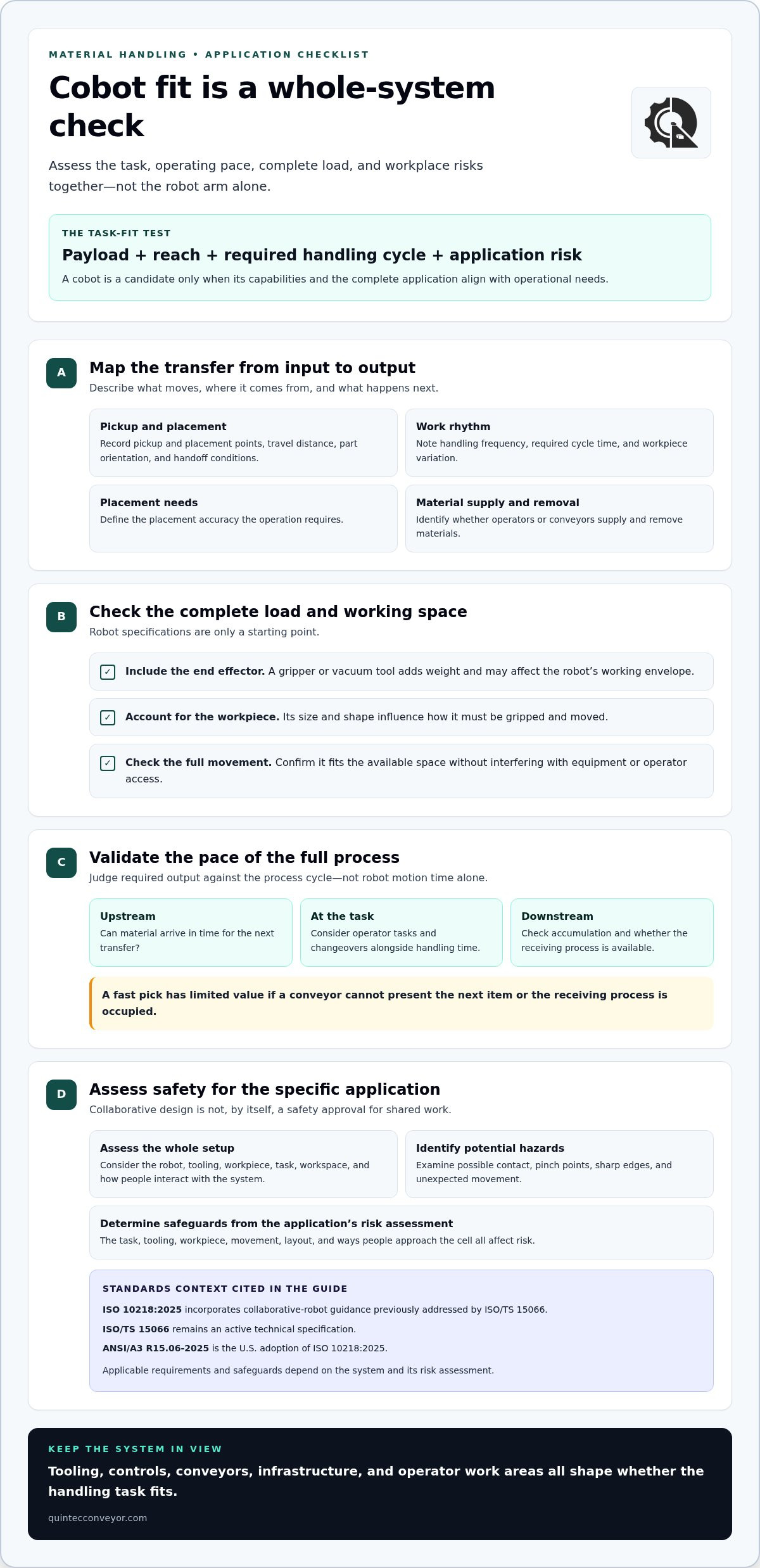
Map each transfer from input to output. Record pickup and placement points, travel distance, part orientation, handoff conditions, and required placement accuracy. Note handling frequency, cycle time, workpiece variation, and whether operators or conveyors supply and remove materials. This reveals constraints that a robot-arm specification alone won’t show.
Include the end effector and workpiece when assessing payload and reach. The tool adds weight and may affect the robot’s working envelope. The load’s size and shape also influence how it must be gripped and moved. Check that the complete movement fits the available space without interfering with equipment or operator access.
Then compare the required output with the full process cycle, not just the robot’s motion time. Upstream material arrival, downstream accumulation, operator tasks, and changeovers can all affect the rate the system sustains. A fast pick has limited value if a conveyor can’t present the next item or the receiving process is occupied.
What does collaborative operation mean for workplace safety?
Collaborative operation is an application to assess, not a safety approval built into the robot. A documented risk assessment should consider the robot, tooling, workpiece, task, workspace, and how people interact with the system. Examine possible contact, pinch points, sharp edges, and unexpected movement, then determine appropriate safeguards for the specific installation.
Standards and guidance must be read in their current scope. ISO 10218:2025 incorporates collaborative-robot guidance previously addressed by ISO/TS 15066, which remains an active technical specification. ANSI/A3 R15.06-2025 is the U.S. adoption of ISO 10218:2025. For an overview of relevant U.S. references, consult OSHA’s Cobot Safety Standards resource. Applicable requirements and safeguards depend on the system and its risk assessment.
Assessing task fit also means looking beyond the robot to the surrounding material flow. Integrated material handling and process engineering can align the handling task with conveyor interfaces, facility requirements, and operator work areas.
Cobot vs. Industrial Robot vs. Conveyor: Compare the Right Automation Approach
No single automation type is right for every movement. The choice depends on whether the process needs flexible handling, dedicated robotic work, steady transport between fixed points, or a coordinated combination. Use the comparison as a starting point, then assess how each option fits the whole workflow.
| Approach | Flexibility and repeatability | Throughput and operator involvement | Typical system scope |
|---|---|---|---|
| Collaborative robot | Adaptable handling; repeatability depends on the application. | Can suit variable tasks or frequent changeovers; people may work nearby when the application is designed for it. | Robot, tooling, controls, sensing, and work area. |
| Industrial robot | Repeatable motion in a defined task; flexibility depends on cell design and reprogramming. | May suit higher-speed or dedicated cells; operator access is planned around the cell’s safeguards. | Robot cell, tooling, controls, and associated safeguards. |
| Conveyor | Consistent movement along a defined route; less suited to changing pickup and placement locations. | Can support continuous or sequenced transport; people may load, unload, or monitor points along the flow. | Connected transport between process points, with controls and transfer interfaces. |
When is a cobot a stronger fit than a conveyor?
A cobot may be a stronger candidate when the material’s destination changes, items need flexible positioning, or a workstation combines automated handling with nearby human tasks. A conveyor is often a more direct choice for moving materials repeatedly along a set route between known points. Compare task variation, orientation, and handoff requirements. Neither approach is universally superior.
When should cobots and conveyors work together?
A hybrid system can pair a conveyor’s steady transport with a robot’s ability to handle a specific operation. For example, a conveyor can present parts or cases at a defined handoff point, where a robot reorients, sorts, or transfers them before they continue downstream. Sensors and controls coordinate arrival and robot action, while accumulation can help manage differences in pace between process steps.
The handoff is critical. If material arrives inconsistently, a robot may wait. If downstream movement stalls, completed work can build up. Design the interfaces, timing, and recovery behavior as part of one connected process. industrial conveyor systems integration guide offers further context on planning those connections.
Collaborative robot material handling is one option within a broader automation strategy. A well-engineered solution may combine cobots, conventional robots, conveyors, and operator tasks, assigning each element the work it handles most effectively.
Plan Collaborative Robot Material Handling in Five Integration Steps
Reliable integration starts with the process, not the robot. Use these five steps to connect the handling task with material flow, facility conditions, and measurable operating goals.
- Define the task. Document the current sequence, workpiece types and variation, handling frequency, constraints, and desired outcomes. Establish baseline measures, such as cycle time, handling accuracy, availability, and labor allocation, before implementation.
- Map the flow. Trace material from input to output, including queues, conveyor transfers, operator interactions, and handoffs. Note where delays or accumulation occur, and identify upstream or downstream bottlenecks that could limit the automation’s value.
- Assess requirements. Translate the task into operating needs: load, reach, placement, cycle expectations, changeovers, and safety considerations. Include the end effector and workpiece in the assessment, and define how the application will interact with nearby equipment and people.
- Engineer the integration. Coordinate the robot with conveyors, controls, facility infrastructure, and operator work areas. Specify how equipment exchanges signals and materials, how the process responds to a missed handoff, and where access, maintenance, and material replenishment fit into the layout.
- Validate operation. Commission the complete process, then compare results with the baseline. Confirm that handoffs, agreed cycle performance, safety measures, and exception handling work as intended before reviewing performance after startup.
How should teams define and engineer the application?
Build the design around observed work rather than an idealized cycle. Include normal production, workpiece variation, queues, operator actions, and likely bottlenecks in the process map. This facility-wide view helps align the robotic task with conveyor interfaces and warehouse infrastructure. For broader planning context, see warehouse robotics integration planning.
What should commissioning and performance review cover?
Test routine operation as well as changeovers, interruptions, and recovery from common process exceptions. Review measures agreed during planning, including cycle time, availability, handling accuracy, and labor allocation. Compare results with the established baseline and account for operating conditions. Performance and return on investment depend on how the system is used and how the surrounding process performs.
For Collaborative robot material handling, integration is complete only when the robot, material flow, controls, and people’s work areas function as a coordinated process. Plan an integrated material handling system around the complete workflow, from initial task definition through commissioning and review.
Build a Complete Material Handling Solution Around the Cobot
A cobot can perform a defined handling task, but its value depends on how well that task connects to the operation around it. People, tooling, controls, conveyors, warehouse infrastructure, and facility processes all influence how materials move. Planning those elements as one system helps ensure the robot’s work supports the flow instead of creating a new constraint.
What does an integrated material handling project bring together?
An integrated project coordinates robotic tasks with conveyor movement, warehouse racking, controls, and operator workflows. For example, a robot’s pickup point must align with how materials arrive, while its placement point must serve the next process without blocking access or interrupting the flow. Clear system boundaries and well-designed handoffs help keep each stage connected. Facility-level choices matter too; the warehouse design services guide explores how layout and material flow relate to broader planning.
Process engineering connects these decisions. It considers where the cobot fits, what equipment it interfaces with, how operators interact with the system, and whether the facility can support the planned arrangement. This wider view can reveal when a conveyor adjustment, infrastructure change, or revised handoff is needed alongside the robotic task.
How can Quintec Conveyors support the next planning step?
Quintec Conveyors brings conveyor design, engineering, and installation together with robotics, infrastructure, and process engineering. This integrated project capability supports evaluation of the wider material flow, not just an individual piece of equipment. The team also brings more than 100 years of collective industry experience, applying its expertise across material handling projects while recognizing that every facility has different requirements.
Bring the task definition, flow map, and operating requirements into planning. These details help shape an integrated solution around the actual work: what moves, where it needs to go, and how people and equipment share the process. Collaborative robot material handling works best as part of a system designed around those requirements.
Quintec Conveyors' conveyor, robotics, infrastructure, and process engineering capabilities connect the handling task with the wider workflow.
Turn Your Material Handling Plan Into an Integrated Solution
Choosing automation starts with the work itself. Match the handling task to required throughput, payload, reach, and assessed safety needs, then compare cobots, conventional robots, and conveyors based on how materials move through the entire operation.
Collaborative robot material handling delivers practical value when the robot fits a coordinated process, not just a single workstation. Consider the connections among tooling, controls, conveyors, infrastructure, and operator workflows. Define the task, map material flow, engineer interfaces, and validate performance against clear operating measures.
Quintec brings integrated conveyor, robotics, infrastructure, and process engineering capabilities to material handling projects, backed by more than 100 years of collective industry experience across the team. A complete view of your workflow can help shape an automation plan around your facility’s requirements.
Discuss your material handling automation project and take the next step toward a well-integrated solution.
Frequently Asked Questions
What is collaborative robot material handling?
Collaborative robot material handling uses a robot to move, position, or present materials within a workflow that includes people. The cobot arm is only one part of the application: tooling, sensing, controls, conveyors, and the work area all influence how the task functions. Examples include transferring parts between a conveyor and a machine, picking items for packaging, or moving cases at a workstation.
Are collaborative robots safe for material handling?
Collaborative robots can be used in material handling applications designed around an appropriate, documented risk assessment. Safety depends on the complete setup, including the robot, tooling, workpiece, movement, workspace, and how people interact with the task. Assess hazards such as contact, pinch points, sharp edges, and unexpected movement. A collaborative design alone doesn’t establish that an application is safe for people to work nearby.
Which material handling tasks are best suited to collaborative robots?
Cobots may suit repetitive handling tasks where adaptable positioning or operator interaction is useful. Examples include pick-and-place between workstations, conveyors, containers, or machines; machine tending alongside adjacent operator work; and some packaging, case handling, or palletizing tasks. Suitability depends on the load, reach, required placement, cycle time, and work area. Evaluate the whole task rather than assuming a cobot will meet a particular production target.
Can a collaborative robot work with an existing conveyor system?
Yes, a collaborative robot can be integrated with an existing conveyor when the task and system interfaces are engineered to work together. Planning should address how materials arrive, where the robot picks and places them, how controls coordinate the handoff, and what happens if material is delayed or the downstream process stops. Conveyor layout, presentation consistency, available space, and operator access can all affect the integration.
How do you choose between a cobot, an industrial robot, and a conveyor?
Choose based on the movement required and how it fits the workflow. A cobot may suit adaptable workstation handling or tasks involving operator interaction. A conventional industrial robot may suit a dedicated cell or higher-speed application, depending on its design. A conveyor can move materials consistently along a defined route. Hybrid systems can combine these approaches, using each for the process steps it handles effectively.
What factors affect the throughput of a collaborative robot application?
Throughput depends on more than the robot’s movement time. Handling frequency, travel distance, load, placement accuracy, end-effector design, and changeovers all influence cycle performance. So do material arrival, conveyor handoffs, operator tasks, and downstream capacity. Compare the required production rate with the full process cycle, including waits and interruptions, then assess performance under representative operating conditions rather than relying on an isolated robot cycle estimate.
Does a collaborative robot need guarding?
Guarding requirements depend on the application’s risk assessment, not simply on whether the robot is classified as collaborative. The assessment considers potential contact, tooling and workpiece hazards, movement, access, and surrounding equipment. It may identify a need for guarding or other safeguards, or determine how the work area must be arranged. Assess the complete system and its operating conditions before deciding how to protect people.