Conveyor Integrator FAQs: Expert Answers for Your Project
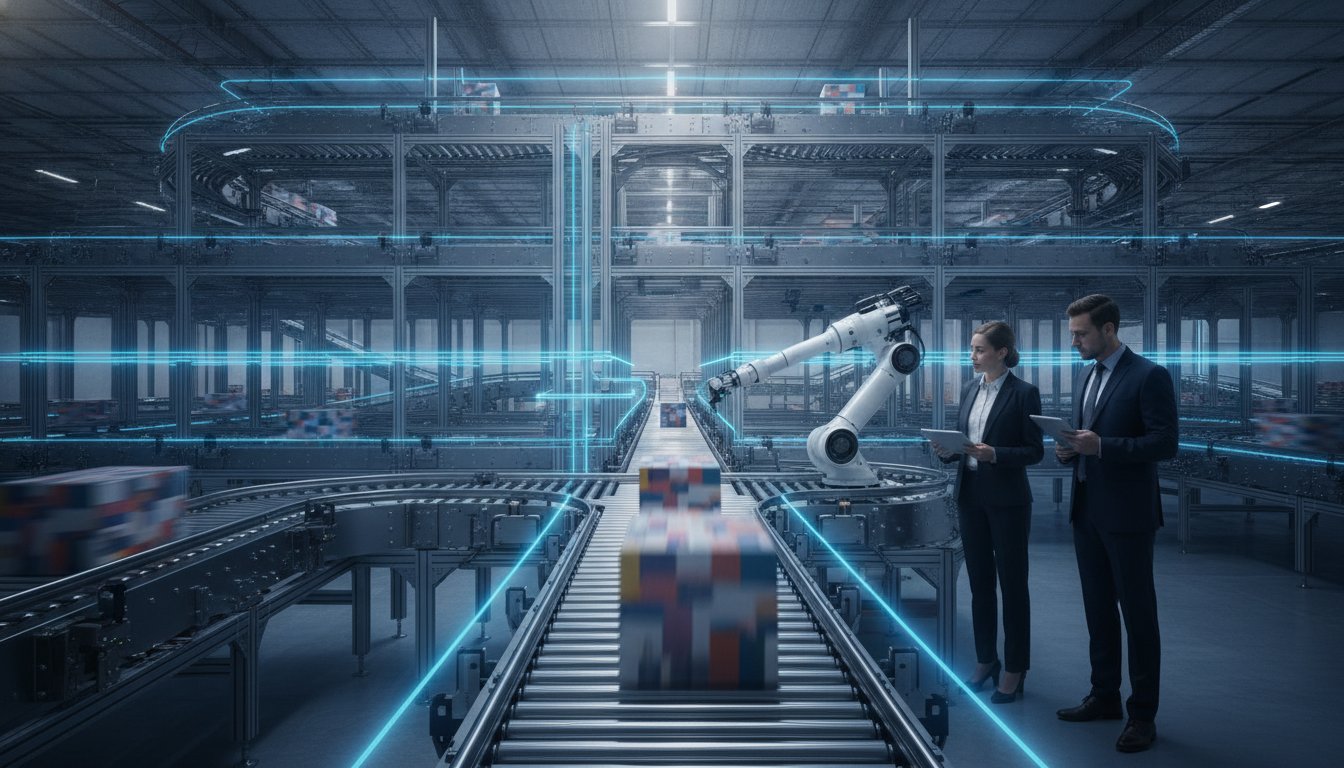
What if the success of your next warehouse expansion depends less on the hardware you purchase and more on the engineering logic that connects it? It is a reality many facility managers face as they balance the need for modern throughput against the risks of operational disruption. You likely recognize that manual processes are no longer sustainable for a 2026 marketplace, yet the technical debt of legacy software and the fear of installation downtime often stall progress. It is essential to address the most common FAQ's when it comes to finding a conveyor system integrator to ensure your investment delivers a truly seamless, automated workflow.
We understand that moving toward a robotics-heavy infrastructure feels like a high-stakes evolution. This article provides expert answers to the most critical questions regarding conveyor system integration, helping you navigate the complexities of process engineering and mechanical installation. We will explore how to sync new equipment with existing ERP systems, calculate realistic ROI, and design a scalable system that reduces labor dependency. By the end of this guide, you will have a clear roadmap for transforming your facility into a high-performance hub of modern excellence.
Key Takeaways
- Understand the fundamental distinction between an equipment vendor and an integrator to ensure your project results in an engineered outcome rather than just a collection of parts.
- Identify the most common FAQ's when it comes to finding a conveyor system integrator to properly vet a partner's ability to handle complex design simulations and large-scale commissioning.
- Learn how to successfully bridge the technical gap between your Warehouse Management System (WMS) and conveyor controls while incorporating advanced robotics for a future-proof workflow.
- Discover proven strategies for minimizing operational downtime, including the critical importance of off-site testing and phased installation schedules.
- Recognize how a national partner with over 100 years of collective experience provides the stability and engineering depth required for multi-site distribution networks.
What is a Conveyor System Integrator vs. an Equipment Vendor?
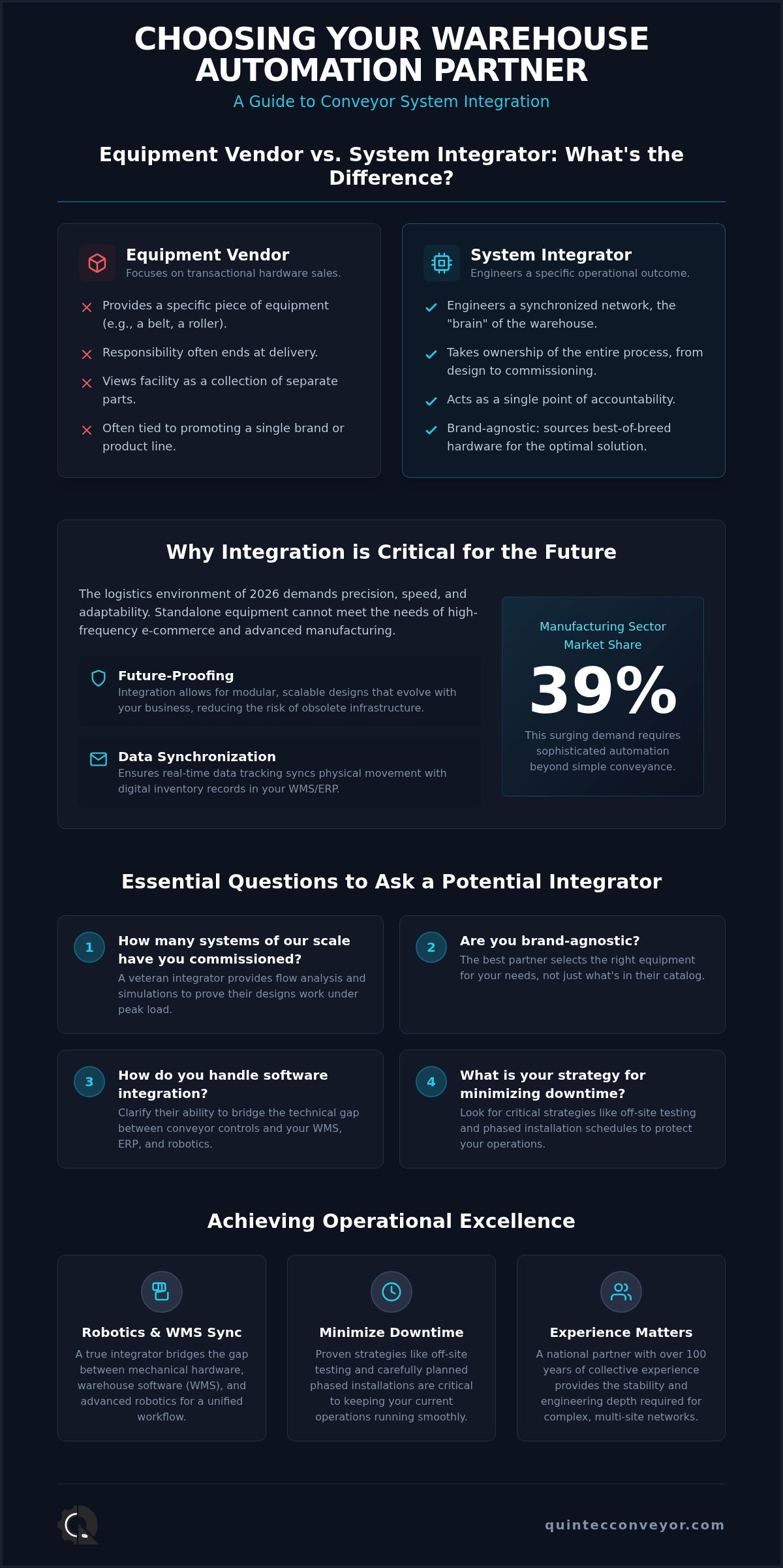
A vendor focuses on the transaction of hardware. They provide a specific piece of equipment, such as a belt or a roller, but their responsibility usually ends once the delivery arrives at your dock. In contrast, an integrator engineers a specific operational outcome. They view the entire facility as a living machine rather than a collection of separate parts. One of the most common FAQ's when it comes to finding a conveyor system integrator is whether a business can simply purchase parts and install them independently. While this is possible for simple setups, standalone equipment often fails to meet the rigorous demands of high-throughput e-commerce. It lacks the unified logic required for complex sortation and high-speed fulfillment.
An integrator identifies operational bottlenecks before a single motor is ordered. They ensure that a conveyor system isn't just a series of moving belts but a synchronized network. This synchronization acts as the "brain" of the warehouse. It utilizes sophisticated control systems to manage flow, prevent jams, and optimize energy usage across the entire floor. By focusing on the logic of the system first, an integrator prevents the costly mistakes that occur when hardware is purchased without a clear process map.
The Core Responsibilities of an Integrator
Integrators take ownership of the entire process engineering phase. This begins with custom system design tailored to your specific throughput goals and facility constraints. Unlike a vendor tied to one brand, a strategic integrator sources best-of-breed hardware from multiple manufacturers to build the most efficient solution. They also manage the complete mechanical and electrical installation lifecycle. This ensures that every sensor and motor works in harmony with your facility’s power and safety standards. Their role is to act as a single point of accountability, bridging the gap between raw equipment and a functional, high-performance operation.
Why Industrial Facilities Need Integration in 2026
The logistics environment of 2026 is defined by smaller, high-frequency order fulfillment that requires extreme precision. With the manufacturing sector accounting for an estimated 39% of the market share this year, the demand for sophisticated automation is surging. Simply moving boxes from point A to point B is no longer sufficient. Facilities now require real-time data tracking to sync physical movement with digital inventory records. Regarding the most common FAQ's when it comes to finding a conveyor system integrator, future-proofing remains a top priority. Integration allows for modular designs that can scale or be reconfigured as your business growth dictates. This reduces the risk of infrastructure becoming obsolete as robotics and automation continue to evolve.
Essential Questions to Ask Before Partnering with an Integrator
Selecting the right partner determines whether your facility meets its 2026 throughput targets or suffers from chronic inefficiencies. One of the most common FAQ's when it comes to finding a conveyor system integrator centers on how to verify a firm's technical competence before signing a contract. You should ask how many systems of your specific scale they've successfully commissioned. A veteran integrator won't just show you a equipment catalog; they'll provide detailed flow analysis and simulations to prove their design works under peak load conditions.
It's also vital to ask if they're tied to a specific manufacturer. A brand-agnostic integrator selects the best fit for your application rather than pushing a specific product line. This flexibility is a significant advantage when sourcing specialized components for unique workflows. Don't overlook post-installation support. Reliable maintenance and engineering support ensure that your system remains operational long after the initial setup. Asking these questions early helps you filter out passive vendors and identify true strategic partners.
Evaluating Engineering and Technical Depth
Partnering with a team that possesses 100+ years of collective industry experience provides a level of security that newer firms can't match. This depth of knowledge is critical for custom material handling system design, where unique facility layouts require bespoke engineering. Ensure your integrator manages both mechanical and controls engineering in-house to avoid communication gaps. They must also strictly adhere to OSHA conveyor safety standards to protect your workforce and ensure regulatory compliance. When you address the most common FAQ's when it comes to finding a conveyor system integrator, technical depth should always be at the top of your list.
Assessing Project Management and Communication
Clear communication prevents project delays and budget overruns. Ask who your single point of contact will be during the installation phase. You need to know exactly how they handle change orders or scope adjustments if facility requirements shift mid-project. A structured conveyor project management methodology ensures transparency from the initial design through final commissioning. If you're looking for a partner that prioritizes this level of precision, exploring the integration services at Quintec Conveyors can provide the strategic guidance your project requires.
How Does Integration Handle Robotics and Warehouse Software?
The intersection of physical hardware and digital logic is where modern facility efficiency is won or lost. Autonomous Mobile Robots (AMRs) are no longer futuristic concepts; they are essential partners to fixed conveyor lines. While fixed systems handle high-volume, predictable paths, AMRs provide the flexibility needed for dynamic routing and seasonal scaling. Integrating these requires a sophisticated control layer to prevent traffic congestion and ensure smooth handoffs between robots and belts. A strategic integrator ensures these two distinct technologies speak the same language.
One of the most common FAQ's when it comes to finding a conveyor system integrator is how they bridge the gap between a facility's Warehouse Management System (WMS) and the Programmable Logic Controller (PLC) on the floor. Without a clean data handshake, the physical system cannot react to real-time order changes. Experienced warehouse system integrators use AI and machine learning to optimize sortation logic, ensuring that the "brain" of the facility is always one step ahead of the physical flow. This proactive approach allows for predictive maintenance, where IoT sensors identify potential motor failures before they cause a line stoppage.
Integrating Advanced Robotics and Automation
Success in high-density sortation depends on matching robotic cycle times with conveyor belt speeds. If a pick-and-place robot operates faster than the take-away conveyor can clear the zone, the resulting bottleneck negates the automation investment. Heavy-duty applications often rely on Chain Driven Live Roller (CDLR) systems for automated palletizing, where precision and weight capacity are non-negotiable. These systems must adhere to strict ANSI conveyor standards to ensure both safety and mechanical reliability during high-frequency operations. Robotics integration isn't just about speed; it's about creating a balanced flow that maximizes the lifespan of every component.
The Digital Nervous System: Controls and Software
A unified digital nervous system provides real-time visibility into every SKU as it moves through your facility. This level of tracking is vital from receiving through shipping to maintain inventory accuracy in a 2026 marketplace. Modern integration also prioritizes the human element. A user-friendly Human Machine Interface (HMI) allows floor staff to monitor system health and resolve minor issues without needing a controls engineer on standby. This transparency reduces downtime and empowers your workforce to manage complex automated workflows with confidence. When addressing the most common FAQ's when it comes to finding a conveyor system integrator, always inquire about their specific software compatibility protocols for your existing ERP or WMS infrastructure.
Addressing Operational Concerns: Installation, Downtime, and Maintenance
The fear of a facility-wide shutdown often paralyzes decision-makers when they consider a major infrastructure upgrade. It's a valid concern; every hour of lost production impacts the bottom line. Among the most common FAQ's when it comes to finding a conveyor system integrator, questions regarding installation timelines and operational disruption consistently rank at the top. A strategic partner doesn't just deliver hardware; they engineer a deployment strategy that respects your current throughput demands while building toward future capacity.
One of the most effective ways to mitigate risk is through the "Golden Rule" of commissioning: testing off-site before any equipment arrives at your facility. This process, often called Factory Acceptance Testing (FAT), ensures that every sensor, motor, and software handshake is calibrated in a controlled environment. By the time the system reaches your dock, the technical variables have been solved. This proactive approach transforms a potentially chaotic installation into a structured, predictable assembly process.
Minimizing Downtime During System Deployment
Modern warehouse retrofits require a surgical approach to installation. Utilizing custom conveyor system design allows engineers to fit new automation within your existing footprint, often utilizing overhead space or modular segments that can be swapped quickly. To avoid peak fulfillment hours, many facilities opt for night-shift or weekend installation schedules. Project phasing is another critical tool. By breaking a large-scale project into manageable stages, an integrator can upgrade one zone while the rest of the facility remains fully operational. This methodical progression ensures that your business stays online throughout the entire transition.
Long-Term System Health and Maintenance
A successful integration contract must look beyond the first day of operation. Forward-thinking engineering involves mitigating the risk of obsolete parts by selecting components with long life cycles and modular designs. You should develop a custom maintenance schedule based on your specific duty cycles rather than relying on generic recommendations. Training your on-site staff to handle basic troubleshooting and wear-part replacement is also essential. It empowers your team and reduces the need for external service calls for minor adjustments. Investing in professional conveyor maintenance ensures that your system remains a high-performance asset for years to come. If you're concerned about how an upgrade might impact your current workflow, the experts at Quintec Conveyors can design a phased deployment plan tailored to your facility's unique schedule.
Choosing a National Partner: Why Experience and Engineering Matter
Scaling a distribution network across multiple states introduces logistical hurdles that local vendors simply cannot navigate. A national integrator provides a centralized engineering standard, ensuring that a facility in one region operates with the same mechanical logic as another thousands of miles away. This uniformity is vital for large-scale networks where cross-facility data and equipment compatibility are required. One of the most common FAQ's when it comes to finding a conveyor system integrator is how a single partner can manage such diverse site requirements simultaneously. The answer lies in a robust infrastructure of process engineering and a deep, vetted network of material handling equipment suppliers.
A national partner offers more than just geographic coverage; they provide a strategic guide for long-term operational excellence. With 100+ years of collective industry experience, a veteran team anticipates the regulatory and logistical friction points that often derail smaller projects. This deep well of knowledge translates directly into fewer project delays and a more predictable ROI. By moving beyond a simple hardware transaction, you gain a partner invested in your scalable growth through 2026 and beyond. It's the difference between buying a machine and investing in a future-proofed solution.
The Advantage of National Reach and Scale
Unified project management is the cornerstone of complex, multi-state rollouts. When you partner with a national integrator, you benefit from consistent engineering standards across all your locations. This reduces the learning curve for your maintenance teams and ensures that spare parts inventories are streamlined. Leveraging a broad network of suppliers also means your project isn't held hostage by a single manufacturer's lead times. You get the best fit for each specific application, backed by a team that understands the nuances of national-scale logistics.
Starting the Integration Journey
The transition to a seamless, automated workflow begins with a comprehensive facility audit. This is a data-driven analysis of your current bottlenecks, floor space constraints, and future throughput needs. Defining clear KPIs is essential during this phase. You must establish goals for throughput, order accuracy, and labor reduction to measure the success of the integration. Addressing the most common FAQ's when it comes to finding a conveyor system integrator often reveals that the most successful projects are those with a clearly defined final sign-off criteria established before the first piece of steel is cut. To begin your facility's evolution, Contact Quintec Conveyors to discuss your 2026 integration strategy.
Building a Future-Proof Foundation for Your Logistics Network
Success in the modern warehouse environment requires more than just purchasing hardware; it demands a strategic alignment of mechanical flow and digital logic. We've examined how a veteran integrator manages the complexities of robotics, software handshakes, and phased installations to protect your uptime. Addressing the most common FAQ's when it comes to finding a conveyor system integrator is the essential first step toward securing a scalable, high-performance facility. Quintec Conveyors provides the seasoned authority and engineering depth needed to navigate these technical challenges effectively.
With over 100 years of collective industry experience and a comprehensive national service footprint, we specialize in the seamless deployment of warehouse automation and robotics. Partner with Quintec Conveyors for your next integration project to ensure your infrastructure is built for long-term operational excellence. Our team acts as a strategic guide, moving your project from initial audit to final sign-off with precision and professional insight. Your facility's transformation is a strategic journey, and we're ready to provide the steady hand and innovative spirit your project deserves. Let's build an efficient future together.
Frequently Asked Questions
What is the typical timeline for a custom conveyor system integration project?
Timeline depends on project complexity, but most custom integrations span four to eight months from the initial facility audit to final sign-off. This includes phases for process engineering, hardware procurement, and mechanical installation. Lead times for specific components, such as sortation shoes or motorized drive rollers, often dictate the pace. A veteran partner manages these variables to ensure the system is commissioned before your peak seasonal demands.
Can an integrator work with my existing conveyor equipment, or must I start from scratch?
Integrators frequently incorporate existing equipment into new automated workflows through strategic retrofitting. This approach maximizes your previous capital investments while upgrading the "brain" of the system with modern controls. We assess the mechanical integrity of your legacy conveyors to ensure they can handle increased throughput speeds. If the equipment is structurally sound, we focus on syncing it with new robotics and updated software protocols for a unified operation.
How do I calculate the ROI of a fully integrated warehouse automation system?
Calculating the ROI of an automated system involves analyzing labor savings, increased throughput capacity, and reduced error rates. Regarding the most common FAQ's when it comes to finding a conveyor system integrator, many businesses overlook the value of reduced product damage and lower energy costs. By comparing your current manual processing costs against the projected automated output, you can determine the exact point where the system pays for itself.
What level of involvement is required from my internal team during the design phase?
Your internal team is most involved during the discovery and data analysis phases to provide accurate throughput requirements and SKU profiles. Once the project moves into the engineering and installation stages, your primary role is to provide a single point of contact for facility access and safety coordination. This collaboration ensures the final system design aligns perfectly with your operational goals while allowing our engineers to handle the technical heavy lifting.
Do you provide integration services for multi-level mezzanines and vertical space?
Yes, we provide comprehensive integration for multi-level mezzanines, spiral conveyors, and vertical reciprocating conveyors to maximize your facility's cube space. Vertical integration is essential for high-density distribution centers where floor space is at a premium. Our engineering team ensures that vertical movement is synchronized with horizontal lines to maintain a steady flow without creating bottlenecks at the transition points between different facility levels.
What happens if our facility software (WMS) is outdated?
An outdated WMS doesn't necessarily require a full software replacement to achieve automation. Integrators often use a Warehouse Control System (WCS) or specialized middleware to bridge the communication gap between legacy software and modern conveyor PLCs. This digital layer translates data in real-time, allowing your existing system to manage inventory while the new controls handle high-speed equipment logic. It's a cost-effective way to modernize without a total software overhaul.
How does Quintec manage national installation projects without local offices?
Quintec manages national projects through a centralized engineering hub that coordinates with a vast network of vetted installers and material handling suppliers across the United States. This model ensures that every site receives the same high standard of process engineering and project management regardless of location. We maintain a single point of accountability for multi-state rollouts, providing consistent results for national distribution networks without the overhead of local satellite offices.
What are the most common mistakes companies make when choosing an integrator?
The most frequent error is selecting a partner based on the lowest equipment price rather than the quality of the engineering logic. This is one of the most common FAQ's when it comes to finding a conveyor system integrator, as businesses often realize too late that poor integration leads to high downtime. Other mistakes include ignoring long-term maintenance requirements or failing to account for future scalability when designing the initial system layout.