Essential Conveyor Parts for Post-Installation Success
Post-installation success isn't defined by the sophisticated hardware on your warehouse floor; it's defined by the readiness of your spare parts inventory the moment a critical sensor fails. You've just invested in a high-performance system, but the real challenge begins when the first consumable component reaches its mechanical limit. Many facility managers quickly find themselves asking: what are the most common conveyor parts needed after installation? Identifying these high-wear items early prevents the staggering costs of unplanned downtime and the logistical headache of long lead times for specialized components.
We recognize that maintaining 99% uptime is your baseline for operational excellence. It's frustrating when a simple bearing failure or a frayed belt brings a complex sortation system to a standstill, eroding the ROI of your new integration. This article provides a comprehensive guide to the high-wear components and critical spares your facility needs to maintain peak efficiency. We'll provide a prioritized list of essential parts, a strategy for predictive maintenance, and a clear roadmap for reducing emergency repair costs through professional foresight and strategic planning.
Key Takeaways
- Identify the most common conveyor parts needed after installation? to navigate the critical "run-in period" where new systems experience their first operational stresses.
- Distinguish between durable components and high-wear consumables like belting and bearings to proactively manage the most frequent causes of downtime.
- Build a strategic spare parts kit using a tiered inventory approach that separates immediate "system down" essentials from parts that allow for longer lead times.
- Learn how modern electrical spares, including VFDs and photo-eyes, serve as the first line of defense against sensor failure and electrical surges.
- Move beyond simple part replacement by integrating professional maintenance and process engineering to maximize the lifecycle of your entire material handling system.
The Lifecycle of a New Installation: Why Parts Fail Post-Startup
Many facility managers assume that a new system integration grants a "grace period" from maintenance. This is a misconception. The reality is that the first few months of operation represent a unique phase where mechanical components settle into their final operational state. This "run-in period" is when you'll likely identify the most common conveyor parts needed after installation? as the system adjusts to real-world throughput and physical tensioning. While a system is new, the physical interaction between various conveyor belt components and drive assemblies can reveal minor alignment shifts that were invisible during dry-run testing.
Even perfectly installed systems encounter early stress. When a facility ramps up to high-throughput peaks, the hardware experiences thermal expansion and mechanical seating that doesn't occur during low-speed commissioning. It's vital to differentiate between manufacturing defects, which are relatively rare in high-quality hardware, and standard "break-in" wear. Professional integration reduces the frequency of these early-stage failures by ensuring that initial tensioning and calibration are handled with precision; however, some level of component "settling" is an inherent part of the mechanical lifecycle.
The "Bathtub Curve" of Equipment Reliability
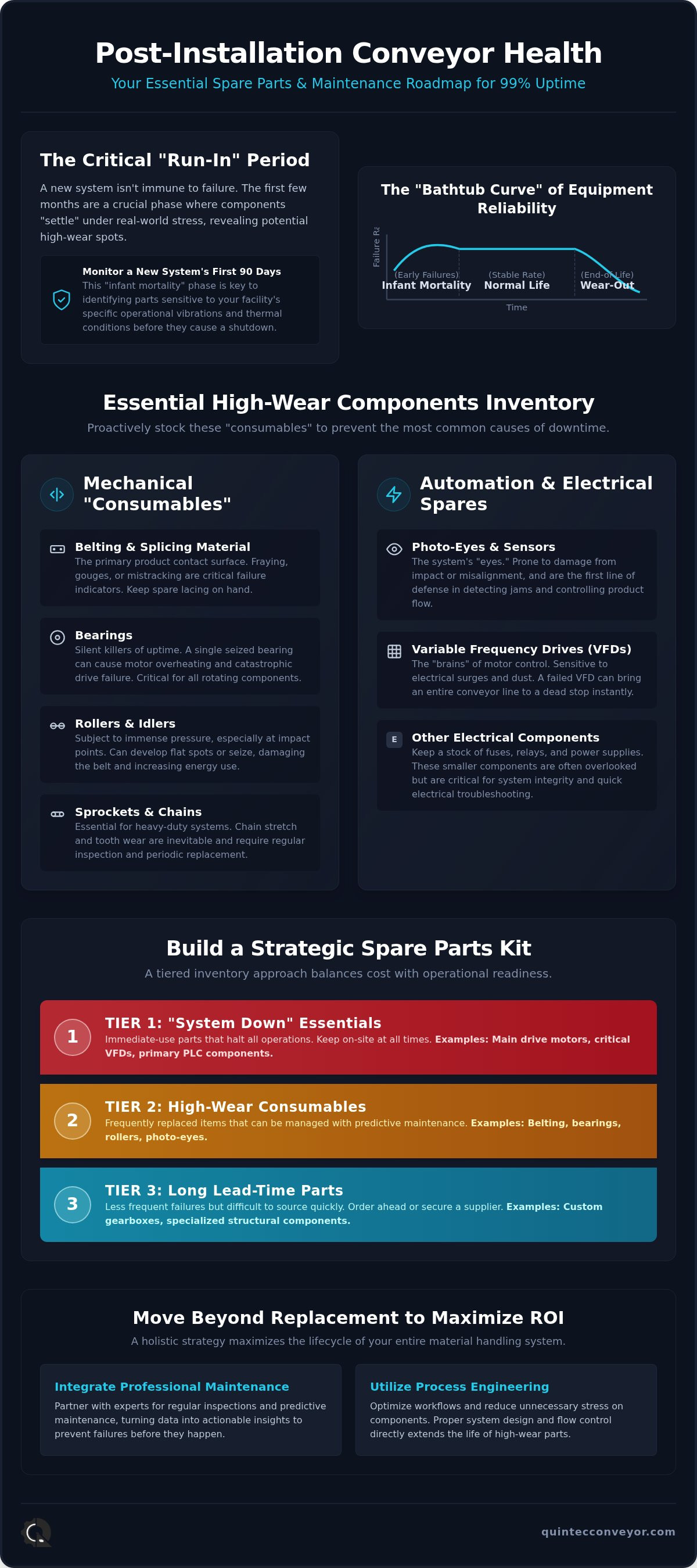
The Bathtub Curve is a graphical representation of the failure rate of a product over time, starting with a high frequency of early failures that stabilizes into a steady state before eventually rising again as parts reach their end-of-life. In industrial maintenance, this curve illustrates why the first 90 days are critical for monitoring belt tracking and motor heat. During this "infant mortality" phase, components that were improperly seated or sensitive to specific facility vibrations will fail early. Diligent monitoring during this window allows you to catch these issues before they cause a total system shutdown.
Environmental Factors and Component Stress
Your facility's environment plays a massive role in part longevity. Dust, temperature fluctuations, and humidity levels impact mechanical parts immediately after startup. For example, high-speed sortation areas create specific "stress points" where friction heat can degrade rollers faster than in standard transport sections. Utilizing custom conveyor systems designed for your specific atmosphere is the best way to mitigate environmental wear. These tailored solutions account for debris ingress and thermal expansion, ensuring that your most common conveyor parts needed after installation? remain operational for their full intended lifecycle.
Mechanical High-Wear Components: The "Consumables" List
Understanding the mechanical hierarchy of your system is essential for long-term stability. While structural frames and heavy-duty supports might last for decades, the moving parts are subject to constant friction, vibration, and load stress. Identifying the most common conveyor parts needed after installation? is the first step toward building a resilient spare parts inventory. These "consumables" require a proactive replacement strategy to avoid cascading failures where one worn component damages the entire drive assembly.
- Belting Material: As the primary contact surface for your product, the belt is the most visible high-wear item and the most frequent replacement need.
- Bearings and Lubrication: These are the silent killers of conveyor uptime; a seized bearing can lead to overheated motors and snapped drive belts.
- Rollers and Idlers: High-load zones and impact points put immense pressure on rollers, which can develop flat spots or seized internal components.
- Sprockets and Chains: In heavy-duty pallet systems, chain stretch and sprocket tooth wear are inevitable consequences of high-torque operations.
Conveyor Belting and Splicing Materials
Operational success depends on the integrity of the belt surface. Fraying at the edges, mistracking, and surface gouges aren't just cosmetic issues; they indicate underlying tensioning problems or mechanical interference. Keeping spare lacing or mechanical splices on hand is a non-negotiable requirement for maintaining throughput during the critical first year of operation. While continuous rubber belts offer smooth transport for small items, modular plastic links allow for faster replacement of specific damaged sections, significantly reducing repair windows. Adhering to OSHA conveyor safety standards during these belt repairs ensures that your maintenance teams remain protected while handling high-tension materials.
Drive Components and Bearings
Drive systems rely on precision components that often have the smallest physical footprint but the largest impact on reliability. It's critical to stock specific bearing sizes for both head and tail pulleys, as these points experience the highest torque and tension. Small parts like drive belts and O-rings often cause the most significant headaches because their failure is immediate and total, bringing entire lines to a standstill. For a deeper look at how these small components influence your system, refer to our Industrial O-Rings guide. Proactively managing these inventory levels is the most effective way to safeguard your investment. If you're unsure which spares are right for your specific configuration, our team can help you develop a tailored conveyor maintenance plan.
Automation and Electrical Parts: The Modern Critical Spares
Modern material handling is no longer just about belts and rollers; it's about the sophisticated data and electrical signals that orchestrate every movement. While mechanical wear is often gradual and predictable, electrical failures are usually sudden and absolute. When determining the most common conveyor parts needed after installation? one must look beyond the steel and rubber. Automation components are the modern critical spares that ensure your system communicates effectively across every sorter and transport section. These parts represent the "brain" and "nervous system" of your facility, and their absence in your inventory can lead to prolonged, expensive outages.
- Photo-eyes and Sensors: These devices act as the sensory organs of the automated warehouse, detecting product presence and orientation.
- Variable Frequency Drives (VFDs): These controllers protect your motors from electrical surges and manage the precise speeds required for sorting.
- Solenoids and Pneumatic Actuators: These are critical for the high-speed diverts found in cross-belt sorter systems.
- Motor Brushes and Fuses: These are low-cost items that prevent high-cost stops; having them on hand is the simplest way to avoid an emergency call-out.
Sensors and Alignment Tools
Sensors are uniquely vulnerable to the physical realities of a busy warehouse floor. In new systems, minor adjustments in product flow can lead to "product jams" that physically strike or displace sensitive photo-eyes. It's necessary to stock pre-configured replacement sensors to ensure that a simple alignment issue doesn't turn into a multi-hour troubleshooting session. As AI and smart technology integrate deeper into logistics, sensors are becoming more communicative. They now provide health data that allows for predictive replacement, but you still need the physical hardware on the shelf to act on those insights.
Control System Components
Variable Frequency Drives (VFDs) play a vital role in maintaining the efficiency of industrial conveyor systems. They manage the ramp-up speeds that reduce mechanical stress on belts and gearboxes. While mechanical parts are often interchangeable, proprietary PLC cards and I/O modules should be kept on-site despite their higher initial cost. These components are the bridge between your physical conveyor and the overarching warehouse control system (WCS). In facilities where robotics intersect with traditional transport, having these electronic spares on hand is the only way to guarantee that a software-driven machine doesn't become a stationary piece of iron due to a single blown circuit.
Strategic Inventory: Building Your Post-Installation Spare Parts Kit
Creating a spare parts strategy is a sophisticated exercise in risk management rather than a simple procurement task. To maintain 99% uptime, you must categorize your inventory based on the operational impact of a component's failure. When asking about the most common conveyor parts needed after installation? the answer depends on whether a part's failure causes a localized hiccup or a total facility shutdown. A tiered approach ensures that your capital is invested in the components that offer the highest protection against unplanned downtime.
- Tier 1: Critical Spares: These are "System Down" items that require immediate replacement. If a head pulley bearing or a primary drive belt fails, the line stops. These must be kept on-site at all times.
- Tier 2: Essential Spares: These components can often be replaced within a 24 to 48-hour window without causing a total system collapse. Examples include specific rollers in non-critical transport sections or redundant sensors.
- Tier 3: Maintenance Spares: These are structural components or long-lead items like custom-sized motors. These are replaced during scheduled downtime rather than emergency windows.
Calculating the ROI of on-site inventory requires looking past the purchase price of the hardware. The cost of a single $100 sensor is negligible compared to the thousands of dollars lost per hour during a system-wide stoppage. When you factor in the premium costs of emergency overnight shipping and the labor required for rushed repairs, maintaining a robust Tier 1 and Tier 2 inventory becomes a clear financial necessity.
The Critical Spares Checklist
Your immediate-response kit should focus on both mechanical and electrical vulnerabilities. Mechanically, this includes bearings, drive belts, and O-rings that are subject to constant friction. Electrically, you must stock fuses, relays, and pre-configured sensors that match your system's specific logic. Recognizing when these parts are nearing failure is just as important as having the replacement ready. For more insight on identifying these issues before they escalate, read our guide on the 7 warning signs your conveyor system needs maintenance.
Managing Lead Times and Sourcing
Identifying "long-lead" items is a vital part of your post-installation success. Custom-sized rollers, specialized gearboxes, or proprietary PLC modules can sometimes take weeks to arrive if they aren't already in your cage. Partnering with a conveyor system integrator allows you to leverage their supply chain to secure these parts more efficiently. For large distribution centers, developing a vendor-managed inventory (VMI) strategy ensures that your most common conveyor parts needed after installation? are automatically replenished. If you're ready to professionalize your parts strategy, contact our team to discuss our comprehensive conveyor maintenance services.
Maximizing ROI Through Professional Conveyor Maintenance
Successful logistics operations recognize that "part-swapping" is merely a reactive tactic, not a comprehensive strategy. While knowing the most common conveyor parts needed after installation? allows for quick fixes, it doesn't address the underlying mechanical stresses that lead to premature wear. True ROI is achieved when maintenance shifts from an emergency expense to a controlled, predictive process. Strategic warehouse design services play a fundamental role here; by optimizing flow and reducing unnecessary inclines or high-impact turns, we can significantly extend the lifecycle of every roller and belt in your system.
Our engineering team focuses on optimizing existing systems to ensure they settle into a high-performance state after the initial run-in period. This involves more than just keeping a stocked cage of spares. It requires a deep understanding of how different components interact under maximum load. When you move from reactive repairs to predictive maintenance, you eliminate the chaos of unplanned downtime and replace it with the steady confidence of a well-managed facility.
The Benefits of Scheduled Maintenance Audits
Scheduled audits are the backbone of a resilient facility. Regular inspections identify wear patterns that are invisible during standard daily checks. We utilize advanced diagnostic tools such as thermography to detect abnormal heat signatures in motors before they seize; vibration analysis identifies bearing imbalances long before they become audible to the human ear. These professional audits significantly extend the equipment lifecycle and maintain the resale value of your infrastructure by preventing the cascading damage that occurs when one small part fails under tension.
Partnering with Quintec for Long-Term Success
Partnering with a veteran integrator provides a level of security that internal maintenance teams often cannot match. Quintec offers national maintenance and engineering support, backed by over 100 years of collective industry experience. This deep well of knowledge helps our clients identify the most common conveyor parts needed after installation? specifically for their unique sortation or transport configurations. We don't just sell components; we provide the process engineering required to eliminate bottlenecks before they impact your bottom line. Our goal is to act as a strategic guide, ensuring your system remains at the cutting edge of efficiency. Contact Quintec Conveyors to optimize your system maintenance today.
Securing Long-Term Performance Through Strategic Oversight
Building a resilient operation requires moving beyond reactive repairs and embracing a culture of predictive maintenance. Identifying the most common conveyor parts needed after installation? is just the starting point for a resilient operation. True stability comes from understanding the interplay between high-wear mechanical consumables and the sensitive automation components that drive modern throughput. By establishing a tiered inventory of critical spares and performing regular audits, you protect your facility from the high costs of unplanned downtime and preserve the integrity of your infrastructure.
Quintec brings over 100 years of combined industry experience to every project, offering national integration and support that extends far beyond the initial startup phase. Our specialized process engineering team is dedicated to optimizing your system for maximum longevity and ROI. We don't just provide hardware; we provide the strategic guidance needed to keep your facility at the cutting edge of efficiency. Ensure your system stays online with Quintec’s expert maintenance services. With the right parts and a proactive strategy, your system is ready for years of uninterrupted success.
Frequently Asked Questions
What are the most common conveyor parts that fail first?
Consumable components subject to constant friction and high torque are typically the first to require attention. The most common conveyor parts needed after installation? often include drive belts, O-rings, and rollers in high-impact loading zones. These parts settle during the initial run-in period and may require early tensioning or replacement as the system reaches full operational capacity. Proactive monitoring of these items prevents minor wear from escalating into major drive assembly failures.
How many spare parts should I keep in stock for a new conveyor system?
Your inventory should follow a tiered risk management strategy based on the operational impact of each component. We recommend stocking at least one of every critical drive component, including motors, VFDs, and primary bearings. For high-wear items, maintaining enough belting material to cover your longest conveyor section is a standard industry practice. This ensures that a localized failure doesn't result in a multi-day facility shutdown while waiting for specialized shipments.
What is the difference between a mechanical splice and a vulcanized splice for repairs?
Mechanical splices use metal fasteners to join belt ends and are ideal for rapid, temporary repairs that get a line back online quickly. Vulcanized splices use heat and pressure to create a seamless, permanent bond that is as strong as the belt itself. While mechanical options are essential for your emergency kit, vulcanized splices are preferred for high-speed sortation systems because they reduce noise and prevent damage to sensitive sensors or diverts.
How often should conveyor bearings be lubricated or replaced?
Maintenance schedules for bearings depend heavily on your facility's environmental factors such as dust and temperature. A standard industrial guideline is to inspect lubrication every 500 to 1,000 operational hours. Replacement is not usually based on a fixed calendar date but rather on the results of vibration analysis or thermography. Catching a bearing failure in its early stages prevents the shaft damage and motor overheating that typically follow a total seizure.
Can I use universal parts on a custom-integrated conveyor system?
Universal parts are suitable for basic hardware like fasteners or standard support brackets, but they are rarely appropriate for critical integrated components. Proprietary PLC cards, specific roller diameters, and custom-engineered drive assemblies require exact matches to maintain the system's calibrated performance. Using non-spec parts can lead to mistracking, increased electrical draw, and potential voiding of equipment warranties. It is always safer to consult your integrator to ensure component compatibility across your workflow.
What are the warning signs that a conveyor motor is about to fail?
The primary indicators of impending motor failure are excessive heat, unusual noise, and increased vibration. If a motor is too hot to touch or shows a high thermal signature during an audit, it is likely struggling with an internal short or a seized bearing. Grinding sounds often point to mechanical interference, while an increased amperage draw suggests the motor is working harder than designed. Identifying these signs early allows for a controlled replacement during scheduled downtime.
How does warehouse automation affect the lifespan of conveyor parts?
Automation increases the duty cycles of your equipment, often running systems at 100% capacity for extended shifts. This constant operation accelerates the wear on mechanical consumables compared to manual transport lines. However, advanced automation also includes precision controls like Variable Frequency Drives that manage ramp-up speeds and reduce mechanical shock. While parts may wear faster due to high throughput, the controlled motion provided by automation helps prevent the sudden, violent failures caused by manual starts.
Should I buy spare parts directly from the manufacturer or an integrator?
Purchasing through an integrator like Quintec provides a holistic advantage because we understand how every part interacts within your specific process engineering. We help you identify the most common conveyor parts needed after installation? across your entire multi-vendor system, which simplifies your procurement process. With over 100 years of collective industry experience, we ensure you receive the correct specifications for your custom setup, rather than just a generic component that might not fit your integration.