Factory Automation Integration Services: A 2026 Buyer’s Guide
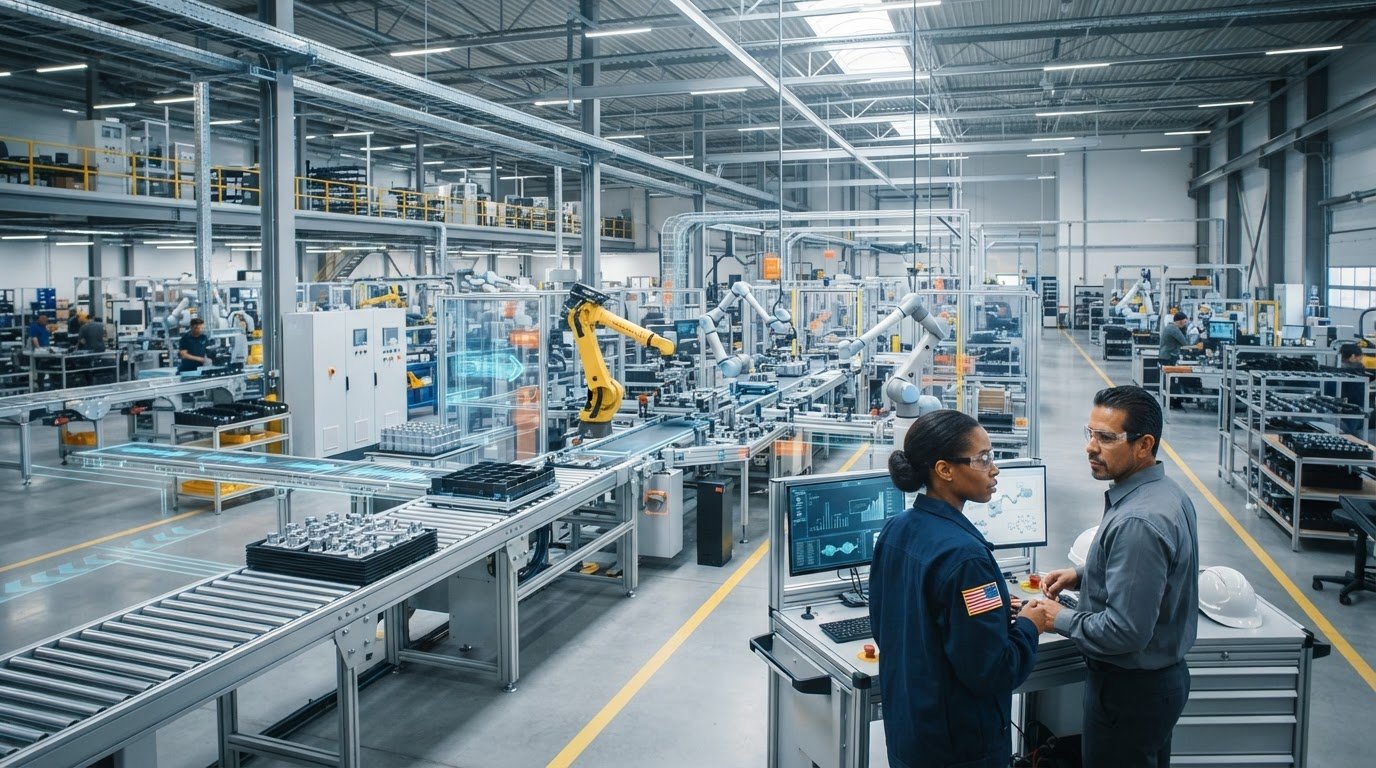
A new robot or conveyor won’t resolve a factory bottleneck if it can’t work with the equipment and processes around it. Factory automation integration services should begin with operational flow, not a list of machines to purchase. When systems are disconnected, even capable equipment can leave gaps in material movement, coordination, and visibility.
When evaluating a project, focus on its scope, system interfaces, installation impact, and ability to adapt as your operation changes. These considerations are connected across the facility: equipment, engineering, and infrastructure all need to support the work your operation must perform.
This 2026 buyer’s guide explains how to assess integration scope and fit, plan around material flow, and prepare for implementation while keeping operational continuity and future needs in view. You’ll learn what to examine from project definition through installation and ongoing improvement, including how conveyors, robotics and automation, infrastructure, and process engineering can work together as a coordinated system.
Key Takeaways
- Factory automation integration services should connect equipment and processes around facility needs, rather than treat each machine as a standalone purchase.
- Assess how conveyors, robotics, infrastructure, and process engineering can support coordinated material flow across your operation.
- Compare project responsibilities for process understanding, engineering, installation coordination, and ongoing support, not just equipment categories.
- Prepare for planning by documenting workflows, product movement, bottlenecks, and future operating needs.
- Quintec brings design, engineering, conveyor integration, robotics, infrastructure, and installation together, backed by over 100 years of collective industry experience.
What Factory Automation Integration Services Connect Across Your Operation
Factory automation integration services bring process assessment, system design, engineering, equipment coordination, and installation together to support how a facility operates. The work starts with the movement of materials and the steps required to transform, stage, store, or dispatch them. Unlike a standalone conveyor or robot purchase, integration aims to make equipment and work areas function as parts of a connected operation.
This distinction matters when a machine completes its task but the overall process still stalls. A work cell may finish faster than products can reach it, or material may build up between production and storage. A facility-level view helps locate constraints and identify which connections a coordinated solution needs to address. For background on the broader concept, see What is Factory Automation?
What belongs in an automation integration project?
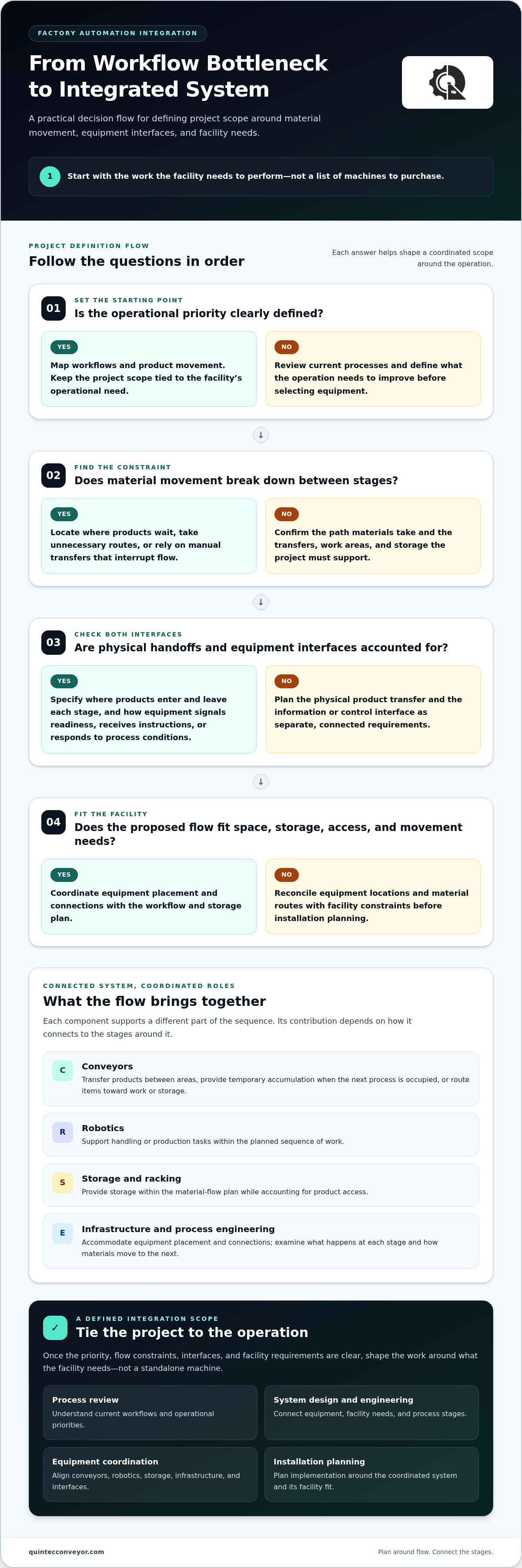
Project scope should reflect facility requirements and clearly defined operational priorities. It may include reviewing current processes, developing a system design, engineering equipment and facility needs, coordinating components, and planning installation. The specific work depends on what the operation needs to improve, the available space, and how materials move through each stage.
For example, conveyors can move products between work areas, robotics can support automated handling or production tasks, and warehouse racking can provide storage within the material-flow plan. Supporting infrastructure accommodates equipment and its placement, while process engineering considers how each stage connects to the next. The industrial conveyor systems executive guide offers additional context on how conveyor systems fit into an integrated operation.
Set the operational priority first, then identify the systems and facility elements needed to address it. This keeps the scope grounded in the workflow and helps prevent equipment decisions from expanding without a clear purpose.
Which operational problems can integration address?
Recurring handoffs, congestion, and inconsistent material movement are reasons to examine the process as a whole. If products wait between work areas, take unnecessary routes, or rely on manual transfers that interrupt flow, adding equipment in isolation may leave the underlying constraint untouched. A process-level assessment looks at where delays occur and how each operation affects the next.
Coordinated equipment can support smoother movement between work areas by aligning transfer points, equipment placement, and storage with the facility’s workflow. The objective is not automation for its own sake. It is a system designed around the path materials take and the work required at each stage.
Integration coordinates equipment and processes to support one operational flow.
Use that definition as a practical starting point: map material movement, identify where flow breaks down, and define which connections a project must address. With those priorities clear, the scope can be shaped around the facility rather than a single machine.
How Conveyors, Robotics, and Infrastructure Work Together
In a connected facility, each piece of equipment has a role in the sequence of work. Conveyors can transfer products between areas, provide temporary accumulation when the next process is occupied, or route items toward a designated work or storage location. Robotics can perform handling or production tasks within that sequence. Their contribution depends on how reliably materials arrive, how the next step is prepared, and where completed work moves afterward.
How material movement and automation interfaces fit together
Planning requires attention to both physical handoffs and information or control interfaces. A physical handoff is where a product moves from one piece of equipment or work area to another. The interface behind it concerns how equipment signals readiness, receives instructions, or responds to a process condition. These are separate considerations, and both affect whether the intended sequence can operate as planned.
Consider a product moving from a conveyor to a robotic handling area and then toward storage. The design needs to account for where the product enters and leaves each stage, what happens if the next stage is occupied, and how equipment and operators interact. It also needs to account for facility constraints, such as available floor space and the route materials must take. Factory automation integration services coordinate these elements around the workflow instead of treating the robot or conveyor as an isolated purchase.
For a deeper look at how robotics can support coordinated movement through a warehouse, the warehouse robotics integration guide explores the role of robotics within automated flow.
Why infrastructure and process engineering matter
Equipment must fit the facility’s storage, access, and movement requirements. Warehouse racking shapes where products are held and how they can be accessed; supporting infrastructure accommodates equipment placement and connections between work areas. If these elements are planned separately, a route that looks efficient on a process diagram may conflict with storage needs or make a transfer point difficult to use.
Process engineering brings the sequence into focus. It examines what work occurs at each stage, how materials move between stages, and where capacity or timing could constrain flow. This helps teams determine whether a conveyor needs to feed one process or several, where accumulation may be useful, and how robotic handling fits into the sequence. The design should respond to actual operating requirements, not assume every facility needs the same arrangement.
Design equipment interfaces around the complete process so each handoff supports the next step in material flow. This helps teams assess not only whether components can be installed, but also how their physical paths, operating sequence, and facility requirements fit together. Quintec connects conveyors, robotics, infrastructure, and process engineering through tailored design and implementation. Explore Quintec’s integration capabilities to see how these elements can be considered as one coordinated system.
How to Evaluate Factory Automation Integration Services Before Choosing
Compare the responsibilities and decisions defined in each project scope, not simply the equipment named in it. A conveyor or robot specification describes a component, but it may not show how the proposed work addresses your workflow, facility conditions, installation needs, or ongoing operation. Factory automation integration services are easier to evaluate when the scope makes connections and responsibilities clear.
What should the service scope make clear?
A useful scope explains how process discovery informs design, which systems and equipment will be coordinated, how installation will be planned, and what handover includes. It should also document assumptions, boundaries, dependencies, and acceptance criteria. These details help teams spot gaps before implementation and make decisions in stages, rather than discovering late in the project that an interface or facility requirement was overlooked.
Tailored planning accounts for existing conditions and operational priorities. For broader guidance on integrator selection, the conveyor system integrator buying guide provides related context.
How do you assess fit beyond equipment specifications?
Compare how each approach addresses the constraints you’ve identified, such as a difficult handoff, limited space, or a mismatch between process stages. Look for a clear connection between the operational need, the proposed design, and how the work will be implemented. Defined interfaces, responsibilities, and staged decisions help reduce integration risk by clarifying dependencies.
| Evaluation area | What a clear project approach addresses | What to compare |
|---|---|---|
| Process understanding | Current workflow, movement needs, bottlenecks, and operating priorities | How the proposed design responds to the facility’s actual constraints |
| Engineering scope | Design responsibilities, equipment interfaces, infrastructure, and assumptions | Whether boundaries, dependencies, and acceptance criteria are documented |
| Installation coordination | Installation planning, work sequence, and coordination with facility operations | How the project accounts for site conditions and operational continuity |
| Lifecycle support | Handover information, maintenance considerations, and future operating needs | Whether the plan considers upkeep and the system’s role as needs evolve |
Compare how the project coordinates conveyors, robotics, infrastructure, and process engineering wherever they affect the same workflow. For example, a design may specify a robot and conveyor separately yet leave unclear how the transfer between them works or what happens when the next stage is unavailable. A well-defined scope includes those interfaces in the planning discussion.
Quintec brings system design, engineering, conveyor integration, robotics, infrastructure, and installation into a tailored approach for industrial operations. Its team has over 100 years of collective industry experience. Explore Quintec’s automation integration capabilities to see how these disciplines can be considered together.
Prepare Your Facility for an Automation Integration Project
Good preparation gives design and engineering teams a clearer picture of how the facility operates and what the system must support. Before installation planning begins, align on operational goals, document current conditions, and identify who will coordinate decisions across production, maintenance, engineering, and facility teams. Factory automation integration services can then be shaped around operating requirements rather than assumptions.
Define requirements and gather facility information
Work through readiness in sequence. Start with the intended operational outcomes, then record how work happens today and what the facility may need in the future. Separate essential requirements from potential later capabilities so the project can prioritize immediate needs while keeping future direction in view.
- Set priorities. Define the operational need the project should address, such as a recurring delay, difficult transfer, or changing storage requirement. Clarify what a successful outcome needs to support without relying on unverified performance targets.
- Map the workflow. Document how products move through work areas, where handoffs occur, and when congestion or interruptions arise. Note operating patterns, including differences between product flows or shifts if they affect how the system must work.
- Gather facility details. Collect available layouts, existing equipment information, infrastructure details, and process documentation. Record known constraints, such as limited space or access requirements, and identify information that is incomplete or may need a site review.
- Plan implementation with the operating team. Identify facility stakeholders, decision points, and coordination needs. Develop an installation approach around actual site conditions and operating requirements, rather than assuming a fixed schedule or shutdown plan.
These steps provide a practical basis for design. Existing equipment, facility interfaces, available space, and material movement all influence how an integrated system can be configured. Clear documentation helps teams distinguish established requirements from open questions before those decisions affect installation planning.
Plan installation, commissioning, and ongoing operation
Installation planning should account for the work sequence, site access, coordination with facility teams, and operational needs during implementation. The approach is specific to the project because conditions, equipment, and priorities differ by facility. Early coordination helps stakeholders understand when decisions are needed and how installation activities relate to ongoing work.
Commissioning is the process of checking system operation against agreed project requirements. Define what needs to be reviewed, who will take part, and how issues or adjustments will be handled. This gives the transition from installation to operation a clear structure and provides a shared reference for evaluating readiness.
Plan for operation after installation, too. Include maintenance considerations and operator handover, and organize relevant system information and operating guidance for the people who will use and maintain the equipment. A thoughtful handover supports continuity and helps teams understand the system’s intended role in the workflow.
Build your project plan around clear priorities and facility-specific requirements. Plan an automation integration project with Quintec.
How Quintec Supports Factory Automation Integration from Design to Installation
A factory automation project needs more than equipment selected to perform individual tasks. Quintec Conveyors brings system design, engineering, conveyor integration, robotics, infrastructure, and installation together to address how materials move through an industrial facility. This integrated approach connects project decisions to the operation they’re intended to support, from initial design through implementation.
A coordinated approach for industrial material handling
Each facility has its own operating priorities, layout, and existing equipment. Quintec’s process engineering helps shape the system approach around those conditions, considering how equipment, work areas, and material movement relate. That context informs design and engineering decisions, so the proposed solution reflects facility needs rather than relying on a standard equipment package.
Depending on project requirements, the system may bring together conveyors, robotics, warehouse racking, infrastructure, and other material handling equipment. These elements have different functions, but their value depends on how well they support the workflow as a whole. Quintec’s integration work considers their coordination as part of system design and installation, with scope tailored to the facility and its operational goals.
Installation translates the design into a working system. Planning around facility conditions and project requirements helps coordinate equipment and engineering decisions as implementation moves forward. The team brings over 100 years of collective industry experience to this work, applying practical knowledge to industrial material handling projects.
Support can also continue after installation. Quintec provides conveyor maintenance to help facilities care for conveyor systems over time. Maintenance planning belongs in the broader operational picture, alongside how equipment will be used and how the system fits into ongoing material movement.
Take the next step toward an integrated system
A focused project discussion starts with your operational priorities. Prepare a summary of the workflow you want to address, relevant facility information, existing equipment details, and known constraints. Layouts or process documentation can also help clarify how materials move and where the project needs to connect with current operations.
These details create a practical starting point for discussing needs, project scope, and integration requirements. The conversation can consider which system elements fit the facility, how design and engineering relate to installation, and what information is needed to develop the project approach. Factory automation integration services are most useful when grounded in the realities of the operation and shaped around its defined priorities.
Ready to discuss your facility’s goals and project requirements? Discuss your factory automation integration project with Quintec.
Turn Your Operational Priorities Into a Clear Next Step
The strongest automation projects begin with a decision about what the operation needs to do better. Choose a priority, define the change you want to enable, and consider how it may affect connected work areas. This gives factory automation integration services a clear purpose and helps shape the project around operational value rather than technology alone.
Before moving forward, capture the questions your team needs resolved: which facility constraints will influence the design, which current processes must remain in view, and how will you assess whether the proposed scope fits? These questions provide a practical basis for a focused project conversation and help turn broad ambitions into decisions your team can evaluate.
Quintec can help translate those priorities into an integration approach tailored to your facility. Start planning your factory automation project and take the next step toward a system built around your operation’s needs. A clear starting point makes progress more manageable.
Frequently Asked Questions
Can factory automation integration services work with existing equipment?
Yes. Existing equipment may be incorporated when its condition, capabilities, interfaces, and role suit the intended workflow. Before design decisions, inventory each machine and note its age, operating condition, available documentation, and connections to neighboring processes. For example, a conveyor that still serves its purpose may remain in place while its transfer point or supporting equipment changes. This assessment helps establish project boundaries and identify where additional engineering review is needed.
How do I measure the success of a factory automation integration project?
Measure success against goals defined before design, using a baseline that reflects normal operating conditions. Select relevant indicators, such as throughput, downtime, process consistency, labor allocation, or material-flow performance, then agree on how and when they’ll be reviewed. Consider product mix and operating patterns when comparing results, since these can affect measurements. A balanced set of criteria offers a more useful view than relying on a single metric.
What information should I prepare before discussing an automation project?
Gather facility layouts, workflow maps, equipment details, product characteristics, and known operating constraints. Add notes about recurring delays, where products wait or change direction, and which outcomes matter most. Photos or marked-up diagrams can help explain an unusual transfer point or crowded work area. Include relevant future plans, such as a process change that could affect material movement. This preparation makes early discussions more specific and helps surface missing information.
Will factory automation integration require production to stop?
Not necessarily. The operational impact depends on project scope, site conditions, and how new equipment connects to current processes. Installation planning should identify dependencies, access needs, and activities that could affect production before work begins. Teams can then develop a sequence and coordination plan suited to the facility. There’s no universal shutdown requirement or timeline; those decisions depend on the system being installed and the operation it must fit.
Is factory automation integration suitable for a smaller industrial facility?
Yes. Facility size alone doesn’t determine whether integration makes sense. A smaller operation might focus on one recurring transfer problem, a constrained work cell, or a specific movement between production and storage, rather than pursue a broad system change. The key is to weigh the process need against available space, infrastructure, and future operating plans. A clearly bounded project helps define an appropriate scope for evaluation.
What happens after an automated system is installed?
After installation, teams can check system operation against agreed project requirements, complete an operational handover, and plan ongoing maintenance for the installed equipment. Operators should understand normal use and know where to find relevant system information. A practical follow-up is to record issues observed during routine operation and compare performance with the original project goals. Maintenance needs vary with equipment and operating conditions, so plans should reflect the system in place.