How to Choose Conveyors for Better Warehouse Flow
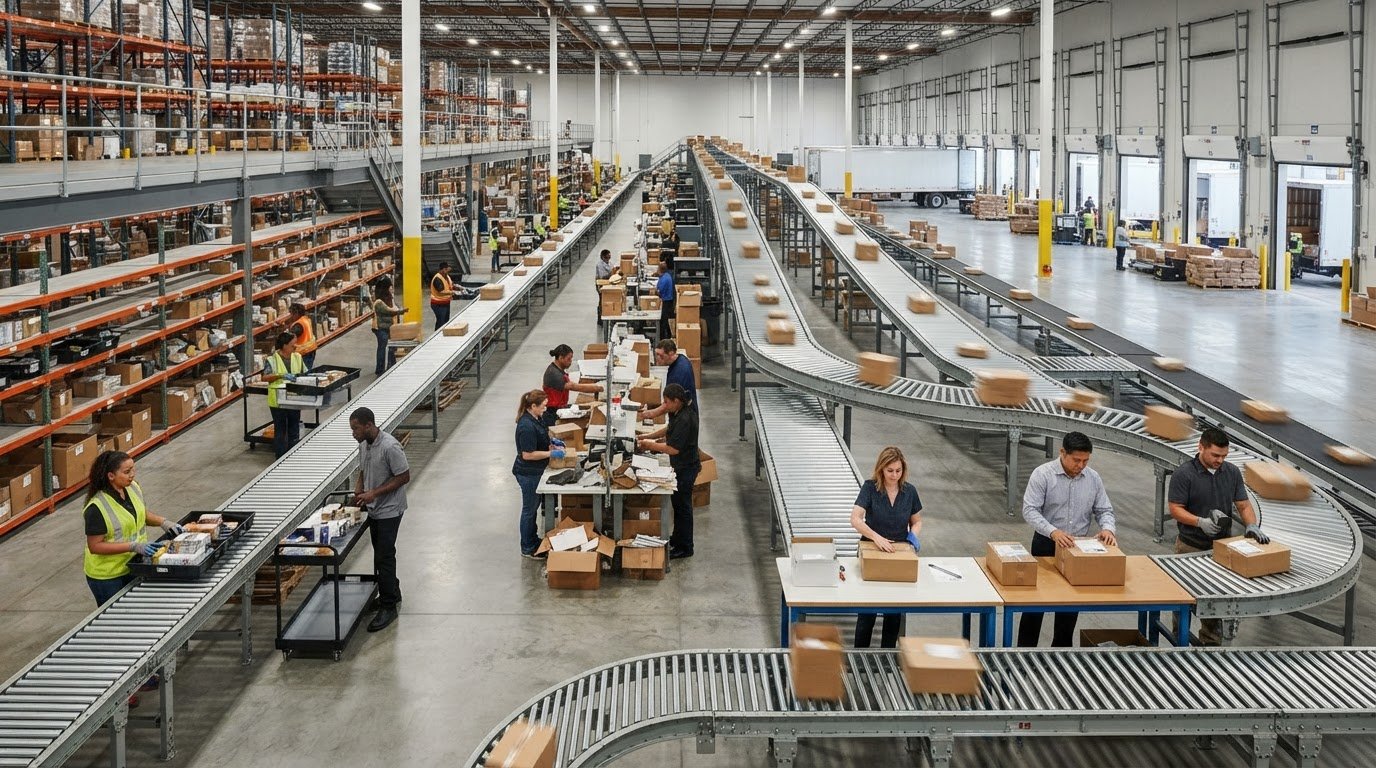
How do I choose a conveyor system that can improve picking and shipping flow in my warehouse? Start with the order journey, not an equipment catalog. Orders that queue between picking, packing, and shipping may point to a handoff or capacity constraint. Manual transport can add labor and make flow less consistent, but a conveyor will help only if it addresses the cause of the delay.
First identify where work slows, then match conveyor options to your product mix, order volume, layout, and shipping needs. This flow-first approach helps you compare equipment against specific tasks and understand how it connects with people, processes, and other material handling systems. Quintec Conveyors provides conveyor design, engineering, and installation, alongside warehouse automation, infrastructure, and process engineering, to develop systems around an operation’s requirements.
Key Takeaways
- Trace orders from release to shipping to locate queues, handoffs, and congestion.
- Define conveyor requirements using product characteristics, workflow interfaces, and measured demand during average and peak periods.
- Compare conveyor approaches against specific tasks, loads, and layout constraints.
- Build a selection checklist around capacity, routing, buffers, safety, access, and measurable flow targets.
- Plan equipment, controls, automation, infrastructure, and racking as connected parts of an integrated project.
Start with the order journey: where does warehouse picking and shipping flow stall?
Orders waiting between picking, packing, and shipping deserve investigation, as do long walking routes, repeated handling, and congested handoffs. These symptoms show where work is accumulating, but they don’t automatically mean a conveyor is the answer. A queue near packing, for example, could reflect limited packing capacity, late replenishment, or uneven order release rather than a transport problem.
Warehouse flow is the coordinated movement of orders through each process step, from release to dispatch, with minimal unnecessary waiting and handling. Trace that movement in sequence: order release, picking, consolidation, packing, staging, and shipping. Follow both orders and their containers to see where progress slows and what is waiting on what.
Map the picking-to-shipping path before choosing equipment
Sketch the physical route alongside the process sequence. Mark each order touchpoint, decision, transfer, and accumulation area, including places where orders wait for a person, workstation, or downstream capacity. Note crossing traffic, backtracking, repeated handling, and routes that change for exceptions. A general overview of conveyor systems can provide equipment context, but your warehouse map should show where transport equipment fits.
Map carton, tote, and pallet movements separately when they follow different routes or need different handling. A picked tote might travel to consolidation, while a packed carton moves toward shipping and a pallet goes to a staging lane. Combining these flows on one sketch can hide conflicting routes and handoffs. A clear map makes those interactions visible before equipment choices constrain the layout.
Use operational evidence to locate the constraint
Pair the map with operating records and direct observation. Review order mix, volume by process step during normal and peak periods, units per order, and shipping cutoff patterns. Then observe representative work in progress: where does travel increase, where do queues form, how long do orders wait, and do containers recirculate or accumulate at packing and shipping interfaces? Compare the records with what staff experience on the floor.
Include exceptions as well as routine orders. Split orders can create extra consolidation work; priority shipments may change the sequence; and replenishment can interrupt picking or leave a pick location unavailable. These conditions may expose a constraint that averages conceal. Record when and where a delay occurs, which order types it affects, and whether it persists across different operating periods.
Use the evidence to distinguish a conveyor-related constraint from an upstream cause. If picked orders are ready but waiting for transport, movement between steps may be limiting flow. If pickers are waiting for stock, investigate inventory availability or replenishment. If work reaches packing faster than stations can process it, adding a conveyor could simply move the queue. Labor availability, order-release timing, and layout can also affect the result. First establish which process step is restricting the number of completed orders reaching dispatch.
Translate picking and shipping requirements into conveyor design inputs
Once the flow constraint is clear, turn the operation’s needs into information an engineering team can use. Define the loads, quantify demand at each step, identify handoffs, and document space, safety, and access constraints. This keeps equipment selection tied to actual work instead of broad assumptions about warehouse volume.
Design capacity should reflect measured demand at each process step and the operating conditions the system must handle. Record volume separately at picking, consolidation, packing, and shipping. Include average activity and observed peaks, and note when demand surges, such as near a shipping cutoff. A single facility-wide average can conceal a packing station that gets overwhelmed during a particular order wave.
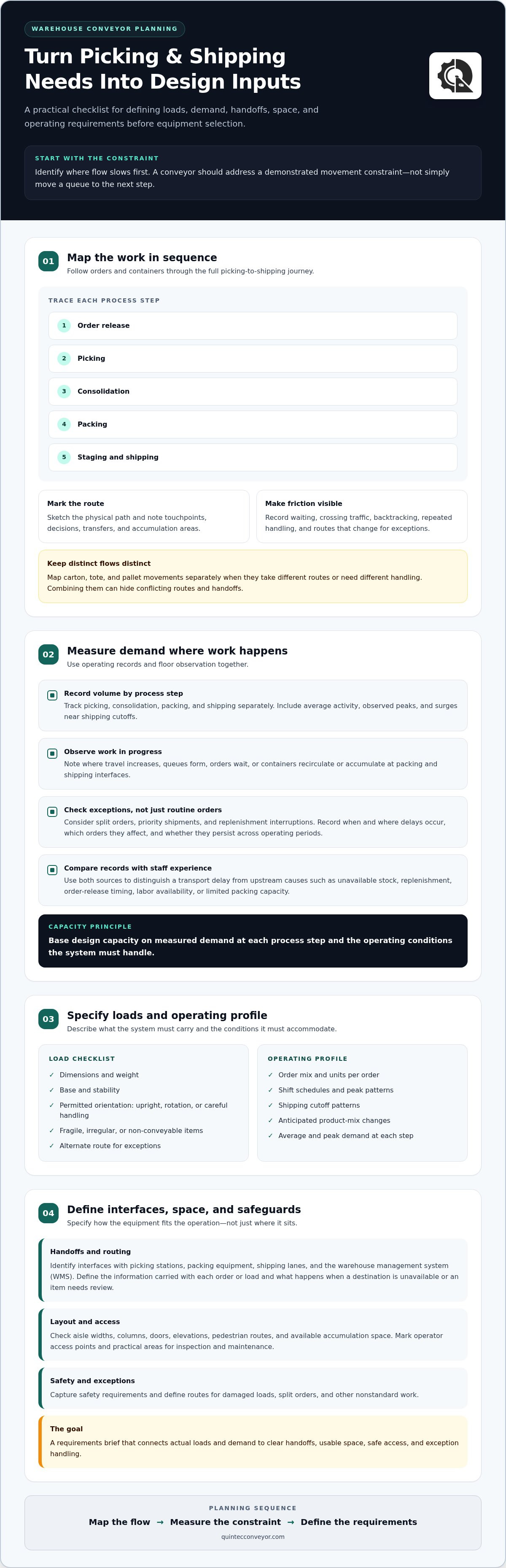
Build a short requirements brief in sequence:
- Document loads and permitted orientations.
- Record order patterns and demand by process step.
- Define equipment, software, and operator handoffs.
- Capture layout, access, safety, and exception requirements.
Define the load and the operating profile
Record the dimensions, weight, base, and stability of the cartons, totes, and pallets that will travel on the system. Note whether each load must stay upright, can rotate, or needs careful handling. Identify fragile, irregular, or non-conveyable items and define an alternate route for them, so exceptions don’t disrupt the primary flow.
Then describe the operating profile: order mix, units per order, shift schedules, peak patterns, and anticipated product-mix changes. These inputs clarify which loads and demand conditions the system must accommodate. MHI's guide to conveyors offers background on conveyor approaches; the right choice for a warehouse depends on matching those approaches to its loads and workflow.
Set handoff, space, and system requirements
Specify where the conveyor meets picking stations, packing equipment, shipping lanes, and the warehouse management system (WMS). Define what information must accompany an order or load at each interface, and what should happen if a destination is unavailable or an item needs review. These details help prevent a design that moves product physically but leaves staff to resolve unclear routing manually.
Check the proposed path against aisle widths, columns, doors, elevations, pedestrian routes, and available accumulation space. Mark operator access points and practical areas for inspection and maintenance. Establish safety requirements and define exception routes for damaged loads, split orders, or other nonstandard work. Include these constraints in the design brief before the layout is set.
Define requirements for both routine work and demanding conditions. Quintec Conveyors plans conveyor systems alongside relevant automation, infrastructure, and material handling needs. See integrated conveyor and material handling systems for an overview of this project approach.
Compare conveyor approaches by picking-to-shipping fit, not by type alone
A conveyor type is useful only if it supports the work at the point where orders need to move. Compare each approach against the route, load, handoff, and downstream capacity identified in your workflow. A solution that transports picked cartons effectively may still create a packing queue if it delivers work faster than the next process can handle.
The table offers a starting point, not a substitute for matching equipment to actual loads and operating conditions. The U.S. Bureau of Labor Statistics’ overview of material moving equipment provides context on how equipment supports the movement of goods. In a warehouse design, focus on how each section connects with workers, workstations, and shipping destinations.
Match transport and accumulation to the work
Consider load bases, stability, and the degree of control needed at each transfer. Belt conveying can support controlled movement for compatible cartons or totes. Roller systems depend on suitable load contact and a layout that manages flow; gravity sections can support short, appropriately positioned transfers, but movement and stopping must suit the task. Accumulation provides a buffer between processes, not extra capacity at a constrained station.
| Approach | Use case and strengths | Constraints and load fit | Picking or shipping interface |
|---|---|---|---|
| Powered belt | Controlled movement along a defined route. | Loads must suit the belt and transfers; assess dimensions, stability, and handling needs. | Can connect picking or packing points to downstream work. |
| Roller | Transport between work areas where loads can move on rollers. | Load bases and stability affect compatibility and flow control. | Can support handoffs near packing or shipping stations. |
| Gravity | Short transfers where a suitable slope can move loads without powered transport. | Route, load behavior, and stopping control must fit the task. | May suit a simple handoff between adjacent process points. |
| Accumulation | Buffers work briefly between processes with different timing. | Needs space and a defined release method; it cannot resolve an ongoing capacity shortfall. | Can help separate upstream delivery from downstream processing. |
Decide when routing or elevation changes matter
If orders must reach different shipping lanes or destinations, assess sortation at the point where that routing decision occurs. Cross-belt sorter systems provide a closer look at one approach to directing items to multiple destinations. The key question is whether routing is a real requirement in the mapped flow, not whether a sorter appears more advanced.
Vertical movement may be relevant when operations span multiple levels or floor space constrains a direct route. Evaluate how an elevation change affects load transfer, access, and the next process. Compare the end-to-end result, not headline speed alone. Match each section to its role, then check that the combined flow reaches packing and dispatch without creating a new queue. For broader design context, explore custom conveyor systems and industrial integration.
Build a conveyor selection checklist that protects flow and flexibility
A selection checklist turns operational requirements into criteria you can review before committing to a layout. Check more than whether a conveyor can move a load. Confirm that the complete route can handle demand, connect with each process, and remain workable for operators during routine tasks and exceptions.
Use these points to assess the proposed system:
- Capacity: Compare expected demand at each process step with its available downstream capacity.
- Load fit: Confirm that package dimensions, weight, base, stability, and orientation suit the selected approach.
- Routing and buffers: Define destinations, exception paths, and where temporary accumulation is useful.
- Interfaces: Review transfers between conveyors, workstations, packing equipment, shipping lanes, and warehouse software.
- Safety and access: Include pedestrian interaction, guarding, emergency access, operator ergonomics, and room for inspection and maintenance.
Define flexibility in practical terms. A layout may allow for modular sections, alternate routing, or a phased project, but those choices don’t guarantee simple future expansion. Document which changes the design should accommodate, the assumptions behind them, and any facility or system constraints that could affect them.
Validate performance against the current operation
Before setting improvement targets, establish a baseline using the current operation. Record throughput by process step, queue time at key interfaces, time from order release to completion, and performance against shipping cutoffs. Then set project-specific targets for those same measures. This gives you a consistent basis for comparing the proposed design with current conditions instead of relying on general claims about efficiency.
Test handoffs as a connected chain. If one conveyor section delivers work faster than packing or shipping can process it, the queue may simply move downstream. Model normal demand, seasonal peaks, SKU changes, and exception orders. Make the assumptions behind projected results visible, including the operating conditions the system is expected to support.
Protect safety, access, and future adaptability
Review pedestrian crossings, guarding, emergency access, and operator reach as part of the layout, not as details to resolve after equipment placement. Allow practical access for cleaning, inspection, repairs, and routine maintenance. If modular or phased design could support future changes, identify those options and their dependencies clearly rather than treating them as a promise of easy expansion.
Compare the design with baseline measures, target outcomes, and realistic operating scenarios. Quintec Conveyors brings engineering together with the wider material handling operation, including conveyor maintenance and process engineering. Learn more about conveyor systems and material handling solutions.
Plan an integrated conveyor project around measurable warehouse outcomes
A successful conveyor project starts with a defined operational problem and ends with a system that can be evaluated against clear objectives. Document the flow issue, translate it into requirements, develop an integrated design, coordinate installation and interfaces, then validate performance against agreed measures. This keeps decisions grounded in the warehouse’s actual order journey instead of treating equipment selection as an isolated purchase.
Prepare a project brief that supports sound decisions
Bring essential operating information into one brief: current routes, observed bottlenecks, product profiles, demand patterns, and facility constraints. State baseline measures and project objectives, such as reducing queue time at a defined handoff or improving the proportion of orders ready before shipping cutoffs. Treat these as targets to assess, not guaranteed outcomes. Include interfaces, exception handling, safety needs, and the people responsible for operating and maintaining the system.
A concise project sequence helps teams work from evidence to a testable design:
- Document: Describe the current workflow, constraints, and source of delay.
- Define: Set load, demand, routing, interface, safety, and access requirements.
- Design: Develop a conveyor concept around the process and facility.
- Integrate: Coordinate equipment with relevant software, automation, infrastructure, and work areas.
- Validate: Test representative workflows and compare results with the baseline.
Not every project needs the same combination of equipment. Conveyor design may account for robotics or other automation, existing infrastructure, warehouse racking, and the way each order moves between processes. Treating these as connected design considerations makes handoffs and space requirements clearer before installation planning advances.
Move from system concept to operational readiness
Design, engineering, installation, and integration work best as coordinated stages of a tailored project. Plan validation around representative orders, load types, routing rules, and handoffs, including common exceptions. This helps reveal whether the system supports the intended workflow across its interfaces, not just whether individual sections operate as expected.
Operational readiness also includes preparing the people and processes that will support the system. Include operator orientation, maintenance planning, and a post-installation review of the agreed performance measures. If results differ from expectations, documented assumptions and baseline data help teams identify whether the issue relates to demand, process changes, interfaces, or system performance.
Build the project around measurable outcomes and a coordinated view of the full operation. Quintec Conveyors provides conveyor design, engineering, and installation, supported by process engineering and experience across the industry. Discuss a warehouse conveyor project shaped around your workflow and operational requirements.
Make your next conveyor decision a workflow decision
Turn your operational observations into a focused project brief. Bring the order patterns, facility constraints, and performance measures that matter most to your team. A clear starting point keeps the discussion centered on your warehouse’s priorities and the outcomes the system needs to support.
Choose equipment by how each design decision supports the full route from picked order to dispatch. The right approach depends on your operation, and a well-defined project brief gives the design process a stronger foundation.
Work with Quintec Conveyors to plan a conveyor system around your warehouse workflow. Discuss your material handling project and the operational requirements it needs to support.
Frequently Asked Questions
How do I know whether a conveyor will improve picking and shipping flow?
A conveyor is most likely to help when delays come from transporting completed picks between process steps, rather than stock availability, order-release timing, or workstation capacity. Compare current travel and waiting with the delay the system is intended to address. Check that the proposed route removes a documented obstacle without simply moving the queue downstream.
Can a conveyor system work with our existing warehouse layout?
Yes. A conveyor can be planned around an existing facility, but the layout must be assessed for clearances, structure, traffic, and process connections. For example, a route may need to work around fixed columns, existing racking, or a busy pedestrian crossing. A scaled floor plan paired with on-site dimensions helps reveal conflicts early and shows whether the route or surrounding infrastructure should be adjusted.
What information should I collect before planning a warehouse conveyor system?
Gather representative order records, package dimensions and weights, and timestamps showing when orders are released, picked, packed, and shipped. Include examples from ordinary periods and unusual cases, such as split orders or priority shipments. Note which processes or systems assign destinations and record order status. Together, these details help distinguish a recurring design need from an isolated event and support useful project assumptions.
Can a conveyor system handle different carton and tote sizes?
It can be designed for a defined range of cartons and totes, provided the loads are compatible with the conveyor and transfer points. Document the smallest and largest common items, differences in base shape, and whether packages can travel in more than one orientation. Also identify items outside the normal range. This information helps determine how mixed loads move and where alternate handling may be needed.
How can conveyors support seasonal peaks in order volume?
Plan around the busiest operating scenarios, not only typical daily demand. Review when volume rises, which order types increase, and whether pressure falls mainly on picking, packing, or shipping. A conveyor may support more consistent transport between steps, while carefully planned accumulation can absorb short timing differences. It won’t resolve a sustained shortage of downstream processing capacity, so test peak assumptions across the complete workflow.
Do conveyors eliminate manual work in picking and packing?
No. Conveyors can reduce some manual transport between work areas, but picking, packing, exception handling, and quality checks may still require people. The impact depends on the tasks in the process and how work is organized around the equipment. Map which activities remain manual and how operators will interact with transfers, controls, and exceptions. This helps set realistic staffing and workflow expectations without assuming automation removes every handling task.
Can a conveyor system connect with warehouse automation and software?
Yes. An integrated design can coordinate conveyor movement with warehouse automation, robotics, and software used to manage order flow. Define what information needs to pass between systems, such as order identification, destination, and routing status, and determine how exceptions should be handled. Clear interface requirements help prevent equipment and software from operating as disconnected components. The integration approach should reflect the systems and processes in the warehouse.