
How AI is Affecting the Conveyor Industry: A 2026 Strategic Overview
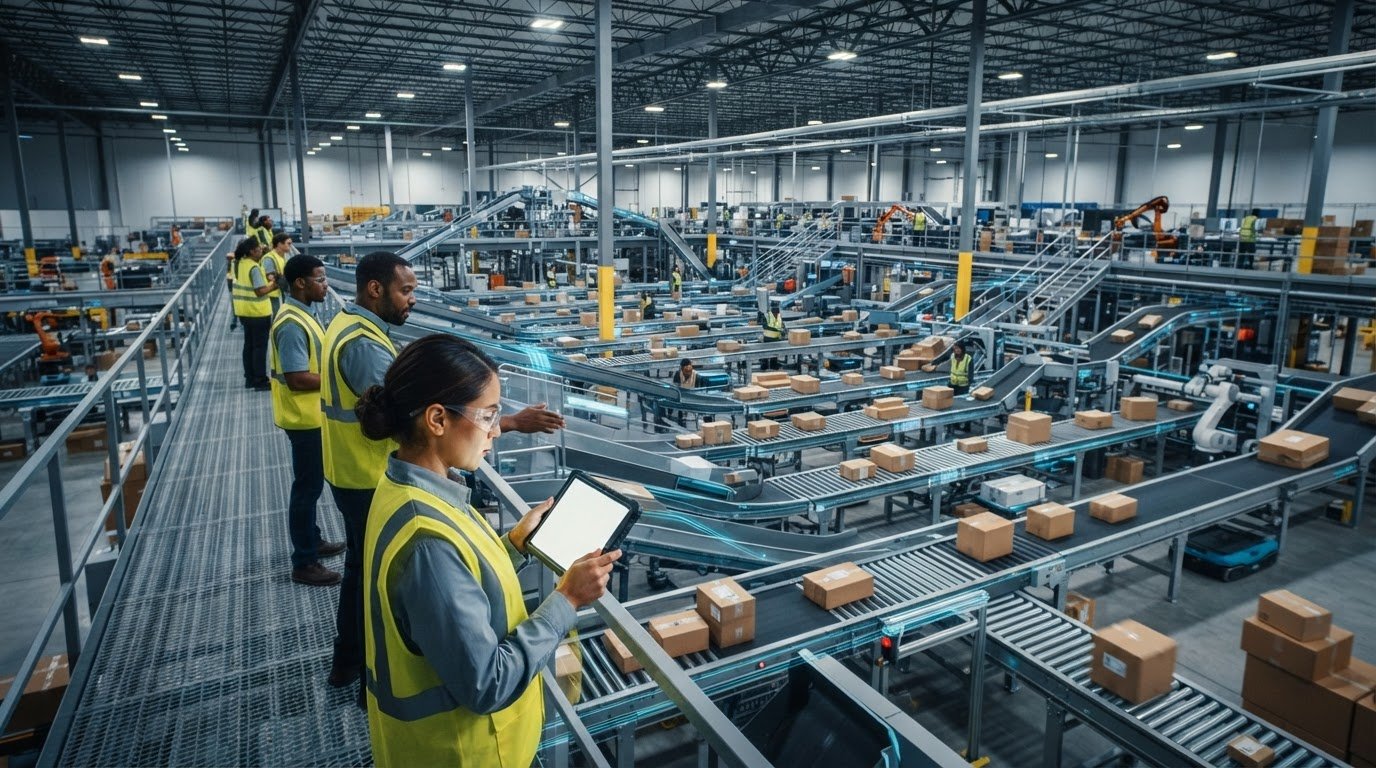
With the average cost of unplanned conveyor downtime reaching $250,000 per hour in 2026, the era of reactive maintenance has become a luxury no facility can afford. You've likely felt the pressure of rising labor shortages and the frustration of sortation bottlenecks during peak demand cycles. It's clear that traditional transport belts aren't enough to maintain a competitive edge in today's high-velocity market. Understanding how AI is affecting the conveyor industry is no longer a futuristic exercise; it's a strategic necessity for long-term stability.
Discover how Artificial Intelligence is transforming conveyor systems from simple transport belts into self-optimizing, intelligent networks that redefine warehouse efficiency. By integrating advanced machine vision and IoT sensors, these systems now act as the sensory organs of your facility, enabling real-time decision making. This strategic overview examines the transition from reactive to predictive maintenance and details how you can increase throughput without adding headcount. We'll provide the roadmap you need to future-proof your infrastructure and turn complex logistical challenges into a streamlined, high-performance operation that values precision and modern excellence.
Key Takeaways
- Understand the evolution of material handling assets into connected sensory networks that feed real-time data directly into your Warehouse Execution System.
- Discover how AI is affecting the conveyor industry by transitioning facilities from reactive troubleshooting to data-driven predictive maintenance models.
- Learn how advanced sortation logic dynamically manages volume surges and optimizes belt density to eliminate costly throughput bottlenecks.
- Identify the core technical criteria for assessing your current hardware readiness and establishing proper data hygiene before deployment.
- Recognize the value of partnering with an experienced integrator to seamlessly blend physical infrastructure with cutting-edge automation.
The Evolution of Conveyors: From Passive Assets to Intelligent Sensory Networks
A traditional Conveyor system traditionally served as the mechanical backbone of a facility, moving items from point A to point B through basic motor control and fixed paths. For decades, these were passive assets, they moved when told and stopped when blocked. However, 2026 marks a definitive tipping point for the industry. We're seeing a shift where hardware is no longer just a transport mechanism but a sophisticated data collector. Understanding how AI is affecting the conveyor industry begins with recognizing this transition from static equipment to autonomous ecosystems that think, learn, and respond in real time.
Modern material handling now relies on real-time edge processing to handle the immense data loads generated by high-speed sortation. By processing data at the "edge"-directly on the conveyor controller rather than a distant server-facilities reduce latency to near zero. This speed is critical for maintaining throughput during peak demand. These systems don't just move boxes; they act as the primary data collection points for your Warehouse Execution System (WES), providing the granular visibility needed for total project management.
Automation vs. AI: Understanding the Difference
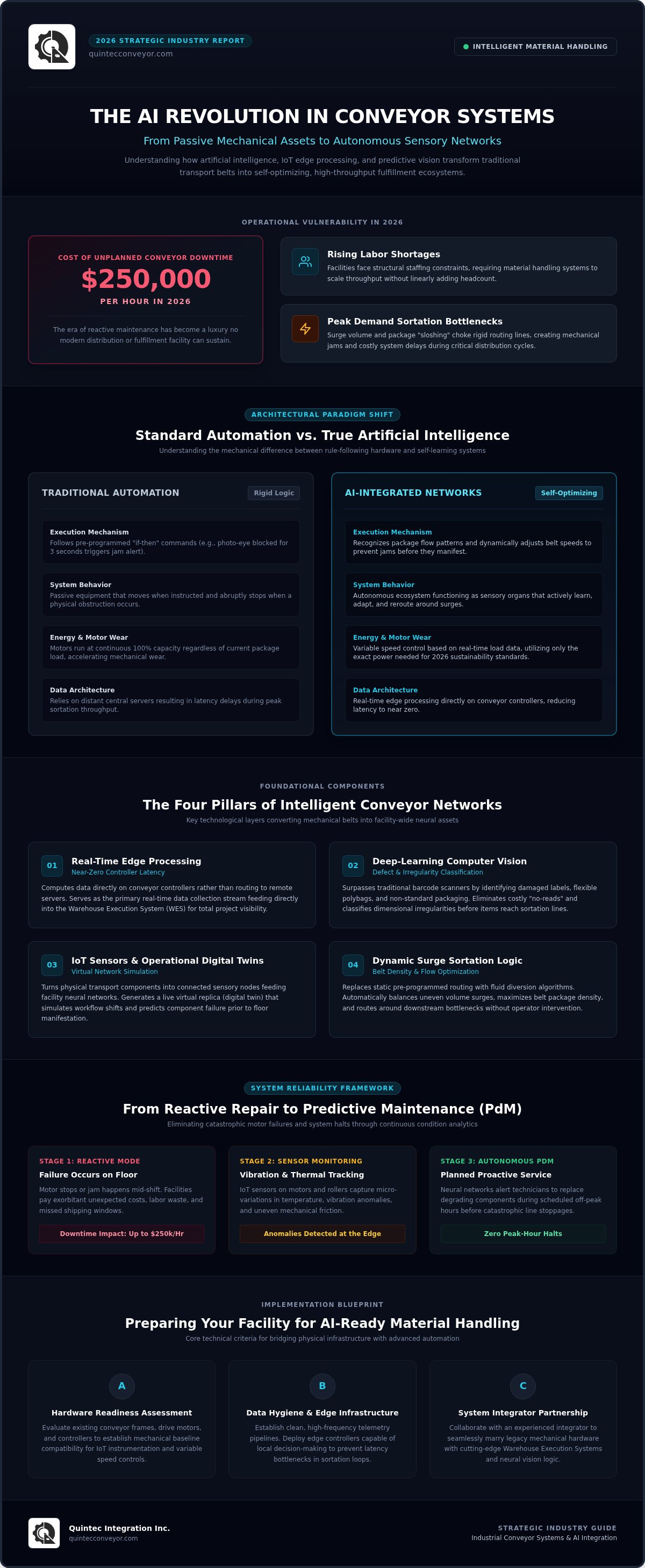
It's easy to confuse standard automation with true Artificial Intelligence, but the distinction is vital for strategic planning. Traditional automation follows rigid "if-then" rules. If a photo-eye is blocked for three seconds, the system triggers a jam alert. AI doesn't just follow rules; it learns and adapts to volume fluctuations. It recognizes patterns in how packages flow and proactively adjusts belt speeds to prevent the jam from ever occurring.
Machine learning significantly impacts energy efficiency and mechanical longevity. By utilizing variable speed control informed by real-time load data, systems can meet the latest 2026 standards for operational sustainability. You aren't just running a motor at 100% capacity all day; you're using exactly the power required for the current load. This moves your facility away from rigid, pre-programmed sortation logic toward dynamic routing that handles "sloshing" or uneven volume surges with ease.
The Conveyor as a Data Source
To achieve high-level results, you must treat your infrastructure as a network of IoT sensors. These sensors feed data into facility-wide neural networks, creating a comprehensive "digital twin" of your operations. This virtual replica allows you to simulate changes or predict failures before they manifest on the floor. Every parcel movement contributes to this model, refining the system's accuracy with every shift. Sensory Conveyor Networks are the essential foundation of 2026 logistics, turning physical movement into actionable intelligence.
AI Vision and Predictive Analytics: The New Standard for System Reliability
Reliability is the metric that defines modern facility success. As systems become more complex, the margin for error shrinks. Understanding how AI is affecting the conveyor industry requires a deep dive into the technologies that ensure uptime: computer vision and predictive analytics. These aren't just software add-ons; they're essential components that transform a mechanical line into a self-correcting system. By identifying package damage or misalignments before they cause physical jams, these tools protect both your product and your equipment.
Computer Vision in High-Speed Sortation
Standard scanners often struggle with irregular packaging, polybags, or damaged labels. AI-driven vision systems use deep learning to identify these items with high precision, significantly reducing the "no-reads" that force manual intervention. By integrating these systems into sortation conveyors, facilities can maintain flow even when package quality is inconsistent. This technology goes beyond barcodes to classify defects and dimensional irregularities in real time, ensuring that only viable parcels continue through the network.
Eliminating Unplanned Downtime with PdM
Reactive repairs are a drain on resources. When a motor fails unexpectedly, the cost isn't just the part; it's the labor and the lost throughput. Industry data shows that unplanned downtime can cost as much as $250,000 per hour. AI-driven predictive maintenance (PdM) changes the equation. By analyzing historical wear patterns and real-time data from vibration and thermal sensors, AI models can predict motor or bearing failure weeks in advance. This allows your team to schedule repairs during planned windows, avoiding the chaos of a mid-shift breakdown.
Facilities adopting these strategies see a 20% to 40% reduction in maintenance costs and can reduce unplanned downtime by up to 70%. This shift allows for targeted interventions rather than broad, scheduled inspections that might miss developing issues. Effective conveyor maintenance now relies on these predictive alerts to optimize spare-parts inventory by 15% to 30%. Implementing these solutions through strategic warehouse automation ensures your facility remains resilient against mechanical fatigue.
Reducing the total cost of ownership (TCO) is the ultimate goal for every facility manager. When you extend belt life by 30% to 50% through AI-optimized tensioning and alignment, the long-term savings are substantial. It's about moving from a state of constant firefighting to a controlled, data-driven environment. As you evaluate how AI is affecting the conveyor industry, the shift toward predictive analytics stands out as the most direct path to sustainable operational excellence.
Solving Complex Logistical Bottlenecks with AI-Driven Sortation Logic
Managing uneven flow and sudden surges in warehouse volume requires a system that adapts instantly to changing conditions. In industrial logistics, this unpredictability often leads to "sloshing", a scenario where product accumulation creates severe downstream constraints. Traditional systems handle these surges by stopping sections entirely, a reactive approach that compromises throughput. Evaluating how AI is affecting the conveyor industry reveals a shift toward dynamic gapping and buffering, allowing systems to maximize belt density while completely eliminating package collisions.
Energy consumption represents another critical area of operational optimization. Through load-dependent variable speed optimization, intelligent networks alter motor speeds based on real-time weight and volume data rather than running at continuous maximum capacity. This targeted approach pairs perfectly with the physical execution of warehouse robotics integration, ensuring that physical picking assets and smart transport lines operate in complete synchronization.
Dynamic Sortation and Routing
Programmable Logic Controllers (PLCs) have long served the industry well, but their fixed code cannot handle multi-tier routing complexities during peak demand. AI sortation logic continuously assesses the status of the entire network, re-routing traffic in real time to avoid congestion points before they form. This predictive routing proves particularly effective within multi-tier modular conveyor systems, where multiple lines converge into single sortation points. While traditional PLC configurations require manual reprogramming to adjust to new throughput profiles, machine learning models adapt organically to changing floor layouts and product mixes.
Maximizing Throughput Accuracy
Speed without precision inevitably leads to product damage and costly rework. AI sortation logic eliminates the trade-off between speed and accuracy by continuously modulating acceleration and deceleration rates based on product fragility and weight profiles. This granular control reduces product damage during high-velocity transitions, establishing a steady operational cadence that is highly effective for "lights-out" warehouse operations where manual oversight is minimal. By managing the physical physics of material handling through software intelligence, facilities can maintain maximum throughput without risking product integrity or system longevity.
Strategic Implementation: Preparing Your Facility for AI-Integrated Material Handling
Implementing advanced technology requires more than just a software license. It demands a rigorous evaluation of your physical infrastructure. As you analyze how AI is affecting the conveyor industry, it's clear that the intelligence of your system is limited by the quality of its mechanical components. A sophisticated AI model cannot optimize a facility if the underlying hardware is incapable of high-speed communication or variable speed response. Successful deployment begins with a strategic assessment: determining whether your current assets are suitable for retrofitting or if a new build is the more viable path for long-term stability.
Data hygiene is the most overlooked factor in modern material handling. If your sensors provide inconsistent or noisy data, the resulting AI outputs will be flawed. Ensuring your photo-eyes, encoders, and thermal sensors provide actionable, high-fidelity inputs is essential before layering on complex algorithms. Collaborating with professional warehouse design services allows you to map AI-driven flow at the engineering stage, ensuring that sensor placement aligns with the logic required for predictive sortation.
Retrofitting Legacy Systems for AI
For many facilities, a complete overhaul isn't financially feasible. Retrofitting offers a middle ground, allowing you to add smart sensors to existing belt and roller conveyors. This process involves upgrading motor drives and controllers to support the feedback loops that AI requires. By integrating modern Variable Frequency Drives (VFDs) that communicate via industrial protocols like OPC-UA, you enable your legacy equipment to respond to real-time optimization commands. The role of custom material handling system design is critical here, as it ensures that new technology integrates seamlessly with older mechanical frames without compromising structural integrity.
The Roadmap to an AI-Integrated Facility
A methodical approach reduces the risk of operational disruption. We recommend a three-step roadmap for facilities looking to modernize. First, utilize process engineering to identify the specific bottlenecks where AI can provide the highest ROI. Second, install the necessary sensor and data infrastructure to begin collecting baseline performance metrics. Finally, implement a pilot AI model in a single sortation zone to validate the logic before a facility-wide rollout. This phased strategy ensures that your staff has time to adapt to working alongside autonomous systems, shifting their focus from manual intervention to high-level system oversight.
Transitioning to an intelligent network is a complex undertaking that requires a steady, expert hand. If you're ready to evaluate your facility's readiness for the next generation of automation, contact Quintec Conveyors today for a comprehensive systems analysis.
The Future of Warehouse Flow: Partnering for AI-Ready Conveyor Integration
The transition to an intelligent material handling ecosystem isn't a simple software patch; it's a comprehensive engineering evolution. As we've explored, understanding how AI is affecting the conveyor industry requires looking past the algorithms to the physical hardware they control. Success in this new era depends on your ability to integrate these disparate systems into a single, cohesive unit. A specialized integrator acts as the strategic guide, ensuring that your investment in Artificial Intelligence translates into measurable gains in throughput and reliability.
Future-proofing your investment means looking beyond the immediate needs of 2026 toward a fully autonomous logistical framework. This requires a commitment to modular designs that can be reconfigured as your business grows. When your infrastructure is built with scalability in mind, you can implement new AI models or robotic assets without tearing out existing lines. It's about building a foundation that values long-term stability and modern excellence in equal measure.
Why Integration Matters More Than Ever
One of the greatest risks in modern warehouse planning is the adoption of siloed AI software. These programs often exist in a vacuum, failing to communicate effectively with the mechanical hardware on the floor. When software and hardware don't speak the same language, the result is increased latency and missed opportunities for optimization. We bridge this gap by combining deep process engineering expertise with advanced robotics integration. This ensures that your conveyors, Warehouse Execution Systems (WES), and Enterprise Resource Planning (ERP) tools function as a unified sensory network.
By prioritizing seamless communication, you avoid the bottlenecks that occur when high-level logic isn't aligned with physical belt capabilities. This integrated approach is essential for managing the complex interplay between autonomous mobile robots and fixed conveyor lines. You don't want a system that's obsolete in two years; you need an infrastructure that adapts as autonomous logistics continue to evolve.
A Partnership for Professional Excellence
Maintaining high-level results requires a partner that offers more than just equipment installation. Professional maintenance and engineering support are the lifelines of an AI-driven facility. As predictive models identify potential failures, you need a national service network capable of executing targeted interventions before downtime occurs. This proactive maintenance model is what separates industry leaders from those still caught in reactive cycles.
Quintec brings over 100 years of collective industry experience to every project. We pair this seasoned authority with a forward-looking spirit, implementing 2026 technology while respecting the proven mechanical principles that ensure stability. This dual personality allows us to act as a steady hand for clients navigating large-scale projects, from initial custom design to national maintenance rollouts. If you're ready to secure your facility's place in the future of autonomous logistics, contact Quintec for an AI-readiness assessment of your conveyor system.
Securing the Future of Autonomous Material Handling
The transformation of material handling from isolated mechanical tracks into interconnected, self-optimizing networks is already reshaping operational benchmarks. Understanding how AI is affecting the conveyor industry allows forward-thinking leadership teams to move past reactive troubleshooting and embrace absolute precision. By utilizing advanced computer vision alongside dynamic sortation logic, modern facilities can eliminate traditional bottlenecks and optimize throughput without unnecessary headcount increases.
Navigating this technological shift requires a reliable, experienced strategic partner. Quintec brings over 100 years of collective industry experience to the table, specializing in high-throughput robotics and automation. Backed by our national installation and maintenance coverage, we ensure your infrastructure remains resilient, scalable, and prepared for the demands of tomorrow. It's time to transition from passive hardware to an intelligent ecosystem. Scale your facility's intelligence with Quintec's AI-ready conveyor solutions and transform your operational challenges into sustainable long-term excellence.
Frequently Asked Questions
How much does it cost to add AI to an existing conveyor system?
The total cost varies depending on the scale of your infrastructure, the number of assets being monitored, and the tier of system integration required. While software and sensor components involve specific monthly or per-station fees, the final investment is determined by hardware readiness and retrofitting requirements. A professional systems evaluation is necessary to determine the precise engineering scope for your facility.
Can AI really reduce my warehouse maintenance costs?
Yes, implementing predictive analytics can reduce overall maintenance costs by 20% to 40% while reducing unplanned downtime by up to 70%. By analyzing historical wear patterns and real-time sensor data, the system schedules targeted interventions before a mechanical failure occurs. This proactive approach optimizes your spare-parts inventory by 15% to 30% and eliminates the high costs associated with sudden, mid-shift breakdowns.
Do I need to replace my entire conveyor to use AI vision technology?
No, a complete replacement is rarely necessary to leverage advanced computer vision. Most modern vision systems can be integrated into existing mechanical frames through custom engineering and control upgrades. This process involves adding high-speed cameras, smart sensors, and compatible Variable Frequency Drives to your current setup, allowing you to modernize your facility without the expense of a complete infrastructure overhaul.
How does AI sortation differ from traditional automated sortation?
Traditional automated sortation relies on fixed, pre-programmed Programmable Logic Controller rules that cannot adapt to unexpected changes. AI-driven sortation logic continuously evaluates the entire network to manage volume surges and prevent downstream congestion in real time. This dynamic routing maximizes belt density and eliminates the traditional trade-off between high-speed throughput and package handling precision.
What kind of sensors are required for AI-driven predictive maintenance?
AI-driven predictive maintenance relies on a network of specialized IoT sensors installed across critical mechanical components. These include vibration sensors on motors and bearings, thermal sensors to detect overheating, and acoustic sensors to identify internal friction. Additionally, laser alignment sensors and smart encoders track belt tension and speed deviations, providing high-fidelity data directly to the analytics platform.
Is AI integration safe for workers on the warehouse floor?
Yes, integrating AI enhances worker safety by establishing a more predictable operational environment. The software monitors system health continuously, automatically slowing down or stopping sections when it detects abnormal resistance or potential jams. This reduces the need for manual clearings and hazardous interventions, ensuring that your team works alongside automated systems with a significantly lower risk of injury.
How long does it take to implement an AI-optimized conveyor network?
The implementation timeline depends on whether you are retrofitting an existing line or building a new, fully integrated system. A typical deployment begins with process engineering and data infrastructure installation, followed by a localized pilot phase. This structured method ensures that your facility maintains operational continuity while your team adapts to the new automation workflows.
What is the expected ROI for AI in the conveyor industry by 2026?
Facilities evaluating how AI is affecting the conveyor industry can expect a rapid return on investment through substantial operational savings. The primary drivers of ROI include the elimination of unplanned downtime, which can cost up to $250,000 per hour, and a 30% to 50% extension in conveyor belt life. These efficiency gains allow operations to achieve significantly higher throughput without adding headcount.