
Tilt Tray Sorter Selection Guide: Engineering High-Speed Warehouse Sortation in 2026
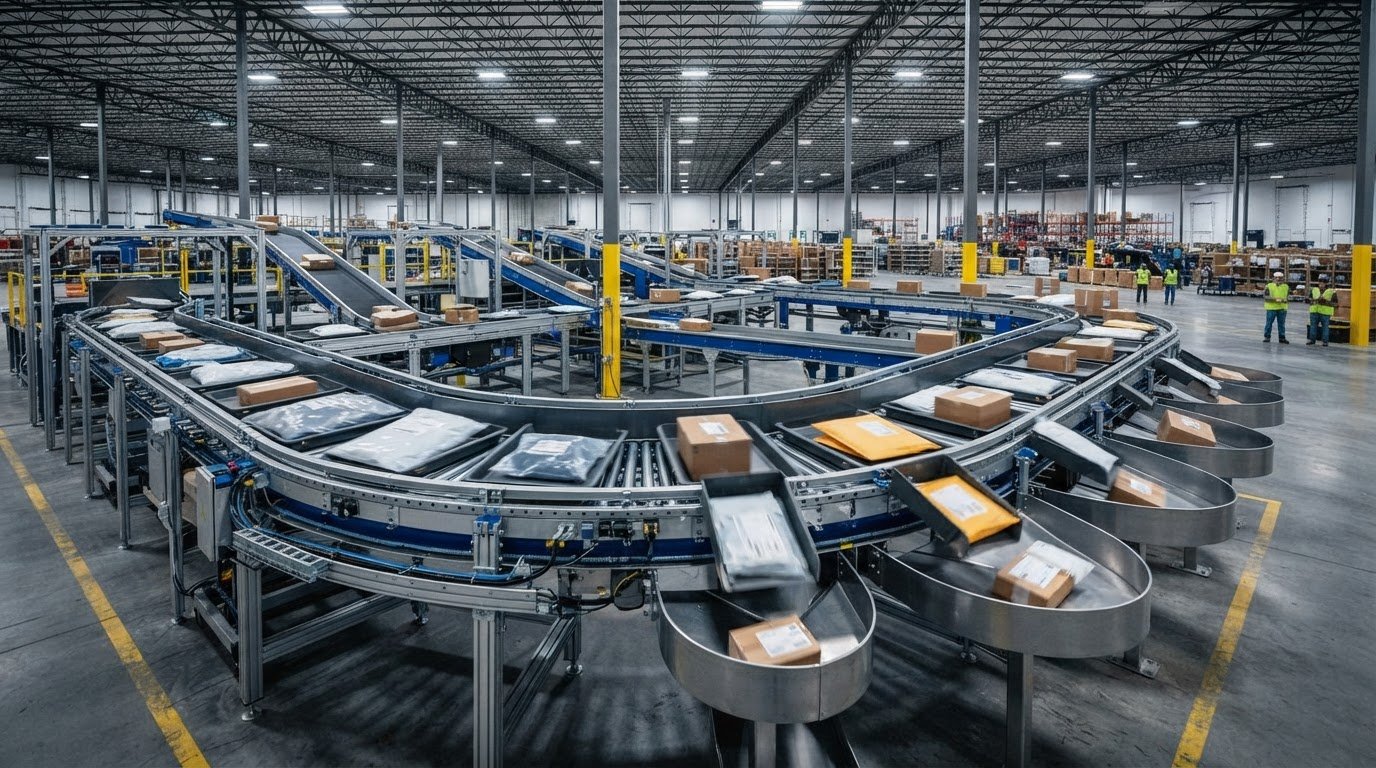
Pushing line velocity to its mechanical limit won't resolve a distribution bottleneck if items tumble from carriers or jam at the discharge chute. True sortation accuracy depends on tray mechanical geometry and integration engineering, not raw loop speed. If you're struggling to balance high-speed sorting with gentle handling for slick polybags and fragile cartons, you aren't alone. Hitting aggressive throughput targets exceeding 10,000 to 20,000 items per hour while adapting to rigid building columns and legacy software constraints often feels like an uphill battle. Specifying the right tilt tray sorter requires looking beyond generic equipment ratings to evaluate how mechanical dynamics directly interact with your specific product mix.
In this guide, you'll discover how to evaluate, specify, and integrate industrial tilt tray sorters to optimize facility throughput, eliminate parcel damage, and protect long-term operational efficiency. We'll examine tray geometry, induction line synchronization, discharge chute profiles, and controls architecture to help you engineer a dependable sortation loop built for modern fulfillment demands.
Key Takeaways
- Master the mechanical operating principles of the tilt tray sorter to combine high-speed sortation loops with controlled, gravity-assisted discharge.
- Evaluate horizontal carousel loops against vertical over-under configurations to optimize sort points while respecting facility footprint constraints.
- Specify custom tray surfaces, lip geometry, and chute deceleration angles to eliminate package tumble and polybag jams across diverse SKU mixes.
- Apply a structured evaluation framework that accounts for multi-year packaging trends to sustain predictable throughput exceeding 10,000 to 20,000 items per hour.
- Synchronize dynamic induction conveyors and controls architecture with existing warehouse software to maintain balanced continuous loop flow.
Understanding Tilt Tray Sorter Mechanics and High-Speed Unit Handling
A tilt-tray sorter operates as a continuous-loop material handling system designed to transport individual inventory items on dedicated mechanical trays. As each tray reaches its programmed discharge point, it tilts laterally to deposit the unit into an assigned chute via gravity. Unlike flat-belt conveyors that push or divert items from underneath, this method cradles product securely within raised tray contours during travel. It excels at managing discrete, high-variability inventory: bagged apparel, boxed pharmaceuticals, multimedia items, and irregular e-commerce parcels.
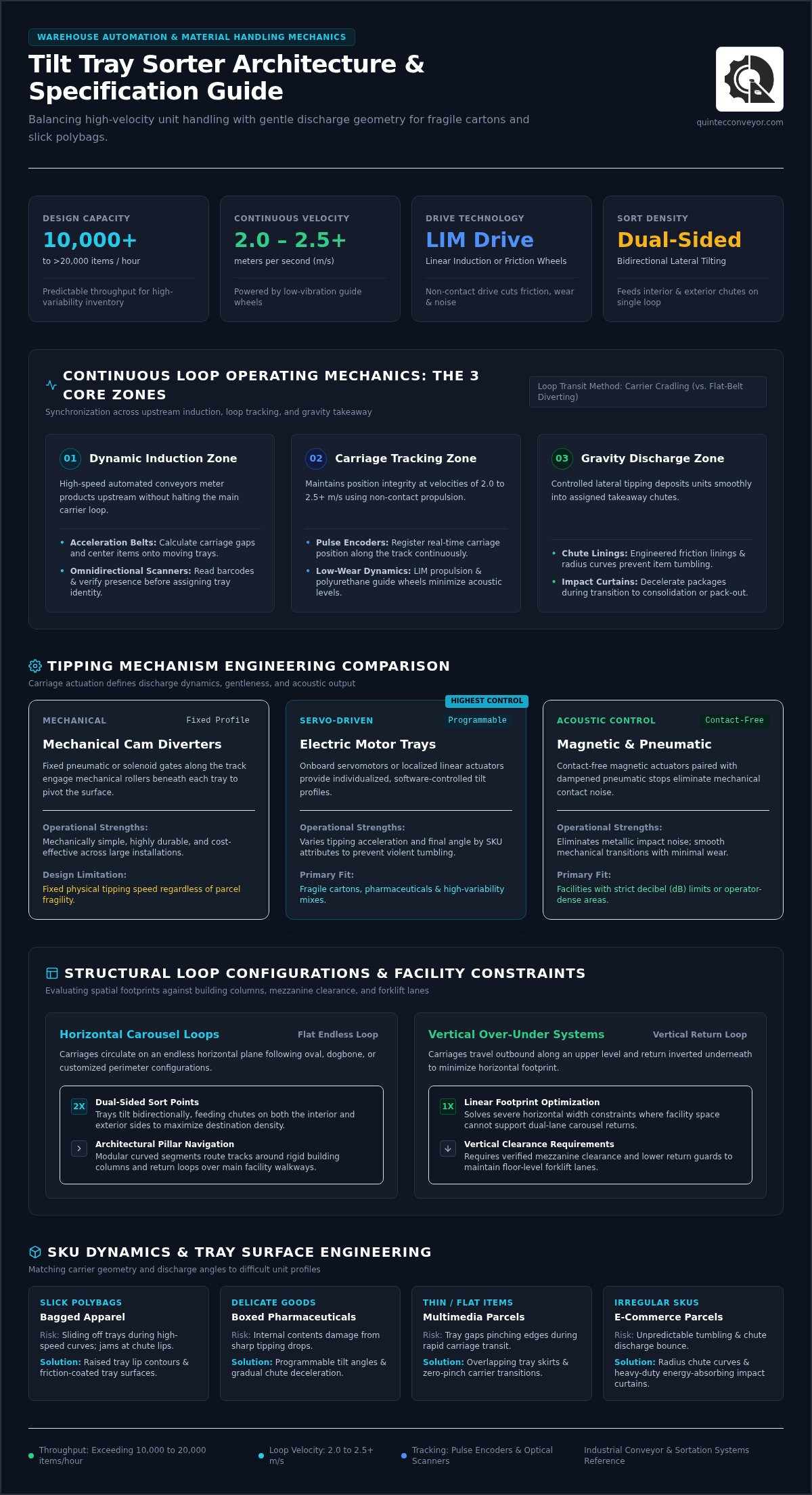
Propulsion drives system reliability. Modern loops utilize non-contact linear induction motors (LIM) or heavy-duty friction drive wheels. Linear induction eliminates mechanical drive chains, significantly cutting friction, wear, and acoustic levels across continuous high-speed runs. Paired with low-friction polyurethane guide wheels, these drives deliver continuous operational speeds often exceeding 2 to 2.5 meters per second with minimal vibration.
The Mechanical Tilting Mechanism: Cam-Driven vs. Electric Actuation
Carriage tipping actuation determines how gently products transition from the carrying tray into the takeaway chute:
- Mechanical cam diverters: Fixed pneumatic or solenoid gates actuate along the track, engaging mechanical rollers beneath the tray to pivot the surface. They are mechanically simple, durable, and cost-effective, though they discharge at a fixed physical speed.
- Electric motor-driven trays: Onboard servomotors or localized linear actuators provide programmable tilt profiles. Controls vary the tipping acceleration and final angle based on product attributes, preventing fragile items from tumbling violently.
- Magnetic and pneumatic actuators: Contact-free magnetic actuation and dampened pneumatic stops eliminate metallic impact noise, making them ideal for facilities requiring strict decibel control.
Core Operating Principles: Induction, Carriage Tracking, and Discharge
Sortation accuracy relies on synchronized interaction between three distinct mechanical zones: induction, tracking, and takeaway.
High-speed automated induction conveyors meter product flow upstream. Dynamic acceleration belts measure incoming item dimensions, calculate tray gaps, and deposit packages precisely into the center of passing carriages without stopping the main loop. Above the induction zone, omnidirectional optical scanners capture barcode data, verify package presence, and transmit unit identity to the system controller.
Once assigned, internal tracking logic registers the carriage position using pulse encoders. When the target destination is reached, the tilting mechanism fires cleanly. Downstream discharge chutes feature engineered friction linings, radius curves, and impact curtains to decelerate packages smoothly, preventing product damage as units transition to outbound packing or consolidation.
Evaluating Tilt Tray Sorter Configurations: Carousel Loops vs. Over-Under Systems
Choosing between a horizontal carousel loop and a vertical over-under system establishes the physical footprint for your entire sortation process. As categorized within modern industrial Conveyor and Sortation Systems, each mechanical arrangement solves distinct spatial constraints. Integrators must evaluate structural building columns, mezzanine clearance, and floor-level forklift lanes before committing to a specific carriage track geometry.
Continuous Horizontal Carousel Loops for Maximum Destination Density
Horizontal carousel loops circulate carriages in an endless flat loop that can follow oval, dogbone, or customized perimeter layouts. Because carriers tilt bidirectionally, a single track feeds discharge chutes positioned along both the interior and exterior sides of the conveyor line. This dual-sided design dramatically cuts required loop length while providing maximum destination density across large sorting operations.
Modular curved segments give system designers the flexibility to navigate around rigid architectural barriers. You can wrap lines around support pillars or route return loops over main facility walkways. It is best practice to evaluate structural footprints using warehouse design services early in planning, ensuring that induction zones and packing workstations have ample clear access.
Linear Over-Under Configurations for Narrow Facility Footprints
Facilities with restricted floor width cannot always accommodate the broad turning radius required by continuous carousels. In these tight environments, an over-under tilt tray sorter delivers high-volume sortation within a compact, linear profile. Carriages travel along an upper sorting deck, tilt to discharge packages, and return inverted along an enclosed lower deck directly beneath the primary line.
This vertical return path keeps system width to a minimum. Sorting chutes typically drop items along one side into dedicated consolidation bins, gaylords, or pack stations. Elevated frame designs also allow facilities to preserve ground-level clearance for forklift pathways and staging zones beneath the sorter. Collaborating with an experienced material handling integrator like Quintec helps ensure your selected mechanical configuration aligns with structural realities while maintaining long-term throughput capacity.
Technical Selection Criteria: Throughput, Item Profiles, and Chute Geometry
Operational sortation throughput is fundamentally an engineering equation balancing carriage pitch, linear travel speed, and induction fill rate. While catalog specifications for a tilt tray sorter often advertise maximum speeds handling 20,000 to 40,000 trays per hour, your actual output depends on package stability. If trays travel too quickly, lightweight polybags slide off track, and heavy parcels risk damaging downstream chutes.
Analyzing Package Characteristics: Polybags, Cartons, and Fragile SKUs
Every packaging medium interacts differently with carriage dynamics:
- Flexible polybags: These shift shape during acceleration. They require tray surfaces treated with textured or high-friction coatings to prevent shifting as carriages round high-speed curves.
- Rigid cartons: Uniform corrugate slides predictably, but square edges can catch during lateral tipping. Trays need beveled perimeters and low-profile retention lips that restrain items in transit while allowing clean gravity release.
- Fragile and irregular merchandise: Glassware, electronics, and odd-dimension SKUs cannot endure abrupt drops. Multi-stage tilt profiles use variable tipping angles to let units slide out under control rather than tumbling violently into takeaway lanes.
Tray Carrier Formats: Single Tray, Dual Tray, and Split-Tray Dynamics
Carriage design must match your product mix. Single trays work well for large apparel boxes, footwear cartons, and general freight. However, if your SKU distribution leans heavily toward small cosmetics, jewelry, or media, single large carriers waste valuable sorting capacity.
Dual-tray carriers position two independently actuated trays on a single mechanical pitch. This allows the system to sort two distinct small items simultaneously to separate chutes, effectively doubling your hourly capacity without increasing conveyor line speed. Alternatively, split-tray systems utilize center-opening bomb-bay doors, dropping small parcels vertically into collection totes with pinpoint accuracy.
Destination Chute Engineering and Gravity Deceleration Design
The exit chute absorbs the kinetic energy generated by the moving sorter. Spiral gravity chutes manage elevation drops cleanly, sending cartons down to lower packing lines without sudden impact. Straight chutes should feature adjustable slope angles, ultra-high-molecular-weight (UHMW) plastic liners, and heavy-duty impact curtains to control descent velocity. In addition, optical photo-eyes placed at chute thresholds detect accumulating backups, automatically commanding upstream controls to divert subsequent items to recirculation loops before a jam shuts down the entire sortation line.
Tilt Tray Sorter Selection Framework: Calculating Total Operational Fit
Selecting sortation machinery demands a systematic approach rather than guesswork. To ensure your capital deployment delivers long-term returns, you need a disciplined framework that evaluates physical SKU profiles, competitive sorting technologies, and mechanical lifecycle demands alongside your wider industrial conveyor systems.
Phase 1: Establishing Operational Metrics and SKU Size Envelopes
Begin by mapping your physical inventory characteristics across a rolling five-year horizon. Document the exact dimensions, weight variances, and centers of gravity for your full catalog. Sizing equipment purely on average package dimensions leads to bottlenecks during volume spikes.
Next, define capacity based on peak items-per-minute requirements instead of smoothed 24-hour averages. A facility processing 120,000 units daily often faces concentrated morning waves requiring 15,000 to 20,000 items per hour. These surge windows dictate whether your line needs multiple induction points and dedicated dynamic recirculation loops.
Phase 2: Comparing Tilt Tray vs. Cross-Belt and Bomb-Bay Technologies
Every sortation mechanism suits specific application niches:
- Tilt tray sorter systems: Provide an economical, mechanically robust solution for uniform parcels, apparel, packaged media, and postal freight. Gravity-based lateral discharge minimizes moving components per carrier, reducing baseline operating complexity.
- Cross-belt sorters: Utilize individual motorized mini-conveyors on each carriage. They excel at handling high-friction rubberized goods, ultra-light polybags, or delicate parcels that require positive, powered discharge into narrow chutes.
- Bomb-bay sorters: Open bottom drop doors to let flat apparel, poly mailers, and thin items fall vertically into collection totes, offering high destination density within narrow, straight-line footprints.
Phase 3: Calculating Mechanical Maintenance Overhead and Lifecycle Cost
Ongoing operational health depends on wear-part management. Sorters running multi-shift operations accumulate millions of cycles annually. Scrutinize mechanical contact points: drive wheels, guide bearings, tilt diverter rollers, and carrier link chains.
Ensure that structural layouts allow direct technician access to critical service locations, particularly along elevated tracks and turnaround curves. Fast maintenance also requires quick-disconnect carriage assemblies. When a carrier needs servicing, technicians should be able to swap out the mechanical assembly within minutes to prevent line stoppages. To design a tailored sortation loop that aligns with your facility's operational flow, partner with Quintec Conveyors for vendor-neutral process engineering and turnkey installation.
Integrating Tilt Tray Sortation into Existing Facility Workflows
High-speed sortation hardware never operates in a vacuum. Even a finely tuned tilt tray sorter fails to deliver on its operational promises if upstream feeding conveyor lines starve the loop or downstream takeaway lanes choke on volume. True facility efficiency requires complete mechanical, electrical, and controls integration across your operational footprint. Partnering with a skilled conveyor system integrator ensures these disparate sub-systems communicate without operational bottlenecks.
Upstream Infeed and Automated Dynamic Induction Synchronization
Carriage utilization depends on the precision of the induction line. High-speed belt mergers meter product flow to match passing carrier intervals perfectly. Multi-stage acceleration belts dynamically adjust spacing, matching conveyor speeds precisely to deposit units into the center of empty trays on the fly. For fragile goods, non-conveyable packages, or returns processing, facilities often pair automated lines with manual induction decks, giving operators ergonomic presentation surfaces to induct challenging items safely.
Vision Systems, Tracking Software, and Control Architecture
Robust tracking software forms the digital backbone of the sortation system:
- Omnidirectional scanning tunnels: Multi-sided optical scan tunnels identify linear and 2D barcodes across top, bottom, and side packaging planes at line speed, virtually eliminating no-reads.
- Synchronized PLC architecture: Programmable Logic Controllers interface with variable frequency drives and pulse encoders, calculating exact tray positions down to milliseconds.
- WES communication: Warehouse Execution Systems translate host orders into dynamic discharge destinations, balancing lane assignments across shifts.
- Predictive diagnostics: Machine vision and real-time sensor dashboards track tray mechanical drift and package positioning, flagging skewed parcels before they create physical jams.
Turnkey Implementation: From Engineering Layout to Commissioning
Process engineering bridges the gap between hardware delivery and live production. Experienced engineers analyze facility elevations, mezzanine clearance, and floor traffic to design support structures that maximize usable cube space. Rigorous pre-commissioning testing validates that sortation loops run reliably across every SKU weight and friction threshold before operations ramp up.
Drawing on over 100 years of collective industry experience, Quintec delivers vendor-neutral engineering, structural integration, and controls commissioning across facilities nationwide. This turnkey approach guarantees your sortation equipment harmonizes with upstream lines, downstream accumulation, and facility management software from day one.
Engineering High-Volume Precision into Your Sortation Network
Achieving reliable sortation at enterprise scale isn't simply a matter of running conveyors faster. Long-term accuracy depends on pairing the right carriage geometry with thoughtful layout design, whether you deploy a continuous dual-sided carousel or a compact over-under system. From engineered gravity chutes that absorb kinetic energy without scuffing parcels to dynamic induction belts that pace high-speed flow, selecting the proper tilt tray sorter transforms unpredictable warehouse bottlenecks into resilient, high-capacity fulfillment pipelines.
Building that operational balance requires seasoned engineering oversight and meticulous system integration. Backed by over 100 years of collective industry experience delivering turnkey material handling solutions, Quintec provides comprehensive national capabilities ranging from initial process engineering to full mechanical and electrical installation. Connect with Quintec Conveyors to design your custom automated sortation system and secure dependable throughput that scales seamlessly alongside your business.
Frequently Asked Questions
What is the standard throughput capacity of an industrial tilt tray sorter?
An industrial tilt tray sorter typically operates between 10,000 and 20,000 items per hour in standard single-tray facilities. High-speed multi-induction loops and dual-carrier designs can reach speeds exceeding 25,000 to 40,000 units per hour. Actual throughput depends directly on upstream induction feeding consistency, average parcel dimensions, and the tipping cycle time of the carriage actuators.
What types of packages and products are unsuitable for tilt tray sorting?
Extremely long cylindrical tubes, uncontained liquids, unpackaged fragile glassware, and heavy items exceeding carriage structural weight ratings are unsuitable for tilt trays. Products with dynamic rolling centers of gravity can shift unexpectedly during travel, leading to premature ejection. Items that exceed tray perimeter dimensions or hang over carriage lips risk snagging framework guides and causing system jams.
How does a tilt tray sorter differ mechanically from a cross-belt sorter?
A tilt tray sorter relies on gravitational sliding caused by mechanical tipping carriages, while a cross-belt sorter uses powered bi-directional belt segments mounted on each carriage. Cross-belts actively drive items off the carrier deck with motorized belts, offering tighter discharge precision for high-friction goods. Tilt trays use fewer onboard motorized parts per carrier, resulting in simpler mechanical layouts and reduced ongoing maintenance complexity.
Can a tilt tray sorter handle both polybags and cardboard cartons on the same loop?
Yes, tilt trays readily handle mixed streams of corrugated cartons and flexible polybags when engineered with appropriate surface friction. Trays with specialized textured patterns or dual-material coatings provide enough grip to prevent polybags from sliding around high-speed curves while still letting rigid boxes tilt off smoothly. Chute geometry must also feature appropriate transition radii to guide both package types cleanly.
How much ceiling clearance and floor space does a tilt tray sortation loop require?
Floor space requirements depend heavily on whether you choose a carousel or an over-under layout. Horizontal carousels require significant footprint width to accommodate turning radii, often needing 20 to 30 feet of lateral corridor space plus discharge chute length. Vertical over-under configurations need narrow corridors but require 14 to 18 feet of vertical clear height to house both upper and lower decks comfortably.
What maintenance schedules are required to maintain high uptime on tray carousels?
High-volume sortation carousels require weekly optical sensor cleaning, chain lubrication checks, and visual inspections of mechanical cam diverters. Monthly schedules should focus on carriage wheel wear, linear induction motor air gaps, and belt tensioning along automated induct lines. Annual audits typically include full carriage alignment verification, structural torque inspections, and thermal imaging of electrical control panels to prevent unexpected mechanical failure.
How does the system handle an item that fails barcode scanning during induction?
When an overhead optical scanner registers a no-read or dimension exception, tracking software marks that specific tray ID as unassigned. The carriage bypasses standard discharge chutes, keeping the product securely on the tray as it navigates the loop. The carrier then discharges the item into a dedicated manual exception chute or sends it around a recirculation spur for rescanning and operator review.
Can a tilt tray sorter integrate with my existing warehouse management software?
Yes, modern sorters integrate directly with legacy Warehouse Management Systems (WMS) through an intermediate Warehouse Execution System (WES) or standard API and industrial Ethernet protocols. The WES handles microsecond-level motor synchronization, scanner data interpretation, and carriage tracking logic, while exchanging higher-level SKU destination instructions, order batches, and real-time inventory confirmations with your core host database.