Newest Conveyor Technologies: Boosting Warehouse Efficiency
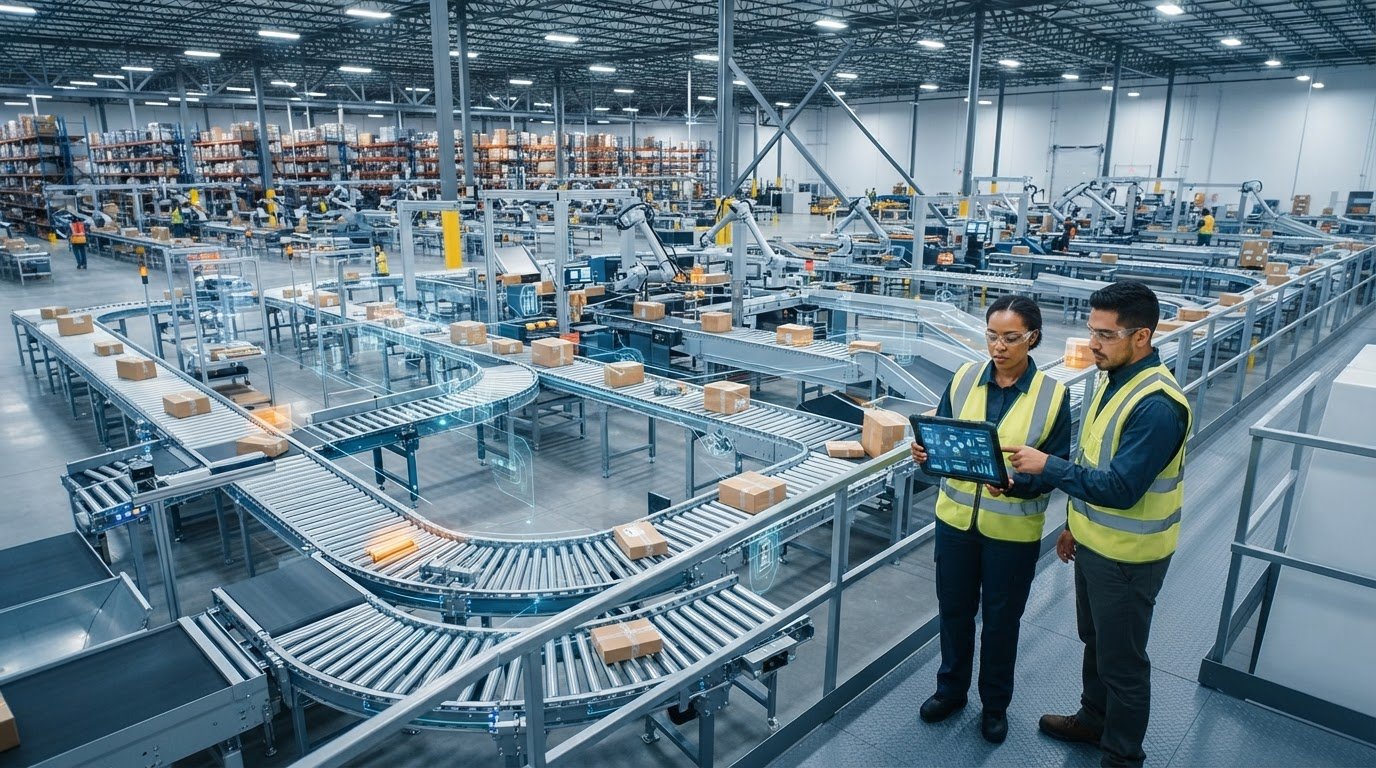
Could the newest conveyor technology be less about a single machine and more about how the whole material-flow system works together? The newest technology associated with conveyors increasingly connects modular equipment, intelligent controls, data monitoring, and robotics. That broader approach matters when marketing claims make it hard to tell which capabilities solve real operational problems and which may add integration work without improving performance.
It’s reasonable to ask whether a new system will fit your facility’s layout, workflows, and existing equipment. The answer depends on the needs it’s designed to address, from bottlenecks and product routing to maintenance visibility and energy use. Technology selection is a systems-engineering decision, not simply a hardware purchase.
This article explains the current conveyor technology categories and the practical roles they can play in a warehouse. You’ll also learn what to assess before investing, including compatibility, controls, workflow requirements, and measurable performance goals. From connected monitoring and flexible conveyor designs to robotics integration, the focus is on identifying options that support your operation, not adopting technology for its own sake.
Key Takeaways
- Assess conveyor technology by the process constraint it addresses, not by how new or advanced it sounds.
- Trace how sensors and scanners connect to controls and software to see whether system data can support timely operational responses.
- Compare connected monitoring, modular designs, machine vision, and robotics against your facility’s needs and integration requirements.
- Evaluate the newest technology associated with conveyors through a practical process: map material flow, check compatibility, pilot where suitable, and measure results against a baseline.
- Include infrastructure, operator readiness, maintenance planning, and future optimization in the scope of an integrated material-flow project.
What Is the Newest Conveyor Technology, and What Makes It Useful?
The newest conveyor technology connects equipment, controls, sensing, and operational data so material can move as part of a coordinated process. The newest technology associated with conveyors is not necessarily a single machine; it can also be the way existing equipment communicates, responds to changing conditions, or adapts to a facility’s workflow.
A smart conveyor system is a material-handling system that uses connected equipment and operational data to monitor or coordinate how products move. That capability is useful only when it addresses a real process constraint. A new control feature won’t resolve a layout bottleneck by itself, and sophisticated equipment may be unnecessary if a simpler change meets the operational need.
This section focuses on industrial and warehouse material flow, not a ranking of vendors. For a foundational overview of conveyor types and applications, see Conveyor system. The key distinction is between equipment innovation, such as a different conveyor configuration, and system-level advances that improve connectivity, coordination, and adaptability across a workflow.
Which conveyor technology categories are advancing?
Several categories are shaping current conveyor systems, each with a different role:
- Connected sensors collect information about equipment or product movement that can help teams monitor flow and identify operating conditions.
- Advanced controls coordinate conveyor zones and equipment responses, supporting functions such as routing and accumulation when the system is designed for them.
- Machine vision uses cameras and image-processing software to inspect or identify items, depending on the application and integration.
- Modular equipment is designed around components that can be configured or adapted to suit a facility’s layout and material-flow requirements.
Artificial intelligence can support analysis, recognition, or decision-making within these technologies. It isn’t a conveyor solution on its own: its value depends on suitable data, connected controls, a defined task, and a way to act on its output. Consider each capability in context rather than assuming that a label such as “AI-powered” guarantees a practical benefit.
How can readers tell innovation from marketing language?
Start with the workflow problem. Ask what the technology is intended to change, such as missed scans, poor visibility, a recurring accumulation point, or difficulty adjusting material flow. Then ask how that change will be observed and measured in your operation. A vendor demonstration can help clarify a capability, but projections about future performance should be distinguished from results shown in conditions relevant to your facility.
Finally, assess the full operating picture. Compatibility with existing conveyors, controls, software, and infrastructure matters, as do maintenance requirements and operator readiness. A systems-engineering review can reveal whether an innovation fits the process or introduces complexity that outweighs its practical value.
How Sensors, Controls, and Data Make Conveyor Systems More Responsive
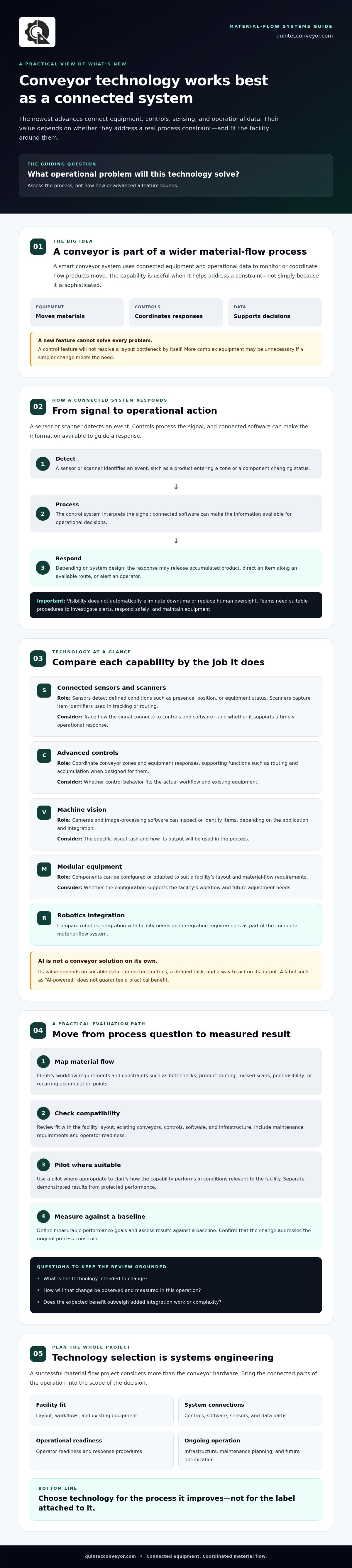
A connected conveyor system turns operating conditions into information that people or equipment can act on. The path typically begins when a sensor or scanner detects an event, such as a product entering a zone or a conveyor component changing status. A control system processes that signal, and connected software can make the information available for operational decisions. Depending on the system design, a response might be to release product from accumulation, direct an item along an available route, or alert an operator to an exception.
This visibility can help teams understand where flow is building up and distinguish a local interruption from a wider process issue. It doesn’t automatically eliminate downtime or replace human oversight. Sensors detect the conditions they’re configured to monitor, and people still need suitable procedures to investigate alerts, respond safely, and maintain equipment.
What roles do sensors, machine vision, and controls perform?
Sensors detect defined conditions, such as presence, position, or equipment status. Scanners can capture item identifiers used in tracking or routing. Where a process requires visual inspection or identification, machine vision can analyze images against configured criteria. These tools have different functions, so selection should start with the information the workflow actually needs.
Programmable logic controllers (PLCs) coordinate equipment actions within a control system. For example, a PLC can use a sensor signal to control a conveyor zone or communicate a condition to another part of the system. Software above the equipment-control layer may provide broader operational visibility. The Material Handling Industry (MHI) offers industry resources on material handling and supply chain developments, useful context when assessing how equipment and systems fit together.
Where can AI and predictive insights fit into conveyor operations?
AI may help identify patterns in operating data, support decisions, or inform adjustments to material flow. Its usefulness depends on data quality and process context. Incomplete signals, inconsistent records, or a poorly defined task can limit the value of an analytical output. Teams should understand what information a tool uses, what action it recommends, and who reviews or approves that action.
Equipment monitoring reports current or recorded conditions; predictive maintenance uses relevant data to estimate developing issues and inform maintenance decisions. A monitoring alert alone isn’t proof that a failure is predicted, nor does an analytical forecast remove the need for inspection and maintenance planning.
Because sensing, controls, software, and equipment must work within one material-flow process, integration deserves attention alongside the technology itself. If you’re assessing how a connected system could fit your operation, explore conveyor integration expertise as part of your planning.
Comparing New Conveyor Technologies by the Problem They Solve
The newest technology associated with conveyors is best compared by its intended job, not by a universal ranking. A useful choice addresses an observed constraint and fits the facility’s equipment, controls, and workflow. The innovative conveyor technology discussed by the Association for Advancing Automation illustrates how options can differ in design and function. Use the comparison below as a starting point for evaluating fit.
| Technology | Best-fit operational need | Integration dependency | Evaluation question |
|---|---|---|---|
| Connected monitoring | Improving visibility into equipment status or material flow | Sensors, controls, and a way to access and interpret relevant data | Which conditions will be monitored, and who will act on alerts? |
| Modular conveyor design | Considering future layout changes or shifts in product flow | Physical layout, interfaces between modules, and system capacity | What can be reconfigured, and what facility constraints remain? |
| Machine vision | Inspecting or identifying items where visual information is needed | Suitable cameras, lighting, software, and connection to the process response | What must the system recognize, and how will exceptions be handled? |
| Robotics | Connecting material movement with tasks such as picking, packing, or replenishment | Conveyor handoffs, task coordination, controls, and workflow design | Where does the handoff occur, and what happens if either process pauses? |
Each option has trade-offs. Modular equipment may support reconfiguration, but changes still need to respect space, capacity, and connected equipment. Monitoring depends on useful data and clear response practices. Vision adds sensing and interpretation requirements, while robotics calls for careful coordination at handoff points and may require maintenance skills suited to the equipment.
Which technologies fit changing layouts and product flows?
Modular designs can be worth assessing when routes or processes may change, though modularity doesn’t remove constraints such as facility infrastructure or interfaces with existing systems. Review the modular conveyor systems guide for further design considerations. Robotic handoffs may fit where conveyors connect with picking, packing, or replenishment. See the warehouse robotics integration guide for more on coordinating those workflows.
How should facilities assess connected and automated options?
Start with a documented bottleneck, then check compatibility with controls, upstream processes, downstream equipment, and data systems. Define how you’ll assess whether the change addresses the constraint before choosing equipment. If robotics is central to the use case, explore industrial robotics and automation services as a related integration topic.
How to Evaluate New Conveyor Technology Before Implementation
Before investing in the newest technology associated with conveyors, establish what your operation needs to improve and how you’ll recognize a meaningful change. Baseline process data should come before technology selection because it shows where the constraint exists and gives the team a fair point of comparison. Without that reference, a project can add equipment without proving whether it solved the original issue.
What should a facility assess before choosing technology?
Document the material-flow process from entry to destination, including product types, throughput patterns, handoffs, exceptions, and interfaces with existing equipment. Note constraints involving layout, controls, infrastructure, staffing, or the need to maintain operational continuity during implementation. The industrial conveyor systems integration guide offers broader context for planning equipment as part of a complete system.
Use that assessment to work through five steps:
- Map the flow. Record how products move, where they pause, and where people or equipment transfer them.
- Define the constraint. State the specific issue, such as inconsistent flow or frequent exceptions, rather than starting with a preferred technology.
- Assess compatibility. Check interfaces with facility controls, upstream processes, downstream equipment, infrastructure, and data systems.
- Pilot where suitable. If a limited trial is practical, define its scope, operating conditions, and review process before it begins.
- Measure the result. Compare relevant observations with the baseline and document any changes in operating conditions.
How can teams define and validate success?
Select measures that correspond directly to the constraint. For a flow-consistency issue, track whether product movement becomes more consistent under comparable conditions. If exceptions are the concern, record their frequency and type. Don’t assume a fixed productivity gain: validate the result in the specific application and account for shifts in product mix, staffing, demand, or operating schedules.
Include safety considerations, maintainability, operator training, and access to technical support in project planning. Confirm who will use the equipment, how routine maintenance will be handled, and what support is available if integration or operation raises questions. These factors affect whether a system can be operated and maintained as intended, not just whether it can be installed.
For a facility-specific review, discuss conveyor integration considerations with Quintec. A careful evaluation connects process engineering and equipment choices to the workflow the system must support.
Integrating New Conveyor Technology Into a Complete Material-Flow System
New conveyor technology delivers value when it supports the full workflow, not just one piece of equipment. A conveyor change can affect how products arrive from an upstream process, pass through controls or robotic handoffs, and move to downstream equipment. Infrastructure, warehouse layout, and process requirements also shape how the system will function. For that reason, the newest technology associated with conveyors should be assessed as part of the facility’s material-flow design.
Why does system integration matter more than an isolated upgrade?
Each part of an automated workflow has dependencies. Conveyor speed or accumulation behavior, for example, may affect the timing of an adjacent process. A robotic handoff needs coordinated product presentation and a defined response if equipment pauses. Controls must communicate as intended, while the physical layout needs to support safe access and ongoing operation. A local upgrade that overlooks these connections can shift a bottleneck rather than resolve it.
Where robotic coordination is part of the project, the warehouse robotics integration guide offers additional context on connecting automated tasks with material movement. Integration requirements vary by facility, so qualified project professionals should review existing interfaces, operational needs, and constraints before finalizing a design.
Project scope should also account for commissioning, operator readiness, maintenance planning, and later optimization. Commissioning verifies that equipment and controls operate as designed within the connected system. Operators need to understand normal operation and how to respond to exceptions. Maintenance planning should reflect the equipment and skills involved, while post-installation review can identify adjustments as actual operating conditions become clear.
What should a practical next step look like?
Prepare a concise overview of the facility’s workflow before evaluating an upgrade. Document:
- How products move, including handoffs and recurring exceptions.
- The operational constraint and the result the project is intended to support.
- Existing conveyor equipment, controls, infrastructure, and adjacent system interfaces.
- Operator, maintenance, and operational-continuity considerations.
This information gives an integration team a practical starting point for assessing options. Quintec Conveyors provides design, engineering, installation, process engineering, automation, and maintenance capabilities for conveyor and material-handling systems. Discussing the workflow and its constraints can help clarify how those elements may fit together, without assuming a technology choice will guarantee a particular outcome.
Discuss a conveyor integration project with Quintec and share the material-flow requirements you’re working to address.
Turn Conveyor Technology Into a Practical Advantage
The newest technology associated with conveyors matters when it addresses a defined operational need and works within the wider material-flow system. Connected monitoring, modular equipment, machine vision, and robotics each serve different purposes. The right choice depends on your workflow, existing interfaces, and the result you need to assess.
Start with the process, establish a baseline, and evaluate compatibility before selecting equipment. Then plan for integration, operator readiness, commissioning, and maintenance alongside the technology itself. That disciplined approach helps separate useful capabilities from features that may not fit your operation.
Quintec provides conveyor design, engineering, installation, automation, and maintenance capabilities. Its team brings over 100 years of collective industry experience to material-handling projects. To explore how technology options could fit your facility’s workflow, discuss your conveyor integration requirements with Quintec.
With a clear operational objective and a well-considered systems approach, your next improvement can be grounded in what your facility truly needs.
Frequently Asked Questions
What is the newest technology associated with conveyors?
There isn’t one conveyor technology that’s newest or best for every operation. Current advances include connected sensors and controls, machine vision, modular equipment, and robotics working alongside conveyor systems. Their value depends on the task: identifying items, coordinating movement, adapting layouts, or connecting material flow with another process. Assess the operational need and the maturity of the specific technology rather than treating “newest” as proof of suitability.
How is AI used in conveyor systems?
AI can analyze operational data to identify patterns, support decisions, or inform adjustments to material flow. For example, an analytical tool might flag recurring conditions for review, but its usefulness depends on accurate data and a clearly defined process. AI doesn’t replace suitable sensors, controls, or human oversight. Before adopting it, establish what information it uses, what output it provides, and how staff will validate and act on that output.
Can new conveyor technology work with an existing system?
It can, provided the equipment and its interfaces are compatible with the existing operation. Assessment may need to cover conveyor controls, upstream and downstream equipment, facility infrastructure, software, and the physical layout. A technology that works on its own may still require changes to communicate or coordinate effectively with surrounding processes. Document current interfaces and involve qualified project professionals to assess integration requirements before selecting or installing an upgrade.
What is a smart conveyor system?
A smart conveyor system combines conveying equipment with connected sensing, controls, or data capabilities to monitor or coordinate material movement. Depending on its configuration, sensors may report product presence or equipment status, while controls coordinate equipment responses. The term doesn’t guarantee a particular level of automation or predictive capability. Ask what the system measures, how information reaches operators or other equipment, and what actions the system can actually perform.
How do I know whether my facility needs conveyor automation?
Look for a recurring operational issue that automation could address, such as a difficult handoff, repeated routing decisions, or a process that depends on consistent product movement. Document how the work is performed now, including exceptions, staffing needs, and interruptions. Then consider whether a change to the process or equipment would address the underlying constraint. Automation is worth assessing when it fits a defined need and can be evaluated against current operations.
What should I evaluate before upgrading conveyor technology?
Define the operational problem and record a baseline that reflects current conditions. Map product flow, handoffs, exceptions, and existing equipment interfaces, then assess fit with controls, infrastructure, staffing, and operating requirements. Consider safety, maintenance needs, operator training, commissioning, and technical support as part of the project. If a pilot is suitable, set its scope and success measures in advance, then compare results under comparable operating conditions.
Does newer conveyor technology reduce maintenance or downtime?
Not automatically. Connected monitoring may make selected equipment conditions more visible, but it doesn’t ensure that issues will be detected or resolved before disruption. Predictive maintenance requires relevant, reliable data and a process for assessing alerts and planning maintenance. New equipment may also introduce different maintenance tasks or skills. Review maintenance requirements, access to technical support, and operator procedures before implementation, then monitor actual operating results rather than assuming downtime will fall.