Robotic Palletizing Systems: The 2026 Guide to End-of-Line Automation
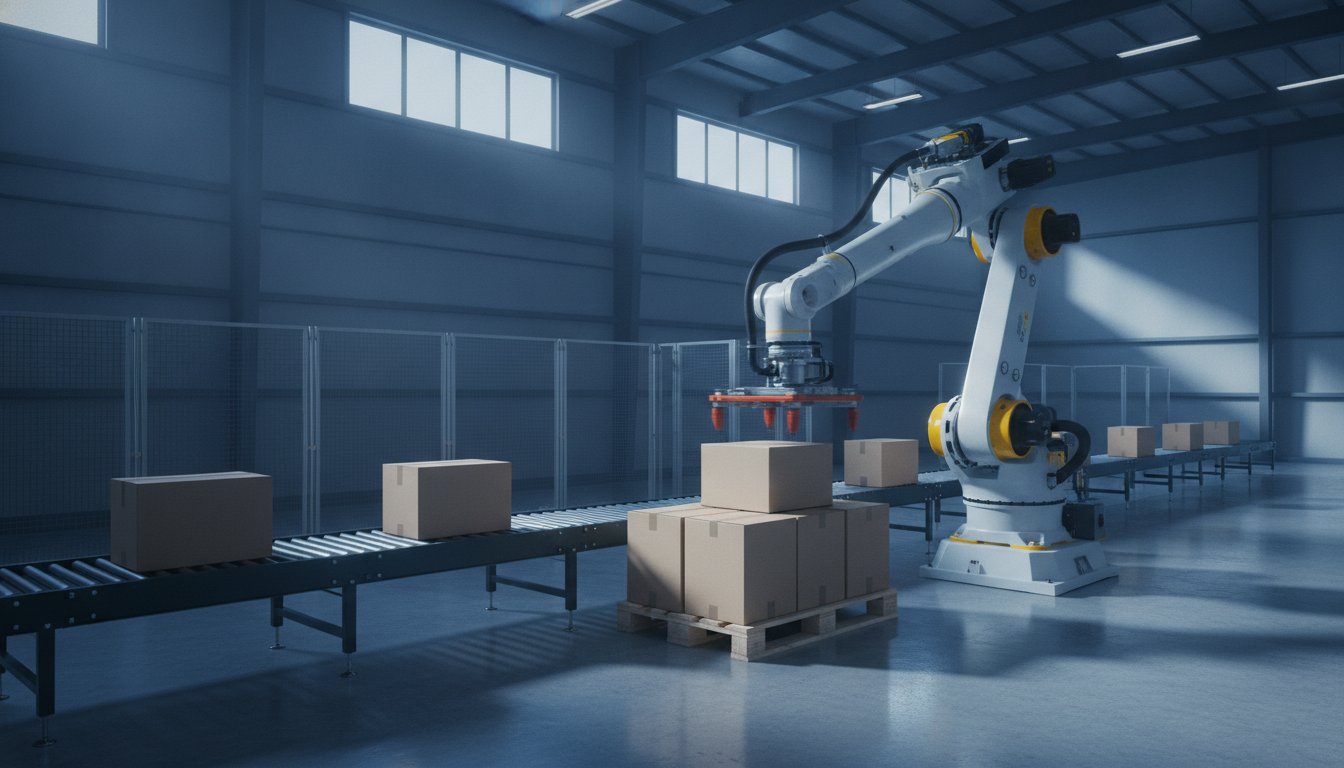
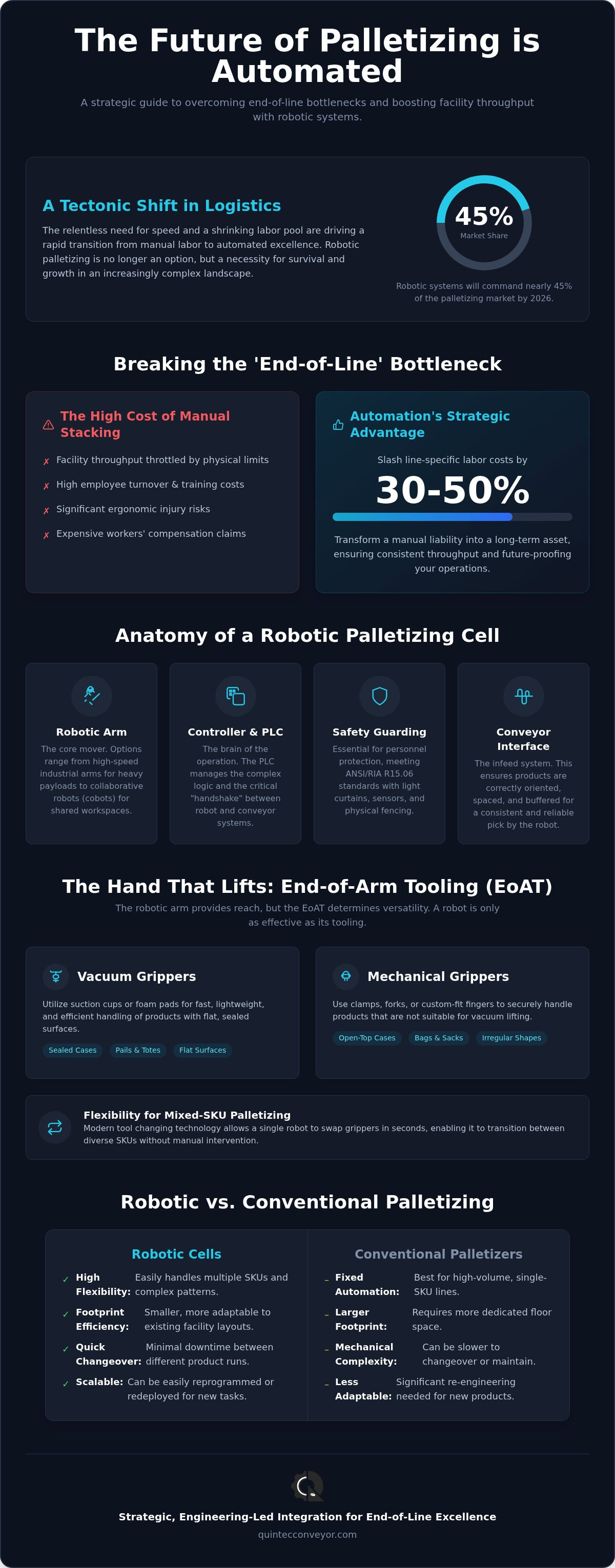
By the end of 2026, robotic palletizing systems are projected to command nearly 45% of the total palletizing market, a shift driven by a relentless need for speed and a shrinking labor pool. You've likely felt the strain of high turnover and the constant risk of ergonomic injuries at the end of your line, where manual stacking often becomes the ultimate bottleneck that prevents your facility from reaching its peak capacity. It's a frustrating reality that even the most efficient production lines can be throttled by the physical limitations of a manual workforce.
This guide explores how integrated robotic palletizing systems eliminate these operational hurdles, slashing line-specific labor costs by 30% to 50% while future-proofing your facility's throughput. We've compiled the latest industry insights to help you transition from manual processes to automated excellence. You'll learn about current ROI timelines, essential safety standards like ANSI/RIA R15.06, and how custom process engineering bridges the gap between your conveyors and the pallet. We're providing a clear roadmap to help you master end-of-line automation and maintain a competitive edge in an increasingly complex logistical landscape.
Key Takeaways
- Understand why manual palletizing has become a major throughput bottleneck and how automation addresses the growing labor scarcity in 2026.
- Discover how selecting the right end-of-arm tooling ensures your robotic palletizing systems handle diverse SKUs with high precision and speed.
- Compare robotic cells against conventional palletizers to identify which solution offers the best footprint efficiency for your facility's layout.
- Learn the technical requirements for the "handshake" between conveyors and robotic controllers to maintain a consistent, buffered product flow.
- Explore why a strategic, engineering-led integration approach is vital for aligning new robotic hardware with your existing warehouse infrastructure.
What are Robotic Palletizing Systems and Why are They Essential in 2026?
At its core, robotic palletizing is the automated process of stacking products, such as cases, bags, or pails, onto a pallet using an industrial robotic arm or a collaborative robot (cobot). Unlike the rigid, mechanical layers of a traditional Palletizer, modern robotic palletizing systems offer a level of flexibility that allows them to handle multiple SKU patterns and product types with minimal changeover time. This transition from "fixed" automation to "flexible" robotics is the defining characteristic of end-of-line logistics in 2026.
The necessity of these systems is rooted in a fundamental shift in the global labor market. With the palletizing market projected to reach $2.57 billion this year, companies are moving away from manual labor not just for efficiency, but for survival. High-speed production lines now move faster than human hands can safely manage; automation is the only way to maintain consistent throughput without compromising safety or quality.
The Crisis of the 'End-of-Line' Bottleneck
Manual palletizing often acts as a speed limit for the entire facility. Even if your upstream picking and sorting are optimized, a slow outfeed creates backlogs that throttle total production. This bottleneck is exacerbated by the "hidden costs" of human labor, including high turnover rates and the ongoing expense of training new staff. Additionally, the repetitive nature of heavy lifting leads to significant workers' compensation claims that impact the bottom line. Within this context, we view robotic palletizing as the final link in a fully automated warehouse flow.
Key Components of a Palletizing Cell
A successful integration requires more than just a robotic arm; it demands a synchronized ecosystem of hardware and software. Each cell typically includes four primary pillars:
- The Robotic Arm: You must choose between high-speed industrial robots for heavy payloads or cobots for smaller footprints where workers and machines share space.
- The Controller and PLC: The Programmable Logic Controller (PLC) manages the complex operations and the "handshake" between the robot and the conveyor systems.
- Safety Guarding: To meet ANSI/RIA R15.06 standards, cells utilize light curtains, safety sensors, and physical fencing to protect personnel.
- The Conveyor Interface: This ensures products are correctly oriented and spaced before the robot attempts a pick.
By integrating these components, facilities can reduce line-specific labor costs by 30% to 50%, transforming a manual liability into a strategic, long-term advantage.
Core Technologies: End-of-Arm Tooling (EoAT) and Robotics
While the robotic arm provides the reach and payload capacity, it's the End-of-Arm Tooling (EoAT) that determines the system's true versatility. In the context of modern robotic palletizing systems, the arm is merely the delivery vehicle for the "hand" that interacts with your product. As the robotic picking market could triple in size by the end of the decade, the industry's focus has shifted from simple lifting to intelligent manipulation. A robot is only as effective as its tooling; choosing the wrong interface can lead to dropped product, damaged packaging, or inconsistent stack stability.
Today's facilities rarely run a single product line for years at a time. Tool changing technology allows a single robot to swap its gripper in seconds, enabling it to transition from heavy pails to fragile cartons without manual intervention. This agility is essential for Mixed-SKU palletizing, where sophisticated software calculates the most stable stack pattern for varying box sizes on a single pallet. If your facility manages high SKU proliferation, partnering with an experienced integrator can help you identify the right balance of hardware and logic for your specific mix.
Vacuum vs. Mechanical Grippers
The choice between vacuum and mechanical systems depends entirely on your product's physical characteristics. Vacuum systems use suction cups or foam pads, making them the standard for sealed cases, pails, and flat surfaces. They're fast, lightweight, and efficient. Mechanical clamps, however, are necessary for heavy bags, open-top crates, or items that lack a reliable surface for suction. For complex operations, hybrid tooling is often the superior choice. These custom-engineered tools can handle the primary product, place slip sheets, and even move empty pallets, consolidating multiple steps into a single robotic motion.
Vision Systems and AI Integration
3D vision systems have revolutionized how robots handle disorganized loads. Instead of needing perfectly positioned boxes, sensors allow the robot to "see" and adjust its grip in real time. This is particularly useful when depalletizing or handling incoming shipments that shifted during transit. AI-driven pattern optimization takes this further by creating dense, stable stacks that won't shift during transport. Integrating these vision capabilities with industrial conveyor systems ensures that every SKU is identified and oriented before it ever reaches the robotic cell, creating a seamless flow from the line to the truck.
Robotic vs. Conventional Palletizing: A Strategic Comparison
Choosing between a traditional palletizer and modern robotic palletizing systems requires a deep understanding of your facility's long-term operational goals. Conventional palletizers, often categorized as high-level or low-level machines, have long been the workhorses of high-volume production. They excel at processing massive quantities of a single SKU at extreme speeds. However, they rely on complex mechanical layers and orienting devices that occupy a massive footprint. In contrast, robotic cells are compact and versatile. They offer a streamlined alternative for facilities where floor space is at a premium and SKU variety is high.
The mechanical complexity of conventional systems often leads to higher maintenance requirements. These machines are filled with chains, sprockets, and pneumatic pushers that require frequent lubrication and adjustment. While a robot has its own maintenance schedule, its reliability is rooted in precision engineering and sophisticated software. Planning a successful robotic palletizing integration involves shifting your focus from mechanical upkeep to software optimization, ensuring the system remains agile as your business evolves.
Flexibility and SKU Management
Traditional systems are typically rigid. Changing a pallet pattern on a conventional machine can take hours of mechanical reconfiguration and testing. Robotic palletizing systems handle these transitions in seconds. With a simple software selection, the robot adjusts its motion path and grip points to accommodate a new product size or stack configuration. This level of adaptability is why modular conveyor systems are the ideal partner for robotics. Together, they allow you to scale or reconfigure your end-of-line layout without replacing the entire infrastructure.
Calculating the Real ROI
Evaluating the return on investment goes beyond the initial CAPEX. While the upfront cost of a robotic cell is a significant investment, the long-term OPEX is often lower due to reduced labor requirements and energy efficiency. You must also factor in the "space value" of your warehouse. By choosing a compact robotic solution, you reclaim valuable floor space that can be used for additional warehouse racking or production lines. Robots provide superior precision, which reduces product damage during the stacking process. This leads to more stable pallet loads and fewer insurance claims related to shipping damage. These benefits provide a steady accumulation of savings over the system's 12 to 36-month payback period.
The Integration Logic: Connecting Conveyors to Robotics
Too many facilities treat robotic palletizing systems as isolated "islands of automation." This fragmented approach often results in sub-optimal cycle times, mechanical friction, and unexpected downtime. True efficiency is found in the "handshake"-the precise digital and physical synchronization between the infeed conveyor and the robotic controller. This communication protocol ensures the robot knows exactly where a product is located, what orientation it holds, and the exact millisecond to execute the pick.
Synchronizing these line speeds requires comprehensive process engineering to prevent the robot from waiting for product or being overwhelmed by a sudden surge. By aligning the upstream production rate with the robotic cell's capacity, you create a steady, predictable output that maximizes your capital investment. If you're ready to design a synchronized end-of-line solution, contact our engineering team to discuss your facility's specific requirements.
Infeed and Accumulation Strategy
Accumulation conveyors serve as the critical buffer that protects your robotic cycle time. Without proper buffering, the system is vulnerable to "slugs," which are large groups of products that arrive too close together, or gaps that leave the robot idle. We utilize zero-pressure accumulation to ensure that fragile goods don't experience back-pressure or collisions while waiting for the robot to clear the previous pick. This technology allows items to wait in individual zones, preventing damage and ensuring a consistent feed. The physical layout of the infeed must be designed so that the robot's reach is maximized, which minimizes the distance it travels to place each item and reduces long-term wear on the robotic joints.
Pallet and Slip Sheet Dispensing
The integration logic extends beyond the primary product to the pallets and stabilizing materials that form the final load. Automating the delivery of empty pallets into the cell via pallet dispensers eliminates the need for manual forklift intervention within the robotic work zone. This significantly improves safety and keeps the robot running at peak speed. Slip sheet dispensers can also be integrated to add multi-layer stability for taller, more complex stacks. Once a pallet reaches its programmed height, the discharge conveyors move the full load to wrapping or labeling stations. This continuous, touchless flow is what transforms a simple robot into a high-performance material handling system.
Partnering with Quintec for Custom Palletizing Integration
Implementing robotic palletizing systems is a complex engineering feat that requires more than just high-performance hardware. At Quintec Conveyors, we bring over 100 years of collective industry experience to every project, providing a level of seasoned authority that ensures your investment is grounded in proven methods. We don't just sell you a robot; we engineer the entire flow of your facility. Our "Integration First" philosophy ensures that every component, from the initial infeed to the final discharge, works in perfect harmony. This holistic approach eliminates the risk of fragmented automation that fails to communicate with your broader warehouse ecosystem.
The Quintec Conveyors Engineering Process
Our process begins with a comprehensive site survey and detailed flow analysis. We don't just look at the pallet; we analyze the entire journey of the product from the production line to the shipping dock. We study your specific SKU requirements to design custom End-of-Arm Tooling (EoAT) that meets your exact payload and speed targets. As a single-source provider, we manage the integration of conveyors, robotics, and warehouse racking under one project management umbrella. This streamlines communication and ensures that your infrastructure is perfectly aligned with your automation goals. Choosing an experienced conveyor system integrator is the most critical decision you'll make in your automation journey. We provide national installation and service coverage, ensuring that your system is installed professionally and meets all safety standards from day one.
Maintenance and System Longevity
Long-term success depends on a proactive approach to system health. We provide structured preventative maintenance schedules that focus on the high-wear components of your cell, such as robotic joints and vacuum end-effectors. In 2026, uptime is the primary metric of success. That's why we offer advanced software support and remote troubleshooting capabilities to resolve issues before they cause significant downtime. Our engineering team remains a strategic partner in your success long after the initial installation is complete. We provide the ongoing software updates and mechanical adjustments needed as your product mix evolves or your throughput requirements increase. This commitment to lifecycle management ensures that your robotic palletizing systems continue to deliver value for years to come. Contact Quintec Conveyors to design your integrated robotic palletizing cell today.
Future-Proofing Your Facility Through Strategic Integration
The transition to robotic palletizing systems is no longer a luxury for modern warehouses; it's a strategic necessity to overcome labor scarcity and throughput limitations. By prioritizing flexible end-of-arm tooling and a seamless "handshake" between your conveyors and robotic controllers, you transform the end-of-line from a bottleneck into a high-performance asset. These systems offer the agility needed to manage complex SKU patterns while significantly reducing long-term operational costs and workplace injuries. Precision in the planning phase ensures that your automation is scalable and ready for the demands of the coming years.
Success in this transition requires a partner who understands that the robot is only one part of a larger, synchronized flow. With 100+ years of collective material handling experience, Quintec provides full-scale design, engineering, and national installation services. We are specialists in seamless robotics and conveyor integration, ensuring that your facility maintains its competitive edge through technical excellence. Streamline your end-of-line with Quintec's robotic palletizing expertise.
Investing in automation today secures your operational stability for the future. We look forward to helping you build a more efficient and reliable logistics infrastructure.
Frequently Asked Questions
What is the typical ROI for a robotic palletizing system?
Payback periods for robotic palletizing systems typically fall between 12 and 36 months. This calculation factors in the 30% to 50% reduction in line-specific labor costs and the elimination of expensive ergonomic injury claims. While the initial capital expenditure is significant, the long-term operational savings and reclaimed floor space provide a compounding return. Facilities often see the fastest ROI when automating high-turnover shifts where manual labor is most inconsistent and difficult to maintain.
Can a robotic palletizer handle multiple SKUs simultaneously?
Yes, advanced systems can handle multiple SKUs simultaneously through sophisticated vision integration and multi-zone infeed conveyors. By utilizing AI-driven pattern optimization software, the robot identifies different product sizes and weights to build stable, mixed-load pallets. This capability is essential for modern high-mix, low-volume production environments. It allows a single robotic cell to manage several production lines at once, maximizing the utilization of your automation investment and reducing the need for multiple machines.
How much floor space does a standard robotic palletizing cell require?
A standard robotic palletizing cell is significantly more compact than a conventional mechanical palletizer. Most cells require a footprint of approximately 150 to 250 square feet, though this varies based on the number of infeed lines and pallet stations. Because robots are flexible, we can often design the cell to fit into tight warehouse corners or even overhead spaces. This efficiency allows you to reclaim floor space for additional warehouse racking or production equipment.
What is the maximum weight a palletizing robot can lift?
Industrial palletizing robots are engineered to handle a wide range of payloads, with heavy-duty models capable of lifting over 1,000 kg. Most warehouse applications focus on case or bag handling between 15 kg and 50 kg. The payload capacity must include the weight of the End-of-Arm Tooling itself. Our process engineering team ensures the robot selection matches your heaviest SKU while maintaining the cycle speeds required to meet your facility's peak throughput targets.
What is the difference between a cobot palletizer and an industrial robot?
Collaborative robots, or cobots, are designed with internal sensors to work safely alongside humans without physical safety fencing. They are generally easier to program and have a smaller footprint but offer lower speeds and payloads. Industrial robots are built for high-speed, heavy-duty applications and require safety guarding like light curtains or fencing to meet ANSI/RIA standards. The choice depends on your specific throughput goals and the physical space available in your facility.
How long does it take to install and integrate a robotic palletizing system?
The physical installation and on-site integration of robotic palletizing systems typically take between one and four weeks. However, the comprehensive engineering process, which includes site surveys, custom tooling design, and software programming, usually spans 12 to 24 weeks from project kickoff. This thorough preparation ensures that the final digital handshake between your conveyors and the robotic controller is seamless, minimizing disruptions to your existing production schedule during the final go-live phase.
Do I need a specialized programmer on-staff to operate a robotic palletizer?
You don't need a specialized robotics programmer on your permanent staff to operate these systems. Modern robotic interfaces use intuitive, task-specific software that allows existing facility operators to select patterns or troubleshoot minor issues. Quintec provides comprehensive training during the installation phase to ensure your team is confident in managing the cell. We also offer remote troubleshooting and ongoing engineering support to handle complex software updates or pattern changes as your business grows.
Can robotic palletizers handle bags, pails, and drums, or just boxes?
Robotic systems are highly versatile and can handle bags, pails, drums, and crates just as effectively as standard boxes. The key lies in the End-of-Arm Tooling design. We engineer specialized mechanical clamps for heavy bags, vacuum grippers for pails, and even magnetic tools for metal drums. This flexibility allows a single robot to transition between different packaging formats with minimal changeover time, making it a superior solution for diverse manufacturing operations.