Vertical Conveyors: Maximizing Facility Footprint and Multi-Level Flow
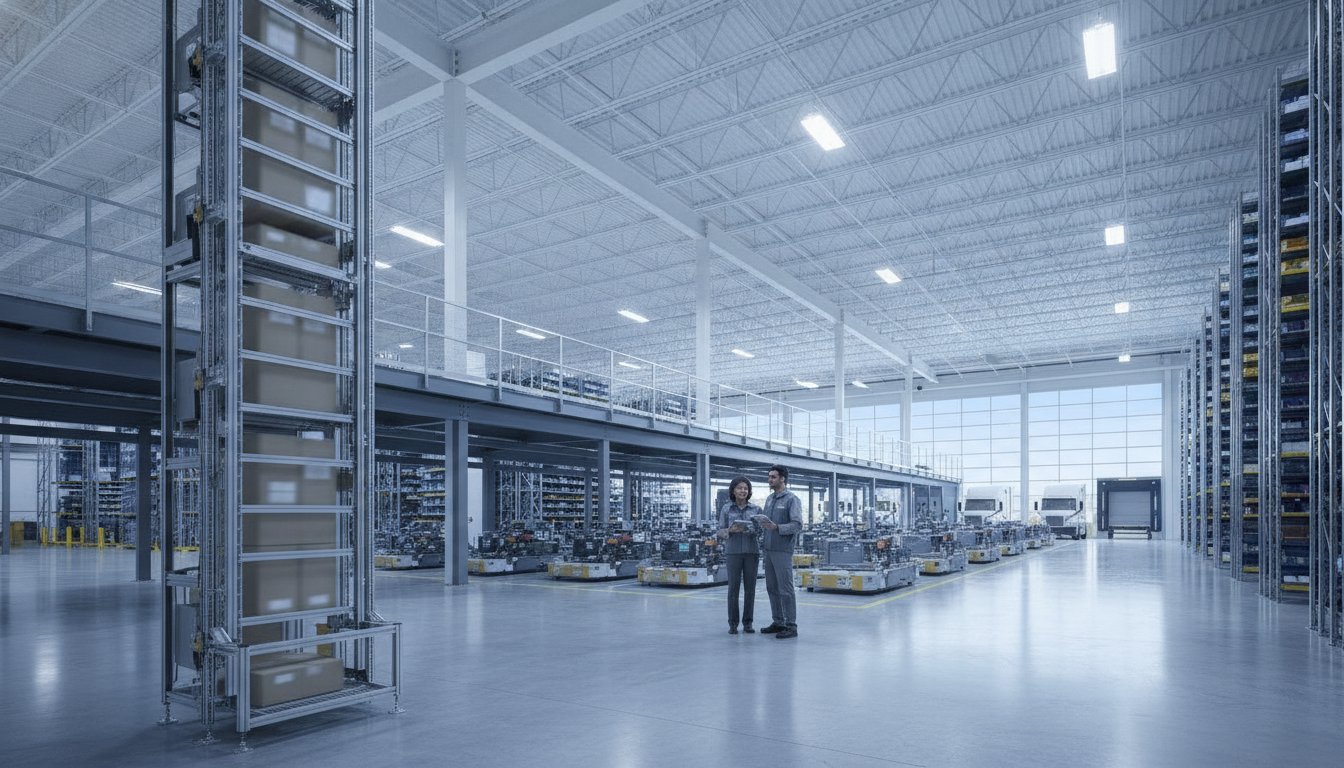
What if the most valuable real estate in your facility isn't the floor space you're standing on, but the empty air directly above it? Most operations managers feel the constant squeeze of a limited footprint, watching as mezzanine access points become bottlenecks and high-lift forklift operations introduce avoidable safety risks. Integrating strategic vertical conveyors into your layout allows you to reclaim that wasted overhead area, transforming it into a high-speed operational asset that drives throughput without expanding your building's walls.
By moving material vertically with mechanical precision, you can eliminate manual handling delays and create a seamless link between floors. This article explores how modern vertical transport systems, backed by over 100 years of collective engineering expertise, provide the architectural backbone for multi-level flow. We'll examine the shift toward smart automation, the role of advanced drive systems in energy efficiency, and why sophisticated process engineering is the ultimate key to maximizing your facility's return on investment. You'll discover how to turn vertical challenges into a competitive advantage for your long-term operational success.
Key Takeaways
- Reclaim valuable square footage by utilizing overhead volume to expand your operational capacity without increasing your facility's physical footprint.
- Identify the critical performance differences between Vertical Reciprocating Conveyors (VRCs) and high-speed continuous vertical conveyors to select the right technology for your throughput needs.
- Enhance worker safety and ergonomics by automating multi-level material movement and eliminating the risks associated with high-reach forklift operations.
- Learn the essential steps for integrating vertical flow into your existing Warehouse Control Systems (WCS) to ensure seamless, synchronized logistics.
- Discover how expert process engineering and professional system integration maximize the long-term ROI of your multi-story material handling infrastructure.
What are Vertical Conveyors and Why Do They Matter in 2026?
A Vertical conveyor is a specialized class of machinery engineered to transport goods between distinct elevations, such as mezzanines or multiple facility floors, without manual intervention. In 2026, the logistics sector has pivoted away from the slow, intermittent nature of human-operated lifts toward continuous, automated vertical flow. This transition is driven by the reality that floor space remains the most expensive asset in any industrial operation. By utilizing the vertical cube, facilities can reclaim thousands of square feet for revenue-generating activities rather than wasting it on wide aisles for forklifts. Quintec's 100 years of collective experience shows that strategic verticality is often the difference between a facility that scales and one that stagnates.
The Role of Verticality in Modern Warehouse Design
Modern warehouse design services now prioritize "cube utilization" over simple footprint planning. As e-commerce demand forces warehouses into urban centers where land is scarce, high-density vertical storage has become a necessity. Traditional forklift-based access creates significant bottlenecks and safety risks. Automated vertical conveyors solve this by providing a dedicated, high-speed path for goods, allowing designers to build up rather than out. This approach ensures that every cubic foot of a building contributes to total throughput. These systems are now essential nodes for integrating robotics and Autonomous Mobile Robots (AMRs), which require precise, predictable hand-off points between levels.
Vertical Conveyors vs. Freight Elevators: Key Differences
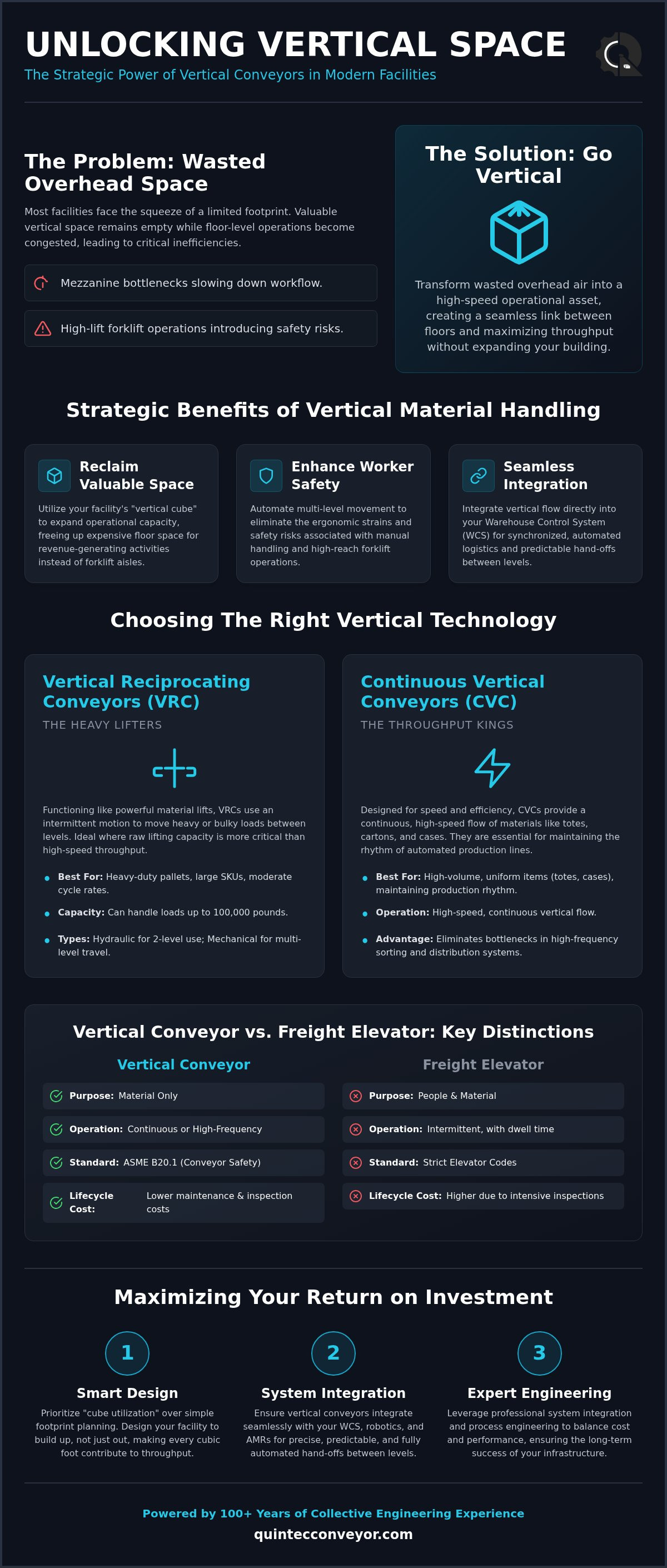
It's common to mistake a material lift for a standard freight elevator, but the regulatory and operational differences are vast. Vertical conveyors are governed by the ASME B20.1 safety standard, which classifies them as part of a conveyor system rather than an elevator. This distinction is crucial for throughput. While elevators require a rider and move at limited speeds with significant dwell time, conveyors offer continuous or high-frequency cycling. They move material, not people.
From a financial perspective, the maintenance and operational costs of an elevator often exceed those of a conveyor over a 10-year lifecycle. Conveyors don't require the same level of intensive, code-mandated inspections as passenger-rated equipment. They also integrate directly into a facility's control logic, allowing for automated handshakes with horizontal lines that an elevator simply can't match. This integration reduces labor costs and eliminates the "danger zone" where pedestrians and high-reach forklifts typically interact.
VRCs vs. Continuous Vertical Conveyors: Choosing the Right Tech
Selecting the correct technology for vertical movement depends entirely on your SKU profile, weight requirements, and desired cycle times. While both systems fall under the category of vertical conveyors, their mechanical behaviors serve vastly different operational goals. Engineering a solution that balances cost with performance requires a deep understanding of how these units interact with your facility's broader automation logic. It's not just about moving a box; it's about maintaining the integrity of your entire production rhythm.
Vertical Reciprocating Conveyors (VRC): The Heavy Lifters
Vertical Reciprocating Conveyors function as powerful material lifts. They move loads between levels using a carriage that travels up and down a fixed mast. This intermittent motion makes them ideal for heavy-duty applications where high throughput is less critical than raw lifting capacity. Hydraulic VRCs provide a reliable, cost-effective solution for two-level applications with moderate cycle rates. Conversely, mechanical VRCs utilize motor-driven chains or cables, making them the preferred choice for multi-level travel and higher duty cycles. These systems can handle everything from lightweight totes to massive 100,000-pound pallet loads. Because they are governed by the ASME B20.1 safety standard, they offer a more operationally flexible alternative to freight elevators for mezzanine access.
Continuous Vertical Conveyors (CVC): The Throughput Kings
If your operation requires non-stop product flow, a Continuous Vertical Conveyor is the superior choice. Unlike reciprocating lifts, CVCs utilize a series of platforms or flights attached to a continuous chain. This allows multiple products to be in transit simultaneously, effectively eliminating the wait time associated with a carriage returning to its starting position. These units are often configured in S-Curve patterns, where entry and exit points are on opposite sides, or C-Curve patterns, which keep entry and exit on the same side. CVCs are indispensable in high-speed e-commerce fulfillment and automated sortation environments. Their ability to maintain a constant cadence ensures that horizontal lines never experience back-pressure from vertical bottlenecks.
The decision often hinges on the drive system's ability to handle specific SKU dynamics and weight distributions. Implementing custom conveyor systems allows you to specify motor types and high-strength transmission media that align with your long-term ROI goals. Selecting the wrong lift mechanism can lead to premature wear or throughput caps that stifle growth. If you're refining your facility's multi-level strategy, you can consult with the Quintec engineering team to evaluate your facility's unique flow requirements and technical constraints.
The Strategic Benefits of Vertical Material Handling
Vertical integration isn't just about moving items; it's a strategic maneuver to maximize ROI and operational longevity. By reclaiming thousands of square feet of floor space, companies avoid the massive capital expenditure and logistical disruption of a building expansion. These systems act as a vital bridge between industrial conveyor systems located on different floors, ensuring the facility operates as a single, cohesive unit. This seamless connectivity eliminates the labor-intensive practice of manual pallet movement or the slow, unpredictable cycling of traditional freight elevators.
Maximizing Facility Throughput and Speed
Implementing vertical conveyors significantly reduces travel time for materials within multi-level pick modules. Instead of goods sitting at a loading dock or waiting for a forklift operator to clear a mezzanine access point, they move at consistent, programmed speeds. This constant flow prevents the common bottlenecks that occur when horizontal systems are forced to wait for vertical availability. In high-volume distribution centers, these units often integrate with cross-belt sorter systems to facilitate multi-level distribution. This allows for complex sorting logic to span across the building's vertical cube, which can dramatically increase the number of packages processed per hour without requiring additional staff.
Safety and Ergonomics in Vertical Lifting
Enhancing worker safety is perhaps the most immediate benefit of automated vertical lifting. High-reach forklift operations are notorious danger zones where heavy loads are frequently suspended above pedestrian traffic. Vertical conveyors eliminate this risk by enclosing the lifting process within safety barriers and interlocking gates. This automation also addresses critical ergonomic concerns that often lead to long-term labor shortages. By reducing the need for manual lifting and transport between levels, facilities see a marked decrease in operator fatigue and repetitive motion injuries. All systems are designed to ensure strict compliance with OSHA and ANSI standards, providing a secure environment that protects both your personnel and your inventory.
The shift toward automated vertical flow also yields significant labor efficiencies. When materials move automatically between floors, your workforce can focus on high-value tasks like order fulfillment and quality control rather than the repetitive task of transporting goods. This reduction in manual transport lowers operational costs and stabilizes throughput during peak demand periods. Ultimately, the strategic integration of verticality transforms a multi-story building from a logistical challenge into a high-performance asset.
Integrating Vertical Conveyors into Your Existing Workflow
Successful integration of vertical conveyors requires more than just mechanical installation; it demands a comprehensive analysis of your facility's operational logic. The process begins with a thorough audit of your current horizontal flow to identify optimal vertical entry points. This step ensures that the transition between levels doesn't create back-pressure on your existing lines. Once the physical path is established, you must determine how the vertical unit interacts with your Warehouse Control System (WCS) or Warehouse Execution System (WES). These digital handshakes are critical for maintaining item tracking and preventing jams during high-volume surges.
Long-term reliability depends on proactive planning. Because vertical units often occupy high-clearance areas, you must establish a schedule for preventative maintenance in these hard-to-reach spaces. Access platforms and safety cat-walks should be designed into the initial layout to ensure that technicians can reach motors and sensors safely. Additionally, keeping a stock of essential conveyor parts on-site is vital to minimize downtime, especially for specialized components like high-strength belts or lift-specific drive motors.
The Integrator Advantage: Engineering a Total Solution
The choice between a conveyor manufacturer vs integrator is a pivotal decision for vertical projects. While a manufacturer sells a product, an integrator engineers a complete workflow. This expertise is necessary to synchronize vertical speeds with horizontal takeoff conveyors, ensuring that products transition smoothly without tipping or colliding. For facilities utilizing automated warehouse robotics, we customize in-feed and out-feed logic to facilitate precise hand-offs, turning the vertical lift into a high-speed node within a larger automated ecosystem.
Future-Proofing with Modular Vertical Units
Modern facilities must remain agile. Utilizing modular conveyor systems allows you to scale your vertical capacity as facility demand increases. These modular designs can be expanded or reconfigured with minimal structural changes, protecting your initial investment. Integrating AI-driven sensors provides real-time performance monitoring, allowing you to detect vibration or thermal anomalies before they lead to mechanical failure. This data-driven approach ensures your multi-level flow remains optimized for years to come.
If you're ready to optimize your facility's vertical potential, partner with Quintec Conveyors for a custom-engineered integration strategy.
Implementing a Vertical Solution with Quintec Conveyors
Choosing the right partner for vertical integration requires a balance of historical expertise and modern technical capability. Quintec Conveyors brings over 100 years of collective industry experience to every project, ensuring that complex logistical challenges are met with proven, high-level solutions. Unlike a passive equipment vendor, we act as a strategic guide, providing comprehensive design, engineering, and installation services across the entire United States. Our national footprint allows us to maintain consistent quality standards and provide long-term maintenance support, regardless of your facility's location.
Why Quintec is the Choice for Complex Vertical Integration
Successful implementation centers on sophisticated process engineering. We ensure that vertical conveyors function as high-throughput assets rather than isolated bottlenecks. This requires a deep understanding of how vertical units interact with existing infrastructure and automated systems. Our team designs custom structural supports to manage heavy vertical loads, ensuring stability and safety at every level. We also specialize in the seamless integration of robotics and automation, creating precise handshake logic that allows AMRs and picking arms to work in perfect synchronization with your vertical flow.
Getting Started: Your Facility Audit
The first step in transforming your overhead space is a comprehensive facility audit. When you prepare for your initial consultation with a conveyor system integrator, it's helpful to have current throughput data and facility CAD drawings ready for review. This information allows our engineers to identify the "low-hanging fruit" in your vertical layout, such as unused air space above existing packing lines or underutilized mezzanine access points. We'll evaluate your SKU profiles and weight requirements to determine the most efficient lift technology for your specific needs.
Quintec's methodical process moves from this initial audit through detailed engineering and final system commissioning. We don't consider a project finished until the equipment is fully integrated into your facility's digital logic and your team is trained on safe operation. Beyond the initial startup, our national maintenance coverage ensures that your vertical conveyors continue to perform at peak efficiency throughout their entire lifecycle. If you're ready to reclaim your wasted square footage and enhance your multi-level flow, contact our team today to request a custom quote and begin your facility's vertical transformation.
Reclaiming the Cube: The Future of Multi-Level Facility Flow
Maximizing your building's vertical cube is no longer a luxury; it's a strategic necessity for high-density logistics. By replacing slow, manual processes with automated vertical conveyors, you transform underutilized air space into a high-throughput engine. The critical distinction between VRC and CVC technology ensures your choice matches your specific weight and speed requirements perfectly, allowing for a scalable operation that handles the demands of modern commerce. Quintec Conveyors provides the seasoned authority and engineering depth required to navigate these complex integrations with confidence.
With over 100 years of collective industry expertise and national installation teams, we deliver custom solutions for high-throughput warehouse automation that prioritize long-term reliability. Our process engineering ensures your vertical transition is a seamless, synchronized link in your total workflow rather than a point of friction. Ready to optimize your footprint and enhance your facility's safety? Contact Quintec Conveyors for a Custom Vertical Integration Audit. It's time to let your facility reach its full potential through modern excellence.
Frequently Asked Questions
What is the main difference between a VRC and a freight elevator?
Vertical Reciprocating Conveyors (VRCs) are governed by the ASME B20.1 safety standard for conveyors, while freight elevators follow strict elevator specific building codes. The most critical distinction is that vertical conveyors are strictly for material transport and cannot carry human passengers. Because they don't require the same pit depth or overhead clearance as elevators, they're often easier to integrate into existing industrial layouts without extensive structural modifications.
How much weight can a vertical conveyor actually lift?
Weight capacities depend on the specific lift technology chosen for your application. Mechanical Vertical Reciprocating Conveyors are the heavy lifters of the industry, capable of moving loads up to 100,000 pounds. Continuous vertical models typically handle lighter individual units, such as totes or cartons, but they excel at maintaining high volume throughput. Our process engineering team ensures the drive system and infrastructure are rated for your heaviest SKU profiles.
Do I need a special permit to install a vertical conveyor in my warehouse?
Permit requirements depend on your facility's location and local building codes. While these systems fall under conveyor safety standards rather than elevator codes, states like California or Massachusetts have specific inspection and permitting processes for material lifts. Working with an experienced integrator ensures your installation meets all national ASME B20.1 standards and local regulatory filings. We recommend checking with your local authority having jurisdiction early in the design phase.
Can vertical conveyors handle pallets, or are they only for boxes?
These systems are highly versatile and can handle a wide range of load types. VRCs are specifically designed for heavy pallet movement and large industrial loads between mezzanine levels. Continuous vertical conveyors are better suited for high speed box, tote, or polybag transport in e-commerce environments. We customize the carrier platforms and in-feed mechanisms to match your specific packaging profile, whether you're moving individual units or full palletized inventory.
How much floor space does a vertical conveyor typically take up?
One of the primary benefits of a vertical lift is its compact footprint. A typical unit requires only slightly more floor space than the dimensions of the load it carries, plus the necessary safety enclosure. This is a fraction of the space required for traditional incline conveyors or the wide turning radii needed for high reach forklifts. It's an ideal solution for facilities where every square foot of ground level real estate is at a premium.
Are vertical conveyors safe for employees to work around?
Safety is a core priority in the design of any automated lift. Modern systems include full safety enclosures, interlocking gates, and emergency stop circuits to protect personnel. Because they automate the movement of goods between levels, they remove employees from the danger zone of high reach forklift operations. These systems are engineered to comply with OSHA and ANSI standards, ensuring a secure environment while reducing the ergonomic risks associated with manual lifting.
How do vertical conveyors integrate with existing horizontal conveyor lines?
Integration is achieved through a combination of mechanical hand-offs and digital control logic. The vertical unit acts as a node within your facility's Warehouse Control System (WCS), using sensors to time the transfer of goods from horizontal lines. This handshake ensures that products transition smoothly without collisions or jams. Our national engineering teams specialize in synchronizing these speeds to maintain a constant, predictable flow across multiple floors or mezzanine levels.
What is the typical ROI for an automated vertical conveyor system?
The ROI for an automated system typically centers on three key areas: space reclamation, labor reduction, and safety. By utilizing the vertical cube, you avoid the high costs of building expansion or off-site storage. Automation also reduces the labor hours spent on manual transport and the operational costs associated with forklift maintenance. Most facilities see a return as throughput increases and the risk of product damage or workplace injury decreases.