The Definitive Guide to Warehouse Material Handling Solutions in 2026
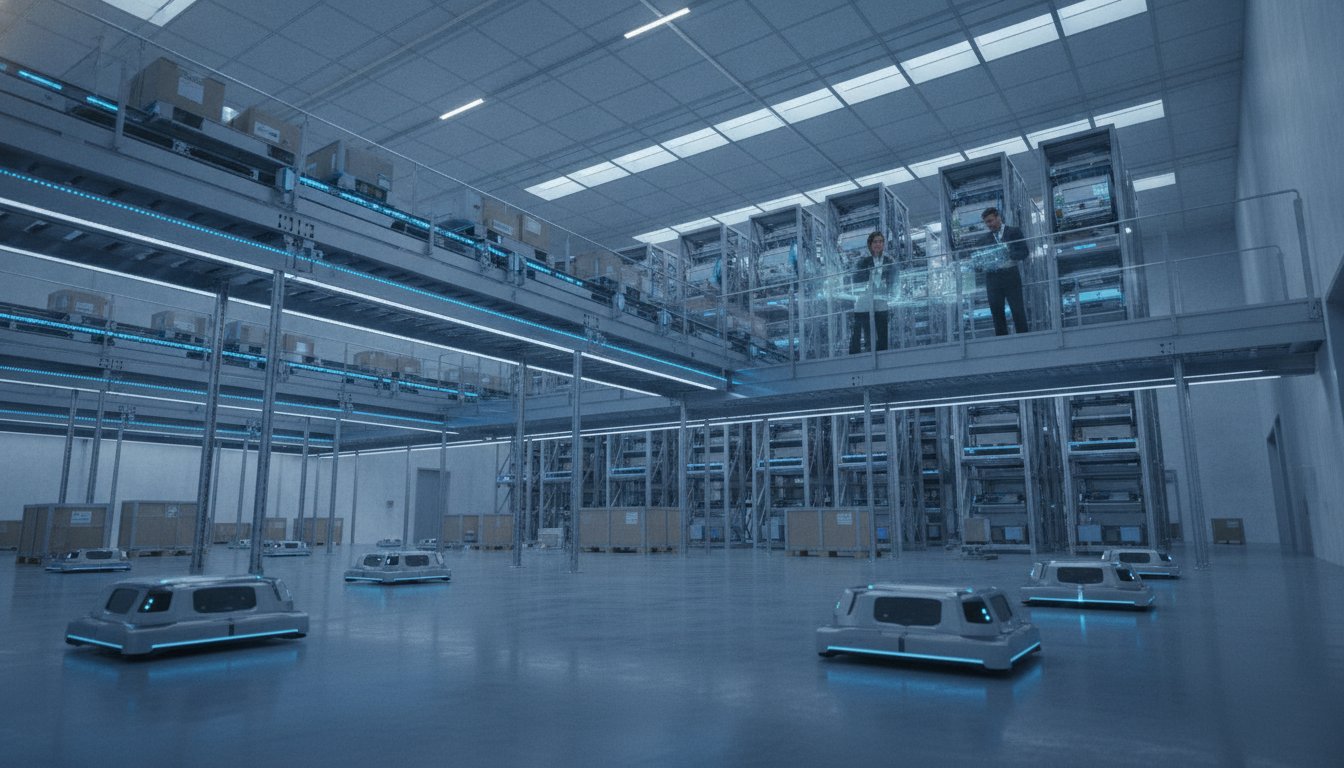
Did you know that labor costs now account for up to 60% of a distribution center's total operating expenses? In an era where every square foot of floor space is a premium asset, relying on disjointed systems or manual processes is no longer a sustainable strategy. You've likely felt the strain of picking bottlenecks and the frustration of equipment that doesn't communicate with your software. It's a common hurdle for growing facilities; however, the path to efficiency requires more than just buying new hardware.
This guide provides the roadmap you need to implement high-performance warehouse material handling solutions that bridge the gap between legacy infrastructure and modern automation. By focusing on strategically engineered flows, you'll discover how to increase throughput while significantly reducing operational costs. We will examine the latest in robotics, modular conveyor systems, and the 2026 OSHA safety standards that are reshaping the industrial landscape. From process engineering to maintenance, this is how you build a future-proofed facility that scales with confidence.
Key Takeaways
- Learn why a flow-centric approach is essential for 2026 industrial facilities to prevent bottlenecks and maximize floor space efficiency.
- Discover how to integrate advanced warehouse material handling solutions, such as high-speed conveyors and picking robotics, to optimize your facility's daily throughput.
- Understand the critical role of warehouse racking as the structural foundation that supports and enables high-speed automated retrieval systems.
- Identify how to conduct a comprehensive facility audit to determine whether manual, semi-automated, or fully automated systems best suit your scalability goals.
- Explore the strategic advantages of the design-build model for ensuring long-term system reliability through professional process engineering and dedicated maintenance.
Defining Modern Warehouse Material Handling Solutions for 2026
The industrial sector has undergone a fundamental transformation. Historically, material handling was viewed as a series of isolated manual tasks focused on moving pallets from point A to point B. Today, warehouse material handling solutions are sophisticated, integrated ecosystems where every mechanical component and data point must work in perfect harmony. In 2026, the competitive advantage doesn't belong to the facility with the most storage; it belongs to the one with the most efficient flow.
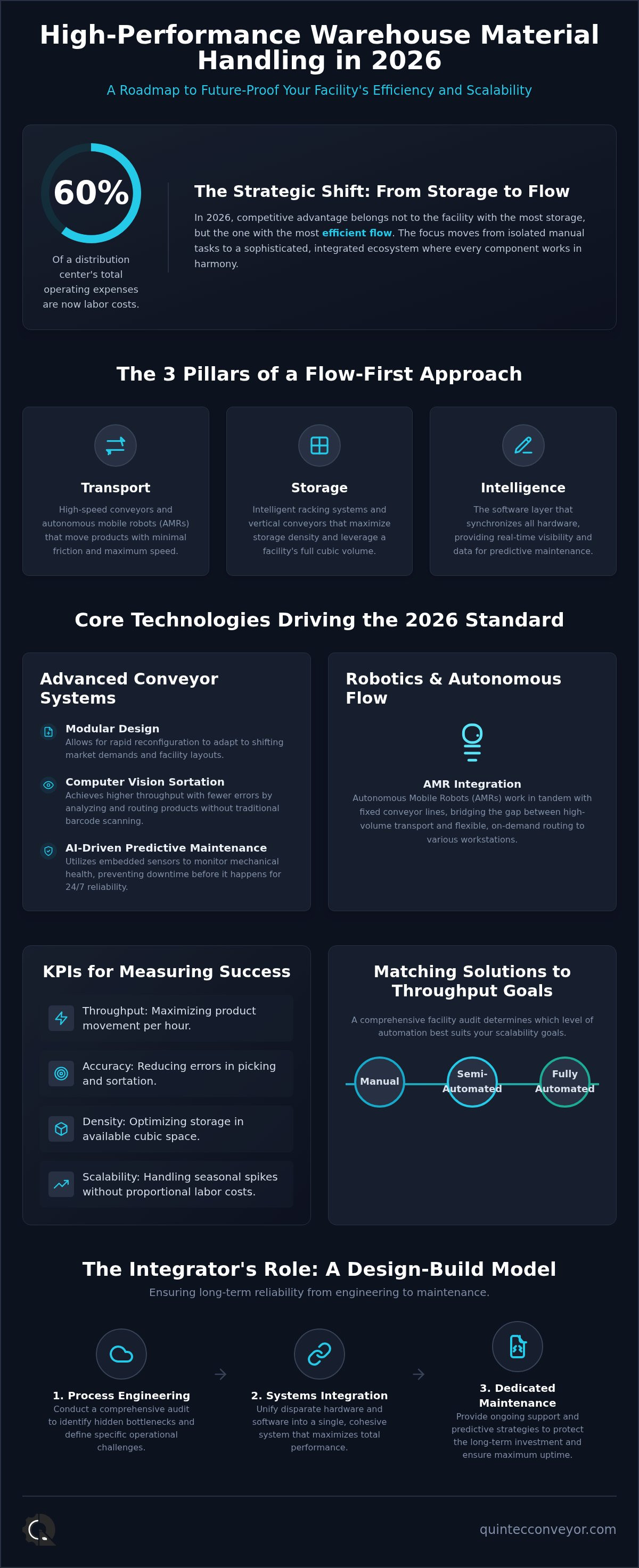
Adopting a flow-first mentality is essential for modern scalability. While storage remains necessary, prioritizing throughput ensures that products move through the facility with minimal friction. This approach relies on three core pillars: transport, storage, and intelligence. Transport involves high-speed conveyors and robotics. Storage includes intelligent racking systems that maximize density. Intelligence is the software layer that synchronizes hardware and provides real-time visibility. Before any equipment is purchased, process engineering must be applied to identify hidden bottlenecks. This proactive phase ensures that the final system is built to solve specific operational challenges rather than simply filling a room with machines.
The Shift Toward Systems Integration
Efficiency is no longer found in standalone machines. Modern facilities require connected workflows where conveyors, robotics, and racking operate as a single unit. A strategic integrator plays a vital role here; they unify disparate hardware brands into a cohesive environment. Material Handling Integration is the synchronization of equipment and data to create a seamless operational loop. This shift moves the focus from individual equipment specs to total system performance, ensuring that your hardware investment doesn't result in disjointed silos of automation.
Key Performance Indicators (KPIs) for 2026 Solutions
Measuring the success of your infrastructure requires a focus on three primary metrics: throughput, accuracy, and density. In a volatile global market, scalability is equally critical. Your facility must be able to handle seasonal spikes without a proportional increase in labor. These goals should directly inform your custom material handling system design. By aligning hardware selection with specific KPI targets, you ensure that your warehouse material handling solutions provide a measurable return on investment and a future-proofed foundation for long-term growth.
Core Technologies: Advanced Conveyors and Robotics
The 2026 standard for high-speed sortation has moved beyond simple belt movement. Today's systems utilize modular designs that allow for rapid reconfiguration as market demands shift. This agility is a cornerstone of modern warehouse material handling solutions. By utilizing computer vision instead of traditional barcode scanning, sortation logic now achieves higher throughput with fewer errors. These systems don't just move products; they analyze and route them with a level of precision that was previously unattainable.
Uptime is non-negotiable for high-volume operations. AI-driven predictive maintenance utilizes embedded sensors to monitor mechanical health in real time. Instead of waiting for a component to fail, these systems alert maintenance teams to potential issues before they cause a shutdown. This proactive approach ensures 24/7 reliability for complex industrial operations. It's a shift from reactive repair to strategic asset management that protects your long-term investment.
Specialized Conveyor Applications
High-capacity facilities often rely on automated pallet conveyor systems to manage heavy-duty loads with precision. These systems are frequently paired with vertical conveyors to exploit the full cubic volume of a facility. According to the Material Handling Institute (MHI), maximizing vertical space is a top priority for facilities constrained by a limited footprint. This multi-level approach allows for a denser storage profile without sacrificing the speed of material flow. If you're looking to upgrade your facility's mechanical flow, partnering with a national integrator can help you select the right combination of conveyors for your specific layout.
Robotics and Autonomous Flow
The integration of Autonomous Mobile Robots (AMRs) with fixed conveyor lines represents the next stage of automation. While fixed systems handle high-volume transport, AMRs provide the flexibility to move goods between disjointed stations or temporary work cells. Success in this area depends on robust 'Handshake' protocols. These digital communication standards allow different automation layers to exchange data safely and efficiently. Robotic arms also play a critical role in palletizing and depalletizing stations. They reduce the physical strain on labor while maintaining consistent cycle times, ensuring that the transition from storage to transport is never a bottleneck.
Optimizing Storage Infrastructure and Racking Systems
In any high-performance facility, racking serves as the skeleton of the entire operation. It isn't merely a place to hold inventory; it's the structural framework that dictates how active transport systems interact with static goods. When designing warehouse material handling solutions, the infrastructure must be engineered to support the dynamic loads and precise tolerances required by automated retrieval systems. This creates a symbiotic relationship where the racking provides the stability and the automation provides the speed.
Maximizing the vertical cube of a facility often involves the strategic use of mezzanine levels. These structures allow for multi-tier operations that double or triple usable floor space without expanding the building's footprint. However, this verticality introduces complexity in material movement. Achieving the right balance between high-density storage and immediate accessibility is a constant challenge. According to reports from Modern Materials Handling, the most successful 2026 facility layouts prioritize selective access for high-velocity SKUs while utilizing deep-lane storage for slower-moving bulk inventory.
Advanced Racking Configurations
Choosing between push-back and pallet flow racking depends heavily on your inventory's turnover requirements. Push-back systems offer high density for Last-In, First-Out (LIFO) applications, while pallet flow systems are ideal for First-In, First-Out (FIFO) management. Regardless of the configuration, structural integrity is paramount when these systems support heavy automation. Integrating industrial conveyor systems into multi-tier racking requires precise engineering to ensure that vibrations and weight loads don't compromise system accuracy or safety.
Infrastructure for Automation
Preparing a facility for advanced automation goes beyond the equipment itself. Floors must be leveled to exacting standards to support the travel paths of robots, and power distribution must be robust enough to handle the peak loads of continuous conveyor operation. Safety barriers and structural protection are also essential in high-traffic zones to prevent accidental damage to critical infrastructure. As more facilities move toward 'Dark Warehouse' capabilities, the design must account for 24/7 operation with minimal human intervention, requiring infrastructure that's both resilient and self-diagnostic.
Strategic Selection: Matching Solutions to Throughput Goals
Success in 2026 starts with a comprehensive facility audit. Many operations buy equipment to fix symptoms rather than underlying causes. Process engineering identifies whether a bottleneck is a mechanical limitation or a logical one. A thorough audit goes beyond counting pallets; it examines the velocity of every SKU and the travel time of every operator. By mapping these flows, you can pinpoint exactly where the system stalls. This data-driven foundation ensures that the chosen warehouse material handling solutions are sized correctly for both current needs and projected growth.
When budgeting for these systems, focus on the Total Cost of Ownership (TCO) over a ten-year horizon. Initial capital expenditure is only part of the equation. Maintenance requirements, energy consumption, and long-term labor savings define the true ROI of an integration project. Professionals should consult the 2026 checklist for sourcing new material handling equipment to ensure no hidden costs are overlooked during the procurement phase. Balancing upfront costs with operational reliability is the hallmark of a strategic investment.
The Automation vs. Manual Debate
Manual picking often remains the best choice for low-volume, high-variability operations where human dexterity is required. However, as order volumes rise, the "Middle Ground" of semi-automation offers a balanced entry point for mid-sized distribution centers. This often involves manual picking onto a motorized conveyor line or using voice-directed systems to increase accuracy without the cost of full robotics. The following table illustrates the general performance expectations for different levels of integration:
| System Type | Throughput Level | Labor Dependency | Flexibility |
|---|---|---|---|
| Manual | Low to Moderate | High | Very High |
| Semi-Automated | Moderate to High | Moderate | High |
| Fully Automated | Very High | Low | Moderate (Fixed) |
Designing for Scalability
Modularity is the most vital feature of 2026 industrial equipment. Facilities must adapt to SKU proliferation and changing order profiles without tearing out existing infrastructure. SKU proliferation is a significant challenge; as variety increases, warehouses must manage a wider range of product dimensions and weights. A scalable system uses modular conveyor segments and adjustable racking that can be repurposed as your inventory mix shifts. Future-proofing means selecting systems that allow for expansion modules to be added during off-peak hours. If you need a partner to help navigate these complexities, you can contact Quintec today for expert integration guidance.
The Integrator’s Role: From Engineering to Maintenance
Transitioning from a strategic plan to a physical reality requires more than just purchasing hardware. Many facilities fail because they adopt an equipment-only model, buying individual components from various vendors without a central engineering vision. In contrast, the design-build model ensures that your warehouse material handling solutions are conceived as a single, unified system. This approach places accountability on a single partner, from the initial CAD drawings to the final bolt in the floor. It eliminates the risk of disjointed systems that don't communicate, ensuring that every piece of infrastructure supports the total facility flow.
The lifecycle of a successful integration project follows a methodical progression: design, install, and maintain. Leveraging over 100 years of collective industry experience allows an integrator to anticipate common installation pitfalls, such as unforeseen electrical constraints or floor load issues, before they delay your go-live date. Long-term reliability isn't an accident; it's the result of professional conveyor maintenance and a commitment to total project management. A partner who understands the mechanical nuances of your system can provide the proactive care needed to prevent costly downtime.
Professional Installation and Commissioning
Integrating electrical and mechanical systems is a high-stakes endeavor that requires precision. During the commissioning phase, it's essential to perform peak-load simulations. These tests ensure the system handles 2026 throughput standards without mechanical strain or software lag. Beyond the physical setup, training your staff is a critical step in the integration process. Operators must understand how to monitor automated flows and respond to system alerts to maintain continuous uptime. This ensures your team is confident in managing the sophisticated technology at their disposal.
Ongoing Process Engineering
A warehouse is a living environment. As your business evolves, your warehouse material handling solutions require regular tuning to remain efficient. Ongoing process engineering uses system analytics to identify new bottlenecks that emerge as order profiles change. This data-driven optimization ensures your facility remains at peak performance long after the initial installation is complete. To secure your facility's future and ensure a seamless transition to automation, partner with Quintec for your next integrated material handling project. Our team provides the expertise needed to turn complex logistical challenges into streamlined operational successes.
Building a Future-Ready Industrial Infrastructure
The landscape of 2026 demands a shift from simply purchasing equipment to engineering an integrated flow. Success requires a synergy between high-speed robotics, modular conveyors, and robust racking systems. By prioritizing a flow-first design, your facility can overcome labor shortages and maximize every square foot of floor space. Implementing high-performance warehouse material handling solutions is a complex undertaking; however, it's the only way to ensure long-term scalability in a volatile global market.
Quintec brings over 100 years of collective industry experience to every project. We provide turnkey design and installation services with national US coverage, moving your operation beyond standalone hardware toward a strategic, integrated ecosystem. Our team is ready to help you navigate these technical challenges with precision and confidence. Request a Strategic Consultation with Quintec Conveyors today to start optimizing your facility's throughput. Your path to a more efficient, future-proofed operation starts here.
Frequently Asked Questions
What are the primary components of a warehouse material handling solution?
The primary components of a warehouse material handling solution include transport systems like conveyors, storage infrastructure such as warehouse racking, and the process engineering that connects them. Modern solutions in 2026 also integrate robotics and automation to handle high-speed sortation. These elements work together to create a unified flow rather than acting as isolated tools. By combining mechanical hardware with intelligent data, a facility can achieve maximum density while maintaining high throughput speeds.
How do I determine if my warehouse needs automation in 2026?
You should consider automation if your labor costs exceed 45% of total operating expenses or if throughput bottlenecks are impacting your ROI. In 2026, many facilities adopt automation to meet new OSHA safety standards and address chronic labor shortages in picking stations. If your current floor space utilization is inefficient, modular warehouse material handling solutions can provide the scalability needed to handle SKU proliferation without requiring a costly physical expansion of your building.
What is the difference between a material handling vendor and an integrator?
A material handling vendor typically sells individual pieces of equipment; an integrator like Quintec designs and installs a complete, synchronized ecosystem. The integrator's role involves using process engineering to ensure that different brands of hardware and software communicate seamlessly. This design-build approach provides a single point of accountability for the entire project lifecycle. It moves your operation from a collection of standalone machines toward a strategically engineered, high-performance industrial flow.
How does a conveyor system improve warehouse safety?
Conveyor systems improve safety by significantly reducing the need for manual heavy lifting and decreasing forklift traffic in high-density zones. Forklift accidents remain a top concern under the 2026 OSHA National Emphasis Program on Warehousing. Modern conveyors include integrated safety sensors, emergency stops, and controlled speeds to protect operators. By automating the transport of goods, you create a more predictable environment that minimizes human exposure to the common hazards found in industrial facilities.
What should I look for when choosing a material handling equipment supplier?
Prioritize a supplier that acts as a strategic integration partner with turnkey design and installation capabilities. You should look for a provider with a deep history of collective industry experience and a national service footprint. A reliable supplier doesn't just deliver hardware; they offer comprehensive process engineering and ongoing conveyor maintenance to ensure long-term uptime. This ensures your system is built on a foundation of structural integrity and can adapt to future market shifts.
Can I integrate new robotics into my existing conveyor system?
Integrating new robotics into a legacy system is possible through the implementation of standardized 'Handshake' protocols and computer vision technology. Autonomous Mobile Robots (AMRs) can be programmed to interact with fixed conveyor lines to bridge gaps in your facility's flow. This modular approach allows you to upgrade specific picking or packing stations without a total system replacement. It's an effective strategy for facilities that need to increase throughput while maintaining their existing infrastructure.
How much floor space can I save with vertical material handling solutions?
Vertical material handling solutions, such as mezzanines and multi-tier racking, can often double or triple your usable floor space without expanding the building's footprint. These systems take advantage of the full cubic volume of a facility, which is critical for operations in high-cost industrial markets. By moving material flow to multiple levels, you can separate high-velocity picking from bulk storage. This verticality maximizes density while ensuring that your warehouse material handling solutions remain highly accessible.
What is the typical ROI for a fully automated warehouse system?
The ROI for a fully automated system is typically evaluated through its 10-year Total Cost of Ownership (TCO). While initial capital costs for mechanized automation can be significant, the long-term savings in labor and increased accuracy often provide a clear financial advantage. Automation reduces the cost per order and protects your operation against rising wage inflation. By optimizing throughput and reducing energy consumption, these systems offer a stable, future-proofed foundation for large-scale industrial projects.