VLM Machine Buying Guide: Maximizing Vertical Storage in 2026
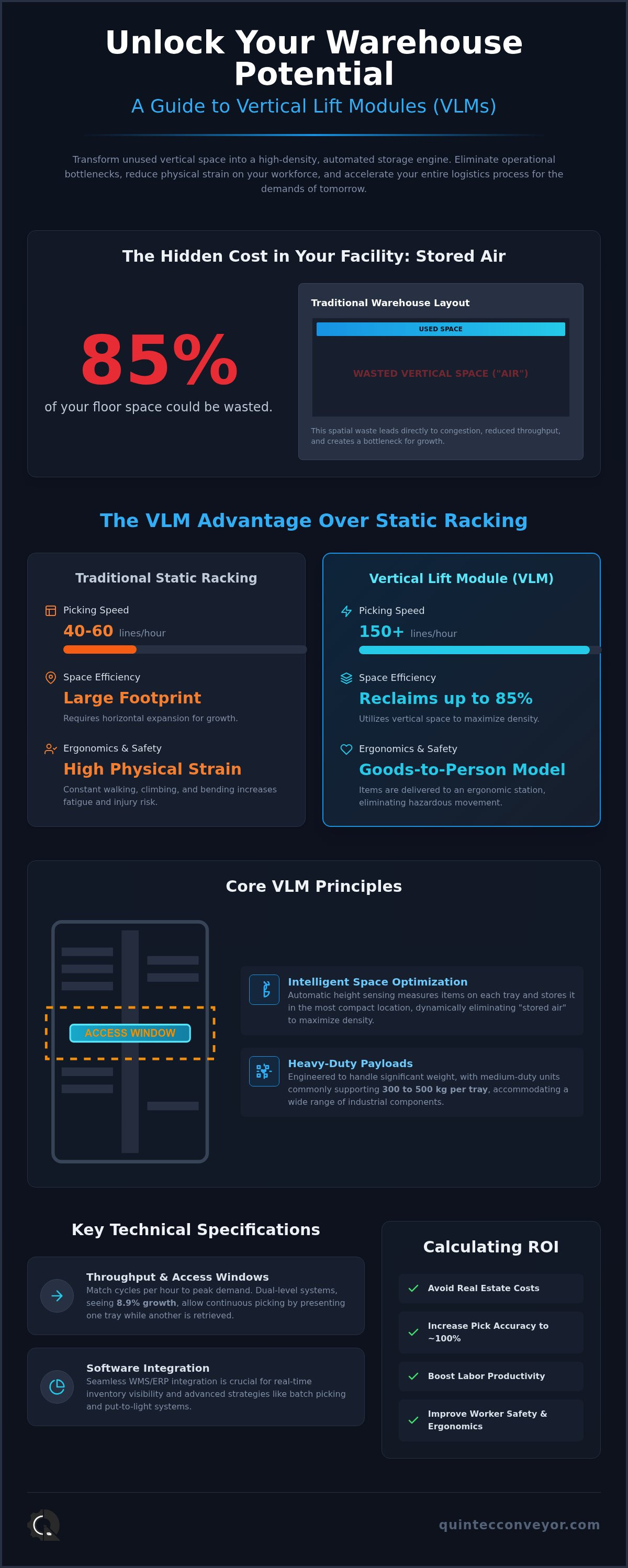
85% of your warehouse floor space is likely being occupied by nothing but air, even as your team struggles to navigate a congested and inefficient facility. This spatial waste isn't just an inconvenience; it's a direct bottleneck to your operational throughput and long-term growth. Integrating a high-performance vlm machine into your workflow transforms this dead vertical space into a high-density, automated storage engine. By shifting from horizontal expansion to vertical precision, you can eliminate the physical strain on your workforce while simultaneously clearing the path for more complex logistics tasks.
We understand that selecting industrial hardware is a major capital investment that requires a strategic, long-term perspective. You've likely felt the pressure of rising pick errors and the worker fatigue that stems from constant climbing and bending. This guide provides the technical insight you need to select a system that doesn't just store items, but accelerates your entire process. We'll show you how to achieve near 100% pick accuracy and create a seamless flow between your storage units and shipping conveyors, ensuring your facility is fully optimized for the 2026 market.
Key Takeaways
- Reclaim up to 85% of your horizontal floor space by transitioning from static shelving to automated vertical storage systems.
- Match your specific inventory profile to technical specifications like tray load capacity and throughput to ensure your vlm machine eliminates operational bottlenecks.
- Distinguish between vertical carousels and VLMs to select the most efficient storage solution for high-mix and variable-height items.
- Calculate clear ROI by factoring in reduced travel time for warehouse associates and the avoidance of expensive real estate expansion.
- Discover how strategic process engineering connects storage modules with industrial conveyor systems for a truly seamless logistics workflow.
What is a VLM Machine and Why is it Essential in 2026?
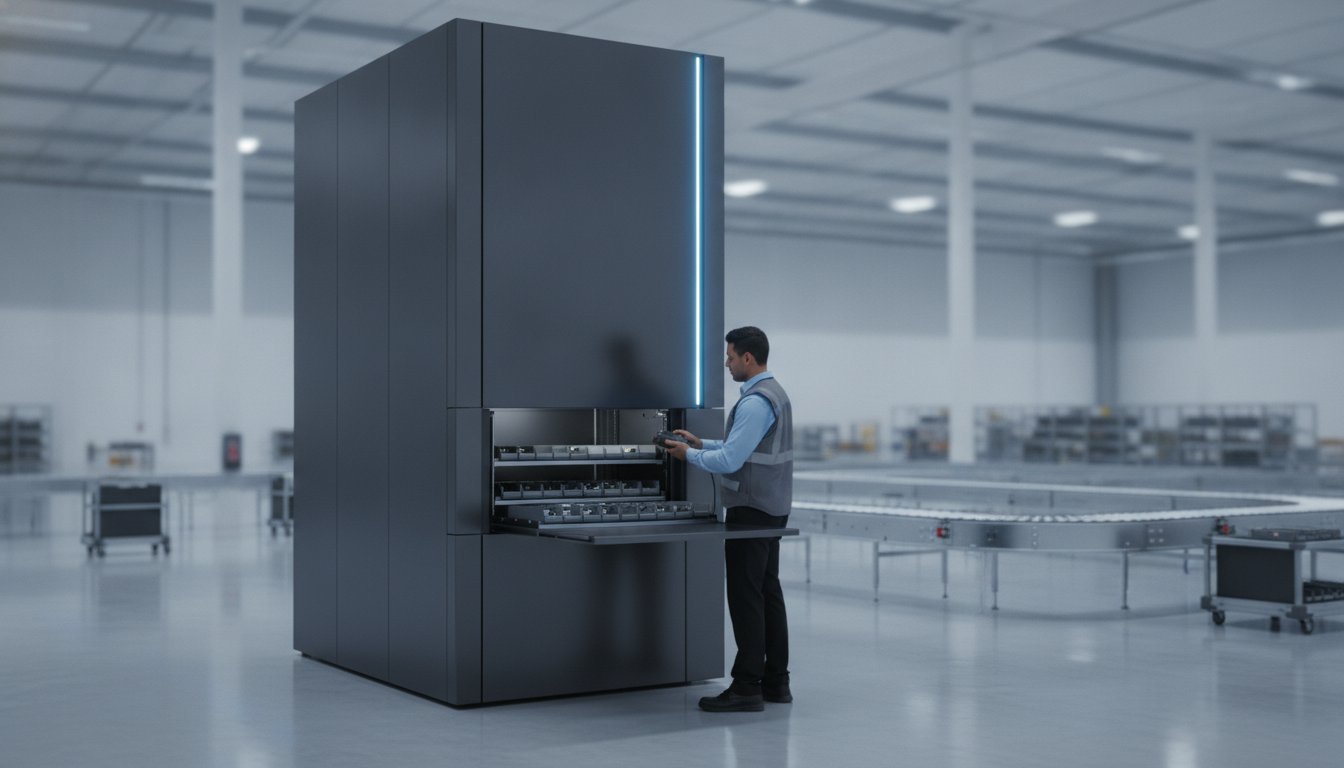
A Vertical Lift Module (VLM) is an automated storage and retrieval system (ASRS) comprising two parallel columns of trays and a central elevator mechanism. This architecture represents a fundamental shift in warehouse philosophy; in the past, pickers traveled to the parts. Now, the vlm machine brings the parts to the picker. This "Goods-to-Person" (GTP) model isn't just about speed. It's about reclaiming the "golden zone" of unused ceiling height that often reaches 40 feet or more in modern facilities. By 2026, industrial real estate costs have reached levels where every square foot of horizontal space must be maximized for production, not just storage.
Automation has moved from a luxury for large enterprises to a necessity for any operation that intends to scale without doubling its footprint. Labor shortages in the logistics sector are no longer temporary hurdles. They're structural realities. Implementing a VLM allows a single operator to manage the inventory volume that previously required a full team of pickers. This efficiency is the cornerstone of modern process engineering, transforming the warehouse from a static cost center into a dynamic engine of throughput.
The Core Mechanics of Vertical Lift Technology
The efficiency of a VLM hinges on its internal intelligence. Most modern units utilize automatic height sensing to measure the profile of items on each tray. The system then places that tray in the most compact location available, effectively eliminating "stored air." The extractor mechanism acts as the central engine, retrieving trays and delivering them to an ergonomic access window. For industrial applications, these systems are engineered to handle significant payloads. Medium-duty units often support 300 to 500 kg per tray, ensuring they can manage everything from small electronics to heavy automotive components.
VLM vs. Traditional Static Racking
The contrast between static racking and a vlm machine is stark. Consider the footprint required for 100 bays of standard shelving. A single VLM unit can often store that entire inventory in a fraction of the space. The performance metrics are equally impressive:
- Picking Speed: Manual picking usually yields 40 to 60 lines per hour. A VLM often pushes throughput to 150 lines per hour or more.
- Space Recovery: Facilities typically reclaim up to 85% of their floor space for other revenue-generating activities.
- Safety and Ergonomics: You remove the hazards of ladders and reach trucks. Workers remain at a fixed station, reducing the risk of ergonomic injuries and the fatigue caused by miles of walking every shift.
Key Technical Specifications to Evaluate
Selecting the right vlm machine requires a meticulous assessment of technical parameters that extend far beyond simple height and width. You must first evaluate tray dimensions and load capacity against your specific inventory profile. Medium-duty trays typically support between 300 and 500 kg, which accounts for approximately 43% of the current market demand as of 2026. A mismatch here leads to mechanical strain or significant wasted volume. In current operations, vertical density is no longer a static calculation. Modern AI-driven slotting software now optimizes tray placement in real-time, adjusting the internal configuration based on shifting demand patterns to ensure high-velocity items remain in the most accessible positions.
Throughput requirements are equally vital. You should calculate required cycles per hour to ensure the machine doesn't become a bottleneck during peak periods. Access window configurations play a major role in this calculation. While single-level delivery is a standard entry point, dual-level systems are seeing an 8.9% growth rate because they allow for continuous picking. One tray is presented to the operator while the next is being retrieved or restowed; this virtually eliminates operator idle time and maximizes the speed of the picking process.
Software Integration: The Brain of the VLM
The digital connectivity of your storage module determines its ultimate utility. Seamless integration with your existing WMS and ERP systems ensures real-time inventory visibility across the entire facility. Strategies like batch picking and put-to-light systems further enhance speed by providing visual cues for multi-order processing. Achieving this level of synchronization often requires professional warehouse design services to plan a software architecture that bridges the gap between storage and fulfillment.
Physical Footprint and Facility Requirements
Your facility must be structurally capable of housing a 40-foot steel tower. Floor load-bearing requirements are critical; you need to verify if your current slab can support the concentrated pressure of a fully loaded unit. Ceiling clearance and fire suppression systems also require early-stage planning. Building codes in 2026 strictly dictate sprinkler obstructions and clearances that can impact your total height potential. Consider your power infrastructure as well. Mission-critical operations require robust electrical layouts and dedicated backup systems to prevent downtime during power fluctuations. If you're planning a facility overhaul, speaking with a systems integrator can help align these technical requirements with your operational goals.
VLM vs. Vertical Carousel: Choosing the Right ASRS
Distinguishing between these two technologies is essential for long-term operational stability. A vertical carousel operates like a Ferris wheel; it utilizes a chain-driven system to move every storage location simultaneously until the requested tray reaches the access window. In contrast, a vlm machine functions as a sophisticated elevator. A central extractor travels vertically to retrieve a specific tray and deliver it to the operator while the remaining inventory stays stationary. This mechanical difference dictates everything from energy consumption to the types of goods you can store.
Carousels are historically reliable for uniform inventory, but they lack the flexibility of modern lift modules. Because every tray moves in a carousel, the entire system must be balanced to prevent mechanical strain. A VLM doesn't share this limitation. Its rack-and-pinion drive system is engineered for precision and longevity, handling unbalanced loads with far greater ease. Maintenance profiles also differ significantly. Chain-driven systems often require more frequent lubrication and tensioning to maintain alignment. Rack-and-pinion systems provide a more robust, low-maintenance profile that supports higher uptime in mission-critical environments. If your facility manages a high-mix inventory with variable heights, the VLM is the logical strategic choice.
When to Choose a Vertical Carousel
Vertical carousels remain a viable solution for specific applications where consistency is the primary factor. They are ideal for uniform-sized items like standard bins, small electronic components, or document archives. Since the entire loop moves, these systems provide very high-frequency access when all items are roughly the same weight and size. Additionally, carousels are often the preferred choice for facilities with lower ceiling heights where a full-scale VLM tower isn't physically possible. They offer a compact footprint for light-duty, high-access needs.
When a VLM Machine is the Superior Choice
A vlm machine offers the versatility required for complex industrial environments. It's the superior choice for handling heavy payloads; some industrial trays support over 2,000 lbs each. This capacity is critical for motor parts, tooling, or heavy raw materials. The system's ability to handle highly variable heights means you can store small fasteners directly alongside bulky machinery components without wasting vertical space. In modern, high-bay distribution centers, the VLM provides maximum scalability, allowing for height adjustments and system expansions that carousels simply cannot match. This adaptability ensures your storage investment evolves alongside your inventory demands.
The Buying Guide: Calculating ROI and Justifying the Spend
Justifying the capital expenditure for a vlm machine requires a shift from viewing storage as a passive expense to seeing it as a strategic asset. The most immediate return is found in direct labor savings. In traditional manual shelving environments, warehouse associates often spend up to 70% of their shift simply walking between aisles. By implementing a "Goods-to-Person" model, you eliminate this non-productive travel time. This allows your existing team to handle significantly higher order volumes without increasing headcount. This efficiency often lets facilities reallocate labor to higher-value tasks like quality control or complex assembly where human insight is most valuable.
Real estate cost avoidance is another primary driver for ROI in 2026. With industrial lease rates continuing to climb, the ability to recover the majority of your floor space can negate the need for a costly facility expansion or a move to a larger site. When you factor in the expense of moving operations, the storage module often pays for itself through footprint consolidation alone. Additionally, the improvement in inventory accuracy shouldn't be overlooked. Every mispick or lost SKU carries a hidden cost in returns processing and customer dissatisfaction. Systems equipped with pick-to-light technology drive accuracy rates toward 99.9%, protecting your margins and your brand reputation while reducing ergonomic injuries that lead to costly compensation claims.
Determining Total Cost of Ownership (TCO)
A comprehensive financial analysis must look beyond the initial purchase price. You need to account for installation, staff training, and ongoing software licensing. It's also vital to apply conveyor maintenance principles to your VLM to ensure long-term uptime and mechanical reliability. Modern units in 2026 often feature regenerative drive systems. These systems capture energy during the tray's descent and feed it back into the facility's power grid, which helps offset operational utility costs over the machine's lifespan.
Future-Proofing Your Investment
Your storage solution must be as agile as your business. Most high-quality modules are designed for scalability; they can be heightened or even relocated if your facility requirements change. Compatibility with emerging technologies is equally critical. Ensure your access window is configured for warehouse robotics integration, specifically for Autonomous Mobile Robots (AMRs) that can take items directly from the VLM to packing stations. If you're ready to evaluate the specific financial impact on your facility, our team can help you design a custom integration plan that maximizes your long-term ROI.
System Integration: Connecting the VLM to Your Workflow
A vlm machine is often perceived as a standalone storage cabinet, but its true value is only unlocked when it's treated as a critical node within a larger automated ecosystem. Purchasing the hardware from an Original Equipment Manufacturer (OEM) is essentially only half the battle. To realize the 85% floor space recovery mentioned earlier, you must integrate the unit into your facility's physical and digital flow. This is where the strategic role of a systems integrator becomes indispensable. We ensure that the transition from storage to movement is frictionless, preventing the storage module from becoming an isolated island of automation.
Connecting the access window to industrial conveyor systems allows picked items to move instantly toward packing and shipping stations. This eliminates the need for manual cart transport and keeps your operators focused on the picking interface. This flow works in both directions; conveyors can also facilitate automated induction, feeding inventory directly into the VLM for replenishment. We often customize these interfaces with ergonomic pick stations and integrated weighing scales to ensure every order is verified for weight and quantity before it ever leaves the storage zone.
VLM and Robotic Synergies
The 2026 logistics landscape increasingly favors fully autonomous solutions. By integrating robotic pick and place systems, you can achieve a lights-out operation where human intervention is minimal. We synchronize tray delivery with robot arm cycles to maintain maximum throughput without idle periods. Advanced AI coordinates these movements, ensuring the robotic arm and the conveyor floor operate as a single, unified machine.
Why Partner with a System Integrator like Quintec?
Total facility optimization requires looking at the flow before, during, and after the storage module. We don't just install equipment; we engineer a comprehensive solution that includes turnkey mechanical, electrical, and software integration. Our team utilizes custom material handling system design to ensure your facility remains scalable. With over 100 years of collective industry experience, we provide the steady hand needed to navigate these complex logistical challenges.
Strategic Vertical Growth in 2026 and Beyond
Transitioning to a high-density storage model is no longer just a space-saving tactic; it's a fundamental requirement for maintaining a competitive edge in 2026. By implementing a vlm machine, your facility can reclaim 85% of its horizontal footprint while simultaneously driving pick accuracy toward near-perfection. The real success of this investment depends on moving beyond standalone hardware to a fully integrated workflow that connects storage directly to your shipping conveyors and robotic systems. This shift ensures your facility isn't just storing more, but moving faster.
Quintec brings over 100 years of collective engineering experience to every project, providing the strategic insight needed to bridge the gap between complex ASRS technology and daily operational flow. We offer national reach with localized engineering support to ensure your system is installed with precision and maintained for maximum uptime. We don't just sell equipment; we design complete logistical engines. Contact Quintec for a custom VLM integration consultation and start reclaiming your floor space today. We look forward to helping you build a more efficient future.
Frequently Asked Questions
How much floor space can a VLM machine actually save?
A vlm machine typically recovers up to 85% of existing floor space by consolidating inventory into a high-density vertical tower. This transition allows facilities to reclaim thousands of square feet for production or shipping operations without expanding the building footprint. By utilizing the full vertical height of a facility, often reaching 40 feet or more, companies can avoid the substantial costs associated with new construction or secondary site leases.
What is the difference between a VLM and a Vertical Carousel?
The primary difference lies in the internal movement mechanism. A Vertical Carousel moves all storage bins simultaneously in a continuous loop, similar to a Ferris wheel. Conversely, a Vertical Lift Module uses a central extractor to retrieve specific trays while others remain stationary. This makes the vlm machine more efficient for high-mix inventory with variable heights, as it optimizes internal tray spacing to eliminate wasted vertical air during storage.
Can a VLM machine be integrated with my existing WMS?
Yes, seamless integration with Warehouse Management Systems (WMS) and Enterprise Resource Planning (ERP) platforms is a standard requirement for modern automated facilities. Strategic integration ensures real-time inventory visibility and synchronized order processing. Partnering with a systems integrator like Quintec allows you to bridge the gap between your digital records and physical hardware. This creates a unified data flow that improves picking accuracy and reduces manual data entry errors across your logistics chain.
What are the weight limits for VLM trays in industrial settings?
Weight capacities vary based on the specific model and industrial requirements. Medium-duty trays often support between 300 and 500 kg, representing a large portion of the current market demand. For heavier industrial applications, high-capacity trays can handle over 2,000 lbs each. It's critical to match the machine's tray load capacity to your heaviest SKUs to prevent mechanical strain and ensure the long-term reliability of the central elevator and extractor mechanism.
How long does it take to install a VLM machine?
A standard installation typically takes between one and two weeks for the physical assembly of the tower and internal components. However, the total project timeline often extends to several months when accounting for initial process engineering, software integration, and connection to conveyor systems. Thorough planning and turnkey management ensure that the transition occurs with minimal disruption to your daily operations while meeting all safety and building code requirements.
What happens to my inventory if the VLM machine loses power?
In the event of a power failure, your inventory remains securely locked within the internal racking of the unit. Most industrial systems include a manual override or a hand-crank mechanism that allows operators to retrieve critical items during an outage. For mission-critical facilities, we recommend integrating dedicated backup power systems or uninterruptible power supplies to maintain continuous throughput and prevent downtime during localized electrical or grid fluctuations.
Is a VLM machine worth the investment for a small warehouse?
The investment is often justified for smaller warehouses facing high real estate costs or severe labor shortages. While the upfront capital is significant, the ability to store more inventory in a smaller footprint can prevent the need for a costly move to a larger facility. Additionally, the labor efficiency gains allow a smaller team to manage higher volumes. This provides a clear path to return on investment, often achieved within 6 to 18 months.
What kind of maintenance does a Vertical Lift Module require?
Regular preventative maintenance is essential to ensure maximum uptime and equipment longevity. This includes periodic inspections of the extractor mechanism, lubrication of moving parts, and cleaning of optical sensors used for height detection. Applying established conveyor maintenance principles to your storage module helps identify potential wear before it leads to system failure. Professional maintenance services ensure the rack-and-pinion or chain-driven systems remain aligned and operate at peak efficiency for years.