
The Strategic Guide to Automated Pallet Conveyor Systems in 2026
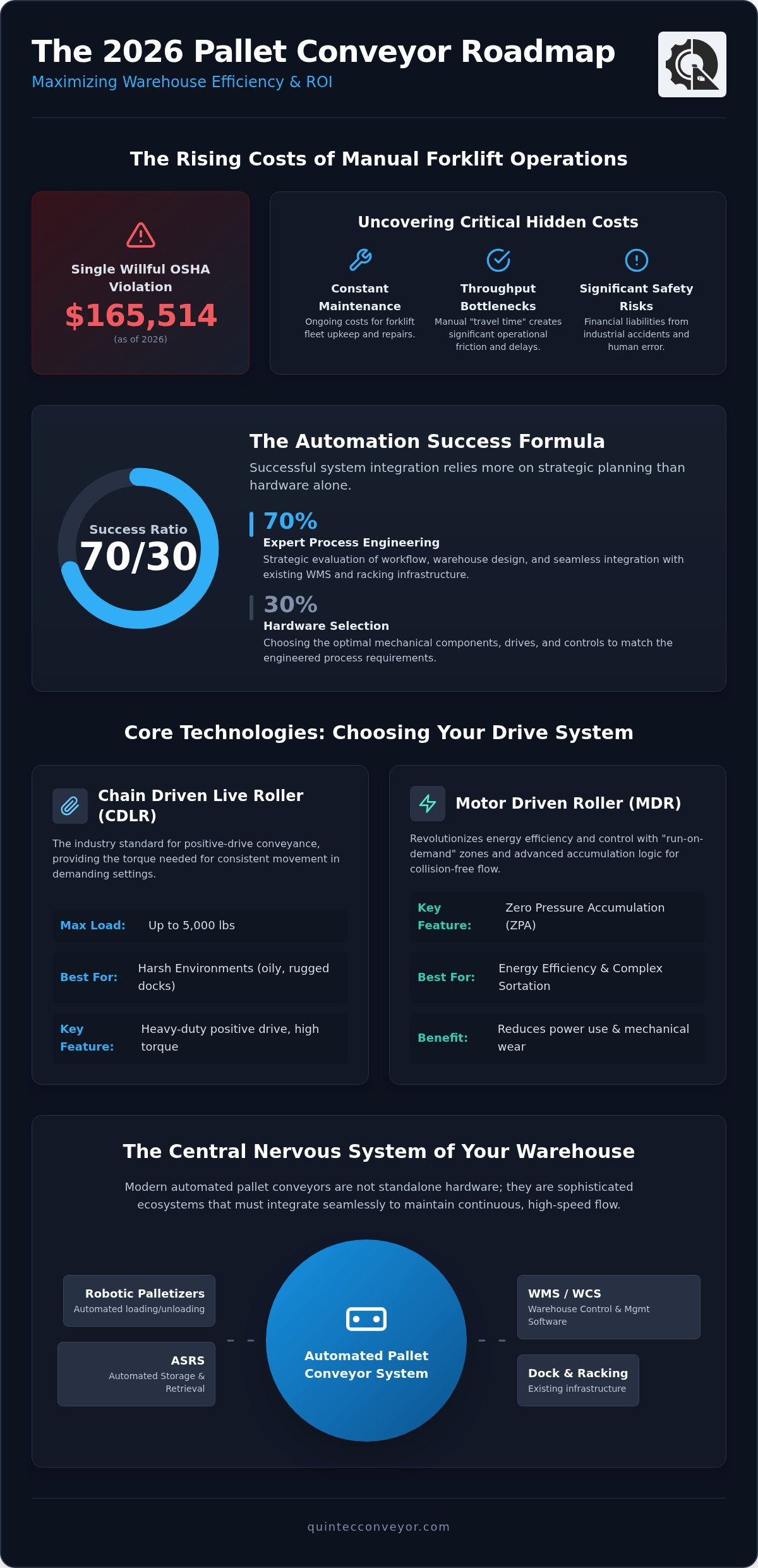
Did you know that a single willful OSHA violation in 2026 can now cost your facility up to $165,514? While the financial sting of safety penalties is severe, it's often the hidden costs of labor shortages and dock bottlenecks that truly erode your bottom line. You've likely realized that relying on manual forklift transport isn't just a safety risk; it's a barrier to the throughput your customers demand.
We understand that the transition to automated pallet conveyor systems feels complex, especially when you're worried about compatibility with your existing racking and WMS. This guide provides a strategic roadmap to help you evaluate, engineer, and integrate these systems to maximize warehouse efficiency and operational ROI. We'll examine the latest GS1 General Specifications, compare mechanical versus robotic palletizing trends, and detail the process engineering steps necessary to ensure your investment delivers long-term reliability and seamless scalability.
Key Takeaways
- Transition from manual forklift transport to high-efficiency pallet movement to eliminate dock bottlenecks and reduce rising labor costs.
- Identify the optimal drive systems and mechanical formats for heavy-duty loads based on specific torque and energy efficiency requirements.
- Understand why successful automated pallet conveyor systems rely on a 70/30 ratio of expert process engineering to hardware selection.
- Discover how strategic warehouse design ensures new automation integrates seamlessly with your existing racking infrastructure and WMS platforms.
- Leverage the risk-reduction benefits of partnering with a national integrator that offers over a century of collective industrial experience.
The Strategic Shift to Automated Pallet Conveyor Systems in 2026
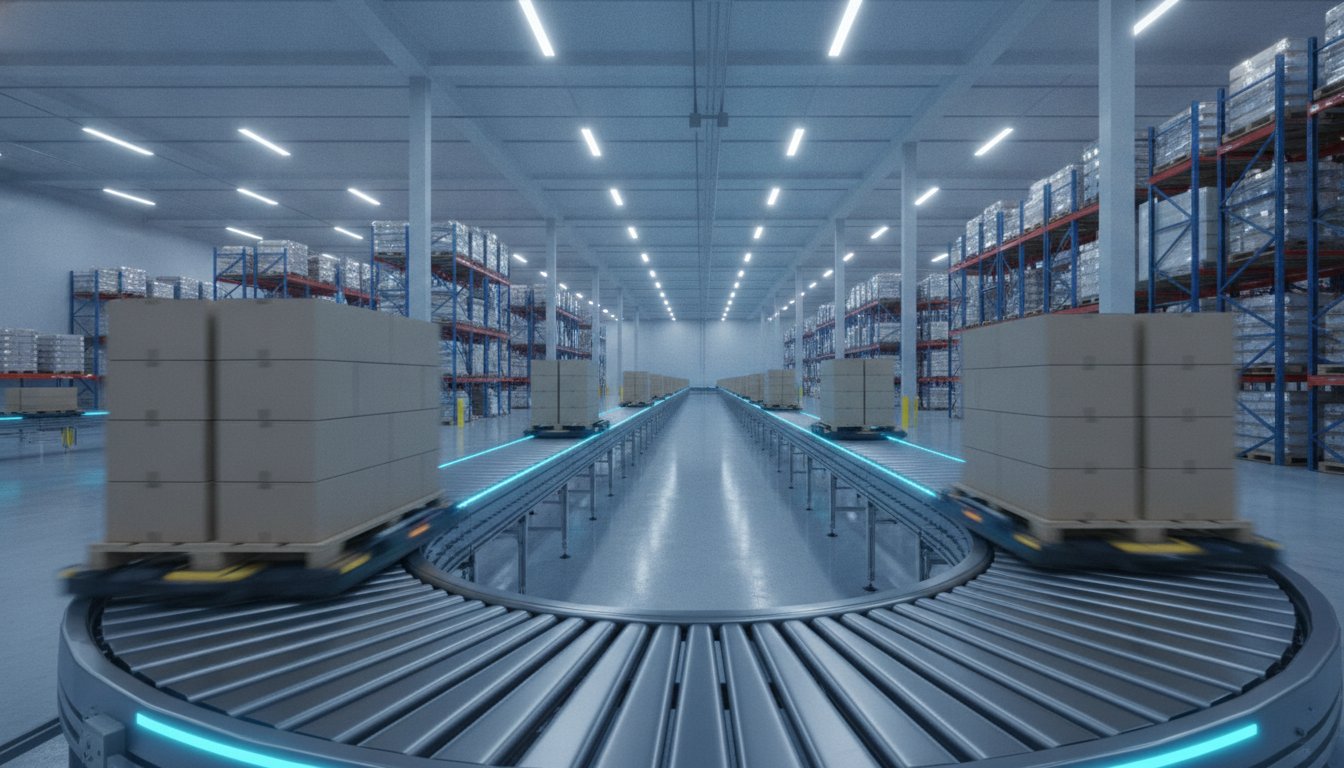
Modern industrial facilities no longer view a conveyor system as simple hardware. In 2026, automated pallet conveyor systems represent the central nervous system of the warehouse. They've moved beyond being mere transport tools to becoming sophisticated ecosystems where mechanical precision meets software logic. This shift is driven by a necessity for 24/7 uptime and the realization that manual pallet movement is a primary source of operational friction. We're seeing a decisive transition toward "lights-out" pallet movement, where human intervention is minimized to improve accuracy and speed.
Overcoming the Limitations of Manual Forklift Operations
Manual forklift transport carries heavy hidden costs that go far beyond the operator's hourly wage. Maintenance for a forklift fleet is constant, and the risk of industrial accidents remains a significant liability. With OSHA penalties for willful or repeated violations reaching $165,514 as of 2026, the financial incentive to automate has never been higher. Automation eliminates the "travel time" waste inherent in large facilities, where drivers spend a large portion of their shift simply moving between docks and racking. By implementing automated pallet conveyor systems, facilities can effectively segregate human traffic from heavy-load movement, creating a safer and more predictable environment.
Defining the Modern Automated Pallet Ecosystem
A high-performance system doesn't operate in a vacuum. It must interface seamlessly with robotic palletizers and Automated Storage and Retrieval Systems (ASRS) to maintain a continuous flow. This coordination requires robust Warehouse Control Systems (WCS) to direct pallet traffic based on real-time priorities. Proper planning through warehouse design services ensures that the hardware layout matches the logical flow of the facility. We define system integration as the harmonious coordination of diverse mechanical components to achieve a single operational goal. It's about ensuring the hardware works in concert with the software to drive maximum ROI and long-term reliability.
Core Technologies Powering Automated Pallet Movement
Selecting the right hardware is a balance of mechanical durability and electronic intelligence. In 2026, automated pallet conveyor systems must do more than just move weight. They need to provide real-time data to AI-driven management platforms while maintaining high torque for heavy loads. High-level Conveyor and Sortation Systems provide the structural foundation needed for high-capacity industrial throughput. Choosing the correct drive system is the first step in ensuring your facility can handle the rigorous demands of modern logistics without premature mechanical failure.
Modularity is the cornerstone of modern industrial planning. By utilizing modular conveyor systems, you can add spurs, transfers, or accumulation zones as your business grows. This prevents the "rip and replace" cycle that often plagues facilities using fixed, welded frames. It also simplifies maintenance since individual modules can be serviced or replaced without halting the entire line. This flexibility is essential for companies that expect their throughput requirements to evolve over the next five to ten years.
Chain Driven Live Roller (CDLR) for High-Capacity Loads
CDLR remains the industry standard for pallets weighing up to 5,000 lbs. It uses a series of rollers driven by a heavy-duty chain, providing the positive drive needed for consistent movement. You'll typically choose between chain-to-chain drives, where each roller is linked to the next, or tangential drives, where a single chain runs beneath the rollers. These systems excel in harsh environments like oily manufacturing floors or rugged warehouse receiving docks where belt-driven alternatives might slip or degrade.
Motor Driven Roller (MDR) and Advanced Sortation Logic
MDR technology has revolutionized energy efficiency in the warehouse. Unlike traditional systems that run constantly, MDR uses "run-on-demand" zones. If a pallet isn't present, the motor stays off, significantly reducing power consumption and mechanical wear. This logic enables Zero Pressure Accumulation (ZPA), which prevents pallet collisions by ensuring each load has a clear zone ahead before moving. For complex routing, sortation conveyors integrated with MDR allow for high-speed pallet diversion with minimal maintenance requirements.
The integration of AI and advanced robotics has changed how we view pallet flow. Modern automated pallet conveyor systems act as the interface between the warehouse floor and robotic palletizing cells. New AI-powered solutions allow conveyors to dynamically recalibrate pallet spacing based on real-time sensor data. This level of synchronization ensures that high-speed sortation remains fluid even during peak periods. If you're planning a facility upgrade, our team can help you evaluate your technical requirements to ensure long-term stability.
Engineering Your System: Key Selection and Performance Criteria
Procurement teams often make the mistake of selecting hardware based on price alone. However, automated pallet conveyor systems must be tailored to the specific load profile of your operation. Off-the-shelf solutions frequently fail in heavy industrial settings because they lack the necessary roller pitch, motor torque, or frame gauge to handle variable loads. Engineering a system requires a deep dive into the physics of your facility, ensuring that every component is rated for the specific stresses it will encounter during peak throughput.
A successful installation begins with a rigorous selection framework. This involves analyzing the interaction between the pallet surface and the roller diameter to minimize vibration and wear. To ensure your facility stays ahead, sourcing new material handling equipment that adheres to 2026 standards for durability and sensor integration is vital. This proactive approach prevents the common "bottleneck" issues that arise when under-engineered equipment meets high-demand production schedules.
Analyzing Load Dynamics and Pallet Integrity
Calculating roller centers is a precise science. If the centers are too wide, the pallet will "bounce" or "dip" between rollers, causing mechanical strain and potential product damage. Generally, you should maintain at least three rollers under the pallet at all times. You must also align roller centers with the stringer orientation of your pallets. If pallets travel with stringers perpendicular to the rollers, they require different support logic than those traveling parallel.
We also have to account for pallet integrity. A single broken bottom board can increase friction, disrupt tracking, and lead to a system-wide jam. This risk is amplified when handling non-standard loads, such as:
- Oversized pallets that exceed standard frame widths.
- Slave boards used to stabilize irregular containers.
- IBC totes that exert high point-loads on individual rollers.
Environmental Factors and Facility Footprint Optimization
Your facility's physical environment dictates material choice. In cold storage applications, standard components can become brittle or lose lubrication efficiency, requiring specialized low-temp bearings. Conversely, high-heat manufacturing environments need heat-resistant seals and specialized motor cooling. When floor space is at a premium, vertical conveyors allow you to reclaim the cubic volume of your facility by moving pallets between levels seamlessly. Low profile designs are engineered specifically to integrate into existing mezzanine structures without requiring extensive floor modifications or structural reinforcements.
The Integration Roadmap: From Process Engineering to Installation
Hardware selection is a critical step, but it's only a fraction of a successful project. In our experience, high-performance automated pallet conveyor systems are roughly 30% hardware and 70% engineering and integration. Buying the right rollers won't solve a throughput issue if the logic governing those rollers is flawed. Utilizing professional warehouse design services during the initial planning phase ensures that your system doesn't just fit the space, but optimizes the entire facility's logic. We focus on creating a scalable control architecture that allows your conveyors to communicate effortlessly with existing robotics and racking infrastructure.
Identifying Bottlenecks Through Simulation and Design
In 2026, we don't rely on guesswork to validate system capacity. We use 3D modeling and throughput simulation to stress-test the design before a single piece of steel is cut. This phase identifies potential congestion points at merge zones or induction stations that static drawings often miss. Opting for custom material handling system design is essential when dealing with unique facility flows or non-standard pallet dimensions. We define "Process Engineering" as the rigorous optimization of material handling logic; it's the invisible layer of intelligence that ensures your pallets move via the most efficient path possible every time.
Integrating Robotics and End-of-Line Packaging Systems
A conveyor line is only as fast as its slowest interface. Seamless integration requires synchronizing your automated pallet conveyor systems with robotic arm palletizers and de-palletizers to maintain a constant cadence. This involves sophisticated "handshake" logic where the conveyor sensors and the robot's PLC (Programmable Logic Controller) exchange data in milliseconds. We also design the critical interfaces for end-of-line systems, such as automated stretch wrappers and strappers. These zones must handle the transition from stationary processing to high-speed transport without losing load stability. Finally, we manage the complex coordination between stationary conveyors and mobile automation, ensuring that AGVs and AMRs have precise, reliable pick-up points that eliminate docking delays.
Successful integration transforms a collection of machines into a unified, high-output asset. If you're ready to move beyond basic equipment sales and invest in a fully engineered solution, you can partner with our systems integration experts to begin your facility's transformation.
Partnering with a National Conveyor System Integrator
Large-scale industrial projects are significant investments that require more than just a hardware vendor. A dedicated conveyor system integrator acts as a strategic partner, bridging the gap between raw machinery and a fully functional, high-output facility. With over 100 years of collective industry experience, we understand that every facility has unique constraints. Our national reach allows us to serve multi-site industrial enterprises across the United States, providing a consistent standard of excellence regardless of your location. We don't just sell equipment; we design the systems that make your automated pallet conveyor systems work as a cohesive unit.
Comprehensive Project Management and Installation
Success in automation requires a turnkey approach that manages the entire project lifecycle. This begins with rigorous process engineering and extends through the final mechanical installation. We handle the complexities of coordinating various trades, ensuring that your infrastructure, warehouse racking, and conveyors are installed with surgical precision. Safety is our primary metric for success. In 2026, OSHA enforcement is stricter than ever, with willful violations now carrying penalties up to $165,514. We ensure your system meets all current national safety standards and GS1 specifications. Once the system is live, our structured conveyor maintenance programs protect your investment, ensuring that your automation continues to perform at peak capacity for years to come.
Maximizing ROI with Strategic Automation
Calculating the true ROI of automated pallet conveyor systems involves more than just looking at the initial purchase price. You must account for the long-term labor savings, reduced forklift maintenance, and the elimination of safety-related downtime. While lightweight, off-the-shelf alternatives might seem attractive initially, industrial-grade infrastructure is significantly cheaper in the long run. Heavy-duty components withstand the rigors of 24/7 operation, leading to lower total cost of ownership and fewer mechanical failures. Strategic automation is about building a foundation for growth that remains reliable as your throughput requirements evolve.
Operational excellence isn't achieved by accident; it's engineered. If you're ready to eliminate bottlenecks and secure your facility's future, the next step is a professional assessment of your current material handling flow. Contact Quintec today for a comprehensive system evaluation and discover how our integration expertise can transform your warehouse ROI.
Future-Proofing Your Facility Through Strategic Integration
The landscape of industrial material handling in 2026 demands a shift from simple hardware procurement to comprehensive system engineering. We've explored how the right choice between CDLR and MDR technologies, combined with rigorous load dynamic analysis, forms the foundation of a reliable operation. However, the true value of automated pallet conveyor systems lies in their ability to bridge the gap between your existing racking and the latest robotics. By prioritizing modular design and process optimization, you ensure your facility can adapt to shifting market demands without costly re-engineering.
With over 100 years of collective industry experience and a national footprint, Quintec provides the seasoned authority needed to manage your project from concept to installation. We specialize in the complex process engineering and robotics integration that drives real ROI and long-term stability. To begin your facility's transformation, request a custom system evaluation from Quintec Conveyors. Let's work together to build a more efficient, safer, and more profitable future for your operation.
Frequently Asked Questions
What is the difference between a pallet conveyor and a case conveyor?
Pallet conveyors are engineered for heavy, bulky loads, typically handling weights between 500 and 5,000 pounds. They use larger rollers, often 2.5 inches in diameter, or heavy-duty chains. In contrast, case conveyors are designed for smaller, lighter items like boxes or totes. These systems use smaller rollers and belts optimized for high-speed throughput of individual units rather than the structural stability required for full pallet loads.
How much weight can a standard automated pallet conveyor handle?
A standard automated pallet conveyor systems setup can typically handle loads up to 5,000 pounds depending on the drive configuration. Chain Driven Live Roller (CDLR) systems are the industry standard for these maximum capacities. Motor Driven Roller (MDR) systems are often rated for lighter pallet loads, usually capping around 2,500 to 3,000 pounds. Engineering the correct roller gauge and motor torque is essential to prevent mechanical failure under heavy industrial stress.
Can automated pallet conveyors integrate with my existing WMS?
Yes, modern conveyor systems are designed to interface seamlessly with your existing Warehouse Management System (WMS) through a Warehouse Control System (WCS). This integration allows for real-time tracking of pallet movements and automated routing based on inventory data. Our process engineering team ensures that the PLC logic on the conveyor floor communicates effectively with your software layer, providing the data visibility needed for high-level facility management and throughput optimization.
What are the maintenance requirements for a heavy-duty CDLR system?
Heavy-duty CDLR systems require a structured maintenance schedule to ensure long-term reliability. Primary tasks include regular lubrication of the drive chains and periodic tensioning to prevent slippage. You should also conduct frequent inspections of the bearings and drive sprockets for signs of wear. Because these systems often operate in harsh environments, keeping the rollers clear of debris is critical to maintaining consistent pallet tracking and preventing premature motor burnout.
How do I choose between chain-driven and motor-driven rollers for pallets?
Your choice depends on your specific throughput goals and load requirements. CDLR is the superior choice for extremely heavy loads or rugged manufacturing environments where durability is the priority. MDR technology is better suited for facilities focused on energy efficiency and quiet operation. MDR systems also excel at zero-pressure accumulation, making them ideal for protecting fragile loads from collisions during high-speed transport or sortation.
What safety features are standard in automated pallet handling systems?
Standard safety features include emergency stop buttons, modular physical guarding, and light curtains that detect human presence in hazardous zones. Advanced automated pallet conveyor systems also utilize interlocked access doors and real-time sensor monitoring to prevent pallet jams or collisions. These features are designed to meet current OSHA standards, ensuring your facility remains compliant while protecting your workforce from the risks associated with moving heavy industrial loads.
How long does the installation of a custom pallet conveyor system take?
The timeline for installing a custom pallet conveyor system varies based on project scope and facility complexity. Generally, the mechanical installation and electrical integration phase can take anywhere from four to twelve weeks once the equipment arrives on-site. This schedule includes the critical "handshake" testing with your existing robotics or WMS. We prioritize a methodical installation process to minimize operational downtime and ensure the system is fully optimized before going live.
Are automated pallet conveyors suitable for cold storage environments?
Yes, automated pallet conveyors are highly effective in cold storage environments when engineered with specialized components. These systems require low-temperature lubricants, sealed bearings, and moisture-resistant electrical enclosures to prevent freezing or corrosion. Designing for these extremes is a core part of our process engineering expertise. We ensure that the mechanical frames and drive systems can withstand the thermal contraction and expansion common in refrigerated or deep-freeze warehouse applications.