Warehouse Automation Trends 2026: What Operations Leaders Should Know
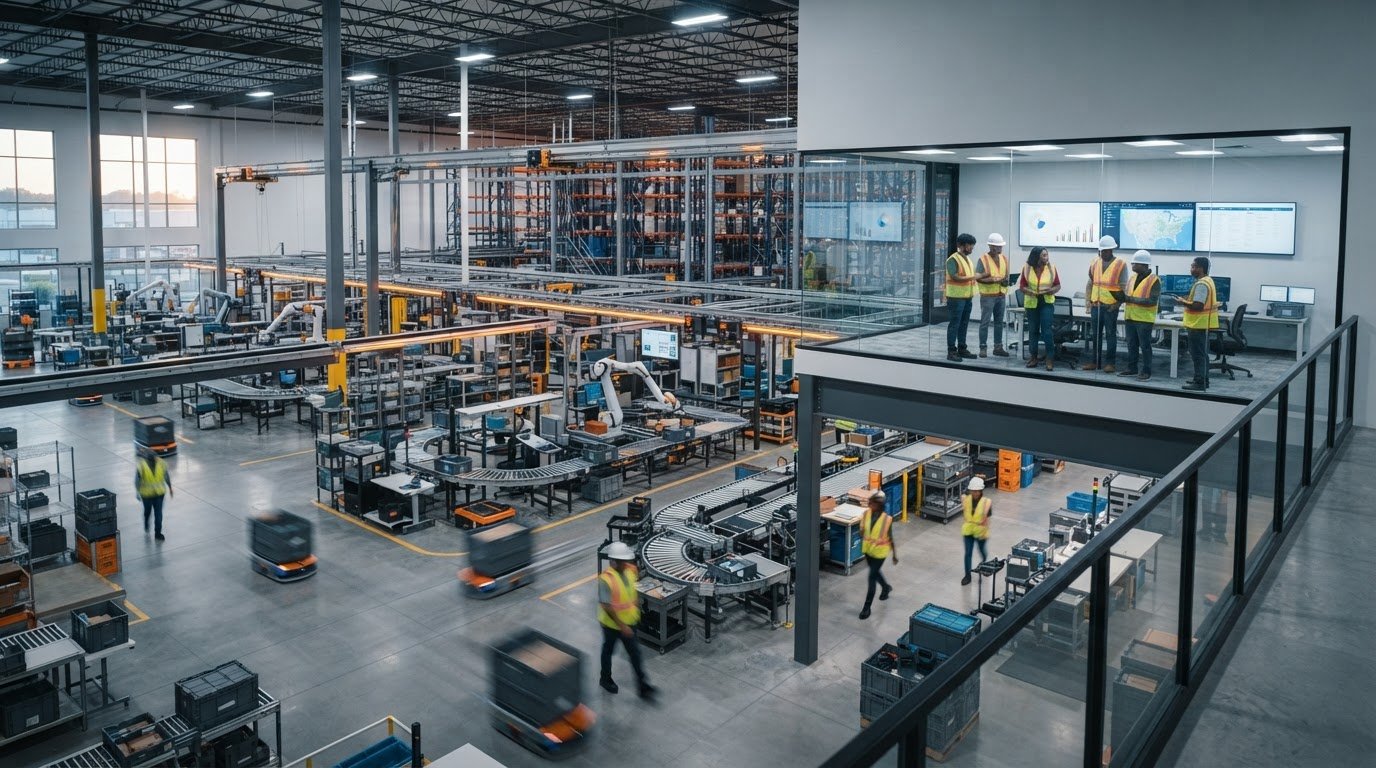
The newest equipment won’t improve a warehouse if it automates the wrong part of the workflow. That’s the central question behind warehouse automation trends 2026: which changes address your operation’s real constraints, rather than add technology for its own sake?
It’s understandable to feel pressure to increase throughput, improve accuracy, and stay flexible while weighing a crowded field of automation options. Individual systems can solve specific tasks, but disconnected investments may add new handoffs and complexity. Lasting improvements depend on how equipment, software, and processes work together.
This guide examines developments shaping warehouse automation in 2026, including robotics, AI-enabled coordination, and modular systems. It also offers a practical way to evaluate each trend against your facility’s workflows, integration requirements, and operating priorities. The goal isn’t to automate everything at once. It’s to identify where connected material flow and thoughtful engineering can make a measurable difference.
Key Takeaways
- Assess warehouse automation trends 2026 by the operational problem each addresses, not by novelty or broad promises.
- Compare automation options by workflow role, prerequisites, and how they’ll connect with existing equipment and systems.
- Establish a process baseline, including demand patterns and exception handling, before defining a pilot or selecting technology.
- Review performance using measures that matter to your operation, such as throughput, accuracy, and flexibility.
- Consider how conveyors, robotics, infrastructure, racking, and process engineering can work together in an integrated material flow plan.
Warehouse Automation Trends 2026: Why Workflow Fit Matters More Than Hype
For operations leaders planning in 2026, the challenge isn’t finding technologies described as innovative. It’s deciding which advances can help meet labor, service, and throughput demands without creating friction elsewhere in the facility. The warehouse automation trends 2026 discussion is most useful when it starts with that decision, not with a list of equipment to buy.
Warehouse automation is the coordinated use of physical equipment, controls, software, and operating processes to move, store, track, and handle goods. Conveyors and automated storage systems move products through a facility, while sensors and software can provide information or coordinate tasks. The logistics automation overview offers useful background on the range of systems that can contribute to a connected operation.
What counts as a warehouse automation trend in 2026?
A trend can be a new technology or a new application of established automation. Conveyors, for example, are proven material-handling equipment; connecting them with controls and operational data can change how work is coordinated. Mobile robots and AI-enabled decision support represent different developments, each with distinct roles and requirements. No facility needs every option. Ask whether a capability fits a specific process and can work with the systems around it.
It’s also useful to distinguish an established capability from an emerging application. A technology may be available while its use in a particular workflow is still evolving. Treat adoption rates and market forecasts carefully: verify figures against a named, current source before using them to justify an investment. Market momentum alone doesn’t show whether a system fits your facility.
Why connected workflow constraints should guide investment
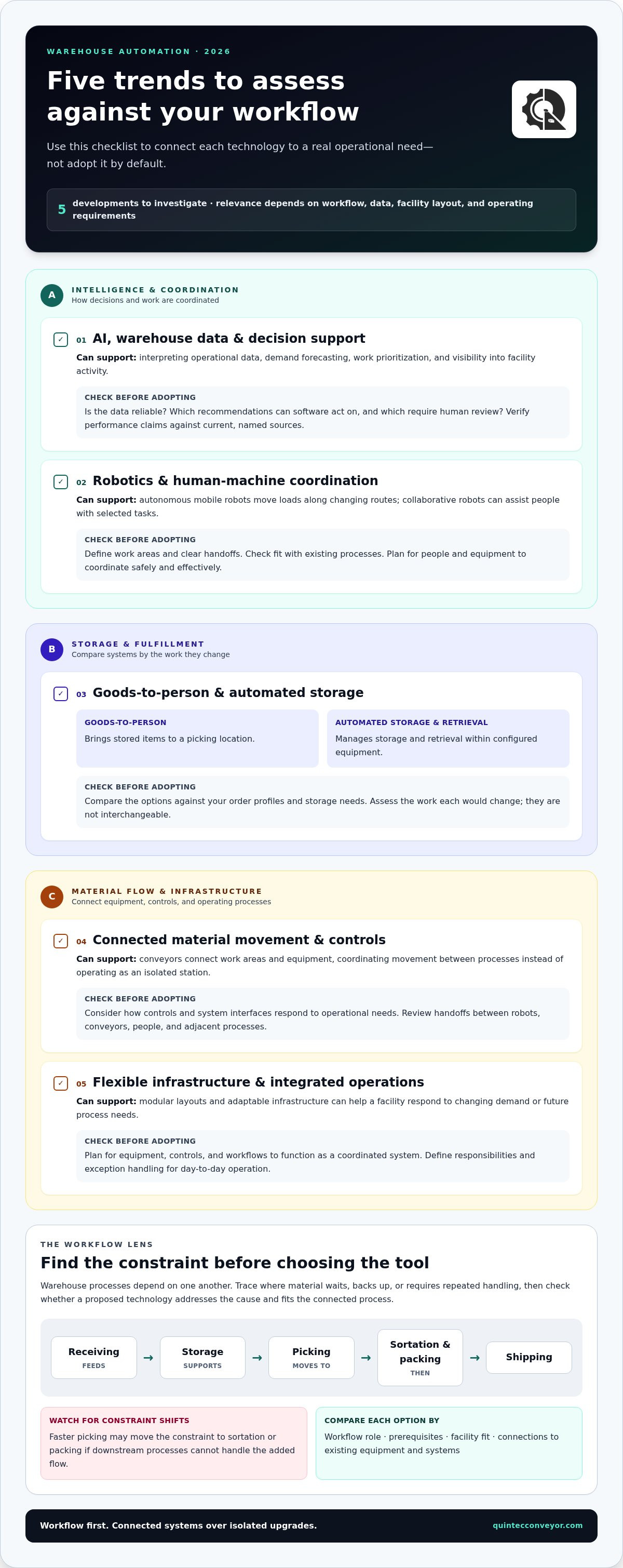
Warehouse processes depend on one another. Receiving feeds storage; storage supports picking; picked orders move through sortation and shipping. A delay, accumulation, or capacity limit in one step can affect the next. Improving picking speed, for instance, may simply move the constraint to sortation or packing if downstream processes can’t handle the added flow.
Trace how material moves through the facility and document where work waits, backs up, or requires repeated handling. Then assess whether a technology addresses the cause of the constraint and how it connects to upstream and downstream operations. This systems view helps distinguish a local equipment improvement from a change that supports the full process.
Workflow-led automation selects and connects technology to resolve documented material-flow constraints, rather than adopting tools because they’re trending. That principle keeps decisions grounded in operational needs and makes it easier to compare potential solutions.
Five Warehouse Automation Trends Shaping Operations in 2026
The warehouse automation trends 2026 conversation spans new tools and changing ways of connecting proven equipment. These five developments are worth assessing, not adopting by default. Their relevance depends on the workflow, data, facility layout, and operating requirements they need to support.
1. AI, warehouse data, and decision support
AI-enabled tools can help teams interpret operational data, support demand forecasting, prioritize work, and improve visibility into facility activity. Their value depends on reliable data and clear decision rights. Teams need to know which recommendations software can act on and which require human review. Verify performance claims and adoption statistics against current, named sources before using them to support an investment case.
2. Robotics and human-machine coordination
Autonomous mobile robots can move loads along changing routes, while collaborative robots can assist with selected tasks alongside people. These applications may help address repetitive movement or handling, but safe, effective operation depends on defined work areas, clear handoffs, and fit with existing processes. Automation is often about coordinating people and equipment, not removing people from the operation.
3. Goods-to-person and automated storage
Goods-to-person systems bring stored items to a picking location, while automated storage and retrieval systems manage storage and retrieval within configured equipment. These approaches can support different order profiles and storage needs, so compare them by the work they would change rather than treating them as interchangeable. Modern Materials Handling’s 2026 automation study provides a reference point for tracking adoption in areas such as conveyors and goods-to-person systems.
4. Connected material movement and controls
Conveyors can connect work areas and equipment, helping coordinate movement between processes rather than functioning as an isolated station. Controls and system interfaces affect how that movement responds to operational needs. Effective warehouse robotics integration considers the handoffs between robots, conveyors, people, and adjacent processes.
5. Flexible infrastructure and integrated operations
Modular layouts and adaptable infrastructure can help a facility respond to changing demand or future process needs. Flexibility still requires planning: equipment, controls, and operating workflows must function as a coordinated system. Human-machine coordination is part of that design, with clear responsibilities and exception handling supporting reliable day-to-day operation.
Use these trends as prompts for investigation. A review of connected material handling solutions can help frame how equipment and facility processes fit together. Next, compare each development with a specific workflow need.
How to Compare Warehouse Automation Trends by Use Case
Compare each option by the job it performs, the constraint it addresses, and the systems it must work with. The table below is a starting point, not a ranking. The right fit depends on your facility’s order profile, SKU mix, available space, labor workflows, and demand variability.
| Approach | Best-fit operational problem | Prerequisites | Integration considerations |
|---|---|---|---|
| Automated storage and retrieval | Storage density or repetitive storage and retrieval work is a constraint. | Compatible inventory, storage, and facility requirements. | Connect storage tasks with inventory records, replenishment, and downstream picking. |
| Goods-to-person | Picker travel is a major factor in order fulfillment. | Order profiles and SKU characteristics that suit centralized item presentation. | Coordinate item delivery with order release, picking, and replenishment workflows. |
| AMRs or other mobile robots | Transport between process areas creates recurring workload or delays. | Defined routes, handoffs, and operating procedures for people and mobile equipment. | Plan task dispatch, traffic interaction, and exception handling across work areas. |
| Conveyors and sortation | Material movement or order routing between stations limits flow. | A process layout and flow volume suited to fixed movement paths. | Align controls and routing logic with upstream release and downstream capacity. |
| AI-enabled decision support | Teams need better visibility or help prioritizing work. | Reliable operational data and clearly defined decision authority. | Clarify how recommendations connect to warehouse systems and daily workflows. |
Match automation approaches to the constraint
Different bottlenecks call for different responses. A storage-density challenge points toward reviewing storage methods and facility space; a picking constraint calls for examining SKU profile, order size, and picker travel. Transport and sortation issues center on movement paths, handoffs, and downstream capacity. Variable demand matters too: a process handling frequent order changes may need a different approach from one with more consistent work. The strategic material handling trends discussion can help place these operational choices within broader business priorities.
Automation suitability depends on the process being improved, the facility it must fit, and the systems and people it must work alongside. No technology is universally best across these conditions.
Assess integration, controls, and operational dependencies
Before selecting an approach, map how instructions and status move among the warehouse management system (WMS), warehouse execution system (WES), programmable logic controllers (PLCs), and equipment. Confirm how work is released, how completion is recorded, and how exceptions reach staff. System visibility and clear handoffs between people and equipment matter as much as the equipment’s assigned task.
For conveyor applications, consider the complete route and its connections to adjacent processes, not just the conveyor segment. This is also a useful lens for evaluating industrial conveyor systems as part of a broader material flow plan. Compare warehouse automation trends 2026 against these operational dependencies before advancing a concept.
A Practical Readiness Framework for Warehouse Automation in 2026
A structured readiness review turns the warehouse automation trends 2026 discussion into a sequence of operational decisions. Document the current process first, then define what a focused pilot should test and how its findings will guide the next phase.
Establish a baseline before choosing a technology
Map product movement from receiving through storage, picking, sortation, and shipping. Include handoffs between people, equipment, and systems, along with recurring exceptions such as misplaced inventory, blocked routes, or work waiting for the next station. A clear flow map helps distinguish a local delay from a constraint affecting several processes.
Separate measured facts from assumptions. Record throughput, order accuracy, congestion, and downtime where reliable information is available. Note gaps where data needs to be collected rather than treating estimates as established performance.
Plan implementation around people, systems, and scale
Use the baseline to move through these planning steps:
- 1. Define the operational objective. State the workflow issue the project should address, such as a recurring queue or excessive movement between process areas.
- 2. Describe demand and constraints. Document order patterns, volume variation, SKU characteristics, available space, and exception handling.
- 3. Set a focused pilot scope. Identify the process area, equipment, users, and interfaces that the pilot will involve. Keep its boundaries clear enough to evaluate what changed.
- 4. Plan integration and operating changes. Identify dependencies across facility layout, infrastructure, controls, software, and existing equipment. Plan staff training, procedures, maintenance considerations, and people-equipment handoffs alongside the technical design.
- 5. Review and determine next steps. Compare pilot performance with the baseline using measures tied to the objective. Use the findings to refine the approach, address gaps, or inform future phases without assuming a particular result.
Choose success measures that reflect the operation’s priorities. A throughput-focused project may track completed work over a defined period, while an accuracy initiative may monitor order errors. Set measurement methods and review intervals in advance, but don’t rely on generic benchmark targets that may not suit your facility.
For a project grounded in connected material flow, explore Quintec’s material handling capabilities, including conveyor design, engineering, and installation alongside automation and infrastructure planning.
How Quintec Connects Warehouse Automation Trends to Material Flow
Automation delivers its strongest operational value when equipment and processes are designed as a connected system. Quintec Conveyors designs, engineers, and installs custom conveyor systems and material handling solutions, bringing equipment choices into the context of facility flow, operating requirements, and handoffs between work areas. This workflow-led approach helps operations leaders assess warehouse automation trends 2026 against practical needs instead of treating each trend as a standalone purchase.
Integrate equipment around the facility’s operating flow
Project planning starts with how materials move through the operation: where goods arrive, how they’re stored, which processes handle them, and how they reach shipping. Engineering around those requirements helps clarify how equipment and infrastructure need to work together. For example, conveyors can connect process areas and support movement between stations, while robotics may address specific handling or transport tasks. Racking and facility infrastructure also shape available space, routes, and equipment placement.
That integrated view matters because a change in one area affects the next. Faster movement can create a queue downstream if sortation or shipping can’t absorb the flow. Considering facility layout and handoffs as part of the design helps align equipment with the broader operation. Quintec’s approach draws on more than 100 years of collective industry experience across material handling and automation.
Build a practical path from trend assessment to implementation
Process engineering helps translate operational requirements into system requirements. Teams can use the documented workflow, constraints, and performance measures to determine how conveyors, robotics, controls, infrastructure, and racking should fit together. This also gives the project a basis for planning installation and considering how the system will be maintained over time.
Scalability belongs in the discussion early. A modular approach may be relevant when the facility needs to adapt its material flow over time, but the design still needs to account for interfaces, available space, and operating procedures. Installation planning and conveyor maintenance are also part of a practical view of long-term system performance, rather than details to leave until after equipment selection.
Quintec connects design, engineering, and installation across material handling projects, helping align equipment choices with facility processes. To take the next step, discuss an integrated material handling project with Quintec.
Turn Warehouse Automation Priorities Into a Connected Plan
The most useful warehouse automation trends 2026 are the ones that address a clearly identified workflow need. Compare technologies by their role in material flow, then assess how they’ll connect with existing equipment, systems, and people. A baseline and carefully scoped pilot can help your team make decisions using operational evidence rather than assumptions.
Bringing those decisions together takes engineering across the full operation. Quintec Conveyors offers custom conveyor design, engineering, and installation, with material handling capabilities spanning automation, robotics, infrastructure, and process engineering. The team brings more than 100 years of collective industry experience to these projects.
Discuss an integrated material handling project with Quintec and take a practical next step toward automation that fits your facility. With a clear view of your workflow and a connected plan, your operation can move forward with confidence.
Frequently Asked Questions
What are the biggest warehouse automation trends in 2026?
Key warehouse automation trends in 2026 include AI-enabled decision support, mobile robotics, goods-to-person workflows, automated storage and retrieval, and more connected material movement. Flexible infrastructure and effective coordination between people and machines also shape how these technologies are applied. They aren’t universal requirements. Compare each trend with a documented workflow constraint, facility layout, order profile, and integration needs before deciding whether it merits further evaluation.
Is warehouse automation worth considering for a mid-sized operation?
It can be worth considering if a specific, recurring constraint affects service, throughput, accuracy, or material movement. Start by documenting the process and its current performance, then compare the potential solution with your order patterns, SKU mix, available space, systems, and staffing workflows. A focused pilot may help assess fit before wider implementation. The right scope depends on operational evidence, not company size alone or pressure to adopt new technology.
How does AI help automate warehouse operations?
AI can support demand forecasting, work prioritization, inventory decisions, and operational visibility by analyzing available warehouse data. For example, decision-support software may help teams identify which tasks need attention as conditions change. Its usefulness depends on reliable data, integration with operating systems, and clear rules about which decisions software can make versus when staff should review recommendations. Assess performance claims against evidence relevant to your workflows and data quality.
Can conveyors work alongside warehouse robots?
Yes. Conveyors and robots can perform complementary roles within a connected material flow. Conveyors can move goods between fixed process areas, while robots may handle selected transport or task-based activities. Effective coordination requires planned handoffs, controls, system interfaces, and procedures for exceptions. Consider how equipment will interact with workers and adjacent processes, rather than evaluating each component in isolation. The overall design should reflect the facility’s routes, operating priorities, and workflow requirements.
What should a warehouse assess before investing in automation?
Document how goods move from receiving through storage, picking, sortation, and shipping. Record demand patterns, SKU and order characteristics, throughput, accuracy, congestion, downtime, and recurring exceptions where data is available. Identify which figures are measured and which are assumptions that need validation. Then define the constraint to address, along with the facility, labor, software, controls, and equipment dependencies that could affect the proposed change.
How can a warehouse make automation scalable?
Plan for future change while defining the first project scope. Document likely shifts in demand, product mix, workflows, and facility requirements, then consider how equipment, controls, software, and infrastructure could accommodate later phases. Use a pilot to review performance against a baseline and capture integration or operating lessons. Scalability isn’t simply adding equipment; it depends on compatible interfaces, clear processes, and a design suited to the facility.
What role do warehouse system integrators play in automation projects?
System integrators help connect equipment, controls, software, and facility processes so automation supports a coordinated workflow. Their work can include understanding operating requirements, engineering system layouts, planning interfaces and handoffs, and coordinating installation. Quintec Conveyors designs, engineers, and installs custom conveyor systems and material handling solutions, with capabilities spanning robotics and automation, infrastructure, racking, process engineering, and conveyor maintenance. Integration planning helps align those elements with the operation’s requirements.